What a gas stove ban means for restaurants(latimes.com)
latimes.com
What a gas stove ban means for restaurants
https://www.latimes.com/food/story/2022-06-02/gas-stove-ban-chinese-korean-bbq-electric-new-buildings-restaurants-future
612 comments
I miss Korean BBQ on a gas or charcoal burner. The only places I have ever managed to have it that was at Jongro in NYC or everywhere in Korea. The electric burner experience just isn't as fun.
Huh, I've never used an induction one, and I've been to a bunch in Chicagoland and LA. Even at home we use a butane grill.
What's a good one in Chicagoland? I get over there every once in a while.
I agree on San Soo Gab San as my fave (both the Chicago and Morton Grove locations are good). There was an awesome one in Lincoln Park that I'm pretty sure closed down that had all you can eat KBBQ _and_ all you can eat sushi.
Not OP, but San Soo Gab San (Western & Foster) was always great when I lived in Chicago.
Hey, if you’re going to make a trip out of it, when you’re done with the BBQ, head a few blocks south and take in the German bars on Lincoln Ave. There used to be a cool little Karaoke place at Lincoln and Western, too.
I think you could easily reproduce the gas experience with a combination of induction and convective heating. It'd be more reliable and it would be easy to have a set temperature rather than needing the wait staff to periodically adjust the burner. It would need appropriate cost and engineering. Plus the under table apparatus would probably be much smaller.
The wood charcoal experience is of course very unique.
The wood charcoal experience is of course very unique.
I live in Tokyo and some yakiniku places even have charcoal table grills.
Commercial induction woks go up to ludicrous power levels. I've seen 15 and 20 kW models online.
> Since gas stoves are so inefficient, natural gas should provide no cost benefit.
In North America, the cost of gas is basically just the cost of transmission. It's so plentiful it's almost free.
Agree that the move to electric has tons of benefits though.
In North America, the cost of gas is basically just the cost of transmission. It's so plentiful it's almost free.
Agree that the move to electric has tons of benefits though.
The low cost contributes to the negative externalities of production. If it was less plentiful, arguably we wouldn't have dramatic methane plumes in the southwest due to atmospheric release.
[deleted]
> A large reason electric (restive and induction) are seen as inferior to gas is that portable units are limited to 120v/15a (few are 20a) so the total possible power is technically less than a gas stove; <1800w vs >2800w effective. However, gas stoves are very inefficient so in reality it's not a huge problem and 240v electric stoves could even be hotter (~4000w) than a gas stove.
Could a combination of induction heating and heat pumps be developed to be hyper-efficient for cooking? Such a system would have to include the vent hood as well, and require the cooks to don insulated gloves. The idea would be to also recover heat going up the vent hood, then concentrate the heat in a stream of hot air which would hit the pans/woks again. Is this even feasible or desirable?
Could a combination of induction heating and heat pumps be developed to be hyper-efficient for cooking? Such a system would have to include the vent hood as well, and require the cooks to don insulated gloves. The idea would be to also recover heat going up the vent hood, then concentrate the heat in a stream of hot air which would hit the pans/woks again. Is this even feasible or desirable?
Simply switching to induction would be a big win. That and keeping the lid on while cooking.
You don't need a heat pump to recover large amounts of heat from the vent - just look at an HRV.
The problem is the reliability of the system. The air going up the vent is incredibly oily. The oil in the air will gum up your heat pump or your HRV core or whatever you use. At a minimum, you destroy your efficiency. More likely, you destroy your equipment.
The problem is the reliability of the system. The air going up the vent is incredibly oily. The oil in the air will gum up your heat pump or your HRV core or whatever you use. At a minimum, you destroy your efficiency. More likely, you destroy your equipment.
I honestly would be interested for an actual chef to weigh in.
I'm all for using an induction stovetop at home, but have people actually seen chefs fry over an open flame? They're moving the pan around, lifting it up and around, using it to toss the food, etc. That would basically be impossible with an induction stovetop.
It seems rather tone deaf to me to not address the issues that the chefs are actually concerned about.
I'm all for using an induction stovetop at home, but have people actually seen chefs fry over an open flame? They're moving the pan around, lifting it up and around, using it to toss the food, etc. That would basically be impossible with an induction stovetop.
It seems rather tone deaf to me to not address the issues that the chefs are actually concerned about.
I don’t know about chefs but my mom always complains about how hard it is to cook with induction heating because it takes very long to switch between high and low temperatures. You can’t be as reactive with induction cooking (alternatively moving the pan off the direct heat and moving it back again might achieve this)
Are you thinking of electric coil? Induction heats up super fast (way faster than gas or electric coil) because the stove itself doesn’t get warm - it transfers energy directly into the pan.
It's an interface issue. Instead of a knob, it's usually a touch interface, with +/- control, and slowish.
UI is orthogonal to the heat source.
Not when the UI includes (or does not include) a view of the heat source.
Don't understand why this was downvoted. The induction stoves I've used all had a touchpad controls, for some reason. They take one second to change the power output 10%, with hotkeys for 100% and 40%.
It would be trivial to add a dial with some simple fail-safe.
They're incredibly responsive, though, more so than the gas stoves I've used. Never tried the following with gas, I'm guessing it would work, but you can easily turn down the power as a pot of pasta has started boiling over, and it'll stop before the foam pours over the top of the pot.
It would be trivial to add a dial with some simple fail-safe.
They're incredibly responsive, though, more so than the gas stoves I've used. Never tried the following with gas, I'm guessing it would work, but you can easily turn down the power as a pot of pasta has started boiling over, and it'll stop before the foam pours over the top of the pot.
It's just a stupid trend in electric cooktop design, not something specific to induction. I've got an SMEG induction combo oven/stove and it has real knobs – out front, where they belong. They also make induction cooktops with real knobs.
Know what brand? I'm planning a remodel and I fucking hate this "smart" trend in my home appliances. Luckily at least the dumb stuff is cheaper.
Already found a knobby oven but all the induction tops are damned touch screens.
Already found a knobby oven but all the induction tops are damned touch screens.
I was curious, so looked at Home Depot in Canada.
I see Samsung and LG with induction oven models, that now have dials for the "burners".
When I bought my range, maybe 5 years ago, I don't think these models existed.
So, perhaps the trend is reversing?
The oven itself seems digital in all cases, but that's fine. I don't mind setting it to 400F by entering the numbers, because that stays static for most of the cooking process.
I see Samsung and LG with induction oven models, that now have dials for the "burners".
When I bought my range, maybe 5 years ago, I don't think these models existed.
So, perhaps the trend is reversing?
The oven itself seems digital in all cases, but that's fine. I don't mind setting it to 400F by entering the numbers, because that stays static for most of the cooking process.
If cost is no concern, the Breville Polyscience Control Freak has a knob and is generally considered the Rolls Royce of induction burners.
Honestly: it looks pretty gimicky, and the dimensions and wattage don't put it in Rolls Royce category for serious cooks. It does 1800 watts into < 20 cm (8 in.) whereas the central burner on my SMEG induction stove does 3000 watts into 27 cm (11 in.). A gastronomy induction stove will get closer to 5000 watts per burner.
It looks like it's far more targeted towards the "magical cooking" crowd than prosumer. It looks like you could probably replace a sous vide bath and a deep fryer with it, but most serious cooks already have those as separate devices, and you'd have to give up your "best" burner while doing so.
It looks like it's far more targeted towards the "magical cooking" crowd than prosumer. It looks like you could probably replace a sous vide bath and a deep fryer with it, but most serious cooks already have those as separate devices, and you'd have to give up your "best" burner while doing so.
Keller uses them at The French Laundry, and Grant Achatz uses them at The Aviary (Though I misspoke in another comment said he uses them at Alinea). Shola Olunloyo and Ivan Orkin are also fans.
If it's good enough for 3 michelin star restaurants and some of the most highly regarded chefs in the industry right now, it's kind of hard to say it's not good enough for serious cooks.
If it's good enough for 3 michelin star restaurants and some of the most highly regarded chefs in the industry right now, it's kind of hard to say it's not good enough for serious cooks.
I already mentioned the brand: SMEG.
This is what I've got:
https://www.smeg.com/products/C9IMX9-1
This is a cooktop with knobs (they have several more):
https://www.smeg.com/products/SI364BM
This is what I've got:
https://www.smeg.com/products/C9IMX9-1
This is a cooktop with knobs (they have several more):
https://www.smeg.com/products/SI364BM
Switching between high and low on my induction cooktop is immediate.
If you can see red coils on your mom's stove under the glass, it's not induction.
If you can see red coils on your mom's stove under the glass, it's not induction.
Your mom's stove has the stupid +/- touch UI, just like mine. Using a knob would solve the problem. I am not complaining because +/- is easier to clean.
The other issue is that induction is invisible, there is no flame. But moving stuff around on x-y has the same effect as with a gas stove. On induction, the pan is the stove. Take it off the induction and the heat subsides. Move it off center and you heat only part of the pan.
The other issue is that induction is invisible, there is no flame. But moving stuff around on x-y has the same effect as with a gas stove. On induction, the pan is the stove. Take it off the induction and the heat subsides. Move it off center and you heat only part of the pan.
Inductive cooktops are quite reactive, the pan stops generating heat as soon as the electricity is cut off, and while the glass does get hot, it cools reasonably quickly, at least IME. Older style "convection" electric cookers were glacially slow in responding to heat changes, since there was a massive amount of heat stored in the heating element.
I can’t imagine many professionals would wildly appreciate changing their core tool from underneath them, regardless of whether the tool is actually better.
If I wanted to stir the pot with a grenade, I’d say it’s like asking Vim users whether they should all move to VS Code.
If I wanted to stir the pot with a grenade, I’d say it’s like asking Vim users whether they should all move to VS Code.
Well they probably should move to emacs.
https://www.youtube.com/watch?v=lpdngXQOkBI
https://www.youtube.com/watch?v=lpdngXQOkBI
> I’d say it’s like asking Vim users whether they should all move to VS Code.
If Vim was actively contributing to climate change and fouling the air of everyone around me, I'd switch tomorrow. VS Code has Vim bindings, I'm sure. I'll be okay. We're long past the point where everybody keeps being able to do their first favorite thing at all times, _and_ we somehow also solve this huge problem we've gotten ourselves into.
If Vim was actively contributing to climate change and fouling the air of everyone around me, I'd switch tomorrow. VS Code has Vim bindings, I'm sure. I'll be okay. We're long past the point where everybody keeps being able to do their first favorite thing at all times, _and_ we somehow also solve this huge problem we've gotten ourselves into.
VS Code obviously contributes more to climate change than Vim.
Yet Vim vs Emacs arguments contribute to a lot of hot air...
Zingggg
Zingggg
I'd gladly move to VS Code if it was more efficient than Vim (and not controlled by Micro$oft, but that's irrelevant). However, that's far from being the case.
I think _because_ of their intimate knowledge of the craft, Chef's are going to give you a wider variety of answers with less certainty than anyone else.
Not a chef, but an avid eater and obsessive home cook:
I eat at a lot of high end restaurants (and usually a couple Michelin starred places per year), many with open kitchens, and in the last 5 years I've noticed a trend towards induction. From the high end cookery blogs that I've read, it's mostly about reducing heat in the kitchen. I have worked in kitchens in the past, and it's difficult to understate the quality of life improvement by a significant reduction in kitchen temperature.
At home I've also switched to induction, and it's been in general great.
Charcoal is actually the trickier one to replace in high end cookery since it's very difficult to simulate the amount of radiant energy with electricity.
I eat at a lot of high end restaurants (and usually a couple Michelin starred places per year), many with open kitchens, and in the last 5 years I've noticed a trend towards induction. From the high end cookery blogs that I've read, it's mostly about reducing heat in the kitchen. I have worked in kitchens in the past, and it's difficult to understate the quality of life improvement by a significant reduction in kitchen temperature.
At home I've also switched to induction, and it's been in general great.
Charcoal is actually the trickier one to replace in high end cookery since it's very difficult to simulate the amount of radiant energy with electricity.
Chef here:
I've used induction, but the biggest annoyance is heat loss when lifting a pan.
Most pans section dishes are moved quite rapidly, lifting then off of the burner, to toss the ingredients(I could be cooking 5-6 dishes at once, so speed is very important), with a gas burner this doesn't matter as the radiant heat is there.
Now I'm assuming there are radiant stovetops that are designed for hospitality, but I've yet to see one, the only I have used the heat started dissipating rapidly when lifting the pan, and my wife was freaking out when the pan made contact thinking that I was going to break the cooktop.
Most pans section dishes are moved quite rapidly, lifting then off of the burner, to toss the ingredients(I could be cooking 5-6 dishes at once, so speed is very important), with a gas burner this doesn't matter as the radiant heat is there.
Now I'm assuming there are radiant stovetops that are designed for hospitality, but I've yet to see one, the only I have used the heat started dissipating rapidly when lifting the pan, and my wife was freaking out when the pan made contact thinking that I was going to break the cooktop.
I wouldn't be surprised if the market is unready to provide something professionals are happy with, and that could be a disaster - but if it's mandated throughout the state, the demand will exist for a supplier to try to do better.
I can say that for my own home cooking purposes, electric coils have always been acceptable, and that's really where my attention is with the ban - I already know I won't feel direct pain from it; whereas restaurant food as a consumer service is a case of "just make something good and I don't care how you do it if it's in line with laws and norms", and the rest is a matter of how much has to change in operations, cooking style etc to make a technology switch. Gas cooking has only been around since roughly the 1850's, following heating and lighting introductions; coal stoves remained popular well into the early 20th century, but coal in cooking today mostly conjures up backyard barbecue. It could easily turn out that the gas-centric styles become a "flash in the pan" niche if we make the switch.
I can say that for my own home cooking purposes, electric coils have always been acceptable, and that's really where my attention is with the ban - I already know I won't feel direct pain from it; whereas restaurant food as a consumer service is a case of "just make something good and I don't care how you do it if it's in line with laws and norms", and the rest is a matter of how much has to change in operations, cooking style etc to make a technology switch. Gas cooking has only been around since roughly the 1850's, following heating and lighting introductions; coal stoves remained popular well into the early 20th century, but coal in cooking today mostly conjures up backyard barbecue. It could easily turn out that the gas-centric styles become a "flash in the pan" niche if we make the switch.
It's all about the heat transfer, previous to gas we used bur ing wood, so a high heat transfer without physical contact. I'm not sure if there is even a way for a ln induction cooktop to provide heat over a distance.
But sure, if it's mandated then chefs will have to change their cooking style, which -with plenty if grumbling from chefs - won't be the end of the world.
But sure, if it's mandated then chefs will have to change their cooking style, which -with plenty if grumbling from chefs - won't be the end of the world.
Sure but resistive stovetops could probably do this. They don’t all have to be induction, right?
I would imagine the vendors of propane & propane accessories would be licking their chops at the prospect of going into all these restaurants.
Induction burners are extremely efficient (>80%) vs something like 40% for gas burners, so the induction would come ahead in your example (1400W vs 1100W).
The cooktops you can buy here in Europe are limited to 3.7kW, and you can bridge two burners for up to 7.4kW. I rarely use one burner beyond ~70% power, anything above gets scorching hot (= burns everything) when using a good iron/steel pan. I heard the US has the infrastructure to deliver 240V so that should be possible.
The cooktops you can buy here in Europe are limited to 3.7kW, and you can bridge two burners for up to 7.4kW. I rarely use one burner beyond ~70% power, anything above gets scorching hot (= burns everything) when using a good iron/steel pan. I heard the US has the infrastructure to deliver 240V so that should be possible.
They might be 80% efficient, but I think around 40% of California electricity comes from natural gas. It’s kind of silly to convert from gas to electricity to heat in terms of efficiency.
It may sound silly at first, but the numbers are not far off. The added losses for 50% (power plant) and 80% (cooktop) efficiency would give you the same 40% overall, but now you don't need massive pipes carrying flammable pressurized gas everywhere. And both of those numbers are probably higher for modern equipment (ex 60/90 = 54% overall efficiency).
I checked this recently. California is still in the 30-40% range for gas/fossil fuels usage on average, but it has achieved a 100% renewables grid for a 15 minute period this year, and it wasn't a fluke or engineered stunt, but one more in a series of record-breaking milestones which have seen the grid periodically blast through the 90% range. So the trend looks good for electric conversion.
Why are they preparing for widespread brownouts this summer? https://www.eenews.net/articles/grid-monitor-warns-of-u-s-bl...
Natural Gas to electric energy conversion happens at a higher efficiency. Millions are invested to ensure that.
In addition every gas to heat thing can't be decarbonised (electricity to gas won't work at this scale and would be hugely inefficient) to negative emissions.
In addition every gas to heat thing can't be decarbonised (electricity to gas won't work at this scale and would be hugely inefficient) to negative emissions.
North American electrical infrastructure is natively 240v, split phase (two 120v hots, with a centre-tapped neutral). All houses have 240v power, and all stoves and ovens are already 240v at 40 or 50 amps. If there's a need for 240v power at a particular location (such as a high powered window AC unit), it's generally quite easy to switch a standard 120v circuit to 240v and replace the outlets on the circuit with their 240v counterparts (identical except the prongs are horizontal).
Getting a bit off topic here, but I’d like to learn more about this…
In most cases wouldn’t you need to run a thicker wire to replace a 120v outlet with 240v?
In most cases wouldn’t you need to run a thicker wire to replace a 120v outlet with 240v?
No, only if you increase the amperage of the circuit breaker. Doubling the voltage just doubles the power you can deliver over the same wire. To keep it the same, you can actually use a thinner wire. That's part of the reason long-distance transmission lines are at many thousands of volts.
You run two hots instead of one, that's 200% "thicker". Between the two hots you now have 240V. Between each hot and the neutral you have 120V like before.
I’m getting tired of people citing the efficiency of electric vs gas without including the any of the electric production and distribution. Sure at the point of use electric is more efficient but what do you think they make that electricity with? Most likely it’s coal, after that it’s natural gas. The best argument in favor isn’t dubious claims to efficiency or even indoor combustion but that it’s fungible. Once you put the electric infrastructure you can transition from one source to another more easily. As more renewables come online you can phase out fossil fuels. I’m a little suspicious of the motivations to go all electric and rip out gas infrastructure. Enron and the recent troubles with the Texas power grid don’t bode well.
In California it's mostly renewable with a small amount of natural gas and nuclear. Occasionally over 90% renewable depending on the time of year.
I don’t know where you got your data but mine would say otherwise
https://www.energy.ca.gov/data-reports/energy-almanac/califo...
https://www.energy.ca.gov/data-reports/energy-almanac/califo...
I'm not a professional cook.
I miss gas stove over the induction because:
1. I have visual indicatation on how hot it is. The numbers is just not so good indicator.
2. I miss trashing pans around, specially when managin multiple things at once. Glass induction would not be able to withstand it. So suddenly I have to be gentle with machinery.
3. God forbid I spill something in the middle of cooking on induction. Suddenly I have to try to cleanup a hot glass and manage the whole mess. Gas, because it was raised, cleanup could be done later once food prep was over.
4. I'f there is powerloss (hi wars and other stuff) I don't really care. I used to run propane tanks 11kg, no pipes, refilled once-twice a year.
I miss gas stove over the induction because:
1. I have visual indicatation on how hot it is. The numbers is just not so good indicator.
2. I miss trashing pans around, specially when managin multiple things at once. Glass induction would not be able to withstand it. So suddenly I have to be gentle with machinery.
3. God forbid I spill something in the middle of cooking on induction. Suddenly I have to try to cleanup a hot glass and manage the whole mess. Gas, because it was raised, cleanup could be done later once food prep was over.
4. I'f there is powerloss (hi wars and other stuff) I don't really care. I used to run propane tanks 11kg, no pipes, refilled once-twice a year.
> God forbid I spill something in the middle of cooking on induction. Suddenly I have to try to cleanup a hot glass and manage the whole mess.
I think you’re overestimating how hot induction stoves get, the element itself doesn’t heat up at all.
When you have a significant spill on a gas stove, it can put the flame out partially or entirely, which is much more of a challenge than wiping off an induction element.
I think you’re overestimating how hot induction stoves get, the element itself doesn’t heat up at all.
When you have a significant spill on a gas stove, it can put the flame out partially or entirely, which is much more of a challenge than wiping off an induction element.
Yeah what is 3. This smells like never used induction before.
Or maybe you haven't. You can burn the sh_t out of your fingers on the glass surface of an induction cooktop. The heat does not magically stay in the cooking vessel. It radiates, as heat is wont to do. Voice of experience. I love induction and think it is safer than gas.
Sounds like they have used a normal (resistive) electric cooktop, not an induction cooktop, and are confounding the two.
> the element itself doesn’t heat up at all.
That doesn't sound like possible to me (I've never used those stove, so I've no knowledge). Although induction only heats the pan, wouldn't the pan simply heat up the stove by contact?
That doesn't sound like possible to me (I've never used those stove, so I've no knowledge). Although induction only heats the pan, wouldn't the pan simply heat up the stove by contact?
They do heat up but not enough to make it impossible to wipe them clean. I hate resistive tops for cooking with a passion. I loved by gas range but induction is fine. It heats up quickly. It can stay consistently low. It goes smoothly from the two in short amount of time. But I’m an European so I don’t suffer from the American cast iron pan fad and just use normal cook wear.
I've been using a nice one for over a year now.
But my main sadness is I can't leave food on the cooktop to cleanup later. Imagine water boils over, suddenly I have to start cleaning cooktop in the middle of cooking. Gas might be extinguished but I can restart and deal with it later once I'm finished cooking.
But my main sadness is I can't leave food on the cooktop to cleanup later. Imagine water boils over, suddenly I have to start cleaning cooktop in the middle of cooking. Gas might be extinguished but I can restart and deal with it later once I'm finished cooking.
I think better tech could solve a lot of this.
1. Can partly be solved with LEDs
2. Should be solvable too. Just stop using normal glass. There's got to be an engineering plastic that's good enough. If Celazole is proven nontoxic that should work, perhaps with fiberglass reinforcement.
3. Can probably be solved too, with nonflat burners. The magnetic field should reach a centimeter up just fine, high enough to be above spills and not worsen messes.
4. Is why we need better battery technology.
1. Can partly be solved with LEDs
2. Should be solvable too. Just stop using normal glass. There's got to be an engineering plastic that's good enough. If Celazole is proven nontoxic that should work, perhaps with fiberglass reinforcement.
3. Can probably be solved too, with nonflat burners. The magnetic field should reach a centimeter up just fine, high enough to be above spills and not worsen messes.
4. Is why we need better battery technology.
Not a chef, but I cook nearly every meal, whether home or at my SO's. A gas stove is a world of difference compared to cooking with an electric one.
One major pain point is that the number settings on electric barely provide insight as to what level of heat you're cooking with, and there seems to be a lack of consistency between one electric stove to another. Whereas with gas, you can just eye the flames and know what you're dealing with without resorting to the knob settings, regardless of which stove you're using.
Another thing that comes to mind is that with a gas burner the pot/pan is above an open flame, so if you need to go from high to low heat, you can do that in an instant. With electric, the pot/pan is resting on a heated surface that gradually cools down and can really ruin whatever's cooking.
One major pain point is that the number settings on electric barely provide insight as to what level of heat you're cooking with, and there seems to be a lack of consistency between one electric stove to another. Whereas with gas, you can just eye the flames and know what you're dealing with without resorting to the knob settings, regardless of which stove you're using.
Another thing that comes to mind is that with a gas burner the pot/pan is above an open flame, so if you need to go from high to low heat, you can do that in an instant. With electric, the pot/pan is resting on a heated surface that gradually cools down and can really ruin whatever's cooking.
> With electric, the pot/pan is resting on a heated surface that gradually cools down and can really ruin whatever's cooking.
Sounds like you need to try an induction cooktop?
Sounds like you need to try an induction cooktop?
I've only had one experience with induction- probably 15 years ago now. It was a place we stayed in hawaii (like pre-airbnb) and there was a sign saying if you even looked at it wrong it would scratch the surface (necessitating a full replacement). Are they really strong now or do you still have to worry about scratching? Some googling suggests that you still need to be careful with cast iron.
No different than a standard resistive electric stovetop with ceramic glass.
It looks almost the same but it's very different as the glass doesn't heat up like the resistive and the heat is instant, like gas and unlike resistive which has a lot of inertia. The glass only heats up from the cookware which is also a safety benefit (less likely to burn yourself).
But the glass itself should be the same.
Cracking the glass of a induction cooktop is still a problem. So I recommend carbon steel over cast iron for this purpose. They’re similar in that they both need to be seasoned. But carbon steel is much lighter and it’s smooth unlike most modern cast iron cookware.
Carbon steel deforms over heat. Also leaks oil through the pores. Or maybe I should have bought a more expensive pancake pan? Otherwise I like it; using both but I am extra careful with the cast iron.
Yes thin carbon steel cookware warps. My wok is a good example of that. But there plenty of high quality thick carbon steel cookware on the market that’s stronger.
What do you mean it leaks oil? I’ve never noticed any like that.
What do you mean it leaks oil? I’ve never noticed any like that.
I always find oil on the induction cooker glass, under the pan. So I assume it leaks through pores when the oil gets hot and fluid? It's an ok quality pancake pan.
https://www.amazon.com/Kitchencraft-Non-stick-Crepe-Master-C...
(the reviewers that claim it sticks have not heated it up properly and the peeled off "teflon" is just burned crêpe)
https://www.amazon.com/Kitchencraft-Non-stick-Crepe-Master-C...
(the reviewers that claim it sticks have not heated it up properly and the peeled off "teflon" is just burned crêpe)
Carbon steel should not have any non-stick coating applied from factory. Using a pure carbon steel pan will create a slick surface. Look at e.g. DeBuyer for a good brand.
In your case I think that oil gets over the lip and around the pan.
In your case I think that oil gets over the lip and around the pan.
Well, I'm attached to my cast iron (pan, griddle, casserole and more), and treating my cooking top roughly (I used to be a cook in a restaurant, there we used carbon steel, which is fine, but sort of a different beast, from cast iron) is just how I roll. So I guess induction is still off the table. Even resistive electric coils don't really handle things quite as well as a gas range with metal grates.
> Whereas with gas, you can just eye the flames and know what you're dealing with without resorting to the knob settings, regardless of which stove you're using.
Not the case. Our son cooks on some cheap-ass gas stove with burners about 2-3" in diameter. I cook on a Viking. There's nothing about the flames on either stove that will give you any idea how many BTU's are reaching the food. You have to learn to correlate the flame appearance with cooking results. First efforts will likely burn on the Viking and slow-cook on the el cheapo.
As noted by another comment, it really does sound as if you have not used an induction stove. And in particular, that you have not seen the latest "innovation" of surrounding the heating elements with variable brightness/size blue LEDs to simulate the flame effect.
Not the case. Our son cooks on some cheap-ass gas stove with burners about 2-3" in diameter. I cook on a Viking. There's nothing about the flames on either stove that will give you any idea how many BTU's are reaching the food. You have to learn to correlate the flame appearance with cooking results. First efforts will likely burn on the Viking and slow-cook on the el cheapo.
As noted by another comment, it really does sound as if you have not used an induction stove. And in particular, that you have not seen the latest "innovation" of surrounding the heating elements with variable brightness/size blue LEDs to simulate the flame effect.
> I cook on a Viking.
Wouldn't know what that's like. I cook on what you call "el cheapos". Was speaking to those models, as they're pretty ubiquitous among most apartments.
> You have to learn to correlate the flame appearance with cooking results.
Dude, that's essentially what I meant. Sorry for not detailing that one should look for color, size, etc of flame, and how one's brain interprets what works and what doesn't.
And no I have not used an induction stove, but am curious.
Wouldn't know what that's like. I cook on what you call "el cheapos". Was speaking to those models, as they're pretty ubiquitous among most apartments.
> You have to learn to correlate the flame appearance with cooking results.
Dude, that's essentially what I meant. Sorry for not detailing that one should look for color, size, etc of flame, and how one's brain interprets what works and what doesn't.
And no I have not used an induction stove, but am curious.
It’s not gas vs electric. It’s gas vs induction vs everything else. An induction cooktop is more powerful than any residential gas range, and responds instantly when you change temperature.
The only two problems I’ve encountered are a) the heat stops instantly if you pick up the pan and b) you don’t get heat up the sides of a wok or other curved pan.
I’ll never go back to gas, and that’s not even considering the health risks of indoor combustion.
The only two problems I’ve encountered are a) the heat stops instantly if you pick up the pan and b) you don’t get heat up the sides of a wok or other curved pan.
I’ll never go back to gas, and that’s not even considering the health risks of indoor combustion.
Third problem on cheap induction cookers: the power control via +/- keys is too coarse in the low region. E.g. for cooking buckwheat, 600W is too much (the water boils too intensively, especially near the end), while 400W is not really enough, and there is nothing in between. Fortunately, 12 minutes @ 600W + 8 minutes @ 400W yield an acceptable result.
Residential gas appliances can draw up to 100 kBTU/h from the gas line. That's about 30 kW. Commercial gas lines are twice as wide, they supply 200 kBTU/h i.e. 60 kW. It's true that 30 kW is more than 2800 W though.
I used to have a very negative outlook on electric cooking for Asian food, specifically where a wok is needed, because I've never seen one get hot enough to imbue the "wok hei" flavor that comes from high-temperature cooking. But then I saw there are bowl-shaped commercial induction wok cookers which should be able to more than match the heat of even the most powerful gas burners. With that, I think induction finally is a real alternative.
They're negating most of Asian cooking by taking away gas. This is stupid and overdoing it imho. It should be done with an adjustment period over 5 years or more.
I'm all electric at home but using a wok on an induction stove is a pita and doesn't even resemble a wok. I have friends who cook as a hobby and swear by gas.
Korean BBQ could be probably done on electric as well. Takes more time though. If I'd open a KBBQ restaurant tomorrow I'd probably do it on electric anyway, for safety reasons.
Would hydrogen be a viable replacement for natural gas? Maybe mixed with sodium (table salt injection?) to have an orange flame instead of invisible.
I'm all electric at home but using a wok on an induction stove is a pita and doesn't even resemble a wok. I have friends who cook as a hobby and swear by gas.
Korean BBQ could be probably done on electric as well. Takes more time though. If I'd open a KBBQ restaurant tomorrow I'd probably do it on electric anyway, for safety reasons.
Would hydrogen be a viable replacement for natural gas? Maybe mixed with sodium (table salt injection?) to have an orange flame instead of invisible.
Hydrogen is actually worse for the climate then natural gas right now. It is harder to transport is made from natural gas anyway. Key word: Steam Reforming
Electricity to Hydrogen has much more energy waste even in a carbon neutral world.
Electricity to Hydrogen has much more energy waste even in a carbon neutral world.
Most gas stove tops in the US are not great for cooking with a wok anyway as they are underpowered and the flame comes out the edges of the "sealed burner".
I use an Iwatani 35FW tabletop butane burner for wok cooking which works much better than my gas stove. It claims 15,000 Btu vs my stoves 7,000. I suspect both claims are inflated, but the Iwatani will boil a pint of water in 1/4th the time of the stove. The wok is acceptably stable on it and the flame pattern is usable if not ideal. The butane cans are well under $2 and will make several meals per can. It's a bit pricey ($100-ish now) but mine has lasted six years of frequent use.
I use an Iwatani 35FW tabletop butane burner for wok cooking which works much better than my gas stove. It claims 15,000 Btu vs my stoves 7,000. I suspect both claims are inflated, but the Iwatani will boil a pint of water in 1/4th the time of the stove. The wok is acceptably stable on it and the flame pattern is usable if not ideal. The butane cans are well under $2 and will make several meals per can. It's a bit pricey ($100-ish now) but mine has lasted six years of frequent use.
Double the voltage and double (or triple) the current for the power consumption/output of an electric range. They are in the power neighborhood of an electric clothes-dryer not an electric hairdryer.
I definitely enjoy cooking with gas more, but a modern induction range will bring a full stock pot to a boil faster than the gas equivalent you find in homes.
I definitely enjoy cooking with gas more, but a modern induction range will bring a full stock pot to a boil faster than the gas equivalent you find in homes.
> gas should provide no cost benefit
If that were true, there would be no need to ban gas stoves. So we can conclude that electric cooking is more expensive than gas.
If that were true, there would be no need to ban gas stoves. So we can conclude that electric cooking is more expensive than gas.
I get wanting to move off these fuels for the big stuff, but surely there can still be some room for novelty. Korean BBQ is fantastic.
Yeah, I also think it's the wrong priority - I mean, what are you going to replace them with? Electric stoves? Then you'd better make sure that the electricity is 100% from renewable sources, otherwise you'll be burning fossil fuels to convert to electricity (with limited efficiency) and then using that electricity to heat stuff (again, with limited efficiency). Then it's much better to burn the fossil fuel to directly heat stuff...
And I don't think it's only Korean chefs that are worried, most professional kitchens use gas stoves.
And I don't think it's only Korean chefs that are worried, most professional kitchens use gas stoves.
Removing local gas means removing a massive network of gas that leaks a lot. And yes it also means that it’s easier to go fully renewable down the supply chain, even if it’s not immediate.
There are advantages to all this regardless. And for exceptional cases, it’s worth noting gas can be bought by the canister… this is how my mother uses her gas stove in Athens, no gas distribution network reaches her.
There are advantages to all this regardless. And for exceptional cases, it’s worth noting gas can be bought by the canister… this is how my mother uses her gas stove in Athens, no gas distribution network reaches her.
> Then you'd better make sure that the electricity is 100% from renewable sources
Yes, that is also the plan, and we can work on more than one thing at a time.
Yes, that is also the plan, and we can work on more than one thing at a time.
Induction stoves are quite efficient. Gas stoves, perhaps counterintuitively, are not. This is mostly because the considerable majority of the heat from the flame goes around the pot without heating it. (A pot on a grate is a terrible heat exchanger.) So it is not obviously a loss to burn gas to make electricity and then to use that electricity to cook. It may even be a win.
All of this ignores that electric cooking can use renewable sources and that gas fired plants can control NOx emissions.
All of this ignores that electric cooking can use renewable sources and that gas fired plants can control NOx emissions.
I've been looking into replacing my terrible electric range with one that has induction burners. One consideration I saw when looking at comparisons was that electric and induction really require a flat bottom pan. If your pan is curved, you need gas to evenly heat it. So when it comes to something like a wok, you need gas. To eliminate gas is to eliminate the wok as a means of cooking.
Sounds dire! But there are multiple solutions, and you can find a lot on the Internets about them.
For a wok, you need an actual electric wok, a special induction stove for woks [0] (of course this is a thing!), or gas.
On the flip side, if you have a mediocre pan with a thick base but thin walls, an induction stove won’t heat the walls the way a gas stove would, which will reduce burning.
[0] https://www.atcooker.com/products/commercial-induction-wok/ for example. I have no idea if this is any good.
On the flip side, if you have a mediocre pan with a thick base but thin walls, an induction stove won’t heat the walls the way a gas stove would, which will reduce burning.
[0] https://www.atcooker.com/products/commercial-induction-wok/ for example. I have no idea if this is any good.
Interesting. I wonder if the law makers are looking at the environmental cost of producing all these new cooktops vs using what has already been produced.
Kind of like the plastic Nalgene bottle you already own, and functions perfectly fine, is better for the environment than throwing it out to buy a new stainless steel bottle. Granted, the water bottle example doesn't require a fuel source for continued use.
Kind of like the plastic Nalgene bottle you already own, and functions perfectly fine, is better for the environment than throwing it out to buy a new stainless steel bottle. Granted, the water bottle example doesn't require a fuel source for continued use.
Most of these laws are for new construction.
> This is mostly because the considerable majority of the heat from the flame goes around the pot without heating it. (A pot on a grate is a terrible heat exchanger.)
I always wonder: Why aren't pots insulated? Just putting the lid on allows me to cut the flame ~~ 80%.
I always wonder: Why aren't pots insulated? Just putting the lid on allows me to cut the flame ~~ 80%.
You want pots to conduct heat, not contain it. The closest comparison is cast iron which has a large mass, so heat ebbs and flows from it slowly (and, is more consistent).
Insulation would mean you have an even harder time transferring heat to the pot, so it's not only worthless, it's actively bad.
Insulation would mean you have an even harder time transferring heat to the pot, so it's not only worthless, it's actively bad.
> Insulation would mean you have an even harder time transferring heat to the pot
Obviously, insulate the sides and top.
Obviously, insulate the sides and top.
You don’t want insulation — you want a heat exchanger. This product is actually quite effective:
https://turbopot.com/
https://turbopot.com/
I was trying to figure out how much CO2 burning natural gas creates to get a grasp of how big of an issue this is. I found a source claiming 116.65 pounds of CO2 per million BTU produced by burning natural gas. Even if we assume chefs have a really hot burner cooking at 20,000 BTU per hour, that's 2.3 pounds CO2 per hour. Add on a little more for the methane released (some sources say 1/3) if you want. Let's just round up to 3 pounds CO2 equivalent/hour cooking for what is likely an overestimation. If anyone has better estimates or sees an error in my math, I'd be happy to hear.
Meanwhile producing a pound of beef causes 22 pounds of CO2 equivalent emissions. So, if you order a 16 oz steak that was cooked for 15 minutes on a gas stove, the stove was responsible for <3.5% of the emissions.
So yeah, seems like a feel good measure that doesn't actually make much of a difference. But maybe that's the point?
https://www.eia.gov/environment/emissions/co2_vol_mass.php
Meanwhile producing a pound of beef causes 22 pounds of CO2 equivalent emissions. So, if you order a 16 oz steak that was cooked for 15 minutes on a gas stove, the stove was responsible for <3.5% of the emissions.
So yeah, seems like a feel good measure that doesn't actually make much of a difference. But maybe that's the point?
https://www.eia.gov/environment/emissions/co2_vol_mass.php
The impact of something else doesn't change the impact of what you do. If someone hands you a $1 million check, you don't say 'this is nothing compared to a $1 billion check; I'm not going to cash it'. If you create an open source project, you don't say 'it's not Linux, so I'm going to abandon it'. It's an absurd rhetorical argument. Just cut the GHG where you can.
This relative impact argument is the latest FUD, IMHO. It's incredible to see whoever come up with one reason after another to resist action on climate change, and then see everyone repeat it. Meanwhile, the world is warming up.
This relative impact argument is the latest FUD, IMHO. It's incredible to see whoever come up with one reason after another to resist action on climate change, and then see everyone repeat it. Meanwhile, the world is warming up.
> Just cut the GHG where you can.
I 100% agree and wasn't trying to discourage anyone from cutting where they can. I just think it's important to actually cut where you can and not make insignificant changes, pat yourself on the back, and call it a day.
Imagine you had an employee that spent 7 hours a day browsing reddit 15 minutes a day smoking cigarettes and 45 minutes actually working. You approach them about wasting time and they respond "You know what boss, you're right. I'll cut out my smoke breaks." You'd be correct to tell them the 15 minutes of smoke breaks aren't the problem, the 7 hours on reddit is the problem!
In the context of my above comment, if you really wanted to cut your CO2 production, you'd stop eating beef. Producing a pound of beans results in around 1 pound of CO2 emissions. When people start eating those instead of steak to cut their emissions, I'll start taking their desire to get rid of gas stoves seriously. Meanwhile, the world is warming up.
I 100% agree and wasn't trying to discourage anyone from cutting where they can. I just think it's important to actually cut where you can and not make insignificant changes, pat yourself on the back, and call it a day.
Imagine you had an employee that spent 7 hours a day browsing reddit 15 minutes a day smoking cigarettes and 45 minutes actually working. You approach them about wasting time and they respond "You know what boss, you're right. I'll cut out my smoke breaks." You'd be correct to tell them the 15 minutes of smoke breaks aren't the problem, the 7 hours on reddit is the problem!
In the context of my above comment, if you really wanted to cut your CO2 production, you'd stop eating beef. Producing a pound of beans results in around 1 pound of CO2 emissions. When people start eating those instead of steak to cut their emissions, I'll start taking their desire to get rid of gas stoves seriously. Meanwhile, the world is warming up.
I think the point is that a lot of the actions being taken are more for optics than impact.
This ban is only in LA, tiny localized action is more like someone handing you a check for 30 cents when you're a billionaire... you're probably not going to bother cashing that check. I'm not even a millionaire and I have often let checks for less than $1 sit around for too long, so I can't cash them.
Focusing on these 30 cent checks, which distract from the million and billion dollar checks, seems to just be a means to kick the can down the road. We don't have time for that.
This ban is only in LA, tiny localized action is more like someone handing you a check for 30 cents when you're a billionaire... you're probably not going to bother cashing that check. I'm not even a millionaire and I have often let checks for less than $1 sit around for too long, so I can't cash them.
Focusing on these 30 cent checks, which distract from the million and billion dollar checks, seems to just be a means to kick the can down the road. We don't have time for that.
I'd much rather the second largest city in the US take an initial stand that hopefully leads others to follow than sit around for 20 years waiting for Congress to fix things.
The eventual legalization of marijuana at the federal level will have started with cities and states decriminalizing its possession and use.
Change has to start somewhere.
The eventual legalization of marijuana at the federal level will have started with cities and states decriminalizing its possession and use.
Change has to start somewhere.
Yup. "We can't fix all of humanity's problems overnight, so let's do nothing at all." is a false dichotomy.
LA is working towards a 100% carbon-neutral power grid by 2035.
Korean BBQ should use charcoal, methane grills are a weak imitation at best.
Actual article title: "The end of Korean BBQ in L.A.? What the gas stove ban means for your fave restaurants"
Subtitle, emphasis mine: "Chinese and Korean chefs in Los Angeles are worried that a ban on future gas stoves may alter their kitchens forever."
Subtitle, emphasis mine: "Chinese and Korean chefs in Los Angeles are worried that a ban on future gas stoves may alter their kitchens forever."
Authentic BBQ would use a char coal grill, not gas. Gas bbq's are a lot less nice in terms of flavor. I guess, they could just switch to using gas in containers instead of getting it via a pipe into the building. I assume that would still be legal.
(Originally submitted title was editorialized and has since been corrected. It was something like “Los Angeles gas ban will destroy Korean BBQ.”)
This is such a foolish law, environmentally speaking.
I totally understand doing this once we've phased out burning natural gas for electricity.
But we are not there today, today we are burning natural gas for electricity. So using electricity instead of natural gas in your home is wasteful.
And yes I'm well aware that induction stoves are a thing. But induction stoves of today cannot run all four burners and the stove at the same time.
We would need to basically double the electric supply to the range to do that.
The standard 50 amp plug is not enough. And a lot of homes go with the cheaper 30 amp.
Each burner needs around 15 amp and then the stove needs maybe 30. Basically you need around 100 amp supply, or more realistically two 50s.
Of course homes typically max out at 200 amp service, so 100 amp for the stove plus 50 amp for the car plus 30 amp for the dryer plus 30 amp for the water heater plus 30 amp for the AC, and you can see we're in trouble.
I totally understand doing this once we've phased out burning natural gas for electricity.
But we are not there today, today we are burning natural gas for electricity. So using electricity instead of natural gas in your home is wasteful.
And yes I'm well aware that induction stoves are a thing. But induction stoves of today cannot run all four burners and the stove at the same time.
We would need to basically double the electric supply to the range to do that.
The standard 50 amp plug is not enough. And a lot of homes go with the cheaper 30 amp.
Each burner needs around 15 amp and then the stove needs maybe 30. Basically you need around 100 amp supply, or more realistically two 50s.
Of course homes typically max out at 200 amp service, so 100 amp for the stove plus 50 amp for the car plus 30 amp for the dryer plus 30 amp for the water heater plus 30 amp for the AC, and you can see we're in trouble.
you don't know what you're talking about or anything about induction stoves
induction stoves are far more efficient in terms of heat transferred to food vs gas, which mostly heats the air instead
and yeah it's a bummer the one time every 2 years you go to use all 4 burners at once you won't be able to max amp it
induction stoves are far more efficient in terms of heat transferred to food vs gas, which mostly heats the air instead
and yeah it's a bummer the one time every 2 years you go to use all 4 burners at once you won't be able to max amp it
I use all 4 burners at the same time at least every week, if not more often.
You must not cook very much.
It's not hard: boil water for pasta, potatoes, make a soup, and then cook a protein, and bake a cake. That's not a complicated meal - you could do than on any random day.
> which mostly heats the air instead
That isn't actually true, which you can tell for yourself by simply putting your hand near a fire, and a fire with a pot on it.
You must not cook very much.
It's not hard: boil water for pasta, potatoes, make a soup, and then cook a protein, and bake a cake. That's not a complicated meal - you could do than on any random day.
> which mostly heats the air instead
That isn't actually true, which you can tell for yourself by simply putting your hand near a fire, and a fire with a pot on it.
> bake a cake
I'm willing to bet most people don't bake cakes daily. When i cook it's usually 2, max 3 at the same time, even with a multi-course meal.
I'm willing to bet most people don't bake cakes daily. When i cook it's usually 2, max 3 at the same time, even with a multi-course meal.
So therefor, it's fine if you now have a stove that can only heat 2 burners at once.
Why have the other burners at all? We could save so much space if we just had 2 burner stoves and no ovens since I never bake either. I do use the oven occasionally but occasionally is not enough excuse to have it I guess. Obviously no one even needs a stove at all, that's what restarants and grubhub are for right?
Why have the other burners at all? We could save so much space if we just had 2 burner stoves and no ovens since I never bake either. I do use the oven occasionally but occasionally is not enough excuse to have it I guess. Obviously no one even needs a stove at all, that's what restarants and grubhub are for right?
> 30 amp for the dryer plus 30 amp for the water heater plus 30 amp for the AC,
Heat pump water heaters and heat pump air heaters solve that problem and save money.
Heat pump dryers on the other hand are a bit rubbish (take a very long time to dry clothes, but they do save money).
Heat pump water heaters and heat pump air heaters solve that problem and save money.
Heat pump dryers on the other hand are a bit rubbish (take a very long time to dry clothes, but they do save money).
Heat pump water heaters are also bad, I wanted to buy one and didn't because they are very slow to heat the water. Too slow to be useful for me.
They are especially bad in northern climates since the incoming water is cold, and they put cold air in your house - which then has to be heated by the home heater.
An A/C is already a heat pump.
They are especially bad in northern climates since the incoming water is cold, and they put cold air in your house - which then has to be heated by the home heater.
An A/C is already a heat pump.
> water heater…slow
it goes in an insulated tank? why does the speed matter? the tank is always at temperature. if you run out of hot water, that’s a tank size issue, not a heater technology issue.
it goes in an insulated tank? why does the speed matter? the tank is always at temperature. if you run out of hot water, that’s a tank size issue, not a heater technology issue.
A 40 gallon tank can provide 2 showers per hour. You can get 80 gallon ones for residential use, larger than that is in commercial territory.
But that's still just 4 showers - if you have a bunch of people all getting ready for an event, and you also have laundry to do (which uses double what a shower uses, although takes longer) and run the dishwasher, etc.
It's not enough. You would need a truly mammoth tank.
Instead you have a large fire at the bottom, and heat the water almost as fast as you use it, then you don't run out.
A heat pump water heater would simply not work for a 6 person home in the north in the winter.
But that's still just 4 showers - if you have a bunch of people all getting ready for an event, and you also have laundry to do (which uses double what a shower uses, although takes longer) and run the dishwasher, etc.
It's not enough. You would need a truly mammoth tank.
Instead you have a large fire at the bottom, and heat the water almost as fast as you use it, then you don't run out.
A heat pump water heater would simply not work for a 6 person home in the north in the winter.
Congratulations on creating a scenario in your mind that will never happen. If you are all less than an hour away from leaving for an event, why are you washing clothes that won't be ready in time? Did you really have to run the dishwasher right before Kim's wedding or could you have set it to run while you are gone or after you get back if you somehow have a dishwasher without a timer setting? If you know you need four people to shower, maybe don't all wait until the last minute.
Is this a theoretical analysis? My assessment is that they are already much better, particularly if combined with an efficient house and sufficient battery storage to use low demand electricity. The power output from an ASHP can exceed a typical gas boiler if that is desired.
> The power output from an ASHP can exceed a typical gas boiler if that is desired.
That is desired, and apparently is not actually the case. I did my research and that's what people tell me, so I didn't get one.
They might work better in hotter climates, but in northern ones with incoming water near freezing, they don't.
That is desired, and apparently is not actually the case. I did my research and that's what people tell me, so I didn't get one.
They might work better in hotter climates, but in northern ones with incoming water near freezing, they don't.
Our heat-pump water heater is outdoors, so it doesn't cool the house down any further. Our hot water cylinder is also able to heat water if the heat pump can't keep up.
Someone wired 120 amps to just my stove. I think my A/C is the only other circuit that fat. House is a "builder" model I estimate is about 1 in 10 or 15 around here, from the 1980s.
120amp to your stove? What in the world does the plug look like? I've never seen a plug that big, except with 3-phase.
NEMA doesn’t define a plug that big, so it would have to be hard-wired, and probably has a cutoff switch.
I'm almost sure that's the case. Source: The breaker is 30A x 4 ganged.
"So using electricity instead of natural gas in your home is wasteful."
I (genuinely) wonder if what's true. I remember thinking the same things about electric car "how can burning fuel in a factory, storing it, send it thought line for kilometers and then store them in a car batteries and then feed the motor be more efficient than burning fuel directly in the motor" and was proven false.
Assuming we aldready have the electric lines of course. (I also dont know the ergy waste of packaging the gaz in usable bottle, move them and retrive them, I assume it's significant, maybe i'm wrong).
If you're burning fuel for power that's one thing, but you don't get any conversion losses at all if you're burning it for heat underneath/inside the thing you want to be hot.
[deleted]
You're not losing any if you're burning it inside the thing you want to heat (your home). You definitely lose a lot if you're burning it underneath the thing you want to heat (a pan on the stove); a lot of the heat goes around the pan. Just feel the air above the pan. All of that is wasted heat.
I could see gas being less efficient at heating a pan since it's using convection in an uncontained space.
What I was getting at was the fact that with electric, you're burning the gas inside a heat engine to generate power first, so right off the bat your best outcome is the Carnot limit.
What I was getting at was the fact that with electric, you're burning the gas inside a heat engine to generate power first, so right off the bat your best outcome is the Carnot limit.
The modern power plants with combined cycle have an efficiency of up to 65%.
The power plants with heat cogeneration have an efficiency of up to 80%.
I doubt very much that even half of the energy consumed by burning gas ends inside the cooking pot in most cases.
Regardless of the energy efficiency or pollution risk of gas stoves, there are people who prefer other cooking methods just because they like their results better.
Even if I have a gas stove and I continue to pay for gas as if I would use it, because I live in a condo and there is no individual metering, I have stopped using the gas stove several years ago.
The power plants with heat cogeneration have an efficiency of up to 80%.
I doubt very much that even half of the energy consumed by burning gas ends inside the cooking pot in most cases.
Regardless of the energy efficiency or pollution risk of gas stoves, there are people who prefer other cooking methods just because they like their results better.
Even if I have a gas stove and I continue to pay for gas as if I would use it, because I live in a condo and there is no individual metering, I have stopped using the gas stove several years ago.
[deleted]
An electric motor is more efficient mostly because of regenerative braking. Not having an engine with variable RPM helps.
They should make a car that's basically a generator charging a medium sized battery, and everything else is electric. (Don't directly power the wheels from the engine, that makes things too complicated.)
Kind of like a diesel-electric train, but with a battery to capture energy from regenerative braking, and for surge power.
They should make a car that's basically a generator charging a medium sized battery, and everything else is electric. (Don't directly power the wheels from the engine, that makes things too complicated.)
Kind of like a diesel-electric train, but with a battery to capture energy from regenerative braking, and for surge power.
Isn’t that just a series hybrid?
Yes, that's exactly what that is, and apparently there are none for sale.
There must be a reason why not, but I don't know what it is.
There must be a reason why not, but I don't know what it is.
It's not very efficient, certainly not enough to be "better" than a conventional IC-engined car.
You're carrying around a lot of batteries, motor, and generator that are basically just dead weight. A petrol engine and gearbox is light.
In trains it works quite well because you need an immense amount of torque to pull away, proportionately far far more than you need from even a large truck, and then you need a relatively small amount of power to keep it moving. Having a big generator driving bogey-mounted traction motors with simple reduction boxes means you don't need a huge gearbox and very complicated driveshaft system, and you don't care so much about weight.
You're carrying around a lot of batteries, motor, and generator that are basically just dead weight. A petrol engine and gearbox is light.
In trains it works quite well because you need an immense amount of torque to pull away, proportionately far far more than you need from even a large truck, and then you need a relatively small amount of power to keep it moving. Having a big generator driving bogey-mounted traction motors with simple reduction boxes means you don't need a huge gearbox and very complicated driveshaft system, and you don't care so much about weight.
I've seen this series-hybrid system also used in buses in my town. I'm not a mechanical or electrical engineer, but as far as I understand, the advantage in this scenario is that the motor can run nearly continuously at lower RPM where it is apparently more efficient. The spike in power usage that's needed during acceleration is then handled by the battery acting as a buffer.
Chevy had one called the Volt, but ended production in 2019.
From Wikipedia:
“In 2018, General Motors decided to end production in March 2019. The primary reason given was that the Volt is a sedan, and sales of traditional sedans were in decline. Car salesmen were proving resistant to selling the car because it was more complicated (and thus took more of their time) to explain how the vehicle operated. Marketing trends showed that sales of hybrids were dropping as more customers were turning to all-electric vehicles like the Chevrolet Bolt. The range-anxiety associated with all-electric vehicles had been in decline due to better battery technology, and most hybrid drivers were turning on their gas-powered engines less frequently. The battery technology developed for the Volt had already been incorporated into the Bolt.”
From Wikipedia:
“In 2018, General Motors decided to end production in March 2019. The primary reason given was that the Volt is a sedan, and sales of traditional sedans were in decline. Car salesmen were proving resistant to selling the car because it was more complicated (and thus took more of their time) to explain how the vehicle operated. Marketing trends showed that sales of hybrids were dropping as more customers were turning to all-electric vehicles like the Chevrolet Bolt. The range-anxiety associated with all-electric vehicles had been in decline due to better battery technology, and most hybrid drivers were turning on their gas-powered engines less frequently. The battery technology developed for the Volt had already been incorporated into the Bolt.”
No, the regenerative breaking isn't the reason why electric vehicles are more efficient. Traditional ICE are very inefficient, only converting 20% of chemical energy to kinetic energy (with the rest being turned to heat). Diesels are a better at 40%. (modern ccs gas power plants get to 65% from gas to electricity)
Electric motors in cars are approx. 90% efficient. Combined with charging losses and others, that comes out to approx. 70%-80%.
Regenarative breaking only adds an additional ~20%.
Electric motors in cars are approx. 90% efficient. Combined with charging losses and others, that comes out to approx. 70%-80%.
Regenarative breaking only adds an additional ~20%.
It isn't efficient exactly but it can make financial sense depending on the cost of electricity. Efficiency is not the only metric and needs to be balanced with other issues. An ice engine may be less efficient than a turbine but that does not mean you put a turbine in a pickup truck.
> but it can make financial sense depending on the cost of electricity.
Don't forget to price in carbon emissions and the cost of pollution.
Don't forget to price in carbon emissions and the cost of pollution.
> This is such a foolish law, environmentally speaking.
I concur. This is the same thing as blaming Climate Change on road vehicles when most of Climate Change is caused by energy, shipping, construction, concrete manufacture, glass making, etc. Mostly, Climate Change isn't caused by the People. It's business and industry causing it. IOW, greed causes Global Warming.
So they're focusing on a space that has negligible effect or no effect whatsoever on Climate Change, while there are massive methane and ethane leaks in Bakersfield and Aliso Canyon, the later of which dumped 100K tons of methane into the atmosphere. Pay no attention to most of the stupid oil rigs all over SoCal that are probably leaking mountains of methane and expressly not benefitting CA residents with fuel less than $8/gal.
Why does everything have to be so stupid?! Just shut it all down, every contributor, ban it all, bite the energy bullet now, and stop Climate Change before the dang Thermohaline breaks and Europe freezes over. Well, I guess that will stop it, but we'll all be half asleep and asphyxiating from so much CO2.
I concur. This is the same thing as blaming Climate Change on road vehicles when most of Climate Change is caused by energy, shipping, construction, concrete manufacture, glass making, etc. Mostly, Climate Change isn't caused by the People. It's business and industry causing it. IOW, greed causes Global Warming.
So they're focusing on a space that has negligible effect or no effect whatsoever on Climate Change, while there are massive methane and ethane leaks in Bakersfield and Aliso Canyon, the later of which dumped 100K tons of methane into the atmosphere. Pay no attention to most of the stupid oil rigs all over SoCal that are probably leaking mountains of methane and expressly not benefitting CA residents with fuel less than $8/gal.
Why does everything have to be so stupid?! Just shut it all down, every contributor, ban it all, bite the energy bullet now, and stop Climate Change before the dang Thermohaline breaks and Europe freezes over. Well, I guess that will stop it, but we'll all be half asleep and asphyxiating from so much CO2.
> This is the same thing as blaming Climate Change on road vehicles when most of Climate Change is caused by energy, shipping, construction, concrete manufacture, glass making, etc.
Do you have data on how much each of those sectors contributes? IIRC, road transportation contributes a relatively large amount.
Do you have data on how much each of those sectors contributes? IIRC, road transportation contributes a relatively large amount.
Thanks for the homework, but no thanks. You do it.
Off the top of my head, consumer vehicles globally contribute 5-6% of Climate Change-causing emissions. If you'd care to look, you'll see this pales in comparison to the major contributors, electricity generation, agriculture, deforestation, oil drilling, etc.
If we could overnight stop the major contributors, such as industrial processes, your ice car just wouldn't matter.
Off the top of my head, consumer vehicles globally contribute 5-6% of Climate Change-causing emissions. If you'd care to look, you'll see this pales in comparison to the major contributors, electricity generation, agriculture, deforestation, oil drilling, etc.
If we could overnight stop the major contributors, such as industrial processes, your ice car just wouldn't matter.
If you make the claims, the homework is yours. Otherwise, the claims could say anything.
I suppose you have data on that.
Road transportation is 15% of total CO2 emissions. See https://ourworldindata.org/transport#co2-emissions-by-mode-o...
> I totally understand doing this once we've phased out burning natural gas for electricity
I've been thinking about this in Europe. How to wean oneself off of gas.
The big wins are electric generation, and those can be done within a reasonable timeframe by states with largely unilateral decision making.
But the long tail... Domestic use of gas. That's hard.
How does one ask an entire populace to rid themselves off of gas hobs, gas heated water, gas heated radiators?
It takes time, maybe with concerted effort in only one generation could it be achieved.
Weirdly it makes sense to start banning things on the long tail and seed the idea that this all comes to an end and early adopters need to be on electricity already.
As ridiculous a drop in the ocean of banning a BBQ grill... That long tail has to be addressed.
I'd love to see a ban on all gas combi boilers and gas hobs in the UK as soon as 5 years time. I'm more surprised this isn't seen as an opportunity to innovate in this space and open multiple new markets and leaps in what can be done with electricity.
I've been thinking about this in Europe. How to wean oneself off of gas.
The big wins are electric generation, and those can be done within a reasonable timeframe by states with largely unilateral decision making.
But the long tail... Domestic use of gas. That's hard.
How does one ask an entire populace to rid themselves off of gas hobs, gas heated water, gas heated radiators?
It takes time, maybe with concerted effort in only one generation could it be achieved.
Weirdly it makes sense to start banning things on the long tail and seed the idea that this all comes to an end and early adopters need to be on electricity already.
As ridiculous a drop in the ocean of banning a BBQ grill... That long tail has to be addressed.
I'd love to see a ban on all gas combi boilers and gas hobs in the UK as soon as 5 years time. I'm more surprised this isn't seen as an opportunity to innovate in this space and open multiple new markets and leaps in what can be done with electricity.
One easy thing to do is build all new homes with a good electricity connection, heat pumps and no gas lines anymore. Leaving out gas lines saves a lot of complex infrastructure costs and risks.
Upgrading old homes is less urgent. Make the first step first, the rest will come.
Upgrading old homes is less urgent. Make the first step first, the rest will come.
This is why we created Lun. Every gas boiler's consumption emits about 2tCO2 per year - and there are about 90 million buildings in Europe that could be heated using heat pumps instead, with huge benefits for energy efficiency and carbon emissions.
As you said, it's a hard problem.
Luckily, politicians and bureaucrats are passing more and more legislation that will force the fossil fuels out of heating over the next decade. We see it as our job to make sure it's going to happen in real life by being the glue between all parties in the value chain (consumers, OEMs, installers, utilities, governments, financial institutions).
And we're looking for great people ;) careers.lun.energy
As you said, it's a hard problem.
Luckily, politicians and bureaucrats are passing more and more legislation that will force the fossil fuels out of heating over the next decade. We see it as our job to make sure it's going to happen in real life by being the glue between all parties in the value chain (consumers, OEMs, installers, utilities, governments, financial institutions).
And we're looking for great people ;) careers.lun.energy
For where I live in London, ground heat pumps are infeasible and air heat pumps would produce too much noise and not be permitted under conservation area rules.
What most of the UK needs is an effective drop-in replacement to a combi boiler, ideally one that doesn't need a large water storage cylinder. It could even be a combination of a slow boiler (for radiators) and a fast water heating unit (for bath/shower/taps).
Any retrofit of air or ground heat pumps into Victorian terraces just wouldn't work or be acceptable.
The UK needs to replace millions of these style boilers https://www.worcester-bosch.co.uk/products/boilers/directory...
As yet no comparable electric version exists at similar price, size, capability. This is where a govt can incentivise innovation to both create what we need, and then help it be deployed (first with a stick like banning things, and second with a carrot like helping those in poverty get it for cheap/free).
What most of the UK needs is an effective drop-in replacement to a combi boiler, ideally one that doesn't need a large water storage cylinder. It could even be a combination of a slow boiler (for radiators) and a fast water heating unit (for bath/shower/taps).
Any retrofit of air or ground heat pumps into Victorian terraces just wouldn't work or be acceptable.
The UK needs to replace millions of these style boilers https://www.worcester-bosch.co.uk/products/boilers/directory...
As yet no comparable electric version exists at similar price, size, capability. This is where a govt can incentivise innovation to both create what we need, and then help it be deployed (first with a stick like banning things, and second with a carrot like helping those in poverty get it for cheap/free).
For dense, urban environment I think district heating should we the way to go. Works very well in Denmark!
Still unrealistic.
Requires land for the district heating facility, and then ripping up the road to lay plumbing, etc.
For the UK the solution is known: create and mass produce an electric alternative to the combo boiler.
The numbers required, and the time to fit them offers at least a decade of mid-skilled manufacturing and trades employment, as well as recycling opportunities for the old boilers (aluminium, steel, brass).
The cost can also be spread over time and you can start anywhere once the boilers exist.
Requires land for the district heating facility, and then ripping up the road to lay plumbing, etc.
For the UK the solution is known: create and mass produce an electric alternative to the combo boiler.
The numbers required, and the time to fit them offers at least a decade of mid-skilled manufacturing and trades employment, as well as recycling opportunities for the old boilers (aluminium, steel, brass).
The cost can also be spread over time and you can start anywhere once the boilers exist.
Consumers tend to be price-sensitive and the gas stove is usually cheaper than the low-end electric stove tops, to say nothing of the higher end ones.
Also gas is familiar and popular perception for electric tends to be poorer than gas. Admittedly anecdotal but when I hear someone who I know choosing gas over electric, that is often their primary justification.
Also gas is familiar and popular perception for electric tends to be poorer than gas. Admittedly anecdotal but when I hear someone who I know choosing gas over electric, that is often their primary justification.
[deleted]
And do it for bad political reasons, as opposed to good political reasons or good reasons in the absolute?
Like I don't let Joseph Biden tell me how to talk, what to think, who to blame, whom I should stand by or do in. I'm not going to let him tell me how to cook.
Plus it looks counterproductive, like an uneconomical reduction in gas usage leads to a higher gas usage in the profitable part of the economy to make up for it.
Like I don't let Joseph Biden tell me how to talk, what to think, who to blame, whom I should stand by or do in. I'm not going to let him tell me how to cook.
Plus it looks counterproductive, like an uneconomical reduction in gas usage leads to a higher gas usage in the profitable part of the economy to make up for it.
> So using electricity instead of natural gas in your home is wasteful.
Depends entirely on what you use it for. For heating, burning gas is very efficient: everything gets turned into heat. For cooking, a lot of heat gets lost, because you heat the air, the air heats the pan, and the pan heats the food. An induction stove heats the pan directly, which means less heat is lost, which also makes cooking more comfortable.
> But induction stoves of today cannot run all four burners and the stove at the same time.
Yes they can. Mine does. Of course your electricity supply needs to be powerful enough, but that's easily upgraded. In NL, 3x25A is extremely common. Our house had 1x35A which wasn't enough, so we had it upgraded to 3x35A, and that's plenty.
Of course switching from gas to electricity will mean changes in infrastructure, but that's not a blocking obstacle. It would make sense for any new homes built today to have a better electricity connection and no gas. Heating? Heat pumps are even more efficient than gas heating.
Depends entirely on what you use it for. For heating, burning gas is very efficient: everything gets turned into heat. For cooking, a lot of heat gets lost, because you heat the air, the air heats the pan, and the pan heats the food. An induction stove heats the pan directly, which means less heat is lost, which also makes cooking more comfortable.
> But induction stoves of today cannot run all four burners and the stove at the same time.
Yes they can. Mine does. Of course your electricity supply needs to be powerful enough, but that's easily upgraded. In NL, 3x25A is extremely common. Our house had 1x35A which wasn't enough, so we had it upgraded to 3x35A, and that's plenty.
Of course switching from gas to electricity will mean changes in infrastructure, but that's not a blocking obstacle. It would make sense for any new homes built today to have a better electricity connection and no gas. Heating? Heat pumps are even more efficient than gas heating.
If you're worried about gas usage, the stove seems to be the wrong place to care as well. We use propane for our stove, which comes to somewhere in the neighborhood of $100/year (<30 gallons). Our space heating is oil, and that is over $2000 a year and is more energy dense (~1000 gallons).
If you want to have the most effect on usage, you'll worry about space heating not cooking. As long as your home is warm, you don't care. My wife specifically wanted gas for the stove instead of electric when we redid the kitchen, so we went through the effort to get propane.
If you want to have the most effect on usage, you'll worry about space heating not cooking. As long as your home is warm, you don't care. My wife specifically wanted gas for the stove instead of electric when we redid the kitchen, so we went through the effort to get propane.
I remember reading some studies and IIRC it turned out that overall power usage including energy transfer efficiency and grid leakage for gas stoves and induction was about the same.
One other issue with gas stoves which I believe some California gov agency recently discovered is that even when you're not using them they may contribute to methane gas leakage.
One other issue with gas stoves which I believe some California gov agency recently discovered is that even when you're not using them they may contribute to methane gas leakage.
15% of all natural gas use is residential.
https://www.eia.gov/energyexplained/natural-gas/use-of-natur...
These laws are about removing the need for gas lines entirely.
I think that restaurants count as commercial so the impact would be even higher. It's nonsense to claim that these changes won't have an impact.
https://www.eia.gov/energyexplained/natural-gas/use-of-natur...
These laws are about removing the need for gas lines entirely.
I think that restaurants count as commercial so the impact would be even higher. It's nonsense to claim that these changes won't have an impact.
Using natural gas in an appliance is more efficient than burning it to produce electricity (heat pumps are the exception here). Plus, there's a good chance we will want to use the natural gas grid to move renewable hydrogen, methane, or dimethyl ether because those forms of energy are easier to store and move than electricity.
Electricity doesn't only come from natural gas.
I've got a Control Freak, probably the highest end induction cooktop available for a home chef, and is even used in 3 michelin star restaurants like Alinea. It's amazing for consistency, holding temperature, and a dozen other things. It's quite responsive in general!
But I still reach for my Iwatani butane stove and copper saucepot sometimes. These are still significantly more responsive even than a top of the line induction cooker, and I don't have a gas line.
Gas still has a place in cooking. It has all sorts of drawbacks, from air quality issues for humans, safety issues, etc., but as of right now, there are thermal properties around materials like copper which will not work with induction that mean there are things that simply can't be done with them, and resistive electric is horribly non-responsive. At least with current materials science, there's no true alternative.
But I still reach for my Iwatani butane stove and copper saucepot sometimes. These are still significantly more responsive even than a top of the line induction cooker, and I don't have a gas line.
Gas still has a place in cooking. It has all sorts of drawbacks, from air quality issues for humans, safety issues, etc., but as of right now, there are thermal properties around materials like copper which will not work with induction that mean there are things that simply can't be done with them, and resistive electric is horribly non-responsive. At least with current materials science, there's no true alternative.
Well... I'm full-electric since years and I still have to find a device that really match gas... Induction for me is NEVER able to hold a certain temperature, essentially all plate I've used at low temp just run-and-stop continuously witch combined to very thick pot allow a nearly-constant temp but definitively not much constant.
Classic resistance on aluminum alloy and non-stick PTFE coating on contrary can regulate temp far better BUT can't really heat much more than a bit.
Combining them I can cook at home like with gas, but definitively not the same experience, it's surely comfortable the ability to move gears anywhere, to have simple systems to clean etc but that's is. Cooking quality is far from being the same. For me, at home, suffice. For a pro, for someone who really want good cooking I doubt.
Classic resistance on aluminum alloy and non-stick PTFE coating on contrary can regulate temp far better BUT can't really heat much more than a bit.
Combining them I can cook at home like with gas, but definitively not the same experience, it's surely comfortable the ability to move gears anywhere, to have simple systems to clean etc but that's is. Cooking quality is far from being the same. For me, at home, suffice. For a pro, for someone who really want good cooking I doubt.
The cooker needs to work on continuous mode for setting the power, rather than pulse mode most (all?) of them do.
Perhaps there exist such pro versions.
Perhaps there exist such pro versions.
Perhaps, so far I have seen "relatively few" induction plate of various vendor and shape, none do that at low/mean temp, only pushed to the maximum (witch is used normally just to boil since for frying means melting the fryer itself, so where "the right temp" does not count that much). IR models, including some pro one from a restaurant of some friends, do the same, but at least heating outside the pot the effect is less seen inside. Classic resistance direct coupled with the pot (coated aluminum, BBQ-alike plachas etc) do the same, all seems to be unable to regulate the heat, that's means they can only run full power and regulate temp choosing how much alternate on-and-off states...
Theoretically I can imaging an induction plate made of many very small coils stitched together in a matrix so it's possible power only some of them using the metal of the pot and round-robin rotation of powered coils to keep the heat well spread and a constant transfer of little heat as needed, but so far I do not see anything like that on sale. I only see some pot with small steel inserts in an aluminum alloy to spread better the heat in the pot, some others mix different stratus of materials to achieve something similar but all can't compensate the irregular source of heat much.
Theoretically I suppose IR plate can do the same, so classic resistance instead of a single bend costantan-alike "pipe" (sorry for my English, not my motherlanguage) can be a set of smaller ones with a controller to power just some, but again I do not see anything similar on sale.
Perhaps having a thermometer inside the pot instead of in the plate might be of help to mitigate the effect, but it's hard to achieve, similarly tie a plate with specific pot to ensure a certain behavior can mitigate, but definitively not solve the issue. We have apparently no way to compensate heat dispersion - heat generation...
Just try yourself: put a pot on a plate, with a very thin stratus of cooking oil (<1mm) or just a thinker (<4mm) of water and set the plate to the minimum, you'll see alternation of frying/boiling moment and "low heat" ones. An optical thermometer can easily confirm. For induction even noise can confirm the origin, a power meter can equally certify that.
Theoretically I can imaging an induction plate made of many very small coils stitched together in a matrix so it's possible power only some of them using the metal of the pot and round-robin rotation of powered coils to keep the heat well spread and a constant transfer of little heat as needed, but so far I do not see anything like that on sale. I only see some pot with small steel inserts in an aluminum alloy to spread better the heat in the pot, some others mix different stratus of materials to achieve something similar but all can't compensate the irregular source of heat much.
Theoretically I suppose IR plate can do the same, so classic resistance instead of a single bend costantan-alike "pipe" (sorry for my English, not my motherlanguage) can be a set of smaller ones with a controller to power just some, but again I do not see anything similar on sale.
Perhaps having a thermometer inside the pot instead of in the plate might be of help to mitigate the effect, but it's hard to achieve, similarly tie a plate with specific pot to ensure a certain behavior can mitigate, but definitively not solve the issue. We have apparently no way to compensate heat dispersion - heat generation...
Just try yourself: put a pot on a plate, with a very thin stratus of cooking oil (<1mm) or just a thinker (<4mm) of water and set the plate to the minimum, you'll see alternation of frying/boiling moment and "low heat" ones. An optical thermometer can easily confirm. For induction even noise can confirm the origin, a power meter can equally certify that.
I believe my Samsung Chef Collection ($3300-ish range ~5 years ago) does indeed have PWM or similar sort of fine control. Maybe you are just talking about the standalone induction hobs, but our range definitely seems to do more than just cycle the element on and off, or if it does it cycles it multiple times a second.
Unless I'm missing something, here is the test you proposed, on our highest power burner (it may take a few minutes to finish processing and get 4K available), jumped to the "money shot", jump back to see other details: https://youtu.be/l4vg59llPlY?t=108
Unless I'm missing something, here is the test you proposed, on our highest power burner (it may take a few minutes to finish processing and get 4K available), jumped to the "money shot", jump back to see other details: https://youtu.be/l4vg59llPlY?t=108
Oh, wow, you've made a dedicated video, I'm honored :-)
Well, no, I have bough and seen far cheaper plates, can't compare the USA prices but they are around 200-300€ from local kitchen appliance large vendors like Electro Depot, CDiscount, Ubaldi etc... And none of them offer such kind of behavior like the one in your video.
To be more precise IF I put a pan with so little water on the the largest burner at boost level it evaporate in few seconds and start to make the pan itself red than white hot in few seconds more. I need to use the MINIMUM power for such cases.
Well, no, I have bough and seen far cheaper plates, can't compare the USA prices but they are around 200-300€ from local kitchen appliance large vendors like Electro Depot, CDiscount, Ubaldi etc... And none of them offer such kind of behavior like the one in your video.
To be more precise IF I put a pan with so little water on the the largest burner at boost level it evaporate in few seconds and start to make the pan itself red than white hot in few seconds more. I need to use the MINIMUM power for such cases.
Do modern electric cooktops not operate by PWM?
Only if you measure the pulse width in terms of seconds and not milliseconds.
What is interesting is the hot plate on my 3d printer uses millisecond PWM, but not my stove. I'm not quite sure what the advantages of either method are?
What is interesting is the hot plate on my 3d printer uses millisecond PWM, but not my stove. I'm not quite sure what the advantages of either method are?
PWM normally works with a constant DC voltage. If you’re driving a resistive heater with AC, the duty cycle loses its meaning unless the PWM frequency is much less than the AC frequency.
Good point!
[deleted]
It sounds like you and the parent both have much more demanding needs than we do. My wife and I a pretty serious home cooks, and have been quite happy with our Samsung Chef Collection induction range. We pretty much home cook all of our food, but don't go so far as to make anything where we need to the degree PID feedback temp control.
Not saying there isn't a need for it, just trying to figure out what percentage of homes (or more to the point of this article, restaurants) needs that level of precision.
Air quality issues aside, I just prefer cooking on induction to gas. My inlaws have a nice gas range, I'd guess it's in the $5-10K price. I prefer my induction:
Not saying there isn't a need for it, just trying to figure out what percentage of homes (or more to the point of this article, restaurants) needs that level of precision.
Air quality issues aside, I just prefer cooking on induction to gas. My inlaws have a nice gas range, I'd guess it's in the $5-10K price. I prefer my induction:
  - Less heat going around the pan, heating up the kitchen, the handles...
  - I'd say the induction is as fast as the gas (gas has more BTUs, but dumps a lot into the kitchen?)
  - Clean up is SOOO much easier.  The cooktop doesn't get very hot and is solid surface.  You can move a pan, wipe up a spill, and go right back to cooking, without turning the burner off.  Or after cooking, just wipe it up.  Resistance solid surface and gas both really burn spills on.
  - As fast as gas.
I do cook on indution since years, simply I have to say that it does work but it's not on par nor better than gas in cooking terms, for me suffice, I like the ability to move most electric appliances around also, I like the easiness to clean the induction plate BUT I understand people who don't, that's is.
Having built a new home I do not have gas at all and I have a p.v. system so no interest in gas "extra comfort/regulation", in air quality I have a VMC so...
Having built a new home I do not have gas at all and I have a p.v. system so no interest in gas "extra comfort/regulation", in air quality I have a VMC so...
Just curious: what about induction is not up to par? What sorts of foods does it fall short at?
On frying mainly because with plates I've used/tested (as pointed below in the conversation) is next to impossible keeping a certain temp constant, or it's way too hot or is a stop&go with cycles around 1.5 or so seconds that making good frying very uncomfortable.
Limits in kind of pot (for instance no earthenware some like here in southern EU) or some aluminum classic fryer can be also added to the cons list.
The pro is the easiness of install, for electric appliance in general their move ability around the house without special intervention, for those like me with p.v. of course the self-consumption option.
That's is. As pointed by another user below top-of-the-line plates can do frying at a substantially constant temp, but for me 3k+ buks for a plate is simply excessively expensive for my cooking, illogical to buy, some might consider that an investment.
Limits in kind of pot (for instance no earthenware some like here in southern EU) or some aluminum classic fryer can be also added to the cons list.
The pro is the easiness of install, for electric appliance in general their move ability around the house without special intervention, for those like me with p.v. of course the self-consumption option.
That's is. As pointed by another user below top-of-the-line plates can do frying at a substantially constant temp, but for me 3k+ buks for a plate is simply excessively expensive for my cooking, illogical to buy, some might consider that an investment.
> It sounds like you and the parent both have much more demanding needs than we do
Okay but devil's advocate, bringing it back to the original topic, wouldn't restaurants also have more demanding needs than the average person?
Okay but devil's advocate, bringing it back to the original topic, wouldn't restaurants also have more demanding needs than the average person?
Sure, and as I mentioned above, that's a question I'm curious about. Michelin Star places, certainly. Fine dining, probably. 80%ile and 50%ile, I wonder. Certainly more likely to take advantage of precise control than the average home, because they are at it all day every day. Do they need more precision than the average induction can give? I'm curious but ultimately don't have the answer.
D13Fd(3)
right now, there are thermal properties around materials like copper which will not work with induction that mean there are things that simply can't be done with them, and resistive electric is horribly non-responsive.
As it happens, the latest installment of Technology Connections [1] does direct comparisons of the time required to boil a volume of water on various cooktop technologies. The winner was a cheap electric kettle, followed closely by an electric cooktop. A gas stove fared far worse.
This surprised me, but there's the evidence. In retrospect, the efficiency of the gas stove is significantly impaired because it's not able to transfer as much of its energy into the pot - much of it escapes around the sides.
To be fair, that's not quite the same thing as what you're saying: in car terms I'm comparing 0-60 acceleration times while you're comparing handling. But if I can stretch an analogy, a significant power advantage can cover a lot of sins in handling, see the famed Shelby Cobra for example.
[1] https://www.youtube.com/watch?v=_yMMTVVJI4c
As it happens, the latest installment of Technology Connections [1] does direct comparisons of the time required to boil a volume of water on various cooktop technologies. The winner was a cheap electric kettle, followed closely by an electric cooktop. A gas stove fared far worse.
This surprised me, but there's the evidence. In retrospect, the efficiency of the gas stove is significantly impaired because it's not able to transfer as much of its energy into the pot - much of it escapes around the sides.
To be fair, that's not quite the same thing as what you're saying: in car terms I'm comparing 0-60 acceleration times while you're comparing handling. But if I can stretch an analogy, a significant power advantage can cover a lot of sins in handling, see the famed Shelby Cobra for example.
[1] https://www.youtube.com/watch?v=_yMMTVVJI4c
I think you’re off in your analogy. Parent comment is closer to the 0-60 time because of the responsiveness, and you’re referring to time to move a 1000 lbs mass to 60. When I see “responsive” in terms of cooking and gas, I think of wok cooking (mentioned in the article too) where 100k BTUs are needed for a few seconds at a time to combust atomized oil droplets flipped over the edge of the wok. Combusting that oil properly leaves behind the a small amount of highly flavorful residue that sets apart the best bbq and wok fired dishes.
You can’t get this with a stove that only heats the cooking vessel, even if it has the ability to boil water faster than the same gas stove.
You can’t get this with a stove that only heats the cooking vessel, even if it has the ability to boil water faster than the same gas stove.
Is it even legal to install 100k BTU burner in a residential application? I have a reasonably nice cooktop and the total BTUs of all burners is significantly less than 100k.
This thread is on an article about how removing gas stoves affects Chinese and Korean restaurants.
I wouldn't be surprised if there are places where it is, but I can't find any limit in my local ordinances. For consumers, you're just not going to get a 100k burner in general - I can find a few prosumer ranges that get up to 35k or so on a single burner, but nothing remotely close to what you would see in a professional Chinese kitchen.
For stir-frying I have a 270k BTU propane burner I use outside. I wouldn't want to dump that much heat into the inside of my house in general, unless it was winter I guess.
For stir-frying I have a 270k BTU propane burner I use outside. I wouldn't want to dump that much heat into the inside of my house in general, unless it was winter I guess.
> To be fair, that's not quite the same thing as what you're saying
That's an asterisk you can drive a truck through. "Not quite"? What you're saying has absolutely nothing to do with what the parent is saying.
That's an asterisk you can drive a truck through. "Not quite"? What you're saying has absolutely nothing to do with what the parent is saying.
Boiling water is only a very, very small subset of what a typical person will do when cooking.
Boiling water is a proxy for rate at which energy can be delivered to food.
Heating a pan up to temp is much faster on induction than gas.
Heating a pan up to temp is much faster on induction than gas.
Sure, but it's not just about energy transfer, it is also about temperature stability, ability to ramp up and down in a short time, ability to deliver that heat gradually.
You can't compare an immersion coil with an induction plate or a gas stove directly by only looking at the energy transfer efficiency. There is much more to it than that.
You can't compare an immersion coil with an induction plate or a gas stove directly by only looking at the energy transfer efficiency. There is much more to it than that.
I'm still not seeing the problem. Remove pan from the immersion coil and heat delivery ceases immediately. Adjusting the rate of heat delivery also happens quickly. There may be some cases where you have to alter technique a bit from what you are used to but, aside from wok cooking, I can't think of anything that you can cook over gas that you can't cook on an induction top.
You can't use copper or aluminum pans on induction stoves, so you're not going to be able to have a pan that has both high thermal conductivity and low thermal heat capacity. This is important for cooking things that need to go quickly from high temperature to off, for example hollandaise/bearnaise, caramel, roux. Even deglazing a pan to make a sauce benefits from being able to quickly stop heat transfer before whisking in the finishing butter for an emulsion. You can take your steel-clad pan off the induction coil, but there's still a lot of heat capacity in the pan that will continue transferring to the food.
I mean, I think you're mostly right, in that I wouldn't have to make that many sacrifices in switching from a gas stove to an induction stove, other than having to replace the majority of my pots and pans and learning some new techniques. But there's certainly a non-trivial amount of recipes and techniques that rely on the characteristics of a high-conductivity low-capacity pan over a gas stove.
I mean, I think you're mostly right, in that I wouldn't have to make that many sacrifices in switching from a gas stove to an induction stove, other than having to replace the majority of my pots and pans and learning some new techniques. But there's certainly a non-trivial amount of recipes and techniques that rely on the characteristics of a high-conductivity low-capacity pan over a gas stove.
I've never cooked with copper pans, but I've made all three of those on induction and a steel pan without issues. Temp changes are noticeable almost immediately. There are also aluminum pans with a steel insert at the bottom, made for induction, that have terrible heat retention if you prefer that.
I'm not sure why you're limiting the discussion to inductive stoves. Technology Connections showed resistive heating working most efficiently.
Resistive burners are efficient (though the induction burner he used was faster), but they are not responsive - the heat built up in them does not dissipate nearly as quickly as when you lower the flame on a gas burner. Induction burners are way better in this regard, but you're limited in the cookware you can use. Even aluminum or copper cookware with steel plates don't solve this, because the steel plate does retain the heat. The combination of having a responsive vessel and a responsive heat source gives you a lot more control than just pulling the pan off the heat source and hoping you can juggle it cooling down vs. getting the temp right on the burner, etc. With copper and gas, it is incredibly easy for me to course correct if I realize I'm off on my temp. Copper losing heat so quickly is the key here.
To be clear, I'm not arguing that you can't create a good sauce or work with a delicate protein using induction burners and stainless steel or similar. It's certainly not a requirement! But copper and gas can make it a lot easier once you learn how to use them.
Serious Eats did a good primer on copper cookware, including some interesting links like the cooking for engineers post -https://www.seriouseats.com/buying-copper-cookware
Alex the French Cooking Guy did a video where he purchased a very high end copper sauce pot, and discusses a bit in it (and the rest of his series on sauces) why he went for copper - https://www.youtube.com/watch?v=33ddRK_jG6E
And then there's the element to some stir fried dishes that simply can't be recreated with inductive or resisitive burners alone. Wok Hei isn't universal in Chinese stir-fry, despite some people acting like you have to incorporate it for every single dish you make in a wok, but it is important for some dishes and some regional cuisines. The science behind what wok hei is enough that there are whole chapters dedicated to it in serious treatises on stir frying like Kenji Alt-Lopez's latest book, but the cliff notes is that a lot of it has to do with flames licking up over the the wok. You can kind of recreate this at home by using a small hand torch, but I've never had as good of results with that as going to my backyard and hooking up my high BTU wok burner.
Which reminds me of a good point - propane and butane are not classified as greenhouse gasses, and are perfectly viable substitutes for cooking with gas. I use butane for my indoor Iwatani burner, and propane for my outdoor burner and pizza oven. For indoor use both have general air quality/pollution issues (though no more than existing gas setups, from my understanding), so they're not a magic bullet. But the vast majority of my cooking happens on my induction burner - I'm not super concerned about the infrequent exposure when I really need to reach for the Iwatani to achieve what I'm after.
To be clear, I'm not arguing that you can't create a good sauce or work with a delicate protein using induction burners and stainless steel or similar. It's certainly not a requirement! But copper and gas can make it a lot easier once you learn how to use them.
Serious Eats did a good primer on copper cookware, including some interesting links like the cooking for engineers post -https://www.seriouseats.com/buying-copper-cookware
Alex the French Cooking Guy did a video where he purchased a very high end copper sauce pot, and discusses a bit in it (and the rest of his series on sauces) why he went for copper - https://www.youtube.com/watch?v=33ddRK_jG6E
And then there's the element to some stir fried dishes that simply can't be recreated with inductive or resisitive burners alone. Wok Hei isn't universal in Chinese stir-fry, despite some people acting like you have to incorporate it for every single dish you make in a wok, but it is important for some dishes and some regional cuisines. The science behind what wok hei is enough that there are whole chapters dedicated to it in serious treatises on stir frying like Kenji Alt-Lopez's latest book, but the cliff notes is that a lot of it has to do with flames licking up over the the wok. You can kind of recreate this at home by using a small hand torch, but I've never had as good of results with that as going to my backyard and hooking up my high BTU wok burner.
Which reminds me of a good point - propane and butane are not classified as greenhouse gasses, and are perfectly viable substitutes for cooking with gas. I use butane for my indoor Iwatani burner, and propane for my outdoor burner and pizza oven. For indoor use both have general air quality/pollution issues (though no more than existing gas setups, from my understanding), so they're not a magic bullet. But the vast majority of my cooking happens on my induction burner - I'm not super concerned about the infrequent exposure when I really need to reach for the Iwatani to achieve what I'm after.
they are not responsive - the heat built up in them does not dissipate nearly as quickly as when you lower the flame on a gas burner.
Clearly this is true, but I don't see any reason it needs to be under most usage conditions. On my electric stove, when I want to stop applying heat, I move the pan to side, off the heated surface.
Clearly this is true, but I don't see any reason it needs to be under most usage conditions. On my electric stove, when I want to stop applying heat, I move the pan to side, off the heated surface.
Everything I said applies to resistive heating as well. Efficiency isn't the only relevant metric, and I was attempting to explain how another metric, responsiveness, is more important to me.
Induction is way faster at changing the temperature of the pan than gas.
This statement has to be qualified when you can't use induction to heat the most thermally responsive metals to begin with. And for a lot of dishes, heating is only half the equation - there are times where you need it to cool just as quickly.
If I'm using my cast iron/carbon steel/stainless pans, yeah, I go for my induction burner 100% of the time. But people use copper and aluminum pans for specific reasons as well - I can make a sauce using my induction burner and a stainless sauce pot if I have to, but it's not nearly as easy for me as doing so with my copper sauce pot and my butane burner.
If I'm using my cast iron/carbon steel/stainless pans, yeah, I go for my induction burner 100% of the time. But people use copper and aluminum pans for specific reasons as well - I can make a sauce using my induction burner and a stainless sauce pot if I have to, but it's not nearly as easy for me as doing so with my copper sauce pot and my butane burner.
Gas stove pans should really be more like jet boil pots with fins
This is very true, and my saucier skills are poor, but once upon a time I swore by thin aluminum or copper cookware for making eggs--especially omelettes. A couple of years ago, we decided to install an induction range in our home and, of course, those pieces of cookware were no longer usable and my eggs suffered until I learned about carbon steel pans and modified my technique a little bit. Induction with carbon steel isn't quite as responsive as copper or quality aluminum pieces, but it's dang close when used with a good induction system, and I also haven't had a flare up when frying at high temps since the change over.
Flip side is that cookware maintenance is now higher, and I spend a lot more time ensuring my pans have a good seasoning on them. But good food is worth the effort!
For certain sauces though--especially acidic ones--I'm not sure there's a better option than a gas hob just yet.
Flip side is that cookware maintenance is now higher, and I spend a lot more time ensuring my pans have a good seasoning on them. But good food is worth the effort!
For certain sauces though--especially acidic ones--I'm not sure there's a better option than a gas hob just yet.
If only there was something renewable we could make or grow and could make a flame... but even if sucha thing was invented i guess that wouldn't have the centuries old traditional essence of natural gas any more?
Is this a wood joke? I'm not sure you want everyone burning wood.
Just the korean BBQs. Wood, or other biofuel that gets you a flame.
How is that better than natural gas for climate change and air quality?
biofuel is carbon-neutral. it might cause some particulate pollution, but if it's minimal enough for use in a restaurant dining area, then the environmental impact is probably negligible.
The occupational risk seems pretty high. I recall hearing that using a wood stove indoors to prepare 3 meals a day is equivalent to smoking two packs of cigarettes a day. People would be upset if their employer forced them to smoke two packs of cigarettes a day. For the customer that's in there for an hour or two, though, not a big deal.
that's true, I didn't think about that. a restaurant probably has better ventilation and better fuel than a crappy household wood stove, but even, say, half a pack per day is a lot.
bamboo grown sustainably and turned to charcoal for use wouldn't be introducing new c02 into the atmosphere. it would be carbon neutral. Its definitely better than natural gas which uses carbon that was sequestered millions of years ago
Even if it wasn't, the benefits of the natural gas ban would be only minimally reduced due to small share of natural gas stove usage being in Korean BBQs.
Traditional Korean bbq is done over hot charcoals without any natural gas. The few kbbq restaurants that have approval in the US to do this continue the tradition and the meat tastes way better without the butane taste the same way a bong rip tastes better when you don’t torch it with a lighter for a minute straight.
Of course, this comes with other issues like the potential liability of a server dropping hot coals on a customer.
Of course, this comes with other issues like the potential liability of a server dropping hot coals on a customer.
I was thinking about this. What if you got something like a mini induction melting furnace, and then just had a fan blowing hot air up through a grate that the pan can rest on?
Lots of Korean bbq (yakiniku) restaurants in Japan have shifted to electric hot plates over the last decade. It's honestly a more comfortable experience, no more hot air rushing over your face, or cooking your wrist while turning some meat over.
This is how many korean families do it at home. You have a plug-in, table top griddle. They certainly don't all have gas grills inside their dining areas.
Same in Japan, but so I think yakiniku with gas stove at restaurant is special.
It definitely is.
Is gas preferred over charcoal? I've no clue about what you are talking about but I figure charcoal would have been the oldest cooking method anywhere. Gas has no flavour or soul compared to charcoal cooking.
Smokiness adds more flavor, sure, but is also generally a bigger indoor hazard.
No. Charcoal is preferred. Gas is for cheap bbq places, so it makes sense they would swap to an analogous cheap energy source.
Taste the meat, not the heat. Some nicer kbbq places have in-table charcoal grills. You have to change your clothes at home.
Some restaurants use both charcoal and gas at the same grill. It adds flavor and easy to maintain fire.
I like to see the flames.
Rising sea levels can also end Korean BBQ in LA.
What does sea level have to do with Korean BBQ in LA? Here's the last ~90 years of tide gauge readings from LA, a slightly rising straight line:
The relative sea level trend is 1.04 millimeters/year with a 95% confidence interval of +/- 0.22 mm/yr based on monthly mean sea level data from 1923 to 2021 which is equivalent to a change of 0.34 feet in 100 years.
https://tidesandcurrents.noaa.gov/sltrends/sltrends_station....
The relative sea level trend is 1.04 millimeters/year with a 95% confidence interval of +/- 0.22 mm/yr based on monthly mean sea level data from 1923 to 2021 which is equivalent to a change of 0.34 feet in 100 years.
https://tidesandcurrents.noaa.gov/sltrends/sltrends_station....
> What does sea level have to do with Korean BBQ in LA?
You can't have Korean BBQ in LA if there's no LA ;-)
You can't have Korean BBQ in LA if there's no LA ;-)
Strange to see my previous factual post with a link directly to NOAA downvoted, I'd say let the data speak for themselves?
Here's some more data: LA lies quite high, somewhere between 80 and 130m above sea level:
https://elevationmap.net/los-angeles-us-1002042754
Long Beach lies at 10 m, Monterey at 5 m over sea level. With an average sea level rise of 1.04 mm/year it will take 5000 years for Monterey to get its feet wet. By that time there is a fair chance of the interglacial taking a turn for the worse with temperatures plunging back down for the next glaciation.
LA will burn down (and not from Korean BBQs) before it is swamped by the ocean.
Here's some more data: LA lies quite high, somewhere between 80 and 130m above sea level:
https://elevationmap.net/los-angeles-us-1002042754
Long Beach lies at 10 m, Monterey at 5 m over sea level. With an average sea level rise of 1.04 mm/year it will take 5000 years for Monterey to get its feet wet. By that time there is a fair chance of the interglacial taking a turn for the worse with temperatures plunging back down for the next glaciation.
LA will burn down (and not from Korean BBQs) before it is swamped by the ocean.
I think the issue is that you tried to confront a joke with a fact. It was a joke, after all (LA will last a lot longer than Florida, for instance).
I suppose there won't be any Korean BBQ in Florida by the turn of the next century.
I suppose there won't be any Korean BBQ in Florida by the turn of the next century.
Those Floridians should just take a page out the Dutch play book on how to handle sea water incursions and start building those dikes. Average sea water rise around FL is about 2.5 mm/year so they still have some time.
When all fails they can just move to Yakutat, AK which sees a yearly sea water level drop of 15.5 mm/year. Any other place around Alaska will do since the sea water level goes down everywhere (or the land goes up which is part of the reason for the sea level drop).
When all fails they can just move to Yakutat, AK which sees a yearly sea water level drop of 15.5 mm/year. Any other place around Alaska will do since the sea water level goes down everywhere (or the land goes up which is part of the reason for the sea level drop).
Yes. I've noticed all the wealthy that like to control our lives moving away from the coasts as their mansions go under water.
I always find laughable when governments are scolding or limiting peasants for basically nothing, while ignoring the elephant in the room.
* You need to conserve the water, California peasant! Ignore the fact that 80% of water in California is consumed by agriculture and we are not going to do anything about it.
* You need to stop using your gas stove, peasant! Ignore the fact that we are going to switch off Diablo Nuclear Power plant and replace it with gas plants.
* You need to conserve the water, California peasant! Ignore the fact that 80% of water in California is consumed by agriculture and we are not going to do anything about it.
* You need to stop using your gas stove, peasant! Ignore the fact that we are going to switch off Diablo Nuclear Power plant and replace it with gas plants.
D13Fd(2)
Ignore the fact that we are going to switch off Diablo Nuclear Power plant and replace it with gas plants.
That's a bit disingenuous. Those units were brought online in 1985 and 1986 and are licensed to operate through 2025. That's forty years - which is the life span of a power plant, especially a nuclear power plant. So, they're not being "switched off", they've hit end-of-life. Building a new nuclear power station is logistically impossible. Without getting into it, in essence the U.S. has lost the ability to construct nuclear power stations. People cite the regulatory nightmare, but that's not the real issue - that's an excuse. The real issue is much more complicated.
Note: I work for a U.S. utility that tried to build a nuclear power station due to go online in 2009. We had to abandon the effort and turned the plant into a Integrated Coal Gasification Combined Cycle (IGCC) power plant. It was brought online shortly after President Obama made the statement there will be no more coal plants opened in this country. I still get a chuckle out of that (we've since shuttered several of our coal units and have reduced our CO2 output by 50%). I know of at least two other U.S. utilities that ended up building IGCC plants for the same reasons. All of us already had nuclear generators in our fleet, so we all know how to work with the NRC. Given all the problems we've experienced trying to build new nuclear generation stations I seriously doubt we'll see any new nuclear generation stations built for some time. The last nuclear generation station brought online was in 2016 and took 43 years to build! It also cost billions of dollars. Nobody has the appetite for that kind of endeavor.
That's a bit disingenuous. Those units were brought online in 1985 and 1986 and are licensed to operate through 2025. That's forty years - which is the life span of a power plant, especially a nuclear power plant. So, they're not being "switched off", they've hit end-of-life. Building a new nuclear power station is logistically impossible. Without getting into it, in essence the U.S. has lost the ability to construct nuclear power stations. People cite the regulatory nightmare, but that's not the real issue - that's an excuse. The real issue is much more complicated.
Note: I work for a U.S. utility that tried to build a nuclear power station due to go online in 2009. We had to abandon the effort and turned the plant into a Integrated Coal Gasification Combined Cycle (IGCC) power plant. It was brought online shortly after President Obama made the statement there will be no more coal plants opened in this country. I still get a chuckle out of that (we've since shuttered several of our coal units and have reduced our CO2 output by 50%). I know of at least two other U.S. utilities that ended up building IGCC plants for the same reasons. All of us already had nuclear generators in our fleet, so we all know how to work with the NRC. Given all the problems we've experienced trying to build new nuclear generation stations I seriously doubt we'll see any new nuclear generation stations built for some time. The last nuclear generation station brought online was in 2016 and took 43 years to build! It also cost billions of dollars. Nobody has the appetite for that kind of endeavor.
> That's a bit disingenuous. Those units were brought online in 1985 and 1986 and are licensed to operate through 2025. That's forty years - which is the life span of a power plant, especially a nuclear power plant. So, they're not being "switched off", they've hit end-of-life.
I doubt that is true https://en.wikipedia.org/wiki/Diablo_Canyon_Power_Plant#2021... talks about a report that states "that keeping Diablo operating until 2045 would save the state a cumulative $21 billion," and I doubt they'd make a projection like that if the plant would be worn out in 2025.
It's probably not end of life, it probably just needs maintenance and recertification. This nuclear plant (https://en.wikipedia.org/wiki/Turkey_Point_Nuclear_Generatin...) has some reactors that were built earlier, and are apparently now licensed to operate for a total of 80 years.
> Building a new nuclear power station is logistically impossible. Without getting into it, in essence the U.S. has lost the ability to construct nuclear power stations. People cite the regulatory nightmare, but that's not the real issue - that's an excuse. The real issue is much more complicated.
You make this claim, but you don't really support it. Why is this a "lack of ability" rather than a lack of political will?
I doubt that is true https://en.wikipedia.org/wiki/Diablo_Canyon_Power_Plant#2021... talks about a report that states "that keeping Diablo operating until 2045 would save the state a cumulative $21 billion," and I doubt they'd make a projection like that if the plant would be worn out in 2025.
It's probably not end of life, it probably just needs maintenance and recertification. This nuclear plant (https://en.wikipedia.org/wiki/Turkey_Point_Nuclear_Generatin...) has some reactors that were built earlier, and are apparently now licensed to operate for a total of 80 years.
> Building a new nuclear power station is logistically impossible. Without getting into it, in essence the U.S. has lost the ability to construct nuclear power stations. People cite the regulatory nightmare, but that's not the real issue - that's an excuse. The real issue is much more complicated.
You make this claim, but you don't really support it. Why is this a "lack of ability" rather than a lack of political will?
> Why is this a "lack of ability" rather than a lack of political will?
Even in countries that are massively pushing for nuclear energy and where the utilities are sometimes outright government-owned, like in France, Finland or the UK, nuclear reactor projects have continuously hit massive cost and deadline overruns: Finland's Olkiluoto 3 had 12 years delay and ended up costing over three times as expected, French Flamanville will end up at over six times the estimated budget and at least eight years delay, and UK's Hinkley Point can't even be reliably estimated.
The only ones being able to build out plants is China, and for what it's worth I think they will manage to blow up at least one of them due to shoddy construction.
Even in countries that are massively pushing for nuclear energy and where the utilities are sometimes outright government-owned, like in France, Finland or the UK, nuclear reactor projects have continuously hit massive cost and deadline overruns: Finland's Olkiluoto 3 had 12 years delay and ended up costing over three times as expected, French Flamanville will end up at over six times the estimated budget and at least eight years delay, and UK's Hinkley Point can't even be reliably estimated.
The only ones being able to build out plants is China, and for what it's worth I think they will manage to blow up at least one of them due to shoddy construction.
150 plants in 15 years. There will definitely be at least one meltdown.
>China’s Climate Goals Hinge on a $440 Billion Nuclear Buildout
https://www.bloomberg.com/news/features/2021-11-02/china-cli...
>China’s Climate Goals Hinge on a $440 Billion Nuclear Buildout
https://www.bloomberg.com/news/features/2021-11-02/china-cli...
I’m suspicious of the appropriateness of the even in this phrase. Massive bureaucracies with no competition produce late, cost-ineffective megaprojects, and a nuclear reactor is essentially megaproject bait even if does not actually have to built as one (unlike, say, a hydroelectric station). I’m reminded of how Higgs physics on the LHC is done on two completely independent detectors, ATLAS and CMS, because only building one would have ended up more expensive.
The problem at the root cause is the public's (reasonable!) expectations about safety. Humanity has experienced twice just how much damage a nuclear reactor blowing up can cause, not to mention how brittle they are and how lax people treat safety - just look at how many accidents happened at Sellafield - or the terrorism risk. Many of the experimental design ideas add the question of nuclear weapons proliferation on top.
Accounting for all these risks takes up serious amounts of money, enough to make the construction of a new plant so expensive it literally cannot ever turn a profit against incredibly cheap solar energy and ever-cheaper battery or molten-salt storage.
One might even say that nuclear energy was never profitable because the only way it appeared to be cheap was that the general public took up an extremely risky bet that the reactors would not go boom and because the costs for teardown and storage were never really accounted for.
Accounting for all these risks takes up serious amounts of money, enough to make the construction of a new plant so expensive it literally cannot ever turn a profit against incredibly cheap solar energy and ever-cheaper battery or molten-salt storage.
One might even say that nuclear energy was never profitable because the only way it appeared to be cheap was that the general public took up an extremely risky bet that the reactors would not go boom and because the costs for teardown and storage were never really accounted for.
The other problem is the public's unreasonable expectations about safety. Given the amount of radiation already emitted into the atmosphere by fossil fuels, a nuclear power plant meltdown cannot be considered to be a remarkable addition to that balance.
Except humanity has a very incomplete picture here that suffers cognitive biases. Coal outputs way more cumulative radiation than nuclear, amongst all kinds of other issues, but it’s slow and a little bit at a time so people don’t go up in arms. One or two booms gets all the attention.
There is nothing reasonable about the public expectation of safety when it comes to nuclear energy.
Coal plants cause orders of magnitude more premature deaths, but since they happen in hospitals and cancer treatment centers rather than homes, nobody cares. You can't make a 'Chernobyl' miniseries about cancer and emphysema patients scattered over an entire country (or planet.)
Coal plants cause orders of magnitude more premature deaths, but since they happen in hospitals and cancer treatment centers rather than homes, nobody cares. You can't make a 'Chernobyl' miniseries about cancer and emphysema patients scattered over an entire country (or planet.)
> Humanity has experienced twice just how much damage a nuclear reactor blowing up can cause
We haven't, really. We were quite lucky.
What if the Chernobyl disaster had reached the Pripyat river, and in turn contaminated the Dnieper? We are all familiar with them geography of Ukraine now.
What if a radioactive cloud from Fukushima had reached Tokyo?
What would have been the cost of a temporary evacuation of Tokyo?
We haven't, really. We were quite lucky.
What if the Chernobyl disaster had reached the Pripyat river, and in turn contaminated the Dnieper? We are all familiar with them geography of Ukraine now.
What if a radioactive cloud from Fukushima had reached Tokyo?
What would have been the cost of a temporary evacuation of Tokyo?
I mean.. in both cases you would have to wait for the radiation to dissipate. Have people remain indoors and wait a few days for the cloud to pass. In the case of contamination of a water source, you would want to filter the water before drinking until the radioactive fallout burns itself out. Plus water is exceptionally good at stopping radiation so a nuclear accident into a body of water is like the best case scenario.
Nuclear radiation isn’t a boogeyman, and isn’t the most dangerous type of contamination by a long shot. I would be way more worried about a chemical spill or a industrial accident that released toxic gas.
Nuclear radiation isn’t a boogeyman, and isn’t the most dangerous type of contamination by a long shot. I would be way more worried about a chemical spill or a industrial accident that released toxic gas.
What you described is not the lack of ability, it's the lack of political will.
It is remarkable that the UK does not trust Chinese involvement with our 5g network but we will let them design and build nuclear power stations here.
I think people confuse the lifetime of the plant with the lifetime of the license to operate it. The NRC issues a 40 year license which can then be renewed if approved.
We have come to understand quite a lot better how long it is safe to operate nuclear plants. And less than 40 years is not that old yet for one. Clearly possible not to be at end of lifespan.
As my sibling comment also queries, I wonder what you mean by "Building a new nuclear power station is logistically impossible." Can you expand on this further?
Cost overruns, quality control issues, and the inability to manage large, industrial construction projects lasting a decade or more. I'm reminded of a quote I recently read for why the U.S. continues building aircraft carriers even we arguably no longer need them: it's so we can remember how to build them and keep all the supply chains in place. Nuclear power stations represent the limit for what private enterprise is capable of building. I've always we should have adopted the French model where there's a singular design everybody adheres to, it's approved and methodically modified and everybody in the industry knows how to build them. Instead ours are all snowflakes - which increases the complexity that much more.
"Impossible" might be a bit strong of a word, but recent attempts have proven that the initial estimates of time and cost are not very useful for evaluating actual time and cost of completion. And completion is not a guaranteed outcome, as ballooning costs, corruption, or market conditions can cause failure and loss of billions of dollars of labor and materials.
* VC Summer in South Carolina: failed due to corruption and construction/design incompetence
* Vogtle in Georgia: might finish, but every few months gets delayed more for a grab bag list of reasons. See, for example:
https://thecurrentga.org/2021/12/03/construction-quality-iss...
* Flamanville in France: who knows what went wrong here
* Hinkley Point C in the UK: not looking great
* Olkiluoto in Finland: it finally finished and works! Yay!
https://thecurrentga.org/2021/12/03/construction-quality-iss...
Even in France's first generation of building, of the same design, costs rose as they built more. Nuclear just can not seem to find its groove of being reliably constructed or planned.
* VC Summer in South Carolina: failed due to corruption and construction/design incompetence
* Vogtle in Georgia: might finish, but every few months gets delayed more for a grab bag list of reasons. See, for example:
https://thecurrentga.org/2021/12/03/construction-quality-iss...
* Flamanville in France: who knows what went wrong here
* Hinkley Point C in the UK: not looking great
* Olkiluoto in Finland: it finally finished and works! Yay!
https://thecurrentga.org/2021/12/03/construction-quality-iss...
Even in France's first generation of building, of the same design, costs rose as they built more. Nuclear just can not seem to find its groove of being reliably constructed or planned.
> Those units ... are licensed to operate through 2025. ... So, they're not being "switched off", they've hit end-of-life
But that's not necessarily accurate, either. My dad worked in the nuclear industry all his career and specifically within the licensing group for maybe five or ten years. His job was, for a time, to relicense the plant that he worked at so they could continue after their 40 year initial licensure period.
Maybe Diablo happens to be end of life due to other issues, but saying that the license is up is not the same as it being end of life.
But that's not necessarily accurate, either. My dad worked in the nuclear industry all his career and specifically within the licensing group for maybe five or ten years. His job was, for a time, to relicense the plant that he worked at so they could continue after their 40 year initial licensure period.
Maybe Diablo happens to be end of life due to other issues, but saying that the license is up is not the same as it being end of life.
That's true. There are many nuclear stations that are more than 40 years old. PG&E announced in 2016 they weren't renewing the operating license because California has put emphasis on renewables and if the nuclear power station isn't guaranteed to provide base load then it's too expensive to operate. Otherwise there shouldn't be an issue of running the station until 2035 or 2045. I'm not a resident of California so I don't know the state politics and what all is driving this decision.
> if the nuclear power station isn't guaranteed to provide base load then it's too expensive to operate.
If nuclear can't guarantee baseload, then how is it a better investment than much cheaper renewables?
If nuclear can't guarantee baseload, then how is it a better investment than much cheaper renewables?
I don't believe they're saying that the nuclear plant can't provide the base load, it's that the California government won't commit to buying the base load from the nuclear plant.
Nuclear can guarantee base load, PG&E is arguing the preference for dispatching base load will be given to renewables which would cause Diablo to be dispatched at an expected rate of 50% of what it's being dispatched today. Such a scenario is financially untenable to continue further operation, hence the decision to not renew the operating license - or at least a factor in that decision anyway.
That makes sense. Thanks for the details.
> at least a factor in that decision anyway.
What were the other factors? Were the plummeting LCOE of renewables and storage part of it? Also what about the (previously low) price of natural gas?
Now that natural gas is expensive, it seems like keeping Diablo Canyon operational for another 20 years is back in the table if federal funds can be used to subsidize it:
https://www.utilitydive.com/news/analysts-differ-on-feasibil...
> at least a factor in that decision anyway.
What were the other factors? Were the plummeting LCOE of renewables and storage part of it? Also what about the (previously low) price of natural gas?
Now that natural gas is expensive, it seems like keeping Diablo Canyon operational for another 20 years is back in the table if federal funds can be used to subsidize it:
https://www.utilitydive.com/news/analysts-differ-on-feasibil...
Other factors I'm sure PG&E is considering:
* Cost to extend the operating license of the plant. The NRC will likely mandate modifications be made in order to keep the plant running safely for another 20-40 yers.
* Public Relations. There's strong public opposition to nuclear power. PG&E already has a poor image in California. Closing the plant would be expected to generate some goodwill toward PG&E.
* Soaring insurance costs/increased liabilities. California has made it abundantly clear to PG&E that if Diablo were to have any problems affecting the public in any manner whatsoever then they are totally on the hook for the financial impacts. Look at what happened with the wildfires caused by arcing transmission equipment. Now imagine the costs associated with a nuclear "incident." That's simply too much risk.
Between the high financial risk and decreased dispatch that's a one-two punch that makes continued operations untenable.
* Cost to extend the operating license of the plant. The NRC will likely mandate modifications be made in order to keep the plant running safely for another 20-40 yers.
* Public Relations. There's strong public opposition to nuclear power. PG&E already has a poor image in California. Closing the plant would be expected to generate some goodwill toward PG&E.
* Soaring insurance costs/increased liabilities. California has made it abundantly clear to PG&E that if Diablo were to have any problems affecting the public in any manner whatsoever then they are totally on the hook for the financial impacts. Look at what happened with the wildfires caused by arcing transmission equipment. Now imagine the costs associated with a nuclear "incident." That's simply too much risk.
Between the high financial risk and decreased dispatch that's a one-two punch that makes continued operations untenable.
You're kind making OP's point here, no? In essence, there are some huge failures to resolve these issues at the level where those solutions would matter in terms of moving the needle. The responsibility is being abrogated at the governmental level, and being kicked down to individuals where the cost to benefit ratio is far worse, both for the individual and the environment.
Can you point me to any resources that go into more detail on why the US cannot construct nuclear power stations? I'd love a cliff's notes version if you want to write it up, but I don't want to take up too much of your time
> The real issue is much more complicated.
Come on now, don't leave us hanging like that!
Come on now, don't leave us hanging like that!
That's saying nothing about the extreme amount of gas that will still be burned to heat the food now.
Gas being burned to heat something is way more efficient than gas being burned to turn turbines to make electricity to be transported hundreds of miles to a restaurant only to be used to heat coils at 1500 watts to boil water. I am guessing at least 15 times more gas would be used.
Gas being burned to heat something is way more efficient than gas being burned to turn turbines to make electricity to be transported hundreds of miles to a restaurant only to be used to heat coils at 1500 watts to boil water. I am guessing at least 15 times more gas would be used.
> The last nuclear generation station brought online was in 2016 and took 43 years to build! It also cost billions of dollars. Nobody has the appetite for that kind of endeavor.
It doesn’t have to be this way.
Anybody who says it does should not be allowed near anything in even the lowest levels of government/bureaucracy
It doesn’t have to be this way.
Anybody who says it does should not be allowed near anything in even the lowest levels of government/bureaucracy
If the US is no longer able to create nuclear power stations the reason for the failure is to be found in the regulatory overload, not in the technical ability. The solution therefore is to prune the regulators, not in building new gas-firing plants to replace nuclear power stations whose life can be extended while saving billions of dollars while keeping emissions at the same (very low) level as they've done since they were put on-line.
Here in Europe eyes seem to have been wrenched open and the resistance against nuclear power is being seen for what it is by many, a form of Luddism which is partly pushed by fossil fuel industries. Several countries - the Netherlands and the UK among them - are now planning to build new nuclear power stations. France seems to have been saved from the brink of switching their mostly nuclear power fleet to non-nuclear and is now planning to continue its reliance on nuclear power. Then there is Germany, the black sheep (probably due to it grazing next to a coal-fired power station) of Europe where 'die Grüne' (the Green party) and their ideological allies have managed to increase Germany's emissions substantially by forcing the closure of all nuclear power stations. Germany is one of the better examples on how not to manage power production and distribution.
Here in Europe eyes seem to have been wrenched open and the resistance against nuclear power is being seen for what it is by many, a form of Luddism which is partly pushed by fossil fuel industries. Several countries - the Netherlands and the UK among them - are now planning to build new nuclear power stations. France seems to have been saved from the brink of switching their mostly nuclear power fleet to non-nuclear and is now planning to continue its reliance on nuclear power. Then there is Germany, the black sheep (probably due to it grazing next to a coal-fired power station) of Europe where 'die Grüne' (the Green party) and their ideological allies have managed to increase Germany's emissions substantially by forcing the closure of all nuclear power stations. Germany is one of the better examples on how not to manage power production and distribution.
Europe seems to have the exact same problems with building nuclear power plants that the US does, which suggests that the problem is not with individual regulators who need to be replaced.
Consulting the current list of nuclear power plants under construction around the world by a pro-nuclear power agency here: https://world-nuclear.org/information-library/current-and-fu...
I see the following as the only ones still under construction in all of Europe (not counting Belarus and Russia): 1) Mochovce 3 in Slovakia. Construction started November 2008, originally scheduled to complete in 2012, now hopefully complete later this year, so 15 years total, 10 years late. 2) Flamenville 3 in France. Construction started in 2007, originally scheduled to complete in 2012. Hopefully complete in 2023, so 16 years later, 11 years late. 3) Mochovce 4 in Slovakia. Construction started November 2008, original scheduled to complete in 2013, now hopefully complete in 2023, so 16 years total, 10 years late. 4,5) Hinkley Point C1 and C2 in the UK. Construction started in roughly 2008[1], originally expected to be online 2022 or so ("early 2020s" is the best I can find with Google now, and that's for both C1 and C2 to be online). Now C1 is expected to be complete in 2027, and C2 in 2028. So 19-20 years total, 6 years late.
(The US has two reactors on the list, Vogtle 3 and 4, started in 2009, originally expected to finish in 2016 and 2017, now expected to finish in 2023.)
South Korea has 4 reactors under construction right now (plus two they are building in the UAE). India has 8, China has 19, and Russia has 3 (plus 4 they are building in Turkey, 1 in Belarus, 2 in Bangladesh). Argentina has their first indigenous design under construction- and that appears to be it, as far as nuclear power plant construction goes around the world.
One or more of those countries might have things figured out, but whatever problems the US has seem to be happening across the developed world (minus potentially South Korea), which suggests that it really is not a case where firing a few rogue regulators will fix things.
[1]: The Hinkley Point story is a complete flustercluck of nonsense.
Consulting the current list of nuclear power plants under construction around the world by a pro-nuclear power agency here: https://world-nuclear.org/information-library/current-and-fu...
I see the following as the only ones still under construction in all of Europe (not counting Belarus and Russia): 1) Mochovce 3 in Slovakia. Construction started November 2008, originally scheduled to complete in 2012, now hopefully complete later this year, so 15 years total, 10 years late. 2) Flamenville 3 in France. Construction started in 2007, originally scheduled to complete in 2012. Hopefully complete in 2023, so 16 years later, 11 years late. 3) Mochovce 4 in Slovakia. Construction started November 2008, original scheduled to complete in 2013, now hopefully complete in 2023, so 16 years total, 10 years late. 4,5) Hinkley Point C1 and C2 in the UK. Construction started in roughly 2008[1], originally expected to be online 2022 or so ("early 2020s" is the best I can find with Google now, and that's for both C1 and C2 to be online). Now C1 is expected to be complete in 2027, and C2 in 2028. So 19-20 years total, 6 years late.
(The US has two reactors on the list, Vogtle 3 and 4, started in 2009, originally expected to finish in 2016 and 2017, now expected to finish in 2023.)
South Korea has 4 reactors under construction right now (plus two they are building in the UAE). India has 8, China has 19, and Russia has 3 (plus 4 they are building in Turkey, 1 in Belarus, 2 in Bangladesh). Argentina has their first indigenous design under construction- and that appears to be it, as far as nuclear power plant construction goes around the world.
One or more of those countries might have things figured out, but whatever problems the US has seem to be happening across the developed world (minus potentially South Korea), which suggests that it really is not a case where firing a few rogue regulators will fix things.
[1]: The Hinkley Point story is a complete flustercluck of nonsense.
gas stoves vent toxic fumes into the house, run the risk of blowing your house up, and are inferior to induction stoves in almost every way.
Any time this comes up I love to singe the praises of induction!
Any time this comes up I love to singe the praises of induction!
Induction stoves are seriously inferior to gas, in every way.
They are slower to heat.
They are more expensive to operate.
They are more fragile.
They rely on complex electronics vs. simple mechanics.
They require specific cookware made out of only certain materials.
They require direct contact with the "burner" to work.
In what possible way are they superior?
They are slower to heat.
They are more expensive to operate.
They are more fragile.
They rely on complex electronics vs. simple mechanics.
They require specific cookware made out of only certain materials.
They require direct contact with the "burner" to work.
In what possible way are they superior?
They are faster to heat than gas since they can deliver all energy directly to the pan, whereas gas wastes ~75% of the energy heating the surrounding air. They boil water much faster than even an electric kettle for this reason.
Pot handles don't get hot from the hot air going up the side.
They are much easier to clean. Spills don't get burnt onto the cooktop.
There's no risk of fire or burning oneself.
No risk of a gas leak from bumping a knob.
No harmful pollutants emitted by combusting fossil fuels in an interior space.
Pot handles don't get hot from the hot air going up the side.
They are much easier to clean. Spills don't get burnt onto the cooktop.
There's no risk of fire or burning oneself.
No risk of a gas leak from bumping a knob.
No harmful pollutants emitted by combusting fossil fuels in an interior space.
That's not even mentioning that you can simply by steel discs the size of the burner and use whatever kind of cooking vessel you like.
And when there is a power failure, what then? I live in hurricane country and being without power is a real concern. I happen to have a backup generator which runs on natural gas. But electrical outages are a real thing.
I guess you use a BBQ or eat food that doesn't require cooking for a couple days?
Power failure is very rare where I live so it didn't occur to me. I have never experienced a power outage for more than a few hours in my entire life.
Power failure is very rare where I live so it didn't occur to me. I have never experienced a power outage for more than a few hours in my entire life.
Ironically in today’s world betting on natural gas seems like a losing proposition. I’d feel more comfortable betting on access to electricity than I would betting on access to natural gases.
Consumer Reports, for one, is happy to report that "No other cooking technology we’ve tested is faster than induction."
I would think a lot of the advantages of induction are really obvious, so I don't think your statement that they are "inferior to gas in every way" is particularly in good faith. No gas in a building should be obviously advantageous. Reduced ability to cause burns or fires too. Reduction of use of a potent greenhouse gas.
I would think a lot of the advantages of induction are really obvious, so I don't think your statement that they are "inferior to gas in every way" is particularly in good faith. No gas in a building should be obviously advantageous. Reduced ability to cause burns or fires too. Reduction of use of a potent greenhouse gas.
Why can’t people have the choice for gas or induction? Why must government tell us what kind of stove to use? If reducing greenhouse gases from stoves matters to you, you can make the choice to do that.
I think this mostly comes down to externalities. I somewhat doubt that consumer usage of gas stoves actually matters that much to emissions (though it might be important for getting rid of gas lines, possibly), but in the abstract people doing something with a negative universal externality isn't a purely private choice.
It's a bit like saying, "if you care about the neighborhood being quieter, then you're free to turn off your own radio at night, but don't yell at me for blasting a boombox at 4AM, that's my choice". The greenhouse gases you let out don't stay on your property, they "trespass" onto everybody else's -- so it's more difficult for me to view pollution as a purely individual choice because air pollution is effectively dumping waste onto other people's land.
Of course, sometimes there are ways we can influence outcomes without outright banning things. Maybe you're allowed to play your boombox at full volume at 4AM but have to pay an noise tax? Maybe we subsidize replacing your boombox with an iPod and some decent headphones? Policy is complicated.
But even if you approach this from a pure Libertarian perspective, Libertarianism has a concept of conflicting rights and acknowledges that a recursive "right to infringe other people's rights" doesn't actually work and is reasonable in many situations to ban. I suspect that the pure Libertarian perspective would be that you can burn as much carbon as you like as long as those emissions stay entirely on your property and aren't being dumped into the collective atmosphere for everyone else to deal with.
It's a bit like saying, "if you care about the neighborhood being quieter, then you're free to turn off your own radio at night, but don't yell at me for blasting a boombox at 4AM, that's my choice". The greenhouse gases you let out don't stay on your property, they "trespass" onto everybody else's -- so it's more difficult for me to view pollution as a purely individual choice because air pollution is effectively dumping waste onto other people's land.
Of course, sometimes there are ways we can influence outcomes without outright banning things. Maybe you're allowed to play your boombox at full volume at 4AM but have to pay an noise tax? Maybe we subsidize replacing your boombox with an iPod and some decent headphones? Policy is complicated.
But even if you approach this from a pure Libertarian perspective, Libertarianism has a concept of conflicting rights and acknowledges that a recursive "right to infringe other people's rights" doesn't actually work and is reasonable in many situations to ban. I suspect that the pure Libertarian perspective would be that you can burn as much carbon as you like as long as those emissions stay entirely on your property and aren't being dumped into the collective atmosphere for everyone else to deal with.
In the past 15 years I happened to rent in many cities and use all three technologies to heat my food (that is, gas, resistive and induction) and indeed, induction heats in shortest amount of time.
> are inferior to induction stoves in almost every way
the one way in which they surpass induction stoves is the only thing that counts, instant control of the heat applied to the pan.
the one way in which they surpass induction stoves is the only thing that counts, instant control of the heat applied to the pan.
Have you used induction? My experience is that it's much more responsive than gas.
Yes, it turns on quickly but it also has to vary on and off to maintain the temperature which leads to it either running too cool part of the time or too hot. Gas allows you to set the exact temp you need and it makes a smooth, quick transition and then maintains it perfectly.
My experience of induction stoves is that they are v expensive and have a very short lifespan.
Induction heaters to release fasteners on cars are excellent though
> Gas allows you to set the exact temp you need
No gas stove I’ve used has had this functionality. They let you set the exact output you want, which is not the same (and induction cooktops can do that too).
Yes, if you want to set a specific temperature induction cooktops will cycle, but you can also use them the same way you’d use a gas stove and then they don’t.
No gas stove I’ve used has had this functionality. They let you set the exact output you want, which is not the same (and induction cooktops can do that too).
Yes, if you want to set a specific temperature induction cooktops will cycle, but you can also use them the same way you’d use a gas stove and then they don’t.
Would you spell it out for us? If induction cooktops are capable of continuous control of their output, why do they cycle significantly in set temp mode? At least, I would expect them to cycle minimally for fine tuning, relying on the continuous control of output as much as possible instead of cycling.
Well they don't have perfect output control, but also cycling is just usually a good way to maintain a temperature when you've got a pan and some food sitting on top of it since there's quite a bit of inertia in actually changing the temperature of whatever is on the stove. There are very expensive ones with separate temperature probes that do a lot less cycling and hold the temperature really steady, but most people don't really need that.
Gas stoves would likely cycle as well if they had a temperature set feature. It's what gas ovens do.
Gas stoves would likely cycle as well if they had a temperature set feature. It's what gas ovens do.
Thanks for the reply, I’m still curious though
> cycling is just usually a good way to maintain a temperature when you've got a pan and some food sitting on top of it since there's quite a bit of inertia in actually changing the temperature of whatever is on the stove.
Why precisely is cycling more effective than attenuating down (better word please?) the output? I don’t see what the thermal inertia of what’s on the cooktop has to do with making the optimal (for cooking) choice between cycling and modulating the power.
Without detailed knowledge of the precise energy and time costs, I think it’s a fair default assumption that continuous power modulation should be more efficient, because it’s in a sense a superset of cycling, with much more fine grained control, but you can always set the continuous power output to 0 or 1 to accomplish cycling if in a specific scenario it is helpful.
Maybe when you say “a good way” you mean “a good enough way”? That makes sense, but doesn’t really sell induction stoves relative to gas (if you want to sell induction stoves relative to gas, I suggest to downplay any cycling and promote the continuous output modulation)..
> cycling is just usually a good way to maintain a temperature when you've got a pan and some food sitting on top of it since there's quite a bit of inertia in actually changing the temperature of whatever is on the stove.
Why precisely is cycling more effective than attenuating down (better word please?) the output? I don’t see what the thermal inertia of what’s on the cooktop has to do with making the optimal (for cooking) choice between cycling and modulating the power.
Without detailed knowledge of the precise energy and time costs, I think it’s a fair default assumption that continuous power modulation should be more efficient, because it’s in a sense a superset of cycling, with much more fine grained control, but you can always set the continuous power output to 0 or 1 to accomplish cycling if in a specific scenario it is helpful.
Maybe when you say “a good way” you mean “a good enough way”? That makes sense, but doesn’t really sell induction stoves relative to gas (if you want to sell induction stoves relative to gas, I suggest to downplay any cycling and promote the continuous output modulation)..
This made me look it up because you’re right, that should also be possible. It looks like some indeed are capable of that, while others are not.
My experience with induction cooktops is admittedly mostly with portable ones, because I’m renting for now and can’t install my own stove. I suspect mine’s just not sophisticated enough. :)
My experience with induction cooktops is admittedly mostly with portable ones, because I’m renting for now and can’t install my own stove. I suspect mine’s just not sophisticated enough. :)
Decreasing temperature isn't a function of the range.
Increasing temperature is a function of the range, and in my experience induction is significantly faster.
To the extent that "it must vary on and off to maintain temperature" is true, that's not really relevant. As a sibling poster states, you're not setting a temperatures. You're setting a level of output on both induction and gas. Your food is separated from the output by a heat reservoir and cannot possibly respond quickly enough to induction's on/off switching for this to matter. This does however, seem to be an area where induction can vary greatly in quality, and I suspect most of the complaints people have about induction have more to do with dodgier induction units than they do with the technology versus gas.
Increasing temperature is a function of the range, and in my experience induction is significantly faster.
To the extent that "it must vary on and off to maintain temperature" is true, that's not really relevant. As a sibling poster states, you're not setting a temperatures. You're setting a level of output on both induction and gas. Your food is separated from the output by a heat reservoir and cannot possibly respond quickly enough to induction's on/off switching for this to matter. This does however, seem to be an area where induction can vary greatly in quality, and I suspect most of the complaints people have about induction have more to do with dodgier induction units than they do with the technology versus gas.
Doesn't gas have trouble with very low outputs? Which really isn't such problem with either resistive or induction?
I think you're confusing induction with electric stoves.
Induction does have instant control since it induces heating directly in the pan.
> gas stoves vent toxic fumes into the house, run the risk of blowing your house up, and are inferior to induction stoves in almost every way.
Funny story and rather infamously, the researchers who studied the fumes from gas stoves almost immediately ripped out their gas stoves after the results came back from the studies. Several states are passing or have passed copy-paste laws, written by gas companies, making ripping out gas stoves cost a fee even if the gas company isn't ripping out the gas stoves themselves.
Funny story and rather infamously, the researchers who studied the fumes from gas stoves almost immediately ripped out their gas stoves after the results came back from the studies. Several states are passing or have passed copy-paste laws, written by gas companies, making ripping out gas stoves cost a fee even if the gas company isn't ripping out the gas stoves themselves.
Yep... BP can cause a huge maritime catastrophe (deepwater horizon spill), but let's blame Johnny Average here for drinking soda by using a straw.
The whole carbon footprint thing was created to shift blame from the dirty industry to inviduals - https://www.theguardian.com/commentisfree/2021/aug/23/big-oi...
The whole carbon footprint thing was created to shift blame from the dirty industry to inviduals - https://www.theguardian.com/commentisfree/2021/aug/23/big-oi...
>The whole carbon footprint thing was created to shift blame from the dirty industry to inviduals
you think that "the dirty industry" are just emitting carbon for the fun of it?
you think that "the dirty industry" are just emitting carbon for the fun of it?
They do it because it's more economical in the short term to do it, and our economic system values short term metrics more than long term.
On top of that, our governments are full of cowards who won't create policies that make it more expensive to destroy the planet than to save it.
On top of that, our governments are full of cowards who won't create policies that make it more expensive to destroy the planet than to save it.
"you think that "the dirty industry" are just emitting carbon for the fun of it?"
Yes, for fun and profit.
Yes, for fun and profit.
Profit from whom? All these industries ultimately sell the resulting end products to people.
This idea that Exxon Mobile is solely to blame for gasoline emissions or that a factory owner is the only one responsible for the emissions from their factory, rather than the person who purchases and uses those products is quite frankly absurd.
This idea that Exxon Mobile is solely to blame for gasoline emissions or that a factory owner is the only one responsible for the emissions from their factory, rather than the person who purchases and uses those products is quite frankly absurd.
> This idea that Exxon Mobile is solely to blame for gasoline emissions or that a factory owner is the only one responsible for the emissions from their factory, rather than the person who purchases and uses those products is quite frankly absurd.
No it's not. The cost of pumping CO2 into the air should be factored into the cost of running a polluting factory. If it's not factored in, there's basically zero chance that a "clean" alternative factory will be economically competitive today. Asking everyone in the world to voluntarily spend more on goods that they're not even sure are manufactured in a cleaner way (see "greenwashing") seems like a dead end to me.
No it's not. The cost of pumping CO2 into the air should be factored into the cost of running a polluting factory. If it's not factored in, there's basically zero chance that a "clean" alternative factory will be economically competitive today. Asking everyone in the world to voluntarily spend more on goods that they're not even sure are manufactured in a cleaner way (see "greenwashing") seems like a dead end to me.
As long as there are other options, then I agree with seoaeu that the people who choose to buy polluting products and services do share the responsibility for climate change and other avoidable environmental destruction.
I also agree with you we should factor in CO2 production as a cost, to take advantage of the economic system (which actually works pretty well within it's domain after all, eh?)
I also agree with you we should factor in CO2 production as a cost, to take advantage of the economic system (which actually works pretty well within it's domain after all, eh?)
It doesn’t take a psychic to know that filling up your car with gasoline is going to cause a bunch of emissions. Or that the manufacture of a bicycle pollutes way less than a large SUV.
For some reason lots of people have this idea that the path to solving climate change is for consumers to make no changes to their wasteful consumption, but somehow fix it on the backend so everything is net-zero. In reality, the only workable path must include systematic changes that result in people consuming less (along with lowering industrial emissions for the consumption that remains)
For some reason lots of people have this idea that the path to solving climate change is for consumers to make no changes to their wasteful consumption, but somehow fix it on the backend so everything is net-zero. In reality, the only workable path must include systematic changes that result in people consuming less (along with lowering industrial emissions for the consumption that remains)
It's not a company's fault that the government is unwilling to neutralize externalities. Deciding to do so when everyone else doesn't just means you will fail as consumers switch to cheaper, higher pollution alternatives.
They profit from producing pollution and not having to pay for the clean up.
https://old.reddit.com/r/environment/comments/dbabxu/til_tha...
combine this ^ with:
https://www.usda.gov/media/blog/2016/12/05/tale-fish-two-cou...
> An example of this would be when a wild cod is caught off the coast of Alaska and, due to economic factors, is shipped to another country to be fabricated into fillets and packaged. If this process of turning a whole fish into packaged fillets occurs in China, the cod fillets are declared “Wild Caught Product of China” upon import into the United States.
Yes, the fishing industry is to blame for shipping caught fish from USA to china and back, and the whole thing is very absurd.
combine this ^ with:
https://www.usda.gov/media/blog/2016/12/05/tale-fish-two-cou...
> An example of this would be when a wild cod is caught off the coast of Alaska and, due to economic factors, is shipped to another country to be fabricated into fillets and packaged. If this process of turning a whole fish into packaged fillets occurs in China, the cod fillets are declared “Wild Caught Product of China” upon import into the United States.
Yes, the fishing industry is to blame for shipping caught fish from USA to china and back, and the whole thing is very absurd.
That’s talking about pollution in general rather than greenhouse gas emissions like the post I was responding to.
When it comes to CO2, personal vehicles emit several times more carbon than the entire global shipping fleet.
When it comes to CO2, personal vehicles emit several times more carbon than the entire global shipping fleet.
>Yes, the fishing industry is to blame for shipping caught fish from USA to china and back, and the whole thing is very absurd.
I don't see how it's any more absurd than manufacturing iPhones in China only to have it shipped half way across the world to the American consumer.
I don't see how it's any more absurd than manufacturing iPhones in China only to have it shipped half way across the world to the American consumer.
There's a difference between being manufactured in china, and being manufactured in usa, sent to china, where they pack them in a box, and sent back to USA
You think that "the dirty industry" will voluntarily work to reduce negative externalities if they aren't regulatorily required to do so and if doing so is less profitable than mounting a PR campaign to draw attention away from them would be?
Not op, but no, they don’t do it for fun, they do it for money.
Emitting carbon has negative externalities (climate change) that are not priced into the emissions, rather they are passed onto the future you and future generations. We can change this by putting a price on carbon. This will incentivize the growth of cleaner alternatives, give Joe an opportunity to not contribute to emissions, and this will affect the profits of the “dirty industry”.
The “dirty industry” wants to keep profits as high as possible for as long as possible, it’s just business. Blaming average Joe on the problem is a distraction. Blaming individuals for systemic issues is fruitless. Industry knows this. The longer policy can be delayed, the longer profits can be made.
Emitting carbon has negative externalities (climate change) that are not priced into the emissions, rather they are passed onto the future you and future generations. We can change this by putting a price on carbon. This will incentivize the growth of cleaner alternatives, give Joe an opportunity to not contribute to emissions, and this will affect the profits of the “dirty industry”.
The “dirty industry” wants to keep profits as high as possible for as long as possible, it’s just business. Blaming average Joe on the problem is a distraction. Blaming individuals for systemic issues is fruitless. Industry knows this. The longer policy can be delayed, the longer profits can be made.
The people who finance those emissions are ultimately their customers. If you drive a polluting SUV or eat a ton of beef, those emissions emissions are a consequence of your decisions.
The systematic issues that folk talk about abstractly are things like “too many people pick SUVs rather than commuting by subway” or “society needs to switch away from eating so much beef”. It isn’t just a matter of waltzing into a factory and turning some dials that the greedy factory owner doesn’t want to change
The systematic issues that folk talk about abstractly are things like “too many people pick SUVs rather than commuting by subway” or “society needs to switch away from eating so much beef”. It isn’t just a matter of waltzing into a factory and turning some dials that the greedy factory owner doesn’t want to change
Although personal responsibility is a factor for emissions, my thesis is that it’s not the primary factor.
When I talk about systemic issues, I talk specifically about the distribution of personal choices people can make that lead to outcomes. Taken into context, this means that if I only have one choice for electricity provider, and my investor owned utility makes a decision to burn coal to generate electricity, there’s very little I can do to change that. If the area I live in has only single family zoning, things are so spread out that it means that most people need a car for basic human needs like going to work and getting groceries. In my city electricity and transportation represents 80% of emissions. These systems have big impacts. You can throw all the personal responsibility that you want at that and not make any meaningful changes.
We don’t have to have these systems, you could empower the community to make power purchasing agreements to buy electricity on the wholesale market that would be cleaner than what the utility provides. You could pass mixed use zoning to allow developers the autonomy to build commercial/residential mid rise buildings. People could walk to a lot more stuff. We just choose not to do that.
This is a matter of waltzing into your town hall, state legislature, and congress and demanding that we allow people the ability to make better choices. If people had real choices, we’d have better outcomes.
When I talk about systemic issues, I talk specifically about the distribution of personal choices people can make that lead to outcomes. Taken into context, this means that if I only have one choice for electricity provider, and my investor owned utility makes a decision to burn coal to generate electricity, there’s very little I can do to change that. If the area I live in has only single family zoning, things are so spread out that it means that most people need a car for basic human needs like going to work and getting groceries. In my city electricity and transportation represents 80% of emissions. These systems have big impacts. You can throw all the personal responsibility that you want at that and not make any meaningful changes.
We don’t have to have these systems, you could empower the community to make power purchasing agreements to buy electricity on the wholesale market that would be cleaner than what the utility provides. You could pass mixed use zoning to allow developers the autonomy to build commercial/residential mid rise buildings. People could walk to a lot more stuff. We just choose not to do that.
This is a matter of waltzing into your town hall, state legislature, and congress and demanding that we allow people the ability to make better choices. If people had real choices, we’d have better outcomes.
>Taken into context, this means that if I only have one choice for electricity provider, and my investor owned utility makes a decision to burn coal to generate electricity, there’s very little I can do to change that
Many jurisdictions in the US allow people to sign up for alternative energy providers. Electricity is fungible, so technically you might be using electrons from a coal power plant, but on a kWh basis you are supposed to be getting all your electricity from renewable sources. That's basically how so many companies can say they're running on "100% renewable power", without having to build wind turbines/solar panels around their facilities.
>If the area I live in has only single family zoning, things are so spread out that it means that most people need a car for basic human needs like going to work and getting groceries.
1. You can vote with your feet.
2. of all the issues to bring up, this seems like the weakest one. NIMBY zoning laws are probably the most grass-roots type of lobbying there is. It's hard to blame corporations for that.
>You can throw all the personal responsibility that you want at that and not make any meaningful changes.
The comment you replied to doesn't mention "personal responsibility" at all. It only mentions "people" and "customers", ie. groups of people. If 80% of consumers don't want their electricity bills to rise and like white picket suburban houses, that's ultimately a problem with "people" and "customers", even if the remaining 20% are trying to be green but can't be.
Many jurisdictions in the US allow people to sign up for alternative energy providers. Electricity is fungible, so technically you might be using electrons from a coal power plant, but on a kWh basis you are supposed to be getting all your electricity from renewable sources. That's basically how so many companies can say they're running on "100% renewable power", without having to build wind turbines/solar panels around their facilities.
>If the area I live in has only single family zoning, things are so spread out that it means that most people need a car for basic human needs like going to work and getting groceries.
1. You can vote with your feet.
2. of all the issues to bring up, this seems like the weakest one. NIMBY zoning laws are probably the most grass-roots type of lobbying there is. It's hard to blame corporations for that.
>You can throw all the personal responsibility that you want at that and not make any meaningful changes.
The comment you replied to doesn't mention "personal responsibility" at all. It only mentions "people" and "customers", ie. groups of people. If 80% of consumers don't want their electricity bills to rise and like white picket suburban houses, that's ultimately a problem with "people" and "customers", even if the remaining 20% are trying to be green but can't be.
> they do it for money.
They do it because it's what consumers want. It's not industries job to kneecap themselves so that less scrupulous companies can gain market share.
They do it because it's what consumers want. It's not industries job to kneecap themselves so that less scrupulous companies can gain market share.
Carnival cruise ships alone produce 10x more pollution than all vehicles in Europe combined[1]. So yes, it is for fun. And profit.
[1] https://www.ft.com/content/8bceef94-86cd-11e9-a028-86cea8523...
[1] https://www.ft.com/content/8bceef94-86cd-11e9-a028-86cea8523...
But if they weren't royal caribbean would.
>Carnival cruise ships alone produce 10x more pollution than all vehicles in Europe combined[1].
1. I get the joke you're trying to make, but realistically speaking the fact that the company is in the "fun" industry, doesn't mean the company itself is being run "for fun".
2. that's at least somewhat misleading because the pollutants mentioned are pollutants that tend to be aggressively curtailed for land vehicles (because of their negative effects on local air quality), but are far less of an issue on the open sea
3. I get excusing the consumer if the good/service in question is essential and there's no pollution free alternative, but it seems weird to pin the blame on Carnival when consumers are making entirely discretionary purchases that are known to have negative environmental impacts.
1. I get the joke you're trying to make, but realistically speaking the fact that the company is in the "fun" industry, doesn't mean the company itself is being run "for fun".
2. that's at least somewhat misleading because the pollutants mentioned are pollutants that tend to be aggressively curtailed for land vehicles (because of their negative effects on local air quality), but are far less of an issue on the open sea
3. I get excusing the consumer if the good/service in question is essential and there's no pollution free alternative, but it seems weird to pin the blame on Carnival when consumers are making entirely discretionary purchases that are known to have negative environmental impacts.
Not fun but profit.
Look at the classic beer industry... you have/had a crate full of standardized glass bottles, with metal caps and paper labels, you pay some deposit to take the crate and the bottles, you drink the beer, return the crate and the empty bottles to be washed and refilled, get back your deposit (or take a new full crate), and that's it. Yes, some energy goes for transport and washing of those bottles.
Now look at soda industry.... you have 6 plastic bottles full of soda, capped with plastic, with plastic labels, wrapped in plastic (a "six pack"), set on a pallet, wrapped in more plastic, that you throw away after you drink them (or return them for recycling, and then china burns them).
And in the meantime, we're discussing and banning plastic straws.
And this is just a tiny thing, compared to all the poisons that are emited by large industries, especially in 3rd world countries using unregulated, dangerous chemicals (pesticides, herbicides,...) that are killing the local ecosystems, so nestle can earn 2cents extra on a box of cocoa powder.
Look at the classic beer industry... you have/had a crate full of standardized glass bottles, with metal caps and paper labels, you pay some deposit to take the crate and the bottles, you drink the beer, return the crate and the empty bottles to be washed and refilled, get back your deposit (or take a new full crate), and that's it. Yes, some energy goes for transport and washing of those bottles.
Now look at soda industry.... you have 6 plastic bottles full of soda, capped with plastic, with plastic labels, wrapped in plastic (a "six pack"), set on a pallet, wrapped in more plastic, that you throw away after you drink them (or return them for recycling, and then china burns them).
And in the meantime, we're discussing and banning plastic straws.
And this is just a tiny thing, compared to all the poisons that are emited by large industries, especially in 3rd world countries using unregulated, dangerous chemicals (pesticides, herbicides,...) that are killing the local ecosystems, so nestle can earn 2cents extra on a box of cocoa powder.
>Look at the classic beer industry... you have/had a crate full of standardized glass bottles, with metal caps and paper labels, you pay some deposit to take the crate and the bottles, you drink the beer, return the crate and the empty bottles to be washed and refilled, get back your deposit (or take a new full crate), and that's it.
I'm not sure what time period "classic" implies, but what you described hasn't been the case for years.
About 12 percent of all U.S. beer was sold in returnable bottles in 1981. Since 2007, the percentage has been negligible, according to statistics kept by the Washington, D.C.-based Beer Institute.
https://www.cbsnews.com/news/reusable-beer-bottles-facing-ex...
>Yes, some energy goes for transport and washing of those bottles.
I find it strange that you admit this is a thing, but ultimately gloss over it. What really is the TCO of plastic bottles vs glass bottles? It's tempting to conclude that reusing must be better than throwing stuff out, but given the costs associated with transporting heavy glass bottles and/or sanitizing them, it's not exactly obvious which one has overall higher costs.
>(or return them for recycling, and then china burns them).
There's a lot wrong with recycling today (eg. ending up in landfills because recycling is too expensive), but what you described isn't one of them. Landfill space in the US is cheap as it is. Nobody is shipping plastic half-way across the world only to incinerate them.
I'm not sure what time period "classic" implies, but what you described hasn't been the case for years.
About 12 percent of all U.S. beer was sold in returnable bottles in 1981. Since 2007, the percentage has been negligible, according to statistics kept by the Washington, D.C.-based Beer Institute.
https://www.cbsnews.com/news/reusable-beer-bottles-facing-ex...
>Yes, some energy goes for transport and washing of those bottles.
I find it strange that you admit this is a thing, but ultimately gloss over it. What really is the TCO of plastic bottles vs glass bottles? It's tempting to conclude that reusing must be better than throwing stuff out, but given the costs associated with transporting heavy glass bottles and/or sanitizing them, it's not exactly obvious which one has overall higher costs.
>(or return them for recycling, and then china burns them).
There's a lot wrong with recycling today (eg. ending up in landfills because recycling is too expensive), but what you described isn't one of them. Landfill space in the US is cheap as it is. Nobody is shipping plastic half-way across the world only to incinerate them.
> I'm not sure what time period "classic" implies, but what you described hasn't been the case for years.
It's still the case in many countries for "normal" (non craft, etc.) beers.
> I find it strange that you admit this is a thing, but ultimately gloss over it. What really is the TCO of plastic bottles vs glass bottles? It's tempting to conclude that reusing must be better than throwing stuff out, but given the costs associated with transporting heavy glass bottles and/or sanitizing them, it's not exactly obvious which one has overall higher costs.
Considering that CO2 is not the only thing, and we have problems with microplastics, we should consider that impact too.
> There's a lot wrong with recycling today (eg. ending up in landfills because recycling is too expensive), but what you described isn't one of them. Landfill space in the US is cheap as it is. Nobody is shipping plastic half-way across the world only to incinerate them.
But we did just that, before china banned import. We ship that stuff over to china "for recycling" and they burn it. Same with e-waste in africa ( https://www.smithsonianmag.com/science-nature/burning-truth-... )
It's still the case in many countries for "normal" (non craft, etc.) beers.
> I find it strange that you admit this is a thing, but ultimately gloss over it. What really is the TCO of plastic bottles vs glass bottles? It's tempting to conclude that reusing must be better than throwing stuff out, but given the costs associated with transporting heavy glass bottles and/or sanitizing them, it's not exactly obvious which one has overall higher costs.
Considering that CO2 is not the only thing, and we have problems with microplastics, we should consider that impact too.
> There's a lot wrong with recycling today (eg. ending up in landfills because recycling is too expensive), but what you described isn't one of them. Landfill space in the US is cheap as it is. Nobody is shipping plastic half-way across the world only to incinerate them.
But we did just that, before china banned import. We ship that stuff over to china "for recycling" and they burn it. Same with e-waste in africa ( https://www.smithsonianmag.com/science-nature/burning-truth-... )
>Considering that CO2 is not the only thing, and we have problems with microplastics, we should consider that impact too.
Realistically speaking the amount of microplastics being generated from drink bottles is negligible in first world countries. Over there, the overwhelming amount of plastic waste is properly managed (recycled or landfilled), which means they're not sitting in rivers degrading and generating microplastic.
> But we did just that, before china banned import. We ship that stuff over to china "for recycling" and they burn it. Same with e-waste in africa ( https://www.smithsonianmag.com/science-nature/burning-truth-... )
Again, it's more complicated than that. The importers are actually trying to recycle the plastic/e-waste. It's just that through a combination of incompetence/malice, that some of the unrecycleable waste gets improperly disposed.
https://www.npr.org/sections/goatsandsoda/2019/03/13/7025017...
>China had plenty of capacity to handle plastics and lots of cheap laborers to sort the recyclable materials from the nonrecyclable. By 2016, the U.S. was exporting almost 700,000 tons a year to China alone. Overall, China imported 7 million tons from around the world.
>About five years ago, the Chinese government started to worry about all this trash coming in. A lot of the plastic was contaminated with stuff that made it difficult and expensive to recycle – paper, food waste, plastic wrap (which is not recyclable). And some of the plastic was hard to recycle and thus not profitable to import.
I suppose your statement is technically true in the sense that yes, we do ship plastic to china, and yes, they burn some of it, but that statement is still misleading. With the same logic you could also say that we send people to hospitals to die.
Realistically speaking the amount of microplastics being generated from drink bottles is negligible in first world countries. Over there, the overwhelming amount of plastic waste is properly managed (recycled or landfilled), which means they're not sitting in rivers degrading and generating microplastic.
> But we did just that, before china banned import. We ship that stuff over to china "for recycling" and they burn it. Same with e-waste in africa ( https://www.smithsonianmag.com/science-nature/burning-truth-... )
Again, it's more complicated than that. The importers are actually trying to recycle the plastic/e-waste. It's just that through a combination of incompetence/malice, that some of the unrecycleable waste gets improperly disposed.
https://www.npr.org/sections/goatsandsoda/2019/03/13/7025017...
>China had plenty of capacity to handle plastics and lots of cheap laborers to sort the recyclable materials from the nonrecyclable. By 2016, the U.S. was exporting almost 700,000 tons a year to China alone. Overall, China imported 7 million tons from around the world.
>About five years ago, the Chinese government started to worry about all this trash coming in. A lot of the plastic was contaminated with stuff that made it difficult and expensive to recycle – paper, food waste, plastic wrap (which is not recyclable). And some of the plastic was hard to recycle and thus not profitable to import.
I suppose your statement is technically true in the sense that yes, we do ship plastic to china, and yes, they burn some of it, but that statement is still misleading. With the same logic you could also say that we send people to hospitals to die.
That is false. The carbon footprint idea was designed to analyze what is going on and conceive of next steps. The argument you are making is clearly false because basic calculations show that industry and commerce have carbon footprints far larger than individuals.
Also this criticism fails to take into account how people actually live. When I was in Menlo Park, California it was discovered that pool filter pumps draw lots of energy over time because they get left on and old designs are extremely inefficient. This news spread and all over town older boomers who of course lived a lifestyle with pools in their backyard had their pool filter pumps upgraded to modern designs and often changed to have them powered by solar and allowed to stop overnight. The savings from a neighborhood of rich folks converting pool filter pumps all in a short period of time was significant and now a huge constant draw from the local grid has been eliminated. There is no way that is a plot by dirty industry, just a big victory that gets overlooked because of carelessness and political projection.
Also this criticism fails to take into account how people actually live. When I was in Menlo Park, California it was discovered that pool filter pumps draw lots of energy over time because they get left on and old designs are extremely inefficient. This news spread and all over town older boomers who of course lived a lifestyle with pools in their backyard had their pool filter pumps upgraded to modern designs and often changed to have them powered by solar and allowed to stop overnight. The savings from a neighborhood of rich folks converting pool filter pumps all in a short period of time was significant and now a huge constant draw from the local grid has been eliminated. There is no way that is a plot by dirty industry, just a big victory that gets overlooked because of carelessness and political projection.
This is a low quality comment, but it reminds me of the signage purportedly spotted at a BP Gas Station that said "You are responsible for your spills" https://thebasispoint.com/bp-gas-station-sign-you-are-respon...
In life, do we behave in every way like the worst person we know? If my neighbor doesn't take out their trash, that doesn't mean I shouldn't do it. In fact, it works the opposite way: We each influence others; if we don't do it, fewer around us will; if we do something good, more people around us will - we set the standards. I try to act like the best person I know (and fail often!).
Consumer do emit significant amounts of carbon, and whatever someone else does, we need to reduce it. Pointing the finger at someone else and saying, 'well they do it', doesn't help climate change; it just throws around blame - generally a useless distraction in life - and adjusts our standards to the lowest denominator.
Consumer do emit significant amounts of carbon, and whatever someone else does, we need to reduce it. Pointing the finger at someone else and saying, 'well they do it', doesn't help climate change; it just throws around blame - generally a useless distraction in life - and adjusts our standards to the lowest denominator.
If 90% of the problem is caused by someone else, then spending 99% of the media coverage and legislation on me is just a highly-effective diversionary tactic! Come on, now.
> 90% of the problem is caused by someone else
Is that true? Or is it true that no factor is more than 10%, so everyone can use this rhetoric and say '90% isn't me!'
Also, if you think about it, though it's a very trendy take (which you can see repeated many times on this page) - think past the trend: it's a transparent, embarrassing abdication of responsibility. As just one person, only a tiny amount of the world is impacted by me, but I still have full responsibility for it. I don't sh-t in the street and say, '99.99% isn't me'. A soldier doesn't go AWOL and say, 'only 0.0001% of the battle is me'.
> 99% of the media coverage and legislation on me
Is that true? And if so, is it only the things you read about, the media coverage covering things that interest their readers and not generally addressing technical regulations of power plants?
There's such an attempt at a victim position - a common rhetorical tactic to disrupt progress and serious consideration of issues. Instead of pointing the finger and using rhetoric, which accomplishes nothing, what are you doing about climate change?
Is that true? Or is it true that no factor is more than 10%, so everyone can use this rhetoric and say '90% isn't me!'
Also, if you think about it, though it's a very trendy take (which you can see repeated many times on this page) - think past the trend: it's a transparent, embarrassing abdication of responsibility. As just one person, only a tiny amount of the world is impacted by me, but I still have full responsibility for it. I don't sh-t in the street and say, '99.99% isn't me'. A soldier doesn't go AWOL and say, 'only 0.0001% of the battle is me'.
> 99% of the media coverage and legislation on me
Is that true? And if so, is it only the things you read about, the media coverage covering things that interest their readers and not generally addressing technical regulations of power plants?
There's such an attempt at a victim position - a common rhetorical tactic to disrupt progress and serious consideration of issues. Instead of pointing the finger and using rhetoric, which accomplishes nothing, what are you doing about climate change?
Neither is true nor false, it was a rhetorical exaggeration for effect. But yes, it's very close because corporations are far more responsible for CO2 than individuals.
> Transportation (27% of 2020 greenhouse gas emissions) – The transportation sector generates the largest share of greenhouse gas emissions. Greenhouse gas emissions from transportation primarily come from burning fossil fuel for our cars, trucks, ships, trains, and planes. Over 90% of the fuel used for transportation is petroleum based, which includes primarily gasoline and diesel.2
> Electricity production (25% of 2020 greenhouse gas emissions) – Electricity production generates the second largest share of greenhouse gas emissions. Approximately 60% of our electricity comes from burning fossil fuels, mostly coal and natural gas.3
> Industry (24% of 2020 greenhouse gas emissions) – Greenhouse gas emissions from industry primarily come from burning fossil fuels for energy, as well as greenhouse gas emissions from certain chemical reactions necessary to produce goods from raw materials.
> Commercial and Residential (13% of 2020 greenhouse gas emissions) – Greenhouse gas emissions from businesses and homes arise primarily from fossil fuels burned for heat, the use of certain products that contain greenhouse gases, and the handling of waste.
> Agriculture (11% of 2020 greenhouse gas emissions) – Greenhouse gas emissions from agriculture come from livestock such as cows, agricultural soils, and rice production.
> Land Use and Forestry (13% of 2020 greenhouse gas emissions) – Land areas can act as a sink (absorbing CO2 from the atmosphere) or a source of greenhouse gas emissions. In the United States, since 1990, managed forests and other lands are a net sink, i.e., they have absorbed more CO2 from the atmosphere than they emit.
> the media coverage covering things that interest their readers and not generally addressing technical regulations of power plants?
This is insanely naive. The media is propaganda which benefits their owners, the same ones that own the polluting corporations.
3/4 of Transportation comes from road travel, only 45% of which is consumers, so... 9% of emissions due to road travel by consumers. The EPA doesn't distinguish between "Commercial and Residential" but we can be extremely generous and say 50% of that residential (we're ignoring that commercial is actually using the vast majority due to refrigeration, lighting and air conditioning)... then around 15% is due to things consumers have direct power over. Obviously I mixed numbers (greenhouse gasses vs. just CO2) but as you can see by rough estimate, the rhetorical exaggeration is not far off at all. Newspapers just blame individuals so that those who actually have control of these things and profit from it can keep profiting.
> Instead of pointing the finger and using rhetoric, which accomplishes nothing, what are you doing about climate change?
Nice ad hominem but it would fail even if it weren't a logical fallacy, because the answer is far more than almost everyone, which is pretty easy in Sweden using public transportation, buying only green electricity, living next door to two second hand stores and buying virtually nothing ever anyway (being a minimalist) and running everything into the ground before I replace it.
> Instead of pointing the finger and using rhetoric
Correctly identifying the source of the problem is exactly what everyone should do in every situation, otherwise you end up with the wrong solutions.
[1] https://www.epa.gov/ghgemissions/sources-greenhouse-gas-emis...
[2] https://ourworldindata.org/co2-emissions-from-transport
> Transportation (27% of 2020 greenhouse gas emissions) – The transportation sector generates the largest share of greenhouse gas emissions. Greenhouse gas emissions from transportation primarily come from burning fossil fuel for our cars, trucks, ships, trains, and planes. Over 90% of the fuel used for transportation is petroleum based, which includes primarily gasoline and diesel.2
> Electricity production (25% of 2020 greenhouse gas emissions) – Electricity production generates the second largest share of greenhouse gas emissions. Approximately 60% of our electricity comes from burning fossil fuels, mostly coal and natural gas.3
> Industry (24% of 2020 greenhouse gas emissions) – Greenhouse gas emissions from industry primarily come from burning fossil fuels for energy, as well as greenhouse gas emissions from certain chemical reactions necessary to produce goods from raw materials.
> Commercial and Residential (13% of 2020 greenhouse gas emissions) – Greenhouse gas emissions from businesses and homes arise primarily from fossil fuels burned for heat, the use of certain products that contain greenhouse gases, and the handling of waste.
> Agriculture (11% of 2020 greenhouse gas emissions) – Greenhouse gas emissions from agriculture come from livestock such as cows, agricultural soils, and rice production.
> Land Use and Forestry (13% of 2020 greenhouse gas emissions) – Land areas can act as a sink (absorbing CO2 from the atmosphere) or a source of greenhouse gas emissions. In the United States, since 1990, managed forests and other lands are a net sink, i.e., they have absorbed more CO2 from the atmosphere than they emit.
> the media coverage covering things that interest their readers and not generally addressing technical regulations of power plants?
This is insanely naive. The media is propaganda which benefits their owners, the same ones that own the polluting corporations.
3/4 of Transportation comes from road travel, only 45% of which is consumers, so... 9% of emissions due to road travel by consumers. The EPA doesn't distinguish between "Commercial and Residential" but we can be extremely generous and say 50% of that residential (we're ignoring that commercial is actually using the vast majority due to refrigeration, lighting and air conditioning)... then around 15% is due to things consumers have direct power over. Obviously I mixed numbers (greenhouse gasses vs. just CO2) but as you can see by rough estimate, the rhetorical exaggeration is not far off at all. Newspapers just blame individuals so that those who actually have control of these things and profit from it can keep profiting.
> Instead of pointing the finger and using rhetoric, which accomplishes nothing, what are you doing about climate change?
Nice ad hominem but it would fail even if it weren't a logical fallacy, because the answer is far more than almost everyone, which is pretty easy in Sweden using public transportation, buying only green electricity, living next door to two second hand stores and buying virtually nothing ever anyway (being a minimalist) and running everything into the ground before I replace it.
> Instead of pointing the finger and using rhetoric
Correctly identifying the source of the problem is exactly what everyone should do in every situation, otherwise you end up with the wrong solutions.
[1] https://www.epa.gov/ghgemissions/sources-greenhouse-gas-emis...
[2] https://ourworldindata.org/co2-emissions-from-transport
Every example of corporate CO2 emission is in service of consumer needs.
The consumer is obviously accountable too.
You can't sit and eat a mail order stake from japan and say you have no carbon footprint, but the airline and ag industries do.
The obvious answer has always been cap and trade, but it is dead on arrival because consumers don't want to pay more for their CO2 intensive goods.
The consumer is obviously accountable too.
You can't sit and eat a mail order stake from japan and say you have no carbon footprint, but the airline and ag industries do.
The obvious answer has always been cap and trade, but it is dead on arrival because consumers don't want to pay more for their CO2 intensive goods.
> Every example of corporate CO2 emission is in service of consumer needs.
They have no power over how such things are produced. Markets are not democracies. Everything those corporations are doing can be done in a sustainable way, but they choose not to for the sake of growth.
You're also forgetting all the manipulative advertising and propaganda driving people to consume more for the sake of growth.
Anyway, even if every single consumer made the absolute best choice (which is impossible given information asymmetry and finite wealth), then corporations would still be responsible for 90% and the news would still be talking about individuals 99% of the time.
They have no power over how such things are produced. Markets are not democracies. Everything those corporations are doing can be done in a sustainable way, but they choose not to for the sake of growth.
You're also forgetting all the manipulative advertising and propaganda driving people to consume more for the sake of growth.
Anyway, even if every single consumer made the absolute best choice (which is impossible given information asymmetry and finite wealth), then corporations would still be responsible for 90% and the news would still be talking about individuals 99% of the time.
Every molecule of CO2 produced goes into a good that consumers purchase.
I would argue that corporations have zero carbon footprint and consumers have 100% of the carbon footprint.
>[consumers] have no power over how such things are produced.
Consumers have 100% of the power. If they dont purchase a good, it wont be produced. The whole reason Industries dont move away from carbon is because consumers refuse to pay more for it.
For example, carbon free airlines are technically feasible today but Dead on Arrival because no one will pay for the ticket.
Regulations can have an impact, but the only reason they work is because they take the option to buy cheap and dirty products away from Consumers.
Like I said above, cap-and-trade is a simple solution but consumers don't want it because they know prices will get past along. 1 million little Industrial regulations will also pass the costs along, but consumers are more okay with them because they erroneously think the cost won't be passed to them. They have a downside that bad are rarely logical and have unintended and sometimes counterproductive consequences.
I would argue that corporations have zero carbon footprint and consumers have 100% of the carbon footprint.
>[consumers] have no power over how such things are produced.
Consumers have 100% of the power. If they dont purchase a good, it wont be produced. The whole reason Industries dont move away from carbon is because consumers refuse to pay more for it.
For example, carbon free airlines are technically feasible today but Dead on Arrival because no one will pay for the ticket.
Regulations can have an impact, but the only reason they work is because they take the option to buy cheap and dirty products away from Consumers.
Like I said above, cap-and-trade is a simple solution but consumers don't want it because they know prices will get past along. 1 million little Industrial regulations will also pass the costs along, but consumers are more okay with them because they erroneously think the cost won't be passed to them. They have a downside that bad are rarely logical and have unintended and sometimes counterproductive consequences.
> I would argue that corporations have zero carbon footprint and consumers have 100% of the carbon footprint.
Nope, because they have no control over the products that are available, how they are produced and most likely cannot afford to pay more.
> Consumers have 100% of the power.
No, 0%. They have _NO_ vote on how industry does what it does. Industry is not a democracy. They cannot just not buy food and electricity. That's stupid. They have to buy the things they can afford. The working class doesn't just have extra cash laying around, they buy what they can afford, unlike infinite growth corporations who are trying to avoid profit loss.
Alas, I can see you've already made up your mind about this.
Nope, because they have no control over the products that are available, how they are produced and most likely cannot afford to pay more.
> Consumers have 100% of the power.
No, 0%. They have _NO_ vote on how industry does what it does. Industry is not a democracy. They cannot just not buy food and electricity. That's stupid. They have to buy the things they can afford. The working class doesn't just have extra cash laying around, they buy what they can afford, unlike infinite growth corporations who are trying to avoid profit loss.
Alas, I can see you've already made up your mind about this.
>No, 0%. They have _NO_ vote on how industry does what it does. Industry is not a democracy. They cannot just not buy food and electricity. That's stupid. They have to buy the things they can afford. The working class doesn't just have extra cash laying around, they buy what they can afford..
There are options to buy low carbon, and nobody does. People can vote with their wallets or they can vote at the ballot box. They will pay the increased cost either way.
I think you are in error if you think that somehow making the change with regulations means the cost wont be passed to consumers.
There are options to buy low carbon, and nobody does. People can vote with their wallets or they can vote at the ballot box. They will pay the increased cost either way.
I think you are in error if you think that somehow making the change with regulations means the cost wont be passed to consumers.
> There are options to buy low carbon, and nobody does. People can vote with their wallets or they can vote at the ballot box. They will pay the increased cost either way.
I already addressed this twice, but let's do it a third time. People don't "vote" with their wallets. That's nonsense and not democracy because the "votes" aren't distributed remotely equally. Most people don't have margins to make these choices easily, as I already said... and are also being fed manipulative advertisements and propaganda, as I already said.
> I think you are in error if you think that somehow making the change with regulations means the cost wont be passed to consumers.
Nope.
I already addressed this twice, but let's do it a third time. People don't "vote" with their wallets. That's nonsense and not democracy because the "votes" aren't distributed remotely equally. Most people don't have margins to make these choices easily, as I already said... and are also being fed manipulative advertisements and propaganda, as I already said.
> I think you are in error if you think that somehow making the change with regulations means the cost wont be passed to consumers.
Nope.
> I think you are in error if you think that somehow making the change with regulations means the cost wont be passed to consumers.
That's a misconception spread by the anti-tax crowd. The seller can take the increased cost out of their own profits or they can try to pass it along as an increased the price, but they can't just demand that people buy their product at the higher price.
First, in this respect, there is no difference between regulatory costs and other costs (e.g., raw materials); it's just costs. Second, goods are generally already priced to maximize profit (profit each x items sold), and not based on cost (e.g., not 'cost + 50%'); increasing prices (the first factor) causes the quantity of sales (the second factor) to drop. The ability to increase prices without sacrificing profits depends on the price elasticity of the item: if you have the only well in a desert, you can charge what you want for water; if it is 100 yards from a clear, running river, your ability to increase prices is limited.
For example, it might cost Coca-Cola to 2 cents to make a liter of Coke and they might charge $2. If regulations increase the cost to 10 cents, will they now charge $2.10? No, they chose $2 as the price that generates maximum revenue; that doesn't change with the increased cost. They likely eat the cost themselves.
That's a misconception spread by the anti-tax crowd. The seller can take the increased cost out of their own profits or they can try to pass it along as an increased the price, but they can't just demand that people buy their product at the higher price.
First, in this respect, there is no difference between regulatory costs and other costs (e.g., raw materials); it's just costs. Second, goods are generally already priced to maximize profit (profit each x items sold), and not based on cost (e.g., not 'cost + 50%'); increasing prices (the first factor) causes the quantity of sales (the second factor) to drop. The ability to increase prices without sacrificing profits depends on the price elasticity of the item: if you have the only well in a desert, you can charge what you want for water; if it is 100 yards from a clear, running river, your ability to increase prices is limited.
For example, it might cost Coca-Cola to 2 cents to make a liter of Coke and they might charge $2. If regulations increase the cost to 10 cents, will they now charge $2.10? No, they chose $2 as the price that generates maximum revenue; that doesn't change with the increased cost. They likely eat the cost themselves.
Dude, you are completely missing the point. Real change should be regulatory, to massive corporations that do by far most damage.
Blaming average joe is turning large part of population into fed-up-by-all-this-shit group, I can see it around me quite a bit.
Me personally I am still all in, but at this point I am completely fed up with radical and utterly naive folks who blame all general population and push for more restrictions, celebrating straws and ignoring lobbying elephants. Thats not where real solution is.
Going your way is a very ineffective solution that will take too long to get into effect (convince population that will make politicians realize this is what gets them elected, and over time regulations come), and the damage needs to be addressed now
Blaming average joe is turning large part of population into fed-up-by-all-this-shit group, I can see it around me quite a bit.
Me personally I am still all in, but at this point I am completely fed up with radical and utterly naive folks who blame all general population and push for more restrictions, celebrating straws and ignoring lobbying elephants. Thats not where real solution is.
Going your way is a very ineffective solution that will take too long to get into effect (convince population that will make politicians realize this is what gets them elected, and over time regulations come), and the damage needs to be addressed now
That's not what the activists are doing at all - especially the idea of ignoring industry (!!) or "blaming" anyone (but the oil industry)!
It's the same old tactic used by reactionaries to polarize and disrupt every other discussion - somehow twist the reactionaries into victims, demonize whoever by just lobbing tons of BS at the wall, and turn it into an impossible emotional discussion. End of discussion!
I don't care what you think about activists; I think that's an intentional distraction - just like the others that have been used for decades to prevent action on climate change. You are doing a great job of it.
You are missing the point, purposely, because now we are talking about your BS (and there is more BS in the comment, but I have better things to do).
It's the same old tactic used by reactionaries to polarize and disrupt every other discussion - somehow twist the reactionaries into victims, demonize whoever by just lobbing tons of BS at the wall, and turn it into an impossible emotional discussion. End of discussion!
I don't care what you think about activists; I think that's an intentional distraction - just like the others that have been used for decades to prevent action on climate change. You are doing a great job of it.
You are missing the point, purposely, because now we are talking about your BS (and there is more BS in the comment, but I have better things to do).
If someone builds a shitty damn (for holding water), and it collapses, and this results in flood waters destroying whole cities, and while your house is being destroyed by water, is it really worth it to focus on your neighbor pissing into the water from his rooftop? I mean yes.. technically he's contributing to the flooding, but you know...
https://old.reddit.com/r/environment/comments/dbabxu/til_tha...
combine this ^ with:
https://www.usda.gov/media/blog/2016/12/05/tale-fish-two-cou...
> An example of this would be when a wild cod is caught off the coast of Alaska and, due to economic factors, is shipped to another country to be fabricated into fillets and packaged. If this process of turning a whole fish into packaged fillets occurs in China, the cod fillets are declared “Wild Caught Product of China” upon import into the United States.
So, I cannot buy straws because of pollution, but large industry, can catch fish in alaska, transport it to china, process it there, transport it back to US and sell it?
https://old.reddit.com/r/environment/comments/dbabxu/til_tha...
combine this ^ with:
https://www.usda.gov/media/blog/2016/12/05/tale-fish-two-cou...
> An example of this would be when a wild cod is caught off the coast of Alaska and, due to economic factors, is shipped to another country to be fabricated into fillets and packaged. If this process of turning a whole fish into packaged fillets occurs in China, the cod fillets are declared “Wild Caught Product of China” upon import into the United States.
So, I cannot buy straws because of pollution, but large industry, can catch fish in alaska, transport it to china, process it there, transport it back to US and sell it?
I hate to be that guy (I honestly do) but should we even mention the carbon footprint of America being in a near constant state of war/"police action" somewhere in the world since ~1967 (the argument could be made for earlier, but there was a break there, I guess).
Carbon study from 2017: https://rgs-ibg.onlinelibrary.wiley.com/doi/10.1111/tran.123...
Carbon study from 2017: https://rgs-ibg.onlinelibrary.wiley.com/doi/10.1111/tran.123...
War could be effective in reducing carbon production, but sadly not enough combatants die on the continental soil, a few million dead combatants there each year would do wonders for cutting down emissions.
> switch off Diablo Nuclear Power plant and replace it with gas plants.
This is not true, it will be replaced with zero carbon generation, including geothermal. For intermittent zero carbon generation, there needs to be matched storage, which will consist both of "regular" lithium storage, and some newer less tested tech for longer duration storage.
This is mandated specifically by law, so if it doesn't happen then somebody is violating the law. It was senate bill 1090, passed in 2018:
https://www.powermag.com/press-releases/california-gov-brown...
And two years before the law mandating it, the zero carbon replacement was part of the original closure announcement:
https://www.greentechmedia.com/articles/read/pge-to-replace-...
However, I see this false claim repeated again and again, and some weird nuclear lobbying group has performed SEO to have their misinformation be high up on the search results:
https://www.ans.org/news/article-3835/four-clues-that-diablo...
I spend most of my hobby time researching energy, and find that nuclear proponents are often the lowest information contributors on forums, repeating dates talking points, and in the rare cases that they have data, it's far out of date. I really wonder where these whisper campaigns come from, because its really clear when a new bit of talking points has been released through the propaganda networks.
This is not true, it will be replaced with zero carbon generation, including geothermal. For intermittent zero carbon generation, there needs to be matched storage, which will consist both of "regular" lithium storage, and some newer less tested tech for longer duration storage.
This is mandated specifically by law, so if it doesn't happen then somebody is violating the law. It was senate bill 1090, passed in 2018:
https://www.powermag.com/press-releases/california-gov-brown...
And two years before the law mandating it, the zero carbon replacement was part of the original closure announcement:
https://www.greentechmedia.com/articles/read/pge-to-replace-...
However, I see this false claim repeated again and again, and some weird nuclear lobbying group has performed SEO to have their misinformation be high up on the search results:
https://www.ans.org/news/article-3835/four-clues-that-diablo...
I spend most of my hobby time researching energy, and find that nuclear proponents are often the lowest information contributors on forums, repeating dates talking points, and in the rare cases that they have data, it's far out of date. I really wonder where these whisper campaigns come from, because its really clear when a new bit of talking points has been released through the propaganda networks.
Seems like it would still be better to switch off a gas plant and replace that with geothermal, etc. IF the nuclear staton is still in good working order of course.
First, they are also adding far more generation to get rid of gas, that's part of the IRP process that's happening right now, and the law SB 100 mandated a fast changeover.
The Diablo Canyon nuclear plant does not meet old laws on the use of once-through-cooling, laws that grandfathered in existing licenses, but required new operating licenses to meet the environmental rules. 15 years ago, the utility started evaluating the cost of fixing the cooling situation, and found that it was not economical. Which led to the 2015 decision to not extend the license, and replace DC with renewables, geothermal, storage, and hydro.
Even if it were cheaper to retrofit the cooling, there's a strong technological argument to instead invest in new technologies. Every bill on dollars invested in these new technologies makes them cheaper and drives down prices for future installs. However spending billions on cooling does nothing to improve future construction efficiency. Nuclear power is less a technology than it is a construction project. We do not gain efficiency in construction when we build more nuclear infrastructure.
The Diablo Canyon nuclear plant does not meet old laws on the use of once-through-cooling, laws that grandfathered in existing licenses, but required new operating licenses to meet the environmental rules. 15 years ago, the utility started evaluating the cost of fixing the cooling situation, and found that it was not economical. Which led to the 2015 decision to not extend the license, and replace DC with renewables, geothermal, storage, and hydro.
Even if it were cheaper to retrofit the cooling, there's a strong technological argument to instead invest in new technologies. Every bill on dollars invested in these new technologies makes them cheaper and drives down prices for future installs. However spending billions on cooling does nothing to improve future construction efficiency. Nuclear power is less a technology than it is a construction project. We do not gain efficiency in construction when we build more nuclear infrastructure.
> it will be replaced with zero carbon generation, including geothermal.
No. It will be replaced by gas, because we've pretty much tapped out on sources of geothermal and hydroelectric power, and wind/solar are intermittent. So the only thing that's left is gas or coal.
>which will consist both of "regular" lithium storage, and some newer less tested tech for longer duration storage.
No. Lithium for long-term grid scale storage (let's say, on the order of even a day, though in reality we need a few weeks of storage) is never going to work. Outside of pumped storage (for which you need the right geography), there are no other options.
You're going to be burning gas or coal if you shut down Nuclear. Germany is finding that out the hard way.
>so if it doesn't happen then somebody is violating the law. It was senate bill 1090, passed in 2018:
Congress can pass any bill they want, but physics wins every time.
>I spend most of my hobby time researching energy, and find that nuclear proponents are often the lowest information contributors on forums, repeating dates talking points, and in the rare cases that they have data, it's far out of date.
In all your research around energy, did it ever strike you as odd that no region in the world is powered by renewables (outside of hydro and geothermal)? How about the fact that Germany, at the same time they are touting wind energy, is building multi-billion dollar pipelines to ship Russian gas for decades? Should raise some questions on the viability of solar and wind - no?
No. It will be replaced by gas, because we've pretty much tapped out on sources of geothermal and hydroelectric power, and wind/solar are intermittent. So the only thing that's left is gas or coal.
>which will consist both of "regular" lithium storage, and some newer less tested tech for longer duration storage.
No. Lithium for long-term grid scale storage (let's say, on the order of even a day, though in reality we need a few weeks of storage) is never going to work. Outside of pumped storage (for which you need the right geography), there are no other options.
You're going to be burning gas or coal if you shut down Nuclear. Germany is finding that out the hard way.
>so if it doesn't happen then somebody is violating the law. It was senate bill 1090, passed in 2018:
Congress can pass any bill they want, but physics wins every time.
>I spend most of my hobby time researching energy, and find that nuclear proponents are often the lowest information contributors on forums, repeating dates talking points, and in the rare cases that they have data, it's far out of date.
In all your research around energy, did it ever strike you as odd that no region in the world is powered by renewables (outside of hydro and geothermal)? How about the fact that Germany, at the same time they are touting wind energy, is building multi-billion dollar pipelines to ship Russian gas for decades? Should raise some questions on the viability of solar and wind - no?
Bald assertions do not refute reality.
Here is a year old article on the DC replacement package, and there are lots of CPUC PDFs that are more recent and go into more detail:
https://www.canarymedia.com/articles/solar/california-approv...
> we've pretty much tapped out on sources of geothermal
No, the technology is changing and there are far far more sites due to enhanced geothermal:
https://en.wikipedia.org/wiki/Enhanced_geothermal_system
> Lithium for long-term grid scale storage (let's say, on the order of even a day, though in reality we need a few weeks of storage) is never going to work.
The GW and GWh of deployed lithium ion batteries seems to disagree with your unsourced version of reality...
> Congress can pass any bill they want, but physics wins every time.
I've found that people that say that "physics" is why we can't deploy renewables never, not even once, can back up their assertion with any physics. It's a dead give away that you haven't even evaluated the problem.
> In all your research around energy, did it ever strike you as odd that no region in the world is powered by renewables
Before there was a telephone network, did it ever strike anyone that because it didn't exist, it would never be possible?
Energy technology is changing at an immense pace, and anybody who says "we can't do it because we haven't done it before" is not really thinking about reality.
Germany is always brought up as if it is some sort of energy disaster, and even if it were, it would not disprove the ability of renewables to power a grid. There's all this vague rumors and unsourced assertion about Germany really screening things up, but no technical details, quantitative assertions, or benchmarks that back that up.
Here is a year old article on the DC replacement package, and there are lots of CPUC PDFs that are more recent and go into more detail:
https://www.canarymedia.com/articles/solar/california-approv...
> we've pretty much tapped out on sources of geothermal
No, the technology is changing and there are far far more sites due to enhanced geothermal:
https://en.wikipedia.org/wiki/Enhanced_geothermal_system
> Lithium for long-term grid scale storage (let's say, on the order of even a day, though in reality we need a few weeks of storage) is never going to work.
The GW and GWh of deployed lithium ion batteries seems to disagree with your unsourced version of reality...
> Congress can pass any bill they want, but physics wins every time.
I've found that people that say that "physics" is why we can't deploy renewables never, not even once, can back up their assertion with any physics. It's a dead give away that you haven't even evaluated the problem.
> In all your research around energy, did it ever strike you as odd that no region in the world is powered by renewables
Before there was a telephone network, did it ever strike anyone that because it didn't exist, it would never be possible?
Energy technology is changing at an immense pace, and anybody who says "we can't do it because we haven't done it before" is not really thinking about reality.
Germany is always brought up as if it is some sort of energy disaster, and even if it were, it would not disprove the ability of renewables to power a grid. There's all this vague rumors and unsourced assertion about Germany really screening things up, but no technical details, quantitative assertions, or benchmarks that back that up.
>Here is a year old article on the DC replacement package, and there are lots of CPUC PDFs that are more recent and go into more detail
Uh huh ... you say that, but then there is a Stanford/MIT study from 2021 that called the closing of the plant a terrible idea. This utopian replacement of DC with no-gas sources is just that .. utopian.
>No, the technology is changing and there are far far more sites due to enhanced geothermal
... EGS is a science project with no clear path to commercial viability.
>The GW and GWh of deployed lithium ion batteries seems to disagree with your unsourced version of reality...
No! Who is actually using Lithium ion for grid storage? WHO? Lithium Ion is finding a nice little niche in providing very short term storage to even out spikes in electrical transmission. That's great, but not good enough to make wind/solar viable.
>Before there was a telephone network, did it ever strike anyone that because it didn't exist, it would never be possible?
Uh huh.
>Germany is always brought up as if it is some sort of energy disaster, and even if it were, it would not disprove the ability of renewables to power a grid.
Germany isn't an energy disaster, but it goes to show you that actions speak louder than words. If Germany was confident that they could replace fossil fuels with Wind/Solar/Battery they wouldn't spend billions to build gas pipelines from an authoritarian nation ... for decades to come.
So the question for you is: What do you they know that you don't.
Uh huh ... you say that, but then there is a Stanford/MIT study from 2021 that called the closing of the plant a terrible idea. This utopian replacement of DC with no-gas sources is just that .. utopian.
>No, the technology is changing and there are far far more sites due to enhanced geothermal
... EGS is a science project with no clear path to commercial viability.
>The GW and GWh of deployed lithium ion batteries seems to disagree with your unsourced version of reality...
No! Who is actually using Lithium ion for grid storage? WHO? Lithium Ion is finding a nice little niche in providing very short term storage to even out spikes in electrical transmission. That's great, but not good enough to make wind/solar viable.
>Before there was a telephone network, did it ever strike anyone that because it didn't exist, it would never be possible?
Uh huh.
>Germany is always brought up as if it is some sort of energy disaster, and even if it were, it would not disprove the ability of renewables to power a grid.
Germany isn't an energy disaster, but it goes to show you that actions speak louder than words. If Germany was confident that they could replace fossil fuels with Wind/Solar/Battery they wouldn't spend billions to build gas pipelines from an authoritarian nation ... for decades to come.
So the question for you is: What do you they know that you don't.
The solution has to be both. LA city government can't replace the grid or set national energy policy. National policy is held hostage by climate deniers who refuse to lift a finger on anything that would have any actual scale. Saying we can't act locally because there's not enough action globally is nonsequitar. We have to do both. People using gas stoves and overwatering lawns has to stop regardless of anything else. We can't just wait for everyone else to go first.
LA actually has their own eléctrica utility, and could set their own generation choices.
Unfortunately the politics are completely attached to dirty energy transmitted from other states, due to jobs and weird Union personalities.
Unfortunately the politics are completely attached to dirty energy transmitted from other states, due to jobs and weird Union personalities.
Sad but true. This is all about politicians are trying to be “woke/progressive” without actually trying to solve the problem.
Would keeping Diablo nuclear plant and focusing on replacing other plants with clean energy help global warning? Yes! But that is hard.
Would keeping Diablo nuclear plant and focusing on replacing other plants with clean energy help global warning? Yes! But that is hard.
Upvoted since I agree with the sentiment, although at some point, real changes do start in our own lives. Less driving, smaller homes, abandoning those trashy free plastic bags in stores (wtf - I'm so sick of seeing plastic bag litter stuck in shrubs, why do we even have them!). Problem is, most people are incredibly defensive about making any sort of change, even if it means being better stewards of our neighborhood.
Anyway, this stove one is sad, it really removes one of those tiny luxuries. Like no more quick roasting of some greasy naan bread on the stove. That's a real loss.
Anyway, this stove one is sad, it really removes one of those tiny luxuries. Like no more quick roasting of some greasy naan bread on the stove. That's a real loss.
I was driving home the other day and heard on the radio that the LA city government implemented a ban on plastic utensils at city events. This is what happens when you cannot perform at your job and you just do anything which can be persuaded with little effort to show that you're not just fucking around all day at work. Watching local government operate is a sight to behold. I don't even know on what merits these people get elected. They are absolutely incapacitated and inadequate.
I'm going to be a bit pedantic because I do think it's important that folks get a full understanding of what the water situation in California is that doesn't sound cherry-picked or narrative driven.
https://www.ppic.org/publication/water-use-in-california/
80% of human consumption is by agriculture and most of that agriculture is not satiating the needs of Californians. It's also important to note that farms are doing significant work on this:
> Higher-revenue perennial crops—nuts, grapes, and other fruit—have increased as a share of irrigated acreage (from 16% in 1980 to 33% in 2015 statewide, and from 21% to 45% in the southern Central Valley). This shift, plus rising crop yields, has increased the economic return on water used for agriculture. Farm production generated 38% more gross state product in 2015 than in 1980, even though farm water use was about 14% lower.
The rest of the economy is outpacing these efficiencies though, so it pales agricultures value to the GDP year over year.
Urban water usage is also falling:
> The San Francisco Bay and South Coast regions account for most urban water use in California. Both rely heavily on water imported from other parts of the state. Total urban water use has been falling even as the population grows. Even before the latest drought, per capita water use had declined significantly—from 231 gallons per day in 1990 to 180 gallons per day in 2010—reflecting substantial efforts to reduce water use through pricing incentives and mandatory installation of water-saving technologies like low-flow toilets and shower heads. In 2015, per capita use fell to 146 gallons per day in response to drought-related conservation requirements. Much of the recent savings came from reducing landscape watering, which makes up roughly half of all urban water use. Per capita use has since rebounded slightly, but a new state law will require further long-term reductions.
Big takeaway here, large urban centers are not in our best interest.
Environment use is split into four categories:
- Water in rivers protected as “wild and scenic” under federal and state laws
- Water required for maintaining habitat within streams
- Water that supports wetlands within wildlife preserves
- Water needed to maintain water quality for agricultural and urban use
> Half of California’s environmental water use occurs in rivers along the state’s north coast. These waters are largely isolated from major agricultural and urban areas, and their wild and scenic status protects them from significant future development. In dry years, the share of water that goes to the environment decreases dramatically as flows diminish in rivers and streams. At the height of the 2012‒16 drought, the state also reduced water allocations for the environment to reserve some supplies for farms and cities.
I think environment needs to be split out into its own categories, one is very farm adjacent, two have to do with maintaining habitats that (our own) interactions have devastated or made dependent on artificial means, and the last is basically "untapped" water.
Fixing water in California isn't going to be as simple as sweeping changes in agriculture, though that is needed as well. It also means dismantling dense urban centers and making them more sustainable and establishing criteria for when we support a habitat artificially and for how long.
https://www.ppic.org/publication/water-use-in-california/
80% of human consumption is by agriculture and most of that agriculture is not satiating the needs of Californians. It's also important to note that farms are doing significant work on this:
> Higher-revenue perennial crops—nuts, grapes, and other fruit—have increased as a share of irrigated acreage (from 16% in 1980 to 33% in 2015 statewide, and from 21% to 45% in the southern Central Valley). This shift, plus rising crop yields, has increased the economic return on water used for agriculture. Farm production generated 38% more gross state product in 2015 than in 1980, even though farm water use was about 14% lower.
The rest of the economy is outpacing these efficiencies though, so it pales agricultures value to the GDP year over year.
Urban water usage is also falling:
> The San Francisco Bay and South Coast regions account for most urban water use in California. Both rely heavily on water imported from other parts of the state. Total urban water use has been falling even as the population grows. Even before the latest drought, per capita water use had declined significantly—from 231 gallons per day in 1990 to 180 gallons per day in 2010—reflecting substantial efforts to reduce water use through pricing incentives and mandatory installation of water-saving technologies like low-flow toilets and shower heads. In 2015, per capita use fell to 146 gallons per day in response to drought-related conservation requirements. Much of the recent savings came from reducing landscape watering, which makes up roughly half of all urban water use. Per capita use has since rebounded slightly, but a new state law will require further long-term reductions.
Big takeaway here, large urban centers are not in our best interest.
Environment use is split into four categories:
- Water in rivers protected as “wild and scenic” under federal and state laws
- Water required for maintaining habitat within streams
- Water that supports wetlands within wildlife preserves
- Water needed to maintain water quality for agricultural and urban use
> Half of California’s environmental water use occurs in rivers along the state’s north coast. These waters are largely isolated from major agricultural and urban areas, and their wild and scenic status protects them from significant future development. In dry years, the share of water that goes to the environment decreases dramatically as flows diminish in rivers and streams. At the height of the 2012‒16 drought, the state also reduced water allocations for the environment to reserve some supplies for farms and cities.
I think environment needs to be split out into its own categories, one is very farm adjacent, two have to do with maintaining habitats that (our own) interactions have devastated or made dependent on artificial means, and the last is basically "untapped" water.
Fixing water in California isn't going to be as simple as sweeping changes in agriculture, though that is needed as well. It also means dismantling dense urban centers and making them more sustainable and establishing criteria for when we support a habitat artificially and for how long.
you're the real hero, thank you!
"Bypass paywalls clean" for firefox addons also works to see the content (and a whole lot other news sites too).
In Europe almost everyone and many (most?) restaurants are electric-only.
It means nothing for restaurants except they'll need to get electric appliances and grills will be slightly less common (since electric grills aren't great and solid fuel grills require their own hood vent).
It means nothing for restaurants except they'll need to get electric appliances and grills will be slightly less common (since electric grills aren't great and solid fuel grills require their own hood vent).
> many (most?) restaurants are electric-only.
Are you in the restaurant industry? Maybe you know more than me, but about 3/4 of restaurants I go to in Europe have open kitchens, and I mean it's completely obvious that every single one of them is using gas, as you can literally see the flames, and I guess those with closed kitchens it's similar, so I can't square what you're saying with my own eyes.
Are you in the restaurant industry? Maybe you know more than me, but about 3/4 of restaurants I go to in Europe have open kitchens, and I mean it's completely obvious that every single one of them is using gas, as you can literally see the flames, and I guess those with closed kitchens it's similar, so I can't square what you're saying with my own eyes.
European restaurants (in any EU country, even Germany) absolutely do use gas, and it's fairly common.
Depending on the restaurant, i'd go as far as to say "all" of them use it. At least the ones worth mentioning. Heating up hotdogs can probably done one something other than gas.
Fewer natgas stover in Germany, more in Italy. Netherlands has like 92% of households hooked up to natural gas. Restaurants are mostly gas or induction.
Depending on the restaurant, i'd go as far as to say "all" of them use it. At least the ones worth mentioning. Heating up hotdogs can probably done one something other than gas.
Fewer natgas stover in Germany, more in Italy. Netherlands has like 92% of households hooked up to natural gas. Restaurants are mostly gas or induction.
> At least the ones worth mentioning
Of the top of my head can name a fair amount of 2/3 star restaurants that are all electric.
BTW, Germany is among the MOST addicted to gas in the EU, despite their greenwashing.
Generally the nations with the most nuclear energy are the lost likely to choose electric > gas.
Of the top of my head can name a fair amount of 2/3 star restaurants that are all electric.
BTW, Germany is among the MOST addicted to gas in the EU, despite their greenwashing.
Generally the nations with the most nuclear energy are the lost likely to choose electric > gas.
the famous french restaurants are cooking on electric, really?
https://iea-etsap.org/E-TechDS/PDF/R06_Cooking_FINAL_GSOK.pd...
Here's some stats.
And yes I'm in the restaurant industry.
Also keep in mind in Europe you can buy large cooking suites that look like traditional ranges that are all electric. You can get electric "French top" ranges. Most combi ovens sold are electric.
In homes most built-in ranges are electric/induction. Freestanding ranges are slightly in favour of gas but most ovens are electric, even in freestanding applications.
Here's some stats.
And yes I'm in the restaurant industry.
Also keep in mind in Europe you can buy large cooking suites that look like traditional ranges that are all electric. You can get electric "French top" ranges. Most combi ovens sold are electric.
In homes most built-in ranges are electric/induction. Freestanding ranges are slightly in favour of gas but most ovens are electric, even in freestanding applications.
Doesn't seem to support your view? 'Within the EU, little data is available ... 41,000 electric devices and 9,200 gas appliances were sold'.
And I mean like I say - I have eyes and I can see that it definitely is not the case that the majority of restaurants in Europe do not use gas.
If you say you work in restaurants then I'm sure you know what you're talking about - only explanation can be we're connected to this website from parallel universes.
And I mean like I say - I have eyes and I can see that it definitely is not the case that the majority of restaurants in Europe do not use gas.
If you say you work in restaurants then I'm sure you know what you're talking about - only explanation can be we're connected to this website from parallel universes.
So how many kitchens did you visit, what country, and what appliances were obviously gas?
> 41,000 electric devices and 9,200 gas appliances were sold'.
??? That's a 4.5/1 ratio in favour of electric. Anyhow tons of new restaurants in EU countries use electric appliances. Yes gas exists, probably large majority in some countries, definitely minority in new builds, and varies by country.
I also did say it's many, the "most" part was followed by a "?". Because as you pointed out, hard stats are hard to find.
> 41,000 electric devices and 9,200 gas appliances were sold'.
??? That's a 4.5/1 ratio in favour of electric. Anyhow tons of new restaurants in EU countries use electric appliances. Yes gas exists, probably large majority in some countries, definitely minority in new builds, and varies by country.
I also did say it's many, the "most" part was followed by a "?". Because as you pointed out, hard stats are hard to find.
I can literally see the flames in almost all restaurants I go to.
That's very informative, thanks.
Second. It's just not cooking with electric, it sucks. It's not an adequate substitute the way electric heat is a substitute for gas heat. Not equivalent.
I think it's ineconomical, takes too long to cook for a restaurant, just fucking sucks. It fucking sucks. Big gas ranges are the best, especially if they produce a huge flame and you can cook your bacon quickly and really get it nice, crispy. With electric the bacon ends up slimey.
Plus it takes for ever to boil anything, no more soup.
I think it's ineconomical, takes too long to cook for a restaurant, just fucking sucks. It fucking sucks. Big gas ranges are the best, especially if they produce a huge flame and you can cook your bacon quickly and really get it nice, crispy. With electric the bacon ends up slimey.
Plus it takes for ever to boil anything, no more soup.
>Plus it takes for ever to boil anything
Tell me you've never cooked on induction without telling me.
If there's ONE thing an induction range does quantitatively better than a gas range, it's boil water...
Tell me you've never cooked on induction without telling me.
If there's ONE thing an induction range does quantitatively better than a gas range, it's boil water...
Oh that's induction...just used electric resistance heating, that makes sense. Yeah water boilers.
OK, well I take back the comment I made, not fully informed.
OK, well I take back the comment I made, not fully informed.
I could have specified but at the professional level and high end in homes, electric basically means induction nowadays, for cooktops.
In a professional kitchen an all electric setup would be:
- induction cooktops
- electric oven, usually a combi
- electric fryers
- electric water circulators
And then they'll often add a small charcoal burning grill to the setup for grilling (I know, not electric but works with no gas hookup).
In a professional kitchen an all electric setup would be:
- induction cooktops
- electric oven, usually a combi
- electric fryers
- electric water circulators
And then they'll often add a small charcoal burning grill to the setup for grilling (I know, not electric but works with no gas hookup).
Huh? Almost everyone I know in France ("Europe" is too big and varied to generalize imo) has a gas stove.
It's fine if the construction of new gas lines is banned because gas heaters can live for over three decades, even as it makes construction of new housing slightly more expensive because any alternative to gas is more expensive to build, but the real elephant in housing costs is the land anyway.
Restaurants and anyone else wanting gas in a new construction can go and use bottled gas.
Restaurants and anyone else wanting gas in a new construction can go and use bottled gas.
It seems like an alternative might be to use induction to warm a small heat exchange device, then blow air through it so that extremely hot air similar to a gas flame comes out. Probably some engineering would be needed, but not that much. There are already serious problems with water vapor condensation from burning natural gas so this could potentially be a superior alternative with more opportunities for controlling the heat output.
Charcoal is another option and doesn't have the water vapor problem either (it also cooks better and hotter than gas).
No point to induction then. Just use a resistive element. Seems like it would be hard to heat the air fast enough to compete, but who knows.
[deleted]
This is basically my holy grail electric stovetop. I want a ring coils just like in my broiler sitting just below a normal stove grate because heating the air is basically the only way to get even heat distribution.
Induction can also do that i know but I’m not really a fan of my stovetop being basically not user serviceable and a sealed box of electronics and glass.
Induction can also do that i know but I’m not really a fan of my stovetop being basically not user serviceable and a sealed box of electronics and glass.
From what I can tell, gas stove bans would really just be a side effect of the broader measure, which is requiring homes to be "emission free". The measure seems to be more directly about heating/water/etc... Which makes me wonder if it might not just make sense to add some exclusions for some specific appliances for places like restaurants. I don't know the numbers, but I doubt that stoves in specific are the highest carbon emitters, even in restaurants. But I could very well be wrong.
Ignoring the environmental debate, purely for your own benefit I see light-to-medium-confidence evidence that gas stoves should be avoided just because they decrease the quality of air inside your home while you're cooking.
It's not something I'm willing to make a strong claim about, but if I was buying a house or redoing a kitchen I personally would not put in a gas stove, and if I was renting I would avoid an apartment that has one.
Again, I'm not going to make a strong claim increased particulate count during cooking is even something that's worth worrying about in the first place, but I do think the evidence is strong enough to at least warrant additional attention, and assuming that it turns out that gas stoves really do significantly lower air quality nearby during use, I could see a somewhat reasonable argument to be made that they shouldn't be allowed in newly constructed homes just on that basis, or at least a requirement that there be better ventilation attached to them than often currently is.
Ignoring the environmental debate, purely for your own benefit I see light-to-medium-confidence evidence that gas stoves should be avoided just because they decrease the quality of air inside your home while you're cooking.
It's not something I'm willing to make a strong claim about, but if I was buying a house or redoing a kitchen I personally would not put in a gas stove, and if I was renting I would avoid an apartment that has one.
Again, I'm not going to make a strong claim increased particulate count during cooking is even something that's worth worrying about in the first place, but I do think the evidence is strong enough to at least warrant additional attention, and assuming that it turns out that gas stoves really do significantly lower air quality nearby during use, I could see a somewhat reasonable argument to be made that they shouldn't be allowed in newly constructed homes just on that basis, or at least a requirement that there be better ventilation attached to them than often currently is.
I live in MA, and in my old house I heated and cooked with gas.
In the summer my gas bill was $30. In the winter my gas bill would go up to about $200. One extremely cold January in 2015 nearly cost $300.
So, yeah, space heating uses much more gas than cooking.
In the summer my gas bill was $30. In the winter my gas bill would go up to about $200. One extremely cold January in 2015 nearly cost $300.
So, yeah, space heating uses much more gas than cooking.
I wonder what affected your air quality more? I could see it either way.
Inherently gas furnaces pipe their fumes out outside, so air quality should be better for the furnace than the gas stove, even though the furnace uses way more gas.
Exterior though, obviously the furnace is worse since its all going outside.
Exterior though, obviously the furnace is worse since its all going outside.
Good points. I wonder how the leakage from the relatively large amount of furnace gas compares to the leakage from the relatively small amount of stove gas. For example, if the furnace uses 10x cubic feet of gas and leaks 50% less per cubic foot than the stove, the furnace will leak 5x more cubic feet than the stove. (Completely made up numbers.)
Then the next question is, how does the furnace leak in the basement affect the air quality where people typically breathe?
Then the next question is, how does the furnace leak in the basement affect the air quality where people typically breathe?
[deleted]
Modern gas furnaces use the outside atmosphere for combustion. It helps get them high (for gas) efficiency levels!
https://www.youtube.com/watch?v=lBVvnDfW2Xo
https://www.youtube.com/watch?v=lBVvnDfW2Xo
We had a Viking stove with an extremely powerful fan. In general, it sucked everything out.
The furnace vented outside.
The furnace vented outside.
In Vancouver, where 54% of CO2 emissions is natural gas use in buildings, the City has recently banned natural gas use in new building construction, however they did leave the door open to allowing natural gas use for cooking and fireplace. I suppose the dominant amount of CO2 is coming from water heating and home heating.
Perhaps there are some allowances for restaurants as well. I think that would make sense to me.
I recall reading at the time when these policies were announced that home builders felt that it would be pretty bad with money for a home to pay for a gas hookup purely for cooking, so in the future the only people that would probably do it would be rich cooking enthusiasts that have money to throw away. Regular people would probably decline gas altogether.
(Personally when my ancient gas stove recently broke I replaced it with a new induction stove and I'm finding it exceptionally great)
Perhaps there are some allowances for restaurants as well. I think that would make sense to me.
I recall reading at the time when these policies were announced that home builders felt that it would be pretty bad with money for a home to pay for a gas hookup purely for cooking, so in the future the only people that would probably do it would be rich cooking enthusiasts that have money to throw away. Regular people would probably decline gas altogether.
(Personally when my ancient gas stove recently broke I replaced it with a new induction stove and I'm finding it exceptionally great)
Does that include the CO2 from power generation?
It is far easier and cheaper to capture CO2 emissions at the generation source than at each single point of use. Longer term, we build a cleaner grid.
Sure. BC is 87% hydro, 5% biomass, 3% wind.
Why not just apply a gradually increasing natural gas tax across the state? Wouldn't that have a similar effect to a ban-for-future construction, provide consumers with choices, and generate revenue?
The problem with that is you end up with people who are too poor to afford to replace their gas kitchen and too poor to afford this new tax. By applying it only to new builds, you eventually phase out gas without ever putting financial stress on anyone.
You can then speed it up later by paying for houses to be upgraded to electric.
You can then speed it up later by paying for houses to be upgraded to electric.
I've seen this topic pop up on HN from time to time. Most of the discussion comes from folks concerned about climate change saying inductions fine and folks die hard about gas cooktops.
Where are the people interested in new ways to prepare compounds for digestion? Is anyone charring surfaces with a laser? Retuning microwave antenna to target lipids? Levening with organisms other than yeast?
Where are the people interested in new ways to prepare compounds for digestion? Is anyone charring surfaces with a laser? Retuning microwave antenna to target lipids? Levening with organisms other than yeast?
Is hydrogen practical? What about other forms of bio-gas?
Personally I wonder if shutting down the gas network for cooking, and backup generators, is short-sighted. It seems to make more sense to push for mixing in carbon neutral gas sources and letting cost be more of a motivating factor.
IE: I pay about $20 a month for gas in the summer when I just use it for cooking and grilling. They could swap in carbon-neutral gas and double my bill and I wouldn't care. BUT, if I was paying for gas to heat my house, you betcha I'd switch to a heat pump if my cost of gas doubled. (I have solar and heat with a heat pump. I only have gas for cooking and a backup heater.)
Carbon-neutral gas: Figure out how to harvest methane from decaying plant matter.
Personally I wonder if shutting down the gas network for cooking, and backup generators, is short-sighted. It seems to make more sense to push for mixing in carbon neutral gas sources and letting cost be more of a motivating factor.
IE: I pay about $20 a month for gas in the summer when I just use it for cooking and grilling. They could swap in carbon-neutral gas and double my bill and I wouldn't care. BUT, if I was paying for gas to heat my house, you betcha I'd switch to a heat pump if my cost of gas doubled. (I have solar and heat with a heat pump. I only have gas for cooking and a backup heater.)
Carbon-neutral gas: Figure out how to harvest methane from decaying plant matter.
Yeah, it's absolutely short sighted. Gas appliances are more efficient than electric appliances powered by natural gas fired power plants. While hydrogen might be a way's away (plus it requires redesigning everything), people (for example, Oberon fuels in California) are already mixing renewable dimethyl ether (similar to propane, but the central carbon atom is an oxygen atom) with propane in tanks for gas grills. Storing fuels is cheaper and better for the environment than storing electricity. Expanding the electric grid will be more challenging than repurposing the gas grid.
Doesn't that omit the impact of natural gas on climate change?
I mean it impacts the climate whether it’s burned in a burner or in a power plant. We shouldn’t do either, but if you stop just the appliances you’ll just end up burning more in a power plant.
> if you stop just the appliances you’ll just end up burning more in a power plant
That power plant doesn't have to use natural gas.
That power plant doesn't have to use natural gas.
Right but they do at the moment
Not all power plants do, and we can change those too, and if we want to ween ourselves off natural gas then we need to do the consumer end too.
This isn't really true. Electric heating is as close to 100% efficient as is practical in the real world. I would also be shocked to learn that gas turbines at a power plant extract fewer watts per unit of gas than a simple (likely poorly maintained) burner in a residential setting.
That may be true for stoves where heat goes into the air but it’s not true for other appliances. Most modern gas furnaces have an efficiency of about 80%, meaning 20% of energy is lost as exhaust. Some newer systems have efficiencies as high as 98.5%, and older systems might go as low as 56% [1] Natural gas combined cycle plants (they have have multiple turbines for increased efficiency) around 50% efficiency (efficiency is limited by the thermodynamics of converting heat to electricity) [2]
So even with the worst furnace and the best power plant, the furnace still has similar efficiency. In the average case, furnaces are more efficient.
[1]: https://www.energy.gov/energysaver/furnaces-and-boilers [2]: https://www.sciencedirect.com/topics/engineering/natural-gas...
So even with the worst furnace and the best power plant, the furnace still has similar efficiency. In the average case, furnaces are more efficient.
[1]: https://www.energy.gov/energysaver/furnaces-and-boilers [2]: https://www.sciencedirect.com/topics/engineering/natural-gas...
This is not true since the vast majority of electric whole home heating units sold today are heat pumps, which are up to 300% efficient [1]. If the power generation and distribution is 33% or higher efficiency, then a heat pump will outperform a natural gas furnace operating at 100% efficiency.
EDIT - Here's a video that explains it much better than I could, although it's a bit long, this YouTuber is great. [2]
[1] https://tristate.coop/advantages-heat-pumps-energy-efficienc... [2] https://www.youtube.com/watch?v=MFEHFsO-XSI
EDIT - Here's a video that explains it much better than I could, although it's a bit long, this YouTuber is great. [2]
[1] https://tristate.coop/advantages-heat-pumps-energy-efficienc... [2] https://www.youtube.com/watch?v=MFEHFsO-XSI
The best gas generators are (approx) 60% efficient. Gas furnaces are around 90% efficient.
Electric heat pumps can go up to 300% efficient, and they don't care what kind of power source the grid uses.
Electric heat pumps can go up to 300% efficient, and they don't care what kind of power source the grid uses.
> Gas appliances are more efficient than electric appliances powered by natural gas fired power plants
The very opposite is true. Gas cooking surfaces waste 75% of the heat into air.
The very opposite is true. Gas cooking surfaces waste 75% of the heat into air.
I know this is about the environmental impacts, but isn't it also bad for you to have in your home? Surprised that's not more discussed here.
It's discussed prominently every time gas stoves are even sideways-relevant to an article?
Apologies, maybe I'm blind but can you point me in the right direction in this comments section?
I don't see how it makes sense: the electricity has to be generated, which is almost always via burning something to heat a boiler. Then the electricity is sent to houses via the grid, which involves further losses. So you burn something, make heat, make electricity, send the electricity though wires, to make heat. Vs, just making heat directly in the house to accomplish the job.
If all our electricity came from renewable power then sure, I agree. But most does not. So, this seems like putting the cart before the horse. Why not focus on improving how we generate electricity before we tear out all the gas?
My undergrad degree was electrical engineering. Basically, it seems visible to everyday people, and theatrical, but not that helpful or practical. Happy to hear how I'm wrong. I am certainly very concerned about the environment.
If all our electricity came from renewable power then sure, I agree. But most does not. So, this seems like putting the cart before the horse. Why not focus on improving how we generate electricity before we tear out all the gas?
My undergrad degree was electrical engineering. Basically, it seems visible to everyday people, and theatrical, but not that helpful or practical. Happy to hear how I'm wrong. I am certainly very concerned about the environment.
We figured out that burning fossil fuels indoors is a bad idea.
> Why not focus on improving how we generate electricity before we tear out all the gas?
You have to shift the demand side while you are shifting supply, in order to keep the incentive for investment going.
You have to shift the demand side while you are shifting supply, in order to keep the incentive for investment going.
> But most does not. So, this seems like putting the cart before the horse. Why not focus on improving how we generate electricity before we tear out all the gas?
What percentage should be from renewables before we start switching? What if it takes 10 years to get 90% of stoves replaced? It's surely not a "wait until the grid is 100% clean" situation.
Then add in the fact that induction stoves (and I believe electric stoves) are significantly more efficient than gas. With gas stoves, a ton of the heat just goes out into the kitchen, whereas induction gets much more directly into what you're cooking.
There's also the climate impact of unburned gas leaking into the atmosphere, though I don't know how significant this is. Ideally, we want to get to a place where we don't have to build gas transmission infrastructure to every building. This will take ages, so if it's important, we should start now, not after everything else is in place at the generation side of things.
Outside of climate concerns, there are also some significant negative health effects of gas stoves. e.g., much higher rates of asthma in households with gas stoves[0]
I have a strong preference for cooking with gas, mostly due to familiarity, but there are major downsides to the technology.
[0] https://slate.com/technology/2020/12/gas-stoves-hazardous-as...
What percentage should be from renewables before we start switching? What if it takes 10 years to get 90% of stoves replaced? It's surely not a "wait until the grid is 100% clean" situation.
Then add in the fact that induction stoves (and I believe electric stoves) are significantly more efficient than gas. With gas stoves, a ton of the heat just goes out into the kitchen, whereas induction gets much more directly into what you're cooking.
There's also the climate impact of unburned gas leaking into the atmosphere, though I don't know how significant this is. Ideally, we want to get to a place where we don't have to build gas transmission infrastructure to every building. This will take ages, so if it's important, we should start now, not after everything else is in place at the generation side of things.
Outside of climate concerns, there are also some significant negative health effects of gas stoves. e.g., much higher rates of asthma in households with gas stoves[0]
I have a strong preference for cooking with gas, mostly due to familiarity, but there are major downsides to the technology.
[0] https://slate.com/technology/2020/12/gas-stoves-hazardous-as...
Somehow it looks to me like it will take much more time to rump up our electricity production, especially from renewable sources, than switching at some stage to electric stoves and cars. Not that I mind improving the situation in all fronts but it certainly not the main issue that we need to focus on. I don't even believe climate change is such an issue but I also don't mind trying some improvements to appease people who are worried, it is just that we need at least to focus on the main problems and make it in a way that will not be too costly and bankrupt us all.
Thank you. I appreciate your comments. It does make sense that most of the heat from a gas stove does not go into the cooking vessel. In fact I often use the electric kettle to speed cooking by pre-boiling water, then adding it to the cooking pot. And I also can see that the unvented exhaust from the combustion of the gas is unhealthy. And also, that leaks of gas into the atmosphere from poorly maintained pipes adds significant further greenhouse gases, as we know natural gas is a far worse greenhouse gas than CO2.
Regarding, the timing of it all, I guess at the root my attitude here, is one of frustration, where ... we have known about this for literally 100 years, but we just don't care. Now we make theatrical laws, but current events are more of the same: warmongering and blowing one another up is more interesting than actually addressing our biggest problem: climate change.
But by all means I am all for whatever we can do and I agree we should do all the helpful things ASAP.
My concern with the law was that I honestly wasn't entirely convinced it's actually the right thing to do. But I certainly appreciate those three points you made above.
Do you feel this law makes sense as well for colder areas that require homes to be heated?
Regarding, the timing of it all, I guess at the root my attitude here, is one of frustration, where ... we have known about this for literally 100 years, but we just don't care. Now we make theatrical laws, but current events are more of the same: warmongering and blowing one another up is more interesting than actually addressing our biggest problem: climate change.
But by all means I am all for whatever we can do and I agree we should do all the helpful things ASAP.
My concern with the law was that I honestly wasn't entirely convinced it's actually the right thing to do. But I certainly appreciate those three points you made above.
Do you feel this law makes sense as well for colder areas that require homes to be heated?
My initial reaction to the gas stove thing when NYC started on it a few months ago was definitely "this is not the big culprit in climate change". There are clearly other laws and policies that are more important that we're not doing, and that's frustrating.
But gas stoves, much as I love 'em, are a problem, so we should be addressing that. I do think it's the right time to start shifting people over to electric/induction stoves. I'd favor taxing natural gas or gas stoves rather than outright banning, (and ideally we'd just do a "carbon tax" that covered all greenhouse gases), but political realities might mean the ban is the best we can do.
As for heating in colder climates, from what I understand, heating is also almost always more efficient using a heat pump, so in general I think it holds true that we should be weening off of natural gas everywhere.
But gas stoves, much as I love 'em, are a problem, so we should be addressing that. I do think it's the right time to start shifting people over to electric/induction stoves. I'd favor taxing natural gas or gas stoves rather than outright banning, (and ideally we'd just do a "carbon tax" that covered all greenhouse gases), but political realities might mean the ban is the best we can do.
As for heating in colder climates, from what I understand, heating is also almost always more efficient using a heat pump, so in general I think it holds true that we should be weening off of natural gas everywhere.
> I don't see how it makes sense: the electricity has to be generated, which is almost always via burning something to heat a boiler. Then the electricity is sent to houses via the grid, which involves further losses. So you burn something, make heat, make electricity, send the electricity though wires, to make heat. Vs, just making heat directly in the house to accomplish the job.
This argument seems to assume that all power generation has equal impact on climate change, which clearly isn't true. Am I misunderstanding?
This argument seems to assume that all power generation has equal impact on climate change, which clearly isn't true. Am I misunderstanding?
Interestingly enough, dinner hours are the times when California relies the most on natural gas for electricity production. Hopefully that changes in the future, but I wonder if all this ordinance does is further centralize natural gas usage at a single point of failure.
That's still a benefit. Pipes leak, so by burning all the gas in the same place, you lose way less gas to leaks, and you also gain efficiency since big generators have less waste than small ones.
Gas stovetops are pretty terrible about transferring heat to the food. Most of it flies away into the atmosphere.
Natural gas heating is very inefficient (e.g. versus electric kettle). There was recent Technology Connections video about that:
https://www.youtube.com/watch?v=_yMMTVVJI4c
https://www.youtube.com/watch?v=_yMMTVVJI4c
[deleted]
The problem isn’t the gas being burned, it’s the gas not being burned. Natural gas is a much stronger greenhouse gas, to the point where leaks make up more of the greenhouse effect of residential gas than the CO2 from burning said gas.
You are forgetting how much of the heat coming from the gas stove is simply heating the air around the pot instead of heating what is in the pot. The efficiency of gas stoves is pretty crap-tastic. Induction heats only the pot, and thus heats only what is inside.
(setting aside tiny losses from heating the pan, etc...)
(setting aside tiny losses from heating the pan, etc...)
Technology connections did a video on this recently showing an electric kettle required about 100wh to heat a volume of water and his gas stove took over 300wh to heat the same volume. And it was even worse when he used the large burner.
We're in enough of a climate crisis that we need to be be doing all these climate actions possible immediately all at once in parallel.
At the same time that cities are updating the building code and zoning to phase out CO2 intensive home heating, the state and fed governments can be moving to shift electrical generation away from CO2 intensive methods.
At the same time that cities are updating the building code and zoning to phase out CO2 intensive home heating, the state and fed governments can be moving to shift electrical generation away from CO2 intensive methods.
Gas pipes in old cities like New York and Boston leak constantly, these cities have had thousands of active leaks for a century.
> Why not focus on improving how we generate electricity before we tear out all the gas?
It's incredibly simple. We can, at will, change how the "single" source of energy is generated. There is no time that is too early to have all energy consolidated to one source.
Not only because the plants that generate the electricity are more efficient and cleaner than everyone burning their own fuel (even when they are gas or coal), but because if we are prepared already, as SOON as we make the change to renewables or nuclear, suddenly everything is more clean.
I don't want to be rude here, but I HAVE to assume fully functioning adults are arguing from bad faith here, rather than "not understanding" this concept.
Don't be coy, tell us why you really don't understand this.
It's incredibly simple. We can, at will, change how the "single" source of energy is generated. There is no time that is too early to have all energy consolidated to one source.
Not only because the plants that generate the electricity are more efficient and cleaner than everyone burning their own fuel (even when they are gas or coal), but because if we are prepared already, as SOON as we make the change to renewables or nuclear, suddenly everything is more clean.
I don't want to be rude here, but I HAVE to assume fully functioning adults are arguing from bad faith here, rather than "not understanding" this concept.
Don't be coy, tell us why you really don't understand this.
The internet has successfully changed my mind! A very rare event. No need to appeal to bad faith. I simply received an engineering education which taught me that a great deal of energy is lost along the way to delivering electricity to houses, so that, for the purposes of generating heat, it's usually best to simply generate the heat via the primary route. I also grew up in the Northern Midwest & had to pay electric bills of $800 / month for rentals heated via electric baseboards.
http://insideenergy.org/2015/11/06/lost-in-transmission-how-...
However -- thanks to the free further education I have received here, I now understand the argument for electric stoves (gas stoves less efficient due to heat loss around the sides of the pot and also unhealthy due to combustion in a living space).
Going a step further, do you think that heating houses (e.g. furnaces) as well should be exclusively done via electricity?
I am aware that these laws are for urban areas in California (which don't require much heating). But, I am curious to what extent the argument for greater efficiency & health holds up for the heating of houses and for colder geographic areas, considering that quantity of heat required is much higher, and also that the furnaces are vented much more aggressively.
http://insideenergy.org/2015/11/06/lost-in-transmission-how-...
However -- thanks to the free further education I have received here, I now understand the argument for electric stoves (gas stoves less efficient due to heat loss around the sides of the pot and also unhealthy due to combustion in a living space).
Going a step further, do you think that heating houses (e.g. furnaces) as well should be exclusively done via electricity?
I am aware that these laws are for urban areas in California (which don't require much heating). But, I am curious to what extent the argument for greater efficiency & health holds up for the heating of houses and for colder geographic areas, considering that quantity of heat required is much higher, and also that the furnaces are vented much more aggressively.
For heating the promise of heat pumps is even greater, with "efficiency" of over 300% (possible since the heat energy is transferred from outside). This means it's even more efficient to just burn gas for electricity and use a heat pump for heating.
There are currently quite a few limitations for heat pumps, especially for retrofitting, but for new homes the main argument is initial investment price. A heat pump is initially usually much more expensive than the alternatives (although cheaper over time).
I'm not aware of any health arguments in regards to gas vs. heat pumps.
There are currently quite a few limitations for heat pumps, especially for retrofitting, but for new homes the main argument is initial investment price. A heat pump is initially usually much more expensive than the alternatives (although cheaper over time).
I'm not aware of any health arguments in regards to gas vs. heat pumps.
From what I've read, natural gas power plants have much higher efficiency than point of use. Powerplants try to squeeze every last drop of energy out of the inputs and their byproducts, whereas a home stove just lets energy and byproducts into the atmosphere.
Because the electricity isn’t generated by mostly natural gas anyway and will continue to be for the foreseeable future…this doesn’t reduce emissions, it’s just authoritarian virtue signaling.
If they tell those of us that live in a cold climate that we can’t have gas furnaces and gas water heaters, they are going to be rudely awakened by our response.
If they tell those of us that live in a cold climate that we can’t have gas furnaces and gas water heaters, they are going to be rudely awakened by our response.
It is easier to capture CO2 when using it at a plant to produce electricity than when burning it in a stove.
Generating electricity with natural gas is not surprisingly more efficient than cooking with natural gas.
Also, in California, less than half of the electricity is produced by natural gas.
Also, in California, less than half of the electricity is produced by natural gas.
Your home stove is probably around 7,000 BTU/hr (perhaps up to 20,000 if you have a fancy stove). Professional woks use 100,000 at the very minimum.
That's only 30 kilowatts, which is really modest in terms of power demand for a commercial kitchen. And electric cooking can often deliver heat more efficiently to the cookware. Electric equivalent to 100k BTU/hr gas is not very hard to achieve.
There are certainly 100k BTU/hr induction woks
Sure, gas stoves in restaurants are going to save us but shit like this is fine.
https://jalopnik.com/lufthansa-group-admits-to-flying-18-000...
https://jalopnik.com/lufthansa-group-admits-to-flying-18-000...
Do residential and commercial gas stoves even have a material impact on our emissions?
Just like the paper straw debacle, I find it comical that legislators waste so much energy on ridiculously trivial things instead of putting that energy into something with larger returns.
Just like the paper straw debacle, I find it comical that legislators waste so much energy on ridiculously trivial things instead of putting that energy into something with larger returns.
Not emissions, but their combustion byproducts have been shown to be dangerous to people breathing in the enclosure.
https://rmi.org/insight/gas-stoves-pollution-health/
https://rmi.org/insight/gas-stoves-pollution-health/
Wow. So much bullshit. Where do I start. Most importantly, the motion only bans gas appliances in new construction. Now think about this and re-read the article with this important fact in mind, and you will discover that nothing in the article is actually the least bit relevant for the proposed ordinance. Everything they talk about refers to existing restaurants in existing buildings, which will not be affected by the ordinance.
Even in todays time of massive construction the percentage of actual new buildings is incredibly small. This is a necessary result from the high cost of construction. I am trying to remember if I ever stepped in a genuinely newly built (i.e., less than a year old) building this year, and I cannot. And I live in a city with massive construction and cranes everywhere.
In a city like LA, where most of the area is already built up, there is are so many existing buildings, that it will be many decades before anyone has any difficulty finding a fire grilled meal.
Now about cost. They talk about how expensive it will be to rip out all the gas stoves and put in electric. Again completely irrelevant. If you already have gas stoves, then you are in an existing building, then you will not be affected by the proposed ordinance. The theory about how there will be a glut of used gas stoves on the market is equally stupid.
The part where a restaurant owner compares his gas bill to his electric bill is especially dumb. What does that have to do with anything? He has no electric stoves, his electric bill is mostly for air-conditioning, lighting and ventilation. (Ironically a lot of it I am sure goes for air-conditioning to remove the heat from his kitchen and ventilation to remove the smoke from his gas appliances.)
What the article does not say is that if you stick to the actual proposed ordinance, everyone's costs will go down significantly. When you are talking about new buildings, avoiding the need to build the gas infrastructure results in significant savings and so does skipping all the chimneys, vents and fans needed to remove the smoke from the kitchens. Gas pipes are much more expensive to build than electrical wires, considering they have to move gas under pressure and ensure there are no leaks.
Furthermore, if this ordinance is passed, it will result in savings not only for the developers of new buildings but for all people with gas hookups. This is because the way things currently stand, all gas company customers pay for any new capital outlays of the gas company. Thus, when the gas company has to put in a pipe to feed a new building they charge all their existing customers for that, and include a nice profit margin in their charges. Well, with this new ordinance these charges will be avoided. By the way, this is why the gas company is paying for articles like this.
Regarding quality of food, all of the issues are solvable. You can make an electric wok to heat up fast. If you absolutely need a gush of hot gasses, you can create that with electricity and heat pumps. If you need the smoky smell of barbecue and grill you can achieve that by heating up wood chips with electricity while controlling their temperature without combusting them. This will actually smell and taste better. Gas smoke is not pleasant at all. The pleasant smoky smells and tastes come from chemicals in the wood that evaporate without combustion. Thus, for example, wine that has been casked in wooden barrels is often said to have a pleasant smoky smell, even if the barrels are not actually burned.
All of this is possible and it will be created once there is demand. But there has to be some demand, or at least a promise of demand. And to create initial demand in new buildings, where you are actually making significant savings by not hooking up gas at all, is just an easy slam dunk decision.
Even in todays time of massive construction the percentage of actual new buildings is incredibly small. This is a necessary result from the high cost of construction. I am trying to remember if I ever stepped in a genuinely newly built (i.e., less than a year old) building this year, and I cannot. And I live in a city with massive construction and cranes everywhere.
In a city like LA, where most of the area is already built up, there is are so many existing buildings, that it will be many decades before anyone has any difficulty finding a fire grilled meal.
Now about cost. They talk about how expensive it will be to rip out all the gas stoves and put in electric. Again completely irrelevant. If you already have gas stoves, then you are in an existing building, then you will not be affected by the proposed ordinance. The theory about how there will be a glut of used gas stoves on the market is equally stupid.
The part where a restaurant owner compares his gas bill to his electric bill is especially dumb. What does that have to do with anything? He has no electric stoves, his electric bill is mostly for air-conditioning, lighting and ventilation. (Ironically a lot of it I am sure goes for air-conditioning to remove the heat from his kitchen and ventilation to remove the smoke from his gas appliances.)
What the article does not say is that if you stick to the actual proposed ordinance, everyone's costs will go down significantly. When you are talking about new buildings, avoiding the need to build the gas infrastructure results in significant savings and so does skipping all the chimneys, vents and fans needed to remove the smoke from the kitchens. Gas pipes are much more expensive to build than electrical wires, considering they have to move gas under pressure and ensure there are no leaks.
Furthermore, if this ordinance is passed, it will result in savings not only for the developers of new buildings but for all people with gas hookups. This is because the way things currently stand, all gas company customers pay for any new capital outlays of the gas company. Thus, when the gas company has to put in a pipe to feed a new building they charge all their existing customers for that, and include a nice profit margin in their charges. Well, with this new ordinance these charges will be avoided. By the way, this is why the gas company is paying for articles like this.
Regarding quality of food, all of the issues are solvable. You can make an electric wok to heat up fast. If you absolutely need a gush of hot gasses, you can create that with electricity and heat pumps. If you need the smoky smell of barbecue and grill you can achieve that by heating up wood chips with electricity while controlling their temperature without combusting them. This will actually smell and taste better. Gas smoke is not pleasant at all. The pleasant smoky smells and tastes come from chemicals in the wood that evaporate without combustion. Thus, for example, wine that has been casked in wooden barrels is often said to have a pleasant smoky smell, even if the barrels are not actually burned.
All of this is possible and it will be created once there is demand. But there has to be some demand, or at least a promise of demand. And to create initial demand in new buildings, where you are actually making significant savings by not hooking up gas at all, is just an easy slam dunk decision.
Honestly we should be banning new gas hookups (as proposed here) and going even further to incentivise removal of existing ones. Climate change is a life or death situation, and we need to be acting way faster. That alone is reason enough.
The other reason is that it is better! You can actually get an induction stove to heat up faster than a gas stove, if it is wired properly
The other reason is that it is better! You can actually get an induction stove to heat up faster than a gas stove, if it is wired properly
How's ripping out and replacing existing infrastructure going to reverse climate change? Not to mention that CA is about to have a lot of electricity shortages that will likely necessitate the burning of gas to generate it.
All infrastructure is going to be upgraded at some point. Why wouldn't we make sure the new stuff has fewer externalities?
It will take a generation to upgrade every kitchen. These sort of "start the incremental change" ordinances need to happen at some point. Might as well start now.
It will take a generation to upgrade every kitchen. These sort of "start the incremental change" ordinances need to happen at some point. Might as well start now.
> How's ripping out and replacing existing infrastructure going to reverse climate change? Not to mention that CA is about to have a lot of electricity shortages that will likely necessitate the burning of gas to generate it.
Burning gas at a power plant to generate electricity is still much more efficient than burning gas at home generate heat for cooking.
Burning gas at a power plant to generate electricity is still much more efficient than burning gas at home generate heat for cooking.
You could be running gas through fuel cells if you want, still not as efficient as amortizing existing infrastructure. This reminds of the EV debacle, you should be buying a used Prius or walking places if you care about the environment, everything else is just posturing.
The person you're buying that used Prius from, what are they buying?
Or: When you purchase that EV, what are you doing with your previous car?
2 different perspectives, both require new stock to enter the market. That new stock should be EV.
Or: When you purchase that EV, what are you doing with your previous car?
2 different perspectives, both require new stock to enter the market. That new stock should be EV.
Possibly a new Prius, which should be less environmentally destructive to produce given its lower price (this is kinda disingenuous since price is only a rough predictor of env impact, there’s economies of scale, taxes and subsidies, etc) than an EV. Here’s another question though, in a state like CA which wants to shut down its last nuclear plant, has a bad outlook for hydro in the near future, where would you charge this EV? During the day at work?
I'd charge it during the day at home, or a night at home. Depends on my electricity supply and whatever the time-of-use rates are.
Even charging an EV from a gas-fired power plant is still more efficient than burning gasoline in an ICE. Yes, even with transmission losses and charging losses. Burning gasoline in a small engine is wildly inefficient compared to utility-scale turbines burning natural gas. Hybrids have done a fantastic job in basically doubling this efficiency, but they're still no match for grid energy.
My grid averages about 233kg CO₂ per MWh delivered.
If I had an EV, and I charged it with 3,600kWh each year (12k miles), my annual CO₂ emissions would be around 900kg. Half of this is from gas plants. If I toss some panels on my roof, then the yearly emissions way down.
A new Prius driving the same amount is around 2,100kg.
So the argument comes down to the embodied carbon in the supply chain. The carbon released for EV manufacturing is about double that for a gas-only car. (I don't know where hybrids land on this, probably closer to gas than EV with their small batteries?)
But the operational emissions dwarf the manufacturing and disposal emissions. Cars last a really long time these days.
There are some regions (coal) where an EV will tie with a hybrid for net emissions. That's the worst case, a tie. But only one of those will automatically take advantage of grid improvements, more solar, etc.
Even charging an EV from a gas-fired power plant is still more efficient than burning gasoline in an ICE. Yes, even with transmission losses and charging losses. Burning gasoline in a small engine is wildly inefficient compared to utility-scale turbines burning natural gas. Hybrids have done a fantastic job in basically doubling this efficiency, but they're still no match for grid energy.
My grid averages about 233kg CO₂ per MWh delivered.
If I had an EV, and I charged it with 3,600kWh each year (12k miles), my annual CO₂ emissions would be around 900kg. Half of this is from gas plants. If I toss some panels on my roof, then the yearly emissions way down.
A new Prius driving the same amount is around 2,100kg.
So the argument comes down to the embodied carbon in the supply chain. The carbon released for EV manufacturing is about double that for a gas-only car. (I don't know where hybrids land on this, probably closer to gas than EV with their small batteries?)
But the operational emissions dwarf the manufacturing and disposal emissions. Cars last a really long time these days.
There are some regions (coal) where an EV will tie with a hybrid for net emissions. That's the worst case, a tie. But only one of those will automatically take advantage of grid improvements, more solar, etc.
Same way planting a seed today will give you a tree in 20 years.
Existing infrastructure is emitting CO₂. The stuff we replace it with won't. The gas pipes that are shut off will no longer leak methane.
The next century will be dominated by how we deal with the last century's monumental carbon emissions. We went from 300 to 400 ppm by burning immense amounts of fossil fuels. To go from 400 back to 300 will take a bit of effort. No single policy—in isolation—will "reverse climate change". But all of them will.
Existing infrastructure is emitting CO₂. The stuff we replace it with won't. The gas pipes that are shut off will no longer leak methane.
The next century will be dominated by how we deal with the last century's monumental carbon emissions. We went from 300 to 400 ppm by burning immense amounts of fossil fuels. To go from 400 back to 300 will take a bit of effort. No single policy—in isolation—will "reverse climate change". But all of them will.
I can guarantee you that the fabrication / transportation / installation of a new electric unit far outweighs using the existing gas unit until end of life in terms of CO2 emissions. No different than diving a old truck vs buying a new tesla. Net negative.
> in terms of CO2 emissions
CH4 is the larger concern with natural gas
This paper explains it:
https://pubs.acs.org/doi/10.1021/acs.est.0c00437
CH4 is the larger concern with natural gas
This paper explains it:
https://pubs.acs.org/doi/10.1021/acs.est.0c00437
> The other reason is that it is better! You can actually get an induction stove to heat up faster than a gas stove, if it is wired properly
They're more expensive, though, and it's harder to find ones without 100% terrible touch controls (especially if you're also trying not to pay a ton of money).
If you have a cheap gas range and want an electric replacement at roughly the same price, your options are all garbage, not high-quality induction ranges.
[EDIT] Oh, they also seem to be more fragile and harder and/or more expensive to repair if they do break, making lifetime ownership cost even worse than what the up-front cost alone implies, and that's already not great.
They're more expensive, though, and it's harder to find ones without 100% terrible touch controls (especially if you're also trying not to pay a ton of money).
If you have a cheap gas range and want an electric replacement at roughly the same price, your options are all garbage, not high-quality induction ranges.
[EDIT] Oh, they also seem to be more fragile and harder and/or more expensive to repair if they do break, making lifetime ownership cost even worse than what the up-front cost alone implies, and that's already not great.
> They're more expensive, though, and it's harder to find ones without aren't 100% terrible touch controls (especially if you're also trying not to pay a ton of money).
They're more expensive, but amortized over the cost of the lifespan, it's not a big difference. And because it's more efficient, it's oftentimes going to be cheaper in the long run, depending on the relative price of gas and electricity in your area.
The touch controls issue is real, and I'm sympathetic to that because I really despise them myself. That said, there's no inherent reason that induction stoves have to use these - it's just a style choice - and I suspect as induction stoves get more widespread, if enough people prefer tactile controls, more options will become available. It's not a good enough reason to hold up local public policy that will have a measurable, positive climate impact.
They're more expensive, but amortized over the cost of the lifespan, it's not a big difference. And because it's more efficient, it's oftentimes going to be cheaper in the long run, depending on the relative price of gas and electricity in your area.
The touch controls issue is real, and I'm sympathetic to that because I really despise them myself. That said, there's no inherent reason that induction stoves have to use these - it's just a style choice - and I suspect as induction stoves get more widespread, if enough people prefer tactile controls, more options will become available. It's not a good enough reason to hold up local public policy that will have a measurable, positive climate impact.
I'm kind of excited about this because I hope it increases demand for induction stoves so that they fix useability issues like this, and make more. Right now you're lucky to go to Best Buy or Home Depot and find a single induction stove.
As my marketing teacher used to say: It’s not sold until it’s in the landfill.
Give me the data where it says how much gas stoves contribute to climate change.
It's probably so insignificant that it's purely a point for virtue signaling. I've had a gas stove for years and I still haven't needed to refill the tank, and it's not even that big of a tank. Shipping your new induction stove will probably use more gas than you will in a decade of cooking.
Induction stoves can't be used for things like Woks since you need the heat to come up to the sides of the wok, not just in the part that touches the stove. Many other cuisines need gas stoves to properly work.
It's probably so insignificant that it's purely a point for virtue signaling. I've had a gas stove for years and I still haven't needed to refill the tank, and it's not even that big of a tank. Shipping your new induction stove will probably use more gas than you will in a decade of cooking.
Induction stoves can't be used for things like Woks since you need the heat to come up to the sides of the wok, not just in the part that touches the stove. Many other cuisines need gas stoves to properly work.
You're replying to an article (and comment) that discusses disallowing new gas hookups. The article and a lot of the discussion does focus on cooking though.
The amount of greenhouse gas emissions due to heating is not insignificant.
While in general, heat is heat, and hot water is hot water, disallowing gas hookups means no more gas stoves, which a lot of people and chefs have strong attachments to. Hence the focus.
The amount of greenhouse gas emissions due to heating is not insignificant.
While in general, heat is heat, and hot water is hot water, disallowing gas hookups means no more gas stoves, which a lot of people and chefs have strong attachments to. Hence the focus.
The problem with this point of view is that each contributor to climate change, by itself, is not especially significant. So if we dismiss each individually as being insignificant, we end up doing nothing about any of them. That’s my perception anyway, if you know of the big, highest priority climate change contributor that should be focused on before the smaller things, please let me know!
Yes, the United States military is the biggest institutional carbon emitter in the world.
If we're not doing anything to eliminate the military industrial complex, we're not serious about climate change, either.
If we're not doing anything to eliminate the military industrial complex, we're not serious about climate change, either.
Here's a paper about how methane leaks from gas stoves contribute to climate change: https://pubs.acs.org/doi/10.1021/acs.est.0c00437
The methane contribution alone is significant. Not to mention the CO2 from actually burning the gas
> Climate change is a life or death situation, and we need to be acting way faster.
If it is truly a "life or death" situation, then what you want to do is slow down and carefully evaluate your options to ensure you're not actually going to make things worse.
If California truly is the "land of unintended consequences" then why would we presume that will suddenly disappear just because we're doing the "right" thing?
The rhetoric and the actions do not match. Particularly here.
You're just taking some customers off of gas. Isn't the most obvious outcome that there will be alternative uses found and those industries will buy the glut? Shifting usage from one end of the stack to the other doesn't seem to do anything important in the face of this "life or death" scenario.
If it is truly a "life or death" situation, then what you want to do is slow down and carefully evaluate your options to ensure you're not actually going to make things worse.
If California truly is the "land of unintended consequences" then why would we presume that will suddenly disappear just because we're doing the "right" thing?
The rhetoric and the actions do not match. Particularly here.
You're just taking some customers off of gas. Isn't the most obvious outcome that there will be alternative uses found and those industries will buy the glut? Shifting usage from one end of the stack to the other doesn't seem to do anything important in the face of this "life or death" scenario.
+1
> skipping all the chimneys, vents and fans needed to remove the smoke from the kitchens.
Every kitchen needs ventilation, even if it's fully electric. And if a restaurant is doing a lot of frying this ventilation needs to go somewhere it won't be a nuisance to the surrounding.
> skipping all the chimneys, vents and fans needed to remove the smoke from the kitchens.
Every kitchen needs ventilation, even if it's fully electric. And if a restaurant is doing a lot of frying this ventilation needs to go somewhere it won't be a nuisance to the surrounding.
> ...avoiding the need to build the gas infrastructure results in significant savings and so does skipping all the chimneys, vents and fans needed to remove the smoke from the kitchens
I agree that skipping the gas infrastructure will save some money. However, you can't skip all the chimneys, vents and fans for the kitchen because heating foot produces particles and sometimes smoke.
> Thus, for example, wine that has been casked in wooden barrels is often said to have a pleasant smoky smell, even if the barrels are not actually burned.
Those barrels are always burned. There are various levels of "toast": light toast, medium toast, heavy toast.
> And to create initial demand in new buildings, where you are actually making significant savings by not hooking up gas at all, is just an easy slam dunk decision.
I mean, it saves money for the builders, but will probably cost more money for the people who live or work there. Unless electricity prices go down drastically, which doesn't seem likely.
On the plus side, it's nice not to have gas lines around if there is an earthquake.
I agree that skipping the gas infrastructure will save some money. However, you can't skip all the chimneys, vents and fans for the kitchen because heating foot produces particles and sometimes smoke.
> Thus, for example, wine that has been casked in wooden barrels is often said to have a pleasant smoky smell, even if the barrels are not actually burned.
Those barrels are always burned. There are various levels of "toast": light toast, medium toast, heavy toast.
> And to create initial demand in new buildings, where you are actually making significant savings by not hooking up gas at all, is just an easy slam dunk decision.
I mean, it saves money for the builders, but will probably cost more money for the people who live or work there. Unless electricity prices go down drastically, which doesn't seem likely.
On the plus side, it's nice not to have gas lines around if there is an earthquake.
> By the way, this is why the gas company is paying for articles like this.
That's such huge coincidence! During a break I started to watch https://www.youtube.com/watch?v=hX2aZUav-54 (still on the first few minutes) and the author talks _exactly_ about that, where a gas company (industry?) is paying people to post #cookingwithgas videos.
That's such huge coincidence! During a break I started to watch https://www.youtube.com/watch?v=hX2aZUav-54 (still on the first few minutes) and the author talks _exactly_ about that, where a gas company (industry?) is paying people to post #cookingwithgas videos.
I'm a fan of ClimateTown's videos. My girlfriend is in the oil and gas industry and the latest video on who is to blame for gas prices was a real treat for her.
[deleted]
> so does skipping all the chimneys, vents and fans needed to remove the smoke from the kitchens.
This probably remains almost unchanged for a kitchen with the same capacity. The food creates a ton of vaporized oils, smoke, and steam regardless of how it's heated.
This probably remains almost unchanged for a kitchen with the same capacity. The food creates a ton of vaporized oils, smoke, and steam regardless of how it's heated.
I wonder what are the particulate emissions of gas cooking? Is it entirely sootless? It is not really so big issue with powerplants as those can have more effective control of process and cleaning of output. But at poorly ventilated situations it seems possible to cause lot of harm.
>I wonder what are the particulate emissions of gas cooking? Is it entirely sootless?
Yes. It is entirely sootless[1]. There are no health concerns with gas cooking. There are certainly related concerns, like gas leaks leading to fires or CO poisoning - but of course this isn't the reason for the ban.
[1] Kind of ... all cooking (i.e. the act of applying heat to particles) results in some level of 'harmful' emissions either from the burning of fuel itself, or from the act of heating food particles. In the grand scheme of things, gas stove emissions are just not a big deal.
Yes. It is entirely sootless[1]. There are no health concerns with gas cooking. There are certainly related concerns, like gas leaks leading to fires or CO poisoning - but of course this isn't the reason for the ban.
[1] Kind of ... all cooking (i.e. the act of applying heat to particles) results in some level of 'harmful' emissions either from the burning of fuel itself, or from the act of heating food particles. In the grand scheme of things, gas stove emissions are just not a big deal.
> There are no health concerns with gas cooking.
Citation needed.
https://www.vox.com/energy-and-environment/2020/5/7/21247602...
Citation needed.
https://www.vox.com/energy-and-environment/2020/5/7/21247602...
>that would ban most gas appliances in new residential and commercial construction in the city, citing an effort to combat climate change
I thought it would be due to some sort of safety issues, but no, it's a lot dumber than that. This is nothing more than a costly performative action that does NOTHING for climate change.
I thought it would be due to some sort of safety issues, but no, it's a lot dumber than that. This is nothing more than a costly performative action that does NOTHING for climate change.
California banning gas stoves in restaurants means normal people need to find a way out of the state as soon as possible.
Arn't their wok induction stoves?
Something like this: https://www.amazon.ca/Commercial-Countertop-Induction-Cooker...
Honestly I don't see why you couldn't make a curved emitters anyway.
Or just several emitters.
This seems needlessly dramatic.
Something like this: https://www.amazon.ca/Commercial-Countertop-Induction-Cooker...
Honestly I don't see why you couldn't make a curved emitters anyway.
Or just several emitters.
This seems needlessly dramatic.
For me I think this misses another issue that may or may have not been pointed out: The bigger issue isn't people or resturaunts using gas, but the gas pipelines themselves leaking and emitting green house gasses. Natural Gas isn't going anywheres anytime soon even if we switch over to electric. So why isn't the government making sure leaky gas pipelines get fixed and maintained?
Seems like a lot of the interest in these bans is coming from new research like this [Stanford study](https://news.stanford.edu/2022/01/27/rethinking-cooking-gas/) showing gas stoves emit more methane than previously thought.
They say all residential stoves in the US emit GHG equivalent to 500,000 cars.
There are 276 million cars in the US. So, this problem is about 1/500 of the car problem. If you eliminated all stoves today (eliminate, not replace with induction), you would make an impact equivalent to reducing driving by 0.2%.
Of course it only applies to new construction. If it disincentivizes construction, that's widely considered a feature, not a bug. California is the Land of Unintended Consequences.
They say all residential stoves in the US emit GHG equivalent to 500,000 cars.
There are 276 million cars in the US. So, this problem is about 1/500 of the car problem. If you eliminated all stoves today (eliminate, not replace with induction), you would make an impact equivalent to reducing driving by 0.2%.
Of course it only applies to new construction. If it disincentivizes construction, that's widely considered a feature, not a bug. California is the Land of Unintended Consequences.
Why would this disincentivize construction? If anything, building a home without gas infrastructure should be cheaper. Lower building costs. One less utility meter to be installed. Reduced "impact" charges. Assuming it doesn't lead to a decrease in new home demand vs older homes with gas, this should be a boon to the construction industry.
People don’t want a lack of gas line. Those that care can turn their own gas off, yet sell to someone that does care.
Do we have statistics on people's preferences?
Anecdotes:
I've yet to live in an apartment/house that actually had a gas stove.
No one I know made gas a criterion when house/apartment hunting. They use whatever the place has. When leaving a place with a gas stove, none of them cared if the new place would be electric or gas.
On the flip side, I know quite a few people that exclude places with gas stoves when hunting for housing, because they're used to electric and are worried about fires (never mind if their worry is reasonable or not).
So I've definitely met more people who insist on electric than on gas.
Anecdotes:
I've yet to live in an apartment/house that actually had a gas stove.
No one I know made gas a criterion when house/apartment hunting. They use whatever the place has. When leaving a place with a gas stove, none of them cared if the new place would be electric or gas.
On the flip side, I know quite a few people that exclude places with gas stoves when hunting for housing, because they're used to electric and are worried about fires (never mind if their worry is reasonable or not).
So I've definitely met more people who insist on electric than on gas.
Gas and (real) rangetop extraction are definitely things that I consider, but I do love to cook. An inductive stove-top would be fine, but a resistive one would be a huge negative for me.
I've only lived in apartments that have had had gas ranges or connections in Philly, Tokyo, and Chicago.
The biggest annoyance after my latest move was that every single apartment had flat top electric ranges so I didn't even have option of preferring apartments with gas ranges.
The biggest annoyance after my latest move was that every single apartment had flat top electric ranges so I didn't even have option of preferring apartments with gas ranges.
My preference for electric (although not a dealbreaker, my condo has a gas stove) is solely because they're so much easier to clean. Having an entirely flat stovetop is very relaxing.
> Having an entirely flat stovetop is very relaxing.
That sounds like an induction stovetop (which is electric). Those are nice and becoming more common, but they cost more. The majority of electric stove top ranges are like this:
https://www.istockphoto.com/photo/corroded-kitchen-electric-...
Not exactly flat.
That sounds like an induction stovetop (which is electric). Those are nice and becoming more common, but they cost more. The majority of electric stove top ranges are like this:
https://www.istockphoto.com/photo/corroded-kitchen-electric-...
Not exactly flat.
I have a flat glass electric stovetop, not induction. They seem to be becoming more common from what I've seen.
These are common and cheap:
https://blog.bellinghamelectric.com/hs-fs/hubfs/Above%20the%...
Not induction, so not the same plusses, but the flat stovetop thing is nice, even for an old gas head like me.
https://blog.bellinghamelectric.com/hs-fs/hubfs/Above%20the%...
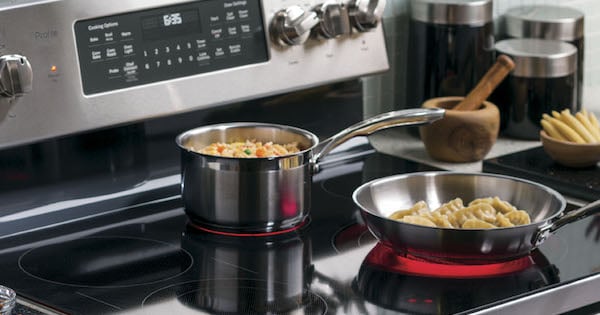
Not induction, so not the same plusses, but the flat stovetop thing is nice, even for an old gas head like me.
My preference is a high end gas cooktop with an electric stove. I also like gas fireplaces. Almost everyone I know has gas and prefers it.
What about induction? The choice isn't gas vs electric anymore. Induction cooktops are night and day different from the old glowing rings style electric cooktops (which are terrible, agreed.)
I would prefer gas over regular electric for kitchen stove and range. I like having a gas water heater, although I understand there are more expensive electric units that end up being more efficient, and that is appealing. I would like to have a gas clothes dryer vs. electric, but don't have the option.
Regular electric ranges typically do not perform as well for cooking. They can be better for cleaning and aesthetics, e.g. smooth top ranges are attractive and easy to clean, but most everyone I've ever talked to who actually likes to cook prefers gas ranges because they can get hotter and are better at temperature control. I don't know if I've ever talked to someone who cares about electric vs. gas ovens though, and I am not sure that either would necessarily have a performance advantage over the other.
Induction ranges are a very appealing subset of electric, but tend to require beefier circuits than most people have running to their kitchen; I've pointed out in other conversations that older houses in the US often don't have the panel capacity to retrofit without also replacing the panel. Induction is also not compatible with aluminum, copper, or glass cookware, which may comprise the majority of cookware in the US (just a guess).
I would agree that most people don't care about this, and will use whatever they have.
Regular electric ranges typically do not perform as well for cooking. They can be better for cleaning and aesthetics, e.g. smooth top ranges are attractive and easy to clean, but most everyone I've ever talked to who actually likes to cook prefers gas ranges because they can get hotter and are better at temperature control. I don't know if I've ever talked to someone who cares about electric vs. gas ovens though, and I am not sure that either would necessarily have a performance advantage over the other.
Induction ranges are a very appealing subset of electric, but tend to require beefier circuits than most people have running to their kitchen; I've pointed out in other conversations that older houses in the US often don't have the panel capacity to retrofit without also replacing the panel. Induction is also not compatible with aluminum, copper, or glass cookware, which may comprise the majority of cookware in the US (just a guess).
I would agree that most people don't care about this, and will use whatever they have.
> I've ever talked to someone who cares about electric vs. gas ovens though, and I am not sure that either would necessarily have a performance advantage over the other.
Actually lots of people care about gas versus electric ovens. If you look at high end ranges, “dual-fuel” is the product category name which is gas stove with electric oven.
One reason why chefs prefer electric ovens, or rather why gas ovens are not preferable is that gas contains humidity. That additional moisture is desirable at times, but not always. On the very high end, an electric oven with a steam reservoir allows the chef to control the humidity. For instance, you can bake bread with steam for a soft rise and finish with no humidity for a crunchy crust. I’ve never seen a steam oven fueled by gas, but I haven’t sought one out. If this has peaked anyone’s interest Anova makes a countertop steam oven that’s great - previously this was only available on commercial equipment and the fanciest home ovens.
Actually lots of people care about gas versus electric ovens. If you look at high end ranges, “dual-fuel” is the product category name which is gas stove with electric oven.
One reason why chefs prefer electric ovens, or rather why gas ovens are not preferable is that gas contains humidity. That additional moisture is desirable at times, but not always. On the very high end, an electric oven with a steam reservoir allows the chef to control the humidity. For instance, you can bake bread with steam for a soft rise and finish with no humidity for a crunchy crust. I’ve never seen a steam oven fueled by gas, but I haven’t sought one out. If this has peaked anyone’s interest Anova makes a countertop steam oven that’s great - previously this was only available on commercial equipment and the fanciest home ovens.
> I like having a gas water heater, although I understand there are more expensive electric units that end up being more efficient, and that is appealing.
Oh for sure - for heating the house and water, I prefer gas. At least where I live it's more cost effective than electric. In fact, my electric bill in my 1 bedroom apartment (all heating was electric) was just a tad lower than my gas + electric when I moved into a much bigger house.
And of course, gas fireplaces. Once you get used to it, you can't imagine life without it. Electric heaters are horrible in comparison.
My comment was really just about cooking as that is what the parent was referring to.
Oh for sure - for heating the house and water, I prefer gas. At least where I live it's more cost effective than electric. In fact, my electric bill in my 1 bedroom apartment (all heating was electric) was just a tad lower than my gas + electric when I moved into a much bigger house.
And of course, gas fireplaces. Once you get used to it, you can't imagine life without it. Electric heaters are horrible in comparison.
My comment was really just about cooking as that is what the parent was referring to.
> I prefer gas. At least where I live it's more cost effective than electric. In fact, my electric bill in my 1 bedroom apartment (all heating was electric) was just a tad lower than my gas + electric when I moved into a much bigger house.
Doesn't this prove the opposite of your point that gas is more cost-effective than electricity? Perhaps I'm misunderstanding, but the last sentence seems to illustrate that electricity is more cost-efficient.
Doesn't this prove the opposite of your point that gas is more cost-effective than electricity? Perhaps I'm misunderstanding, but the last sentence seems to illustrate that electricity is more cost-efficient.
> Doesn't this prove the opposite of your point that gas is more cost-effective than electricity?
I never made that point.
I never made that point.
> Induction ranges are a very appealing subset of electric, but tend to require beefier circuits than most people have running to their kitchen;
Resistive electric ranges almost always require a 240V circuit, and unless you go for a high-end (high output) induction unit, the most that might be required is a new breaker in the panel.
Resistive electric ranges almost always require a 240V circuit, and unless you go for a high-end (high output) induction unit, the most that might be required is a new breaker in the panel.
I personally insist on gas for cooking currently. I also insist on having multiple power sources in a house I buy. And that's helped with the wind storms that knock electric offline every year here in the PNW.
I like cooking with gas, I've had electric and induction as well.
Generally I like having options and backups.
I like cooking with gas, I've had electric and induction as well.
Generally I like having options and backups.
If people prefer gas that much then existing homes will be more highly valued. That does not change the equation for everyone that's already priced out of existing properties.
Considering the extreme shortage of housing inventory in our most prosperous cities I doubt gas hookups kill any projects.
Considering the extreme shortage of housing inventory in our most prosperous cities I doubt gas hookups kill any projects.
This relates to a difficult topic, which is: should modern civilization be 100% carbon neutral?
Some things are inherently difficult to make electric, yet we need them to have what we'd call a "modern civilization". Planes are the biggest one: there is a drive to use more trains instead of planes, but should we give that up? It is definitely a step backwards in civilization, as large parts of the world are now impossible to go to and from. Some people admonish flight tourism as hedonistic and say it harms the planet: but should people not be allowed to travel intercontinentally? Is that the world we want?
I believe the investment in carbon capture and greenhouse gases abatement should be increased. Not just because we'll not meet our climate goals and need a way to clean our atmosphere, but because even if we do we still need some things that burn fossil fuels (possibly for hundreds of years).
In that sense, if all of our energy grid was renewable, heavy industries didn't burn coal, and all cars were also electric, would it matter that we have gas stoves and other modern conveniences? Maybe not.
Some things are inherently difficult to make electric, yet we need them to have what we'd call a "modern civilization". Planes are the biggest one: there is a drive to use more trains instead of planes, but should we give that up? It is definitely a step backwards in civilization, as large parts of the world are now impossible to go to and from. Some people admonish flight tourism as hedonistic and say it harms the planet: but should people not be allowed to travel intercontinentally? Is that the world we want?
I believe the investment in carbon capture and greenhouse gases abatement should be increased. Not just because we'll not meet our climate goals and need a way to clean our atmosphere, but because even if we do we still need some things that burn fossil fuels (possibly for hundreds of years).
In that sense, if all of our energy grid was renewable, heavy industries didn't burn coal, and all cars were also electric, would it matter that we have gas stoves and other modern conveniences? Maybe not.
I don't think that this is relevant at all in the context of this discussion - electric cooking methods - particularly induction - are superior to gas in essentially every way, shape or form - barring the production of wok hei, which is why the article stresses that so much, while conveniently leaving out all the massive downsides of gas stoves.
Gas stoves are also generally used by gas companies to get gas lines drawn into buildings, so that they can easily sell gas to the bigger consumer of gas - heating. And indeed, in this aspect too, gas is _vastly_ inferior to modern heating technologies such as heat pumps.
There is no real convenience trade-off when it comes to gas. It's time for it to die, permanently.
Gas stoves are also generally used by gas companies to get gas lines drawn into buildings, so that they can easily sell gas to the bigger consumer of gas - heating. And indeed, in this aspect too, gas is _vastly_ inferior to modern heating technologies such as heat pumps.
There is no real convenience trade-off when it comes to gas. It's time for it to die, permanently.
Everything you have written is wrong.
Gas is very efficient. If you have the choice of burning gas at a power station (which is how a lot of electricity is generated now a days) and piping it directly into people's homes for the end goal of generating heat, piping wins every time. The inefficiencies of converting gas to electricity and transporting that electricity are significant and well known.
Additionally, I don't know how anyone who has cooked on gas and electric can claim electric is superior. I will grant that a very good electric (ie, induction) _might_ be superior to a very bad gas, but I have used a lot of examples of each and I would choose gas every time (and to demonstrate I am not ideological about this, I always prefer electric ovens over gas).
Heat pumps are also a vastly overrated technology which only work for very well insulated houses with an HVAC system which keeps the rooms ventilated artificially.
I am big on electrification - I'm a Tesla shareholder - but the carbon benefits of electric heating over gas are minute. The Green agenda should avoid battles where the perceived detriment to people's quality of life vastly exceeds the provable environmental benefit.
Gas is very efficient. If you have the choice of burning gas at a power station (which is how a lot of electricity is generated now a days) and piping it directly into people's homes for the end goal of generating heat, piping wins every time. The inefficiencies of converting gas to electricity and transporting that electricity are significant and well known.
Additionally, I don't know how anyone who has cooked on gas and electric can claim electric is superior. I will grant that a very good electric (ie, induction) _might_ be superior to a very bad gas, but I have used a lot of examples of each and I would choose gas every time (and to demonstrate I am not ideological about this, I always prefer electric ovens over gas).
Heat pumps are also a vastly overrated technology which only work for very well insulated houses with an HVAC system which keeps the rooms ventilated artificially.
I am big on electrification - I'm a Tesla shareholder - but the carbon benefits of electric heating over gas are minute. The Green agenda should avoid battles where the perceived detriment to people's quality of life vastly exceeds the provable environmental benefit.
> Gas is very efficient.
The way my entire kitchen noticeably heats up from pan-searing anything says otherwise.
The way my entire kitchen noticeably heats up from pan-searing anything says otherwise.
Burning gas on a stove to heat food is about 40% efficient. Induction is about 85% efficient. Modern CCGT is about 60% efficient. So converting the energy contained in natural gas into electricity in a large CCGT plant and then cooking with the electricity is more efficient than piping the gas to a home and burning it there.
More importantly for me is that, you don't pollute your breathing air with the byproducts of combusting gas indoors in your home - particular nitrous oxides and fine particulates.
More importantly for me is that, you don't pollute your breathing air with the byproducts of combusting gas indoors in your home - particular nitrous oxides and fine particulates.
My friend is just 36 and a chef. She has stage 4 lung cancer. I wonder how much her workplace particulate matter exposure played a role.
> Heat pumps are also a vastly overrated technology which only work for very well insulated houses with an HVAC system which keeps the rooms ventilated artificially.
Well that's weird. I live in 1875 adobe house with no HVAC system other than my wall-mounted minisplits. The house is poorly insulated (adobe has high thermal mass but is a very poor insulator, plus lots of leaky windows and roof construction details). The heat pumps kept us warm during this last winter's 5F overnights.
Well that's weird. I live in 1875 adobe house with no HVAC system other than my wall-mounted minisplits. The house is poorly insulated (adobe has high thermal mass but is a very poor insulator, plus lots of leaky windows and roof construction details). The heat pumps kept us warm during this last winter's 5F overnights.
https://en.wikipedia.org/wiki/Air_source_heat_pump#In_cold_c...
A study by Natural Resources Canada found that cold climate air source heat pumps (CC-ASHPs) work in Canadian winters, based on testing in Ottawa (Ontario) in late December 2012 to early January 2013 using a ducted CC-ASHP. (The report does not explicitly state whether backup heat sources should be considered for temperatures below −30 °C. The record low for Ottawa is −36 °C.) The CC-ASHP provided 60% energy savings compared to natural gas (in energy units).[10] When considering energy efficiency in electricity generation however, more energy would be used with the CC-ASHP, relative to natural gas heating, in provinces or territories (Alberta, Nova Scotia, and the Northwest Territories) where coal-fired generation was the predominant method of electricity generation. (The energy savings in Saskatchewan were marginal. Other provinces use primarily hydroelectric and/or nuclear generation.) Despite the significant energy savings relative to gas in provinces not relying primarily on coal, the higher cost of electricity relative to natural gas (using 2012 retail prices in Ottawa, Ontario) made natural gas the less expensive energy source.
A study by Natural Resources Canada found that cold climate air source heat pumps (CC-ASHPs) work in Canadian winters, based on testing in Ottawa (Ontario) in late December 2012 to early January 2013 using a ducted CC-ASHP. (The report does not explicitly state whether backup heat sources should be considered for temperatures below −30 °C. The record low for Ottawa is −36 °C.) The CC-ASHP provided 60% energy savings compared to natural gas (in energy units).[10] When considering energy efficiency in electricity generation however, more energy would be used with the CC-ASHP, relative to natural gas heating, in provinces or territories (Alberta, Nova Scotia, and the Northwest Territories) where coal-fired generation was the predominant method of electricity generation. (The energy savings in Saskatchewan were marginal. Other provinces use primarily hydroelectric and/or nuclear generation.) Despite the significant energy savings relative to gas in provinces not relying primarily on coal, the higher cost of electricity relative to natural gas (using 2012 retail prices in Ottawa, Ontario) made natural gas the less expensive energy source.
> Additionally, I don't know how anyone who has cooked on gas and electric can claim electric is superior
In addition to all the other responses you've received disputing technical aspects of your post, I'd just like to comment on this one. I've used both extensively (coil, solid resistive, halogen, and infrared for electric, and both bottled and piped for gas), and I far prefer an induction or even a coil stove over gas for everything except for wok. For example, I currently live in a place with a gas stove, and if I want to boil water quickly, I will put 1.7 litres in an electric kettle and 0.3 in a large pot on an appropriately sized burner. By the time the 1500W kettle boils, the water in the pot on the gas stove is ~80°C.
In addition to all the other responses you've received disputing technical aspects of your post, I'd just like to comment on this one. I've used both extensively (coil, solid resistive, halogen, and infrared for electric, and both bottled and piped for gas), and I far prefer an induction or even a coil stove over gas for everything except for wok. For example, I currently live in a place with a gas stove, and if I want to boil water quickly, I will put 1.7 litres in an electric kettle and 0.3 in a large pot on an appropriately sized burner. By the time the 1500W kettle boils, the water in the pot on the gas stove is ~80°C.
>Everything you have written is wrong.
I think most of your counterpoints have been entirely disproven by other posters, but I'll chip in a few more points
>Gas is very efficient. If you have the choice of burning gas at a power station (which is how a lot of electricity is generated now a days) and piping it directly into people's homes for the end goal of generating heat, piping wins every time. The inefficiencies of converting gas to electricity and transporting that electricity are significant and well nown.
This is only true for an energy mix using 100% gas, which is dumb, outdated and rapidly vanishing. Given the very small efficiency difference in gas -> stove to gas -> electricity -> induction, as soon as you have merely a few percentages of renewables, gas becomes the clear loser. The more of the grid we move to renewables, the more gas loses out, and the trend towards renewables is undeniable merely on the economics of it.
That's only covering the cooking-case. Heat pumps are several times more efficient than gas heating down to very low temperatures, I'm really not sure how you can be so wrong on the facts for that point.
>Additionally, I don't know how anyone who has cooked on gas and electric can claim electric is superior. I will grant that a very good electric (ie, induction) _might be superior to a very bad gas, but have used a lot of examples of each and would choose gas every time (and to demonstrate am not ideological about this, always prefer electric ovens over gas).
Whatever small preference people at large have for gas cooking is dwarfed entirely by the list pf drawbacks it has, and that's not even involving the environmental aspects - completely wrecking your indoor air quality is enough of a reason to disregard gas cooking as a technology entirely. Having to risk gas leaks is another aspect that is bafflingly dumb.
>Heat pumps are also a vastly overrated technology which only work for very well insulated houses with an HVAC system which keeps the rooms ventilated artificially.
You very clearly have no idea what you're talking about.
>l am big on electrification - I'm a Tesla shareholder. but the carbon benefits of electric heating over gas are minute. The Green agenda should avoid battles where the perceived detriment to people's quality of life vastly exceeds the provable environmental benefit.
'The Green agenda' - jesus christ.
Any imagined quality-of-life difference between gas cooking and induction is trivial nonsense.
Also, Tesla is not a climate solution, fwiw.
I think most of your counterpoints have been entirely disproven by other posters, but I'll chip in a few more points
>Gas is very efficient. If you have the choice of burning gas at a power station (which is how a lot of electricity is generated now a days) and piping it directly into people's homes for the end goal of generating heat, piping wins every time. The inefficiencies of converting gas to electricity and transporting that electricity are significant and well nown.
This is only true for an energy mix using 100% gas, which is dumb, outdated and rapidly vanishing. Given the very small efficiency difference in gas -> stove to gas -> electricity -> induction, as soon as you have merely a few percentages of renewables, gas becomes the clear loser. The more of the grid we move to renewables, the more gas loses out, and the trend towards renewables is undeniable merely on the economics of it.
That's only covering the cooking-case. Heat pumps are several times more efficient than gas heating down to very low temperatures, I'm really not sure how you can be so wrong on the facts for that point.
>Additionally, I don't know how anyone who has cooked on gas and electric can claim electric is superior. I will grant that a very good electric (ie, induction) _might be superior to a very bad gas, but have used a lot of examples of each and would choose gas every time (and to demonstrate am not ideological about this, always prefer electric ovens over gas).
Whatever small preference people at large have for gas cooking is dwarfed entirely by the list pf drawbacks it has, and that's not even involving the environmental aspects - completely wrecking your indoor air quality is enough of a reason to disregard gas cooking as a technology entirely. Having to risk gas leaks is another aspect that is bafflingly dumb.
>Heat pumps are also a vastly overrated technology which only work for very well insulated houses with an HVAC system which keeps the rooms ventilated artificially.
You very clearly have no idea what you're talking about.
>l am big on electrification - I'm a Tesla shareholder. but the carbon benefits of electric heating over gas are minute. The Green agenda should avoid battles where the perceived detriment to people's quality of life vastly exceeds the provable environmental benefit.
'The Green agenda' - jesus christ.
Any imagined quality-of-life difference between gas cooking and induction is trivial nonsense.
Also, Tesla is not a climate solution, fwiw.
> If you have the choice of burning gas at a power station (which is how a lot of electricity is generated now a days) and piping it directly into people's homes for the end goal of generating heat, piping wins every time.
That’s factually wrong.
> I will grant that a very good electric (ie, induction)
This sentence doesn’t make sense. Resistive and induction cooktops have nothing in common. One is not a good version of the other. It’s a completely different experience. The fact that you don’t seem aware of this seriously hinders your comment.
That’s factually wrong.
> I will grant that a very good electric (ie, induction)
This sentence doesn’t make sense. Resistive and induction cooktops have nothing in common. One is not a good version of the other. It’s a completely different experience. The fact that you don’t seem aware of this seriously hinders your comment.
> Heat pumps are also a vastly overrated technology which only work for very well insulated houses with an HVAC system which keeps the rooms ventilated artificially
I live in a Japanese apartment (=absolutely terribly insulated, single pane glass, drafty as hell) and our minisplits work way better than any resistive heating we've tried. The only other heaters we use are radiant heaters to heat your body quickly if you don't need to heat the rest of the room.
I don't see how "method that heats air using less energy" can be worse than "method that heard air using more energy". Both are just heating air.
I live in a Japanese apartment (=absolutely terribly insulated, single pane glass, drafty as hell) and our minisplits work way better than any resistive heating we've tried. The only other heaters we use are radiant heaters to heat your body quickly if you don't need to heat the rest of the room.
I don't see how "method that heats air using less energy" can be worse than "method that heard air using more energy". Both are just heating air.
> there is a drive to use more trains instead of planes, but should we give that up?
If you have good trains it's not giving things up. Apart from long distance travel HS trains are just better is almost every way.
If you have good trains it's not giving things up. Apart from long distance travel HS trains are just better is almost every way.
Civilization can and must be climate gas neutral. Can be accomplished through massive build-out of geological-time CO2 sequestering, financed with global taxes on greenhouse gas emissions and international agreements to the same effect.
End-state will still have lots of economic processes that require releasing greenhouse gases to the atmosphere, even new or novel ones. But these will be offset by the sequestering paid by their taxation.
Taxes will shift greenhouse gas emissions to no-emission alternatives where that's practical and desirable, probably meaning most of them in the end.
End-state will still have lots of economic processes that require releasing greenhouse gases to the atmosphere, even new or novel ones. But these will be offset by the sequestering paid by their taxation.
Taxes will shift greenhouse gas emissions to no-emission alternatives where that's practical and desirable, probably meaning most of them in the end.
I am convinced that fundamental changes are required in the economy for us to solve climate change. I recently watched a video about carbon offsets by growing trees and it is basically fraud.
You know, using terra preta for soil improvement would generate basically infinite demand bio char which can then be sequestered into the soil.
If you wanted to get carbon out of the atmosphere this would not only sequester carbon, it would also improve the soil and reduce the need for synthetics in conventional farming.
There is no way this will happen. If we had the right economic system we wouldn't be in this mess in the first place.
You know, using terra preta for soil improvement would generate basically infinite demand bio char which can then be sequestered into the soil.
If you wanted to get carbon out of the atmosphere this would not only sequester carbon, it would also improve the soil and reduce the need for synthetics in conventional farming.
There is no way this will happen. If we had the right economic system we wouldn't be in this mess in the first place.
This doesn't just apply to cooking gas though
And there you have it. The essence of environmentalism.
Find a small problem, propose drastic measures to counter it, end up making the problem worse.
Then, later, accuse everyone of impeding progress, and that there is an urgent need for even more drastic measures.
Find a small problem, propose drastic measures to counter it, end up making the problem worse.
Then, later, accuse everyone of impeding progress, and that there is an urgent need for even more drastic measures.
subsubzero(2)
Pretty much every argument I have read in this post boils down to "electric is better" but crucially ignores a) the idea that preferences are individual, and b) even accepting something as universally "better" doesn't mean we ought to legislate it across an entire group of people (AKA centrally plan the economy).
One person’s “centrally planned economy” is another person’s “managing negative externalities”
A lot of the “electric is better” posts have an implied “gas stoves are bad for people and the environment so we should get rid of them but it’s fine because electric is better anyway”.
A lot of the “electric is better” posts have an implied “gas stoves are bad for people and the environment so we should get rid of them but it’s fine because electric is better anyway”.
Negative externalities would ideally just be handled through proportional taxation. Then market incentives work it out. Taxes are used to clean up the externalities.
That's the standard neoliberal solution that never works vs California's experience that phase outs and bans work well.
The problem with neoliberalism is that it is about cutting taxes like these. The FDP in Germany is basically a tax cut party and nothing else.
It currently costs $600 to permanently remove one ton of CO2 from the atmosphere. How many percent of the United States' CO2 emissions are subjected to this level of CO2 tax, along with similar import taxes to avoid shifting emissions to locales with no tax?
This will work.
This will work.
Using $600 per ton of co2 across a 2000mi commercial flight with 150 passengers emitting 50lbs of co2 per mile, that works out to a tax of $200 per passenger (each way). Would double the price of a typical ticket
Yep.
It's pretty obvious that we need to work very hard at getting this cost down.
It's pretty obvious that we need to work very hard at getting this cost down.
can you imagine the amount of fraud that will be happening in CO2 accounting? The carbon credit market is already fraud-galore!
[deleted]
Electric pollutes less. Electric induction has a faster response. Electric is more energy efficient. Electric doesn't require a separate line and utility run to the house. Electric boils water faster. Electric produces less greenhouse gasses.
I mean, there's subjectively better ("I prefer to cook with it") but there are objectively better traits too.
I mean, there's subjectively better ("I prefer to cook with it") but there are objectively better traits too.
Imagine if someone told you you had to marry someone other than your wife, because your wife’s genes are more likely to produce disabled offspring that would place a great burden on the social safety net.
Ok, I'm imagining it. Now what?
Oh wait, were you trying to say that forced divorce and remarriage is the same thing as "this other type of cooking tool should be used instead of the one you are familiar with"?
Hahahaha
Oh wait, were you trying to say that forced divorce and remarriage is the same thing as "this other type of cooking tool should be used instead of the one you are familiar with"?
Hahahaha
Yeah I’m not sure. Maybe it’s better if someone with more empathy imagines it
Stoves are just machines, they don't have feelings nor do they have a self preservation instinct.
sieabahlpark(1)
The problem with "just let individuals choose" arguments is that our population seems to be extremely opposed to taxes that counteract externalities. Of course we should let people choose, but when their choice harms others we have to either charge them more or force them into making a different choice. I'd prefer taxes, but bans seem much easier politically.
It is considered "social engineering" if your tax internalizes costs. I honestly have no idea how people come up with these arguments.
Surely, secretly subsidizing harmful behaviour is twice as bad, first due to the subsidy itself and second for the harm it causes to other people.
Surely, secretly subsidizing harmful behaviour is twice as bad, first due to the subsidy itself and second for the harm it causes to other people.
And we seem to be throwing away the best opportunity that we've ever had to reduce driving quite significantly - by giving up on WFH and forcing people to commute again.
> Seems like a lot of the interest in these bans is coming from new research like this [Stanford study](https://news.stanford.edu/2022/01/27/rethinking-cooking-gas/) showing gas stoves emit more methane than previously thought.
Actually, most of the interest I see is in the indoor air quality impact rather than in the global environmental impact.
Gas stoves emitting particulates wasn't a big deal back when houses were drafty as hell. However, now that everything is sealed up for insulation, indoor air quality is a much bigger deal.
And gas stoves are terrible for indoor air quality.
Actually, most of the interest I see is in the indoor air quality impact rather than in the global environmental impact.
Gas stoves emitting particulates wasn't a big deal back when houses were drafty as hell. However, now that everything is sealed up for insulation, indoor air quality is a much bigger deal.
And gas stoves are terrible for indoor air quality.
The thing is - when you get rid of gas stoves you can get rid of almost all other gas appliances. That’s literally the only thing keeping gas in most homes in the USA and continued in new construction.
When you add in gas water heaters, heating, etc. then gas becomes a more significant contributor to GHG. Whereas switching all of those with heatpumps and induction cuts off the gas lobby from fucking with everyone.
Best way to get gas lobby to stop winning? Get rid of gas stoves. Climate Town has a good video on this subject. https://youtu.be/hX2aZUav-54
When you add in gas water heaters, heating, etc. then gas becomes a more significant contributor to GHG. Whereas switching all of those with heatpumps and induction cuts off the gas lobby from fucking with everyone.
Best way to get gas lobby to stop winning? Get rid of gas stoves. Climate Town has a good video on this subject. https://youtu.be/hX2aZUav-54
Parents smoked for decades, and now tell me I'm crazy for still using a gas stove.
I'll take my chances.
I'll take my chances.
This article is all about climate change and cooking. But in case anyone is interested, I got interested in the health effects of gas stoves vs. induction a few months back. I was frustrated that no one seemed to give the magnitude of the harm. My conclusion was that using a gas stove for your entire life rather than an electric cooktop plausibly creates enough enough NO2 to reduce life expectancy by a couple of months: https://dynomight.net/stoves/ (this is high uncertainty, of course)
It seems questionable to evaluate what happens when you cook without any ventilation. You need ventilation to avoid smelling like food later on. Poor ventilation also has other bad consequences.
I have never lived anywhere, in my entire life, that vented stove air outside — it just "filters" it through a filter nobody ever replaces and blows it back at you, if you're lucky.
Most of the places I've lived have vented stove air outdoors. I've had the kind you're referring to as well, but outdoor venting hasn't been uncommon in my experience. Maybe it's a regional thing; I'm on the east coast FWIW.
Gas stove usage may cause a few months shorter lifespan, but it really is low in my list of health related concerns.
Eating a wholesome non-processed diet and staying active are going to be much more impactful on my health. Worrying about micro optimizations like gas stoves just seems like small potatoes when people are eating processed junk food and are horribly out of shape.
Eating a wholesome non-processed diet and staying active are going to be much more impactful on my health. Worrying about micro optimizations like gas stoves just seems like small potatoes when people are eating processed junk food and are horribly out of shape.
Manpuku Tokyo BBQ in LA does charcoal bbq at the table. As long as they don’t ban that, we’ll be fine.
Cooking is absolutely the last human process that should be de-carbonized.
I grew up using traditional electric (not even inductive; just the normal 1970s kind) and it was absolutely fine. Where I live now has gas (the first in my 50+ year life) and I don't think it's something amazing; I actually find it kind of irritating to be honest. I think it's just what people are used to. Going to electric from gas is irritating, but so is the reverse.
Non-induction electric has the huge huge advantage of being user serviceable but is absolutely garbage to cook with. The coils heat non-uniformly and pans aren’t perfectly flat and so make uneven contact with them.
Now there are “radiant” cooktops but for some dumb reason they encase them in glass which I’m sure is for safety or efficiency but also makes them annoying because, again, pan aren’t flat. We are perfectly capable of making literally a gas stove but with electric coils just like ovens but we don’t. It would solve basically every issue with them except the speed to adjust temperature but I could live with that.
Now there are “radiant” cooktops but for some dumb reason they encase them in glass which I’m sure is for safety or efficiency but also makes them annoying because, again, pan aren’t flat. We are perfectly capable of making literally a gas stove but with electric coils just like ovens but we don’t. It would solve basically every issue with them except the speed to adjust temperature but I could live with that.
Interestingly, I take significant steps to reduce my emissions footprint, but the one thing I won't give up is cooking with a gas stove. It's simply better /as a cook/ than other options. I've used high-end induction, I've used radiant electric, I've used different pan types. Gas is simply the best all-rounder, and has some unique properties that can't be replicated any other way. I take my home cooking very very seriously, and consider it a requirement to have a dual-fuel range.
Propane is a good alternative, especially for the home cook. With good ventilation, charcoal is an option too. Both can actually be hotter that the standard or pro gas stove.
why does everyone assume that humans are supposed to be carbon neutral.........it's not based in anything except postulated opinions.....
We don't need to be carbon neutral if we find another planet to fuck up and find a way to get everyone there. In the meantime, it seems easier to just tone down how much fossil fuel we burn.
While I like gas stoves for cooking in my current apartment I occasionally would smell small amounts of gas and didnt think much of it. I took apart the stove and discovered that not a single fitting from the wall to internally had been done properly (they must use a special type of teflon tape on the threads or a special type of grease. They had neither). The stove was constantly leaking gas. On top of that it had THREE pilot lights constantly running (two for the top, one for the oven) that ended up creating actually quite a bit of heat. I disabled the two top pilots and left the bottom and now light it by hand.
Can't imagine all that gas was great for my health though.
Can't imagine all that gas was great for my health though.
> All that may change by 2023 — at least in new Los Angeles buildings. The L.A. City Council last week passed a motion that would ban most gas appliances in new residential and commercial construction in the city, citing an effort to combat climate change.
I understand this article is aimed at the effects this will cause on restaurants, but I think this could have much larger implications for everyone in the area. This sounds like it's going to put an artificial larger load on an aging electrical grid that is already failing due to lack of generating capacity, without adding any additional generation capacity. So more brown/blackouts during peak loads while increasing the chances of hitting the peak simultaneously by increasing load. Where are they going to get this extra power from?
I understand this article is aimed at the effects this will cause on restaurants, but I think this could have much larger implications for everyone in the area. This sounds like it's going to put an artificial larger load on an aging electrical grid that is already failing due to lack of generating capacity, without adding any additional generation capacity. So more brown/blackouts during peak loads while increasing the chances of hitting the peak simultaneously by increasing load. Where are they going to get this extra power from?
I wonder how come gas stove, an artifact of the 20th century, became a "traditional" thing?
The way people cook on gas stove is just one of many ways it can be, and I'm sure in year 1900, cooking on coal was rather different, and gas must have been an improvement, but also met with skepticism, and probably laments about the lack of charcoal smell or taste.
Gas isn't a tradition written in stone. It has serious issues like hot surfaces and higher chances of burning your skin, scurf on the pans, benzopyrene in the air, and risk of suffocation, heating of the indoor air, etc. Personally, I switched to induction for all these reasons.
It looks like the only downside to induction is that some users need walls hot (I don't) and need cooking to continue if they raise the pan up. I think this is doable with different forms of the oven, and with thicker iron pans: iron absorbs EM waves, it conducts heat well, and it will add thermal inertia. These pans will be heavier, but IMO that's a small price for all the benefits of induction.
The way people cook on gas stove is just one of many ways it can be, and I'm sure in year 1900, cooking on coal was rather different, and gas must have been an improvement, but also met with skepticism, and probably laments about the lack of charcoal smell or taste.
Gas isn't a tradition written in stone. It has serious issues like hot surfaces and higher chances of burning your skin, scurf on the pans, benzopyrene in the air, and risk of suffocation, heating of the indoor air, etc. Personally, I switched to induction for all these reasons.
It looks like the only downside to induction is that some users need walls hot (I don't) and need cooking to continue if they raise the pan up. I think this is doable with different forms of the oven, and with thicker iron pans: iron absorbs EM waves, it conducts heat well, and it will add thermal inertia. These pans will be heavier, but IMO that's a small price for all the benefits of induction.
If the goal was carbon neutrality, why would you start with gas stoves instead of first removing (non-electric) cars from your city?
That's like trimming someone's beard when they're currently bleeding out from five stab wounds to the chest.
You shouldn't even be thinking of that yet, unless you've already given up.
That's like trimming someone's beard when they're currently bleeding out from five stab wounds to the chest.
You shouldn't even be thinking of that yet, unless you've already given up.
> Xie estimates that he pays around $500 to $700 a month on gas, and about $1,200 on electricity.
Since gas stoves are so inefficient, natural gas should provide no cost benefit. It's likely that much of that electricity use from higher AC and refrigerator compressors demand due to gas stoves heating up the interior space (commercial kitchens can get very hot).
It's interesting that Korean BBQ is mentioned since I already see many places using induction stoves for obvious safety reasons; customers are cooking their own food. Hot pot and Hibachi places also seem to either be using electric as well. IME doing KBBQ at home with a portable induction stove and it works very well.
I think overall its ideal for even commercial kitchens to move to electric, it would greatly improve indoor air quality and likely make the kitchen environment more comfortable due to less waste heat. That said there are some cases where having an actual flame is important so it would be nice to see some solution for those dishes - perhaps larger portable propane tanks?