Java Is Underhyped(jackson.sh)
jackson.sh
Java Is Underhyped
https://jackson.sh/posts/2021-04-java-underrated/
801 comments
Your premise is that you are able to chose a language based on how appropriate it is for a specific use case. This alone shows you are not the typical user of Java!
Java is typically used in larger or long-lived organizations. It is rare to start new projects from scratch. Most development is maintenance and extension of existing systems. Even if you start a greenfield project, it would be most prudent to chose the same platform and language which is already used in the organization. An alternative language would not only have to be better, it would have to be very significantly better to make up for the overhead and headache in maintaining code in multiple languages - never mind the increased difficulty in hiring and training developers.
Geeks tend to evaluate language based on how appropriate they would be for a greenfield project with no organizational baggage. But this is an extremely rare use case for most business.
HN often has reports about startups rewriting everything from scratch every four months, when a new language or platform becomes fashionable. But this is not the world where most developers live.
Java is typically used in larger or long-lived organizations. It is rare to start new projects from scratch. Most development is maintenance and extension of existing systems. Even if you start a greenfield project, it would be most prudent to chose the same platform and language which is already used in the organization. An alternative language would not only have to be better, it would have to be very significantly better to make up for the overhead and headache in maintaining code in multiple languages - never mind the increased difficulty in hiring and training developers.
Geeks tend to evaluate language based on how appropriate they would be for a greenfield project with no organizational baggage. But this is an extremely rare use case for most business.
HN often has reports about startups rewriting everything from scratch every four months, when a new language or platform becomes fashionable. But this is not the world where most developers live.
> Even if you start a greenfield project, it would be most prudent to chose the same platform and language which is already used in the organization.
Anecdotally, I see a trend of greenfield projects moving from Java to NodeJS. I can't think of too many organizations that have zero web presence, and basically any modern web presence requires the use of JS, so there's almost always some JS expertise built into the organization.
Anecdotally, I see a trend of greenfield projects moving from Java to NodeJS. I can't think of too many organizations that have zero web presence, and basically any modern web presence requires the use of JS, so there's almost always some JS expertise built into the organization.
Development is going the other way at my org. Our JS services quickly became "out of date", and nobody wants to put in the massive effort required to bring them up to modern JS language features, build tools, and libraries.
In contrast, our Java upgrades remain painless. Many of our JS services have been merged back into older Java back ends
In contrast, our Java upgrades remain painless. Many of our JS services have been merged back into older Java back ends
> there's almost always some JS expertise built into the organization.
That is usually part of the front-end team that don't do the backend SQL work. Tho team that would get assigned the work for a backend greenfield would be versed in Java.
That is usually part of the front-end team that don't do the backend SQL work. Tho team that would get assigned the work for a backend greenfield would be versed in Java.
It’s surprisingly rare for things to split like that. At most companies people will be more skilled at front end or back end work, but it’s rarely a clean separation with front end vs back end teams.
That’s an outgrowth of most projects being quite small. Paying a team or 20+ people to work on one thing is freaking expensive to the point where it needs major benefit or huge company to be worth it. On the other hand maintaining lots of little projects that all automated something can easily pay for a single developer at even fairly small companies. Across tends of thousands of small and midsized companies you get a lot of such teams which grow and shrink, split off and merge over time.
That’s an outgrowth of most projects being quite small. Paying a team or 20+ people to work on one thing is freaking expensive to the point where it needs major benefit or huge company to be worth it. On the other hand maintaining lots of little projects that all automated something can easily pay for a single developer at even fairly small companies. Across tends of thousands of small and midsized companies you get a lot of such teams which grow and shrink, split off and merge over time.
> It’s surprisingly rare for things to split like that.
THIS. The product is blended and so must the teams be. Among all the full-stack developers I've worked with, the "frontend" or "backend" designators tended to describe preference or strength, rather than limitation.
THIS. The product is blended and so must the teams be. Among all the full-stack developers I've worked with, the "frontend" or "backend" designators tended to describe preference or strength, rather than limitation.
Those are pretty strong assertions with no statistics to back them up. It doesn’t reflect the ecosystem I work in.
I think you underestimate the number of huge companies that see major benefit from large teams working large development efforts.
I think you underestimate the number of huge companies that see major benefit from large teams working large development efforts.
I don’t know where you would even look for that kind of statistics for companies that might use Java. That said, America has:
1,829,875 companies with 5-9 employees 779,922 companies with 10-19 employees 467,634 companies with 20 - 49 employees 170,749 companies with 50 - 99 employees
Of that a few are pure software companies, but it’s far more common to want to automate something. Which often means outsourcing it, but then they simply can’t afford these kinds of large projects.
At the other end only 23,553 companies have 1,000+ employees. Yet even at that scale it’s not guaranteed to have large development teams in house, a single hospital can have 1000+ employees and use mostly 3rd party software with a few generalists to stitch everything together.
1,829,875 companies with 5-9 employees 779,922 companies with 10-19 employees 467,634 companies with 20 - 49 employees 170,749 companies with 50 - 99 employees
Of that a few are pure software companies, but it’s far more common to want to automate something. Which often means outsourcing it, but then they simply can’t afford these kinds of large projects.
At the other end only 23,553 companies have 1,000+ employees. Yet even at that scale it’s not guaranteed to have large development teams in house, a single hospital can have 1000+ employees and use mostly 3rd party software with a few generalists to stitch everything together.
Clearly you’re not going to arrive at a good answer starting from first principles. Industry research groups have the numbers, but they’re locked behind paywalls.
Starting from the other end, the Stackoverflow survey has 50% of devs identifying as full-stack. Most surveys have Java as the #2 programming language, where it’s been for the last 20 years. That says nothing about how those devs are organized among teams, but I don’t think it points to such arrangements being “rare”.
Starting from the other end, the Stackoverflow survey has 50% of devs identifying as full-stack. Most surveys have Java as the #2 programming language, where it’s been for the last 20 years. That says nothing about how those devs are organized among teams, but I don’t think it points to such arrangements being “rare”.
Their 2020 survey has: “About 55% of respondents identify as full-stack developers, and about 20% consider themselves mobile developers.”
I always took that kind of a breakdown to mean most website developers where full stack with embedded etc being their own categories. With majority full stack teams including various specialists as needed, which fits my experience over the last 20 years.
However, Android is Java and is frequently used as a front end. As things grow I normally see teams split by system, so I can see mobile being split off as their own team becoming more common even if it’s the still the minority. That said, it’s teams managing the backend teams which would be considering Java vs NodeJS and based on that 55% I think most teams are familiar with JavaScript.
I always took that kind of a breakdown to mean most website developers where full stack with embedded etc being their own categories. With majority full stack teams including various specialists as needed, which fits my experience over the last 20 years.
However, Android is Java and is frequently used as a front end. As things grow I normally see teams split by system, so I can see mobile being split off as their own team becoming more common even if it’s the still the minority. That said, it’s teams managing the backend teams which would be considering Java vs NodeJS and based on that 55% I think most teams are familiar with JavaScript.
Yes of course, don't fix what's not broken.
It's orthogonal to my point though.
It's orthogonal to my point though.
Python projects that start to grow has a tendency to become hard to manage in a way that I have not seen in Java at all.
Java is like you say not the greatest at anything but it is also not the worst at anything. Its great for projects where the you don't know what you should optimize for or don't care.
If java is to boring maybe kotlin is the way to go. I really like kotlin and in my personal experience the only downside is that the IDEs is not as good as the java counterparts yet.
Java is like you say not the greatest at anything but it is also not the worst at anything. Its great for projects where the you don't know what you should optimize for or don't care.
If java is to boring maybe kotlin is the way to go. I really like kotlin and in my personal experience the only downside is that the IDEs is not as good as the java counterparts yet.
I write software in Java. I can't stand python - too wishy-washy.
But my main complaint about Python is trying to use someone else's software. Then it degenerates into a maze of twisty little passages of trying to install the correct set of dependencies, not knowing where those files are installed (which makes it difficult on a cluster, as you may need to do the install on every node separately). Then you try using pip and it fails because some element of what it is trying to install isn't compatible with your operating system for reason 1. So you try anaconda instead, and that fails in a different way, like it runs a C compiler on some file (!?) which fails because $REASON. I have numerous examples of Python software where I have followed the (detailed, precise) installation instructions, and it doesn't work.
Whereas with Java, you just dump the necessary jars into a directory, include them in the classpath, and it works.
Don't get me started on R.
But my main complaint about Python is trying to use someone else's software. Then it degenerates into a maze of twisty little passages of trying to install the correct set of dependencies, not knowing where those files are installed (which makes it difficult on a cluster, as you may need to do the install on every node separately). Then you try using pip and it fails because some element of what it is trying to install isn't compatible with your operating system for reason 1. So you try anaconda instead, and that fails in a different way, like it runs a C compiler on some file (!?) which fails because $REASON. I have numerous examples of Python software where I have followed the (detailed, precise) installation instructions, and it doesn't work.
Whereas with Java, you just dump the necessary jars into a directory, include them in the classpath, and it works.
Don't get me started on R.
I came to say say that's not a language problem, that's a packaging problem. But that would be misleading.
The reason packaging is still a problem in Python are linked to the language:
- to get perfs, you need compiled extensions, which java doesn't need. So a Jar can be fast and portable, while in Python it's an "or" proposition. Wheels help, but they still are OS dependent, so you need a build per OS.
- PYZ arrived very late in Python, while WAR were a very early thing in Java. Few people even know you can distribute a whole Python program in a single zip file with dependencies using something like shiv (shiv.readthedocs.io). So few people do it, and it's a shame. We do it for 0bin though: https://github.com/Tygs/0bin/releases. And it doesn't solve the wheel problem, although nuitka does but it a higher prices to pay.
- packaging tooling have been a mess for 2 decades. Setuptools/distutils/setuptools2, easy_install/pip, and setup.cfg/setup.py/pyproject.toml. We failed as a community on this one. It's getting better, but it's a slow process.
- the Python community is at least half composed of amateurs. It's a good thing for the dynamism of the community, but it also means the software are not very polished. Hard packaging + amateurs = packages that are releases when they reach "just good enough" stage, not one inch more. It also means you'll get things like leaking stack traces, config files in src and the likes.
So yeah, compared to Java, Python packaging and distribution sucks.
But compared to rust all packaging and distribution for all languages do, so there is that.
The reason packaging is still a problem in Python are linked to the language:
- to get perfs, you need compiled extensions, which java doesn't need. So a Jar can be fast and portable, while in Python it's an "or" proposition. Wheels help, but they still are OS dependent, so you need a build per OS.
- PYZ arrived very late in Python, while WAR were a very early thing in Java. Few people even know you can distribute a whole Python program in a single zip file with dependencies using something like shiv (shiv.readthedocs.io). So few people do it, and it's a shame. We do it for 0bin though: https://github.com/Tygs/0bin/releases. And it doesn't solve the wheel problem, although nuitka does but it a higher prices to pay.
- packaging tooling have been a mess for 2 decades. Setuptools/distutils/setuptools2, easy_install/pip, and setup.cfg/setup.py/pyproject.toml. We failed as a community on this one. It's getting better, but it's a slow process.
- the Python community is at least half composed of amateurs. It's a good thing for the dynamism of the community, but it also means the software are not very polished. Hard packaging + amateurs = packages that are releases when they reach "just good enough" stage, not one inch more. It also means you'll get things like leaking stack traces, config files in src and the likes.
So yeah, compared to Java, Python packaging and distribution sucks.
But compared to rust all packaging and distribution for all languages do, so there is that.
>the Python community is at least half composed of amateurs.
or, even worse, scientists.
or, even worse, scientists.
And most recently, tons of self styled "Data scientists". This has, IMO, diluted the rabid rhetoric of the 90's/oughties python community which is good, but replaced it with people who don't know and don't care what good code even looks like, so it can be difficult to work among them.
I feel sometimes that they pride in writing shitty, unmaintainable code; that they do it on purpose. One of the ways they enjoy life is to disregard all "best practices". And I'm not talking about some high-level OOP principles, but the basics - like keeping consistent code style, or even writing some tests.
The previous crowd with love for monkeypatching everything and hate for abstraction other than dictionaries wasn't too pleasant, too.
The previous crowd with love for monkeypatching everything and hate for abstraction other than dictionaries wasn't too pleasant, too.
lol I was just sitting here thinking I miss my Python job and not having trouble with IntelliJ detecting changes in dependencies and how frustrating it is to invalidate caches and reindex the whole project multiple times before I can run tests for the dependency change. I regularly miss the testing libraries we used, too -- it was so absurdly clean and easy to build robust mocks in our DJango stack (and I set up that tooling, largely on my own iniatiative, based on my team's feedback, so it's not like I'm just like wishing other people had already done the work). Now I work with a bunch of Java devs who use to work for Amazon and somehow use that as an excuse for not caring about tests, our ci-cd tools, and all these other things I'd gotten use to thinking of as standard in my past life as a Python dev.
Code style! Hah. First day on the job I asked about that and was told nobody cared and everybody had their own preferences.
... I'm very bitter today. I'm working on it.
Code style! Hah. First day on the job I asked about that and was told nobody cared and everybody had their own preferences.
... I'm very bitter today. I'm working on it.
This sounds more like a people problem than a language problem to me.
I’m in this forks and I have a hard time disagreeing.
Everything is jupyter notebooks, to the point where example documentation is delivered as notebooks and services run notebooks as it’s apparently easier to do that than to get people to write their code properly. “Oh but data exploration” they say, which is fine, but you shouldn’t be doing data exploration in your prod ML pipeline anyway, and you’re writing code, it’s really not that hard to follow some even rudimentary practices.
Everything is jupyter notebooks, to the point where example documentation is delivered as notebooks and services run notebooks as it’s apparently easier to do that than to get people to write their code properly. “Oh but data exploration” they say, which is fine, but you shouldn’t be doing data exploration in your prod ML pipeline anyway, and you’re writing code, it’s really not that hard to follow some even rudimentary practices.
So... Java is bad, but let's ignore Python's problems.
I'm forced to use Python at work, because data scientists demand it, and I can rant about your "good for data" language for at least 24 hours straight.
Python isn't great at anything specifically, but it's crap in a few specific places. No multithreading? Fine! But then Python core libraries are crap at IPC, when multiprocess is the preferred way of parallel computing!
I'm forced to use Python at work, because data scientists demand it, and I can rant about your "good for data" language for at least 24 hours straight.
Python isn't great at anything specifically, but it's crap in a few specific places. No multithreading? Fine! But then Python core libraries are crap at IPC, when multiprocess is the preferred way of parallel computing!
> So... Java is bad, but let's ignore Python's problems.
I don't know where you read either of your propositions in any of my comment.
I don't know where you read either of your propositions in any of my comment.
And I quote "But it's way better for high level stuff, data mangling, scripting, gluing, and for most web dev stuff."
You've listed things that rely on full stack of libraries and deployment options.(except scripting) As someone who has the pleasure to work with Python - Python is horrible at a lot of these things, in spite of the beauty of the language itself.
You've listed things that rely on full stack of libraries and deployment options.(except scripting) As someone who has the pleasure to work with Python - Python is horrible at a lot of these things, in spite of the beauty of the language itself.
It certainly doesn't help that the software I'm interested in is written for science, so there is a tendency to make it work just well enough on the author's machine to allow a paper to be published, and then abandon it.
There is a clear training problem in science. But I believe part of it is that the knowledge on how to write good software is stuck in companies. You can't learn it in school either. I keep hearong about companies that have to make their new hires unlearn what they learned in class... So where would scientists learn good practices? (in my experience books arent the answer either)
I don't think it is primarily a problem in training. It is a problem in incentive. For the most part, scientific software is written to fulfil a goal, and usually that goal is in order to publish a paper. Paper publication is what scientists are judged on, not the quality of the software they write. The software only needs to work well enough to get the paper published. Once the paper is published, all incentive to maintain or improve the software disappears, especially if the message of the paper is primarily the results obtained using the software, because then all of the citations will be referring to those results, not the software.
There are two main exceptions to this rule. One is when an actual software engineer ends up working as a scientist and having to write papers (like me). Then, the paper is more likely to be about the software itself, and the citations of the paper are from people who have also used the same software. This creates an incentive to make the software high quality, in order to get those citations. The other exception is when an institute decides that the world needs a decent piece of software to fulfil a vital role, and actually funds its development.
Oh, I should probably mention - I just helped out with a programming course for undergraduate medical science students. Most of the time I was tearing my hair out about the terrible programming practices being taught by the module leader, who admittedly had absolutely no computer science qualifications whatsoever (and in fact didn't know the difference between a forward slash and a backslash).
I think a solution to this is to recognise software quality as a common benefit, and divert funding towards it, allowing real software engineers to have an actual meaningful career in university. Universities are usually all over common benefit stuff, so you would have thought this would be easy enough. The Research Software Engineer programme in the UK is a start.
There are two main exceptions to this rule. One is when an actual software engineer ends up working as a scientist and having to write papers (like me). Then, the paper is more likely to be about the software itself, and the citations of the paper are from people who have also used the same software. This creates an incentive to make the software high quality, in order to get those citations. The other exception is when an institute decides that the world needs a decent piece of software to fulfil a vital role, and actually funds its development.
Oh, I should probably mention - I just helped out with a programming course for undergraduate medical science students. Most of the time I was tearing my hair out about the terrible programming practices being taught by the module leader, who admittedly had absolutely no computer science qualifications whatsoever (and in fact didn't know the difference between a forward slash and a backslash).
I think a solution to this is to recognise software quality as a common benefit, and divert funding towards it, allowing real software engineers to have an actual meaningful career in university. Universities are usually all over common benefit stuff, so you would have thought this would be easy enough. The Research Software Engineer programme in the UK is a start.
Is shiv better than pyinstaller? When turned my script into a binary with this, it took 10 seconds extra on every execution just to start running the script (Eg to just print the help message). I found that to be unbearable since this was a command line script that was invoked anew for every execution
They don't serve the same purpose.
Pyinstaller builds bundle the python binary with the project. It works without a Python installed on the system, is not portable and the resulting binary is fat. It also can fail in numerous way and be slow, but end users will find it the easier to use when they work.
Pyz files just contains python code. Shiv produce them by bundling your code and the dependencies, but you still need a Python installed on the system to run that. You pay the cost of zipping only on the first run though, after that, it's unzipped. And their are portable if you use no binary wheel. It's light and easy to get right.
In that sense, they look more like War files in Java.
Pyinstaller, like cx_freeze and nuikta are for end users.
Pyz are for devs.
Pyinstaller builds bundle the python binary with the project. It works without a Python installed on the system, is not portable and the resulting binary is fat. It also can fail in numerous way and be slow, but end users will find it the easier to use when they work.
Pyz files just contains python code. Shiv produce them by bundling your code and the dependencies, but you still need a Python installed on the system to run that. You pay the cost of zipping only on the first run though, after that, it's unzipped. And their are portable if you use no binary wheel. It's light and easy to get right.
In that sense, they look more like War files in Java.
Pyinstaller, like cx_freeze and nuikta are for end users.
Pyz are for devs.
If you're not already using the --noupx flag for pyinstaller, you can probably cut that startup latency at least in half. With UPX enabled, the executable has to be decompressed every time it is called. The space saving tends to be minimal and not worth it, definitely not for a CLI where startup latency much more directly impacts the user experience.
Java is so much worse on this front.
> with Java, you just dump the necessary jars into a directory, include them in the classpath, and it works.
Ant, maven, or gradle, and then some jars, somewhere? What's the classpath and whats $JAVA_HOME for this project?
Oh and now I have to make it work in the IDE too, click through a billion menus and dialogs, sync the build system, sync the dependencies, configure runtimes and classpaths, try to rebuild for the 10th time, pray.
> with Java, you just dump the necessary jars into a directory, include them in the classpath, and it works.
Ant, maven, or gradle, and then some jars, somewhere? What's the classpath and whats $JAVA_HOME for this project?
Oh and now I have to make it work in the IDE too, click through a billion menus and dialogs, sync the build system, sync the dependencies, configure runtimes and classpaths, try to rebuild for the 10th time, pray.
Nobody has started a project with Ant in the last decade. Of all the Java projects on Github Ant is probably not even 1%.
> Oh and now I have to make it work in the IDE too, click through a billion menus and dialogs,
You click "Project from existing sources" in IntellIJ and it will recognize both Maven and Gradle projects and just work?
Sync the dependencies? configure runtimes and classpaths? What? With Maven and Gradle? Your talking Ant here.
> Oh and now I have to make it work in the IDE too, click through a billion menus and dialogs,
You click "Project from existing sources" in IntellIJ and it will recognize both Maven and Gradle projects and just work?
Sync the dependencies? configure runtimes and classpaths? What? With Maven and Gradle? Your talking Ant here.
I'm talking about a maven project I have to use sometimes at work. Let me walk you through all the shit I had to do:
I know you will say, this is all fault of whoever made this crap project, or my fault for not fixing it. However this was my experience, and it has been similar every time in my life that I had to touch some java project (although this last one is the worst).
  - Install and set the right java version system-wide
  - Copy some config files for the project system-wide (granted, this is not java specific, but still)
  - Click in some IDE menu to enable some build settings
  - Click in some IDE menu to install some "Lombok" plugin
  - Click in some IDE menu to select the right jdk
  - Click in some IDE menu to edit the run configuration:
    - select main class
    - paste program args
    - paste env vars
    - select right “Use classpath of module:” option
  - Click in some IDE menu to fiddle with "Spring Loader path": modules, dependencies, reorder the dependencies (!)
  - Click in some IDE menu to configure getting the actual logs
  - Click maven-sync, rebuild-project multiple times, restart IDE until it suddenly works
I know you will say, this is all fault of whoever made this crap project, or my fault for not fixing it. However this was my experience, and it has been similar every time in my life that I had to touch some java project (although this last one is the worst).
I've interacted to a ton of Java projects. And with a ton of various other commercial and Open Source projects.
In my experience (sample size of hundreds of projects), Maven projects are <<by far>>, on average, easier to build and manage than most other languages. The repo structure is standardized, the build cycle is standardized, the built packages are always in the same place, etc.
The Java installation is a 1-time think. It's also a quick google away. I see this complaint a lot, I never understand it. It's plain and simple bikeshedding: someone complaining about a 1-time task that takes 5 minutes in total.
The rest of the stuff is IDE specific and I have no idea why you'd have to configure "getting the actual logs"?
In my experience (sample size of hundreds of projects), Maven projects are <<by far>>, on average, easier to build and manage than most other languages. The repo structure is standardized, the build cycle is standardized, the built packages are always in the same place, etc.
The Java installation is a 1-time think. It's also a quick google away. I see this complaint a lot, I never understand it. It's plain and simple bikeshedding: someone complaining about a 1-time task that takes 5 minutes in total.
The rest of the stuff is IDE specific and I have no idea why you'd have to configure "getting the actual logs"?
Well Java is arguably one of the most IDE-reliant mainstream languages. It's completely unusable and unergonomic without the myriad of constant code generation and fixing as you write.
Treating the IDE like a separate problem is not realistic with java.
With e.g. Rust, I can use vim, vscode, whatever floats your boat.
> no idea why you'd have to configure "getting the actual logs"?
Some genius java logging library, I can only guess.
Treating the IDE like a separate problem is not realistic with java.
With e.g. Rust, I can use vim, vscode, whatever floats your boat.
> no idea why you'd have to configure "getting the actual logs"?
Some genius java logging library, I can only guess.
> Well Java is arguably one of the most IDE-reliant mainstream languages. It's completely unusable and unergonomic without the myriad of constant code generation and fixing as you write.
True, but with IntelliJ 99% of what you wrote is auto-configured.
Eclipse needs a bit of hand-holding, but almost everything you described is due to project configuration.
> Some genius java logging library, I can only guess.
That's your problem, you're assuming that Java is dumb and its libraries are dumb. They're not. I'm reasonably sure that <<all>> mainstream Java logging libraries log to console by default.
The previous engineer must have been a marvel of a developer to manage to screw even that up.
What I'd say is: Java, especially older enterprise code, had a ton of over-engineered patterns. These are slowly fading away, except for Spring, and even Spring's simpler these days. Java also tends to have some low quality and a ton of average but unmotivated working devs on Java projects. So yeah, there's that ecosystem problem.
But for example, if you'd start a new project and you approach Java with an open mind, it's one of the most powerful and flexible techs available. And it's much more modern than the stereotypes imply.
True, but with IntelliJ 99% of what you wrote is auto-configured.
Eclipse needs a bit of hand-holding, but almost everything you described is due to project configuration.
> Some genius java logging library, I can only guess.
That's your problem, you're assuming that Java is dumb and its libraries are dumb. They're not. I'm reasonably sure that <<all>> mainstream Java logging libraries log to console by default.
The previous engineer must have been a marvel of a developer to manage to screw even that up.
What I'd say is: Java, especially older enterprise code, had a ton of over-engineered patterns. These are slowly fading away, except for Spring, and even Spring's simpler these days. Java also tends to have some low quality and a ton of average but unmotivated working devs on Java projects. So yeah, there's that ecosystem problem.
But for example, if you'd start a new project and you approach Java with an open mind, it's one of the most powerful and flexible techs available. And it's much more modern than the stereotypes imply.
> with IntelliJ 99% of what you described is auto-configured
It is not, that's what I'm saying. And I don't understand why, if IntelliJ is the de-facto IDE. I'm sure that a fresh project is a one-click import, but an average project that isn't fresh anymore, always have similar IDE-setup-magic problems. At least in my experience over the years.
It is not, that's what I'm saying. And I don't understand why, if IntelliJ is the de-facto IDE. I'm sure that a fresh project is a one-click import, but an average project that isn't fresh anymore, always have similar IDE-setup-magic problems. At least in my experience over the years.
I code in Java, Scala and Python using an IDE just because I like to not remember the documentation to the code.
I know plenty of people who don't use a formal IDE. This "I don't use an IDE" is a stupid flex.
I know plenty of people who don't use a formal IDE. This "I don't use an IDE" is a stupid flex.
Me too, that's why I have vim setup with language-servers. I get inline type info, code completion and so on.
It's not a flex, simply a matter of preference: I find using the mouse too irritating, others prefer it because it's simpler.
But that's not my gripe, my gripe is that setting up IntelliJ, the one defacto standard IDE to actually work is some voodoo ritual of a dozen steps and restarts and so on.
It's not a flex, simply a matter of preference: I find using the mouse too irritating, others prefer it because it's simpler.
But that's not my gripe, my gripe is that setting up IntelliJ, the one defacto standard IDE to actually work is some voodoo ritual of a dozen steps and restarts and so on.
In my experience even Eclipse does a pretty good job of importing Maven projects without needing to tweak things.
Surprisingly, or maybe not, slf4j requires an implementation to be provided at runtime to log anything.
100% lombok can only be developed on eclipse. They have an open issue to make it compile on intellij...
I don't know if something changed, but for sure 2 years ago I used Lombok with IntelliJ.
I don't mean lombok as a library, which works. I mean developing lombok itself
Ah, sorry, haven't done that. It sucks if it's Eclipse only :-(
However I'd expect Lombok users to outnumber Lombok devs 100k to 1 :-)
However I'd expect Lombok users to outnumber Lombok devs 100k to 1 :-)
You can write java with vim, without any trouble. It’s just that Java has the very best IDEs available and I would be stupid to not use them.
IMO it's the other way around. Java has some of the best IDE's around so everyone uses them. You can code in notepad and compile with maven but why would you?
With Rust you code in VIM because there's nothing better. Improving Rust IDE's has been one of the teams big focuses for years. Everyone codes in random text editors because there's no amazing IDE.
With Rust you code in VIM because there's nothing better. Improving Rust IDE's has been one of the teams big focuses for years. Everyone codes in random text editors because there's no amazing IDE.
With rust yoy don't need to constantly generate code. Vim is just perfect, if you have rust-analyze you get inline errors, code completion, jump to definition, autoimport, autoformat...
You don't need to constantly "extract method", move to class, generate all these mountains of classes by rightclick. This says a lot about the language.
But the main point is that with rust it actually just works: there is one way to set global toolchain and per project/dir. You're not required to also click through a million menus and dialogs and copypaste stuff and sync and rebuild and restart to get the editor barely working.
You don't need to constantly "extract method", move to class, generate all these mountains of classes by rightclick. This says a lot about the language.
But the main point is that with rust it actually just works: there is one way to set global toolchain and per project/dir. You're not required to also click through a million menus and dialogs and copypaste stuff and sync and rebuild and restart to get the editor barely working.
> With rust you don't need to constantly generate code.
In Rust, macros generate code on build. In Java, Annotations Processors do. I don't see a big difference between these approaches, besides Java's mechanism being older and crustier. Rust macros generate tons of code.
> if you have rust-analyze you get inline errors, code completion, jump to definition, autoimport, autoformat...
Last time I checked, Rust analyzer was in alpha/beta. Java has all this and it's battle-tested. Including language server for VScode and other lightweight editors, and several options for build plugins that auto format.
> You don't need to constantly "extract method", move to class, generate all these mountains of classes by rightclick.
Lombok, or one of the popular Builder libraries, gets rid of all this boilerplate. I don't generate anything using IDE. In my experience, most Java user don't. There's many mature libraries for geting around class ceremony.
> there is one way to set global toolchain and per project/dir. You're not required to also click through a million menus and dialogs and copypaste stuff and sync and rebuild and restart to get the editor barely working.
You are right. Rusts build system is simpler and better integrated. But Java has amazing build tools, maybe the best out there. A properly configured maven project will compile, test, and run with one command. And it will import into your IDE with a simple "import project, yes"
I have worked on a ton of Java projects over the years and never had to deal with most of what your describe.
In Rust, macros generate code on build. In Java, Annotations Processors do. I don't see a big difference between these approaches, besides Java's mechanism being older and crustier. Rust macros generate tons of code.
> if you have rust-analyze you get inline errors, code completion, jump to definition, autoimport, autoformat...
Last time I checked, Rust analyzer was in alpha/beta. Java has all this and it's battle-tested. Including language server for VScode and other lightweight editors, and several options for build plugins that auto format.
> You don't need to constantly "extract method", move to class, generate all these mountains of classes by rightclick.
Lombok, or one of the popular Builder libraries, gets rid of all this boilerplate. I don't generate anything using IDE. In my experience, most Java user don't. There's many mature libraries for geting around class ceremony.
> there is one way to set global toolchain and per project/dir. You're not required to also click through a million menus and dialogs and copypaste stuff and sync and rebuild and restart to get the editor barely working.
You are right. Rusts build system is simpler and better integrated. But Java has amazing build tools, maybe the best out there. A properly configured maven project will compile, test, and run with one command. And it will import into your IDE with a simple "import project, yes"
I have worked on a ton of Java projects over the years and never had to deal with most of what your describe.
> The Java installation is a 1-time think. It's also a quick google away. I see this complaint a lot, I never understand it. It's plain and simple bikeshedding: someone complaining about a 1-time task that takes 5 minutes in total.
I frequently find that the particular constellation of build tooling and libraries particular projects have requires a particular version of the jvm and all the environment variables set up correctly. In some other languages there is widely used tooling to manage the install and use of the appropriate platform version for the project.
If you're working with a variety of projects, fiddling with the installed jvm and java_home and friends is not a one time thing.
I frequently find that the particular constellation of build tooling and libraries particular projects have requires a particular version of the jvm and all the environment variables set up correctly. In some other languages there is widely used tooling to manage the install and use of the appropriate platform version for the project.
If you're working with a variety of projects, fiddling with the installed jvm and java_home and friends is not a one time thing.
> I know you will say, this is all fault of whoever made this crap project
It is. There's really no excuse for that. If it's been similar every time then you've worked on crap every time.
Building a java project should be (and is on projects I work on) as easy as installing a jvm and running either maven or gradle to build it. End of story.
"Install some lombok plugin" is only necessary if you want the IDE to understand lombok, IntelliJ will just pop up a box saying "Want this?" and you click "Yes". I don't see what's so onerous about that.
The rest you describe is really down to poor developers.
It is. There's really no excuse for that. If it's been similar every time then you've worked on crap every time.
Building a java project should be (and is on projects I work on) as easy as installing a jvm and running either maven or gradle to build it. End of story.
"Install some lombok plugin" is only necessary if you want the IDE to understand lombok, IntelliJ will just pop up a box saying "Want this?" and you click "Yes". I don't see what's so onerous about that.
The rest you describe is really down to poor developers.
No offense, but regardless of how right you might be, you come off as a bit of a condescending asshole. Like "Oh, you don't know that there's a more efficient way to do things? There can't possibly be any explanation other than you're literal human garbage and presumably have brain damage!". Come on, get off your high horse.
I'm really not on my high horse here, if you have a team working on a java project that's that hard to build, they're doing it wrong. Doesn't even matter what the language is really.
So "no offense", but shove it.
So "no offense", but shove it.
There's a difference between - "anything can be turned into an non-compiling pile of crap" and "this ecosystem comes as a pile of crap".
> I know you will say, this is all fault of whoever made this crap project, or my fault for not fixing it. However this was my experience, and it has been similar every time in my life that I had to touch some java project
Yeah that’s a crap project. My experience was always that mvn install / ./gradlew run will just work. On all three OSs. And if I happen upon a decade old random jar file, and run java -jar something.jar, it will just work in the great majority of time. I think no other platform has it this smooth.
Yeah that’s a crap project. My experience was always that mvn install / ./gradlew run will just work. On all three OSs. And if I happen upon a decade old random jar file, and run java -jar something.jar, it will just work in the great majority of time. I think no other platform has it this smooth.
IDE's can be fiddly, and anyway I don't think it's good to depend on an IDE for building.
The project could have been set up instead with the "Maven wrapper"(1) which provides "mvn.cmd/sh" scripts at the top level of the project to fetch and run the proper Maven. So after cloning the project, all you have to do is set a proper JAVA_HOME if it's not already set, and then do "./mvn clean package" at the top of the project to do a complete build. The IDE's will then set themselves up properly if you import the project as a Maven project, and will sync with changes to the Maven pom.xml whenever it changes (Intellij does at least). That's really hard to beat.
(1) https://github.com/takari/maven-wrapper (Being integrated into Maven itself soon).
The project could have been set up instead with the "Maven wrapper"(1) which provides "mvn.cmd/sh" scripts at the top level of the project to fetch and run the proper Maven. So after cloning the project, all you have to do is set a proper JAVA_HOME if it's not already set, and then do "./mvn clean package" at the top of the project to do a complete build. The IDE's will then set themselves up properly if you import the project as a Maven project, and will sync with changes to the Maven pom.xml whenever it changes (Intellij does at least). That's really hard to beat.
(1) https://github.com/takari/maven-wrapper (Being integrated into Maven itself soon).
I can (and often do) build from CLI, that is much smoother. I tried using vim on java, but honestly you need an IDE for all the constant code generation and incessant fixups by mouseclicks that are needed. Vim+coc is more than enough in the other languages that I use.
You're living in a parallel universe from the rest of us. IDE isn't necessary (and positively odd) for building Java.
You do need to be able to build from IDE when you set breakpoints to debug.
Your IDE should be able to connect to any JVM that has been launched with the proper VM arguments.
We occasionally do remote debugging at work. It’s just a matter of copy/pasting the correct JVM incantation into the IDE.
We occasionally do remote debugging at work. It’s just a matter of copy/pasting the correct JVM incantation into the IDE.
I feel the parent comment was about editing, not building.
He is. VsCode (or any editor) + the Eclipse Language Server is more than enough. His complaints about debugging is because he doesn't know about attach debugging.
I can find maybe only one or two things from this list related to Java, both not reflecting current state of affairs. You do not make the need to have a run configuration a language or platform fault, do you?
If you're using IntelliJ from JetBrains, there should be an option to store the run profiles for the project in the version control system.
Even if your project is so messy, then you should be able to just to version a working setup (maybe needing to figure out how to make the correct JDK version be used across different machines) and after that it'd become a question of just having to check out the project from the version control system and click a green button in IntelliJ.
This most likely wouldn't solve all of your issues, but at least would help make onboarding slightly less painful and slow.
Even if your project is so messy, then you should be able to just to version a working setup (maybe needing to figure out how to make the correct JDK version be used across different machines) and after that it'd become a question of just having to check out the project from the version control system and click a green button in IntelliJ.
This most likely wouldn't solve all of your issues, but at least would help make onboarding slightly less painful and slow.
Isn't this rather overblown ? The first 5 steps appear to be a ONE-time framework and system setup for your IDE - and this assumes you have multiple JDK's. You certainly don't need to repeat this for every project.
The run configuration can be automatically created by Intellij by attempting to execute a runnable class. You only need to set program args and env vars if needed - and that would be true for ANY language or program.
The spring loader path appears to be specific for this project.
The run logs are independent of Java. Thats just getting program logs.
There is no need to maven-sync and rebuild-project multiple times, unless you are explicitly refactoring the project module/build structure. Once you have imported a maven project, you can simply click build.
The run configuration can be automatically created by Intellij by attempting to execute a runnable class. You only need to set program args and env vars if needed - and that would be true for ANY language or program.
The spring loader path appears to be specific for this project.
The run logs are independent of Java. Thats just getting program logs.
There is no need to maven-sync and rebuild-project multiple times, unless you are explicitly refactoring the project module/build structure. Once you have imported a maven project, you can simply click build.
You left out Gradle installed/downloaded options, Gradle version, Gradle JVM version, Gradle plugin auto-upgrades and the unholy mess this lot can create.
This is why we virtually all use the ./gradlew script that manage all of that by itself on every platform... No global installation of gradle should ever be done.
You say this as if python could do any better
I think you work at the same company as me!
This is one of the main reasons why I won't work with Java. Everything is much more complex and unnecessarily arcane compared to other languages.
Guess I'm nobody. I created a simple Swing (desktop) app in Java a couple of weeks ago. The process was something like:
Create new Java project in IDE Add no dependencies Use the built in IDE tooling to create a runnable JAR and tick the box to export the Ant build to a build.xml file.
Why would I want to complicate things by adding Maven/Gradle to the mix?
Create new Java project in IDE Add no dependencies Use the built in IDE tooling to create a runnable JAR and tick the box to export the Ant build to a build.xml file.
Why would I want to complicate things by adding Maven/Gradle to the mix?
I will give you the secret trick of senior developers: don't be the one who manages the build process, otherwise leave the project asap.
And I will also give you the secret trick of superninja senior developpers: be the one who manages the build process, so you will never EVER be fired.
And I will also give you the secret trick of superninja senior developpers: be the one who manages the build process, so you will never EVER be fired.
The complexity of maven is well understood and battle tested. The complexity of a custom build is not. In my opinion it is of a far more concerning sort of complexity.
It's an Ant build file - nothing complex at all. If you no or few dependencies and are comfortable managing them manually, Ant is fine.
Non-networked applications don't tend to need to be so paranoid about keeping up to date with the latest versions of dependencies.
Non-networked applications don't tend to need to be so paranoid about keeping up to date with the latest versions of dependencies.
We're probably optimizing for different things. I'm normally optimizing for easy onboarding of someone new. If this is a personal project with few dependencies then ant is probably good enough.
And what if you want/need to add dependencies? A lot of them.
Sure _then_ you might opt to use Maven or Gradle.
My point is there are a wide variety of application types out there, not everything is a web application, not everything needs to use a complex build and dependency management system.
My point is there are a wide variety of application types out there, not everything is a web application, not everything needs to use a complex build and dependency management system.
Yeah, but if you do know Maven, it scales down to small projects. The configuration for a simple project is trivial.
So just use Maven and save anyone coming after you a bunch of trouble when they have to extend your project ;-)
So just use Maven and save anyone coming after you a bunch of trouble when they have to extend your project ;-)
This method is useless for most projects, so yes, you are nobody.
I only had to go a few comments to see someone (the person you're responding to) think Java is the same as it was 15 years ago.
Well, this could be true for some legacy projects with old tooling, but this is not how things work today.
You install the IDE, checkout the code from Git and let IDE get a proper version of JDK for you and fetch dependencies from Maven central to local repo. You really should not copy jars anywhere or set environment variables.
> Oh and now I have to make it work in the IDE too, click through a billion menus and dialogs, sync the build system, sync the dependencies, configure runtimes and classpaths, try to rebuild for the 10th time, pray.
That is not my experience at all. I dont have to rebuild work project many times. Creating new scratch project for playing in is easy and fast. Dependencies are managed by maven and I rarely have to deal with that beyond added dependency tag.
That is not my experience at all. I dont have to rebuild work project many times. Creating new scratch project for playing in is easy and fast. Dependencies are managed by maven and I rarely have to deal with that beyond added dependency tag.
Huh, as a consultant having touched many java code bases, they are all basically the same. Import the maven pom into intellij and run the main class. The folder structure, the code conventions etc are basically the same at every client and every project I've ever seen in java.
All needed is having the correct version of Java, and maybe give maven a password so it can access private libraries. It's dead simple.
And more importantly: it's the same everywhere.
All needed is having the correct version of Java, and maybe give maven a password so it can access private libraries. It's dead simple.
And more importantly: it's the same everywhere.
Yeah, people under-estimate badly how useful the Maven conventions are, because they've never seen them in the C/Python/whatever world.
I haven't used Maven in a bunch of years.
But source code goes in src/main/java. Test code goes in src/test/java, resources (images, files, whatever) go in src/main/resources, test resources go in src/test/resources. There is a pom.xml file that contains dependencies, and if it doesn't, it points to a parent which <<does>> contain them.
There might be submodules and they all are folders containing another pom.xml. That pom.xml generally points to the main pom.xml.
Etc. There's a bit of tedium in there, but <<it's always the same>>!
The level of consistency is something most ecosystems dream about.
And you know what? That means that you can use your spare brain cells for actual creativity or hard work.
I haven't used Maven in a bunch of years.
But source code goes in src/main/java. Test code goes in src/test/java, resources (images, files, whatever) go in src/main/resources, test resources go in src/test/resources. There is a pom.xml file that contains dependencies, and if it doesn't, it points to a parent which <<does>> contain them.
There might be submodules and they all are folders containing another pom.xml. That pom.xml generally points to the main pom.xml.
Etc. There's a bit of tedium in there, but <<it's always the same>>!
The level of consistency is something most ecosystems dream about.
And you know what? That means that you can use your spare brain cells for actual creativity or hard work.
I have done 10+ years of Java development and 1 year of Python. And I disagree, Java packaging is better. You can package all your dependencies in a fat jar like Spring boot does and you only need to run it with java -jar lib.jar and you are good to go.
Dependency management is a mess in the Python world and my number 1 complaint. You have pip, pipenv, poetry, anaconda, to manage your 3rd parties. And if you want to avoid conflicts and have consistent runtime you need to create a virtual environment to install these libraries and redownload everything.
Otherwise libraries are installed user or system wide, in a directory that depends on the Python version that you use but they are not versioned there.
With Maven you don´t have the issue. Your 3rd parties are downloaded in a global cache directory (the Maven repo) and are all versioned. For the delivery you can either provide them all and have the runner set the CLASSPATH or have them packaged into a single jar.
Dependency management is a mess in the Python world and my number 1 complaint. You have pip, pipenv, poetry, anaconda, to manage your 3rd parties. And if you want to avoid conflicts and have consistent runtime you need to create a virtual environment to install these libraries and redownload everything.
Otherwise libraries are installed user or system wide, in a directory that depends on the Python version that you use but they are not versioned there.
With Maven you don´t have the issue. Your 3rd parties are downloaded in a global cache directory (the Maven repo) and are all versioned. For the delivery you can either provide them all and have the runner set the CLASSPATH or have them packaged into a single jar.
Great, but you will actually want to write some code, so you have to do this insane IDE setup clickfest.
I am not saying Python's packaging is any good, it sucks. But you can't realistically ignore Java's IDE shitshow.
I am not saying Python's packaging is any good, it sucks. But you can't realistically ignore Java's IDE shitshow.
It’s pretty much an import project and done. If not, then someone really fcked up that build file.
But this happened to me every time I had to use any java project over the years. Maybe I'm just unlucky.
Please try OSS java projects and educate your build guy. Java the language may have lots of complaints but from the build/packaging point of view its actually one of the best languages out there. And very, very consistent.
I have no clue what you're talking about.
Maven can build a nice fat executable jar, with just one XML block added to the pom.
I've opened a 5year unmaintained project with IntelliJ yesterday - click package and got a working executable.
I opened another project built with SBT... and guess what? No errors!
Let's try that with a Python project (LOL!)
Maven can build a nice fat executable jar, with just one XML block added to the pom.
I've opened a 5year unmaintained project with IntelliJ yesterday - click package and got a working executable.
I opened another project built with SBT... and guess what? No errors!
Let's try that with a Python project (LOL!)
> I can't stand python - too wishy-washy.
That's an interesting take; my experience has been (at least the community) is quite proudly dogmatic on the One Right Way To Do It, for all values of "It".
I also don't like Python, but I think for different reasons and perhaps a bit less than you.
Never used R, but I understand it to be quite fiddly.
That's an interesting take; my experience has been (at least the community) is quite proudly dogmatic on the One Right Way To Do It, for all values of "It".
I also don't like Python, but I think for different reasons and perhaps a bit less than you.
Never used R, but I understand it to be quite fiddly.
> my experience has been (at least the community) is quite proudly dogmatic on the One Right Way To Do It, for all values of "It".
This hasn't been true lately. Python is growing ever more complex.
This hasn't been true lately. Python is growing ever more complex.
I hear you and agree to an extent; my suspicion is the influx of non-CS self-styled "data scientists" using Python for all the ML hype has diluted the historical rabidness.
But, for people still working in "computer science-y" domains, I haven't seen the historical dogmatism lessen; in many cases people are digging in.
But, for people still working in "computer science-y" domains, I haven't seen the historical dogmatism lessen; in many cases people are digging in.
R is an analysis tool. You don't write software in R.
Well, maybe _you_ don't write software in R. Others can write a pretty capable server[0] using just that.
[0] https://github.com/opencpu/opencpu/tree/master/R
[0] https://github.com/opencpu/opencpu/tree/master/R
Of course you can write anything in R but that doesn't mean it will be possible to maintain the codebase for the next 10 maybe 20 years including dev team changes.
In other words R is wrong tool to use for building the software just from maintainability standpoint.
In other words R is wrong tool to use for building the software just from maintainability standpoint.
I agree that in general one would not use R to engineer software. However I disagree regarding low maintainability.
I've seen very complex R packages that have been around for 30+ years. They are actively maintained. Applying good design principles, unit testing, modularity - all that is very much doable in R.
And you will want to write software in R, especially if the purpose is to support the very activity of working with R packages and to expose the R statistical environment over HTTP. Case in point, the software I link to, in my comment above.
I've seen very complex R packages that have been around for 30+ years. They are actively maintained. Applying good design principles, unit testing, modularity - all that is very much doable in R.
And you will want to write software in R, especially if the purpose is to support the very activity of working with R packages and to expose the R statistical environment over HTTP. Case in point, the software I link to, in my comment above.
Most python software use the standard venev setup with pip and requirements.txt, and most java software are distributed as fat jars. Nobody manually sets up dependencies anymore.
As a Java/Python/Go developer I can say that packaging is a solved problem as of 2021.
As a Java/Python/Go developer I can say that packaging is a solved problem as of 2021.
That's really not true.
I like to point out Airflow as an example. It's still a complete nightmare to deal with and it has many steps for just packaging the application.
https://github.com/apache/airflow
I have less trouble packaging and running a 3 year unmaintained Maven Java application, than actively maintained Airflow. And let's not forget that I can target Java 8, without having to install Java 8 on my machine. (Which only adds to Python's complexity)
I like to point out Airflow as an example. It's still a complete nightmare to deal with and it has many steps for just packaging the application.
https://github.com/apache/airflow
I have less trouble packaging and running a 3 year unmaintained Maven Java application, than actively maintained Airflow. And let's not forget that I can target Java 8, without having to install Java 8 on my machine. (Which only adds to Python's complexity)
What do you mean about R? Its packaging and distribution system is great!
Python's packaging is a lot better with Poetry. Use Poetry and build the wheel with poetry build. The lockfile lets you create an exact virtual environment.
Like you mentioned, wheel files are not nearly as customizable as JARs. You can easily pick & choose the dependencies to include in JARs (fat JARs) and change namespaces of dependencies via shading to prevent collisions.
I've generally found it easier to add JARs to Spark clusters compared to attaching wheel files to PySpark clusters.
Like you mentioned, wheel files are not nearly as customizable as JARs. You can easily pick & choose the dependencies to include in JARs (fat JARs) and change namespaces of dependencies via shading to prevent collisions.
I've generally found it easier to add JARs to Spark clusters compared to attaching wheel files to PySpark clusters.
I'm all for a good project-based package manager for Python, but I have tried Poetry several times over the last years and not once has it worked as intended. It always failed to install packages for some reason.
I have to say that I use Python a great deal and I just never run into these issues. Nor have I ever even used Anaconda, I just use virtualenvs and pip and it all works.
It's my guess that you are using a lot of Python libraries that are wrappers around C or C++ libraries which have dodgy cross-platform support, because I can't see another way this is happening. If so, it's hardly fair to blame Python for that...
It's my guess that you are using a lot of Python libraries that are wrappers around C or C++ libraries which have dodgy cross-platform support, because I can't see another way this is happening. If so, it's hardly fair to blame Python for that...
You are kind of right. Install non standard stuff in python is sometimes pain. BUT you can do it absolutely right. Also most of the time only few packages make you trouble. So you just need sometimes a fix for them. That's it. You even can download it and make it completely offline. Instagram is running on python... so it is battle tested. By the way, I would always try to avoid anaconda in production.
> main complaint about Python is trying to use someone else's software. Then it degenerates into a maze of twisty little passages of trying to install the correct set of dependencies, not knowing where those files are installed
Java is far worse on this front. Let's take a look at JEE or Spring - The entire experience is akin to summoning a demon with waving reciting correct incantations in correct places while having no idea about what even goes on in the background. There are MessageChannels, MessageProducers, ClientFactories that interact in mysterious ways and initiated in also very mysterious ways. And then there's EJB's and their containers which are just blackboxes of automagic.
Or how about Hibernate?
Java is far worse on this front. Let's take a look at JEE or Spring - The entire experience is akin to summoning a demon with waving reciting correct incantations in correct places while having no idea about what even goes on in the background. There are MessageChannels, MessageProducers, ClientFactories that interact in mysterious ways and initiated in also very mysterious ways. And then there's EJB's and their containers which are just blackboxes of automagic.
Or how about Hibernate?
Well, it does considerably more things than a hello world python app. So at least compare it to Python’s full blown backend server with ORM and the like.
Django: zero dependencies for years, you could literally copy paste the code and it worked, ORM included.
It now has 2 dependencies. It is a 1000 times easier to use than hibernate, despite being one of the worse ORM in Python.
That the problem with old Java libs like Swing or Hibernate: they have been designed for the 90' and don't leverage the potential of what a modern Java version can do.
It now has 2 dependencies. It is a 1000 times easier to use than hibernate, despite being one of the worse ORM in Python.
That the problem with old Java libs like Swing or Hibernate: they have been designed for the 90' and don't leverage the potential of what a modern Java version can do.
You can use lean Java persistence frameworks with lesser dependencies if you wish. I think mybatis only has 4/5 dependencies and 2 of them are the the standard slf4/logback dependencies.
There are many modern java libraries that are very lean and mean out there and package into small-sized redistributable assemblies.
There are many modern java libraries that are very lean and mean out there and package into small-sized redistributable assemblies.
Pointing to Swing or Hibernate is akin to pointing to GoLang of 2012 or Python of 2001.
I've seen plenty of even small Java projects becoming hard to manage as well. The design pattern hell is a thing.
You know the joke: a dev has a problem, uses Java, and now has a ProblemFactory :)
Not to say Java is not a great language for big projects, it certainly is well equipped for that, especially because it has superb tooling available on the market.
But I've done plenty of big projects in Python, some ended badly, some ended great. Not to mentions dropbox, youtube and instagram are testaments to Python can be used in large projects.
So I don't think Python is unsuitable for big sized projects. You certainly do have to worry about different problems than in Java, especially for projects that started without type hints. In my experience though, you reach less architecture dead ends with Python because the language is so flexible that a bad decision early on can easily be transformed or worked around even very late in the project without much fuzz.
So I don't use "size of the project" in my consideration to not user Python/Go/Rust/etc over Java.
You know the joke: a dev has a problem, uses Java, and now has a ProblemFactory :)
Not to say Java is not a great language for big projects, it certainly is well equipped for that, especially because it has superb tooling available on the market.
But I've done plenty of big projects in Python, some ended badly, some ended great. Not to mentions dropbox, youtube and instagram are testaments to Python can be used in large projects.
So I don't think Python is unsuitable for big sized projects. You certainly do have to worry about different problems than in Java, especially for projects that started without type hints. In my experience though, you reach less architecture dead ends with Python because the language is so flexible that a bad decision early on can easily be transformed or worked around even very late in the project without much fuzz.
So I don't use "size of the project" in my consideration to not user Python/Go/Rust/etc over Java.
> You know the joke: a dev has a problem, uses Java, and now has a ProblemFactory :)
I LOL’d at this joke (again) because it’s true, but if we’re honest, it’s also unfair. ProblemFactory is a bad idiom, rather than anything to do with Java The Language. You could (and IMO, probably should) just use a new Problem().
Java The Language was very stable for a very long time, so IMO the hype and fads got built on top. First we have a constructor - no, now we need a factory, but how to construct a factory? I know, let’s use another factory! All in the same unmodified language.
Likewise, how do we configure an object? First we have methods, but languages are cooler, so let’s build a DSL, no wait let’s use a fluent API so it just looks like a DSL!
I one had a dev replace a constructor call with a fluent builder, so now in the single use case where the object was ever created, we got five LOC where previously we had one.
His code was idiomatic, it was bad engineering, but it wasn’t Java the language.
Java is a pretty great language, but some of the crap people stuck on top of it was (and still is) a nightmare for readability and reusability. I use Go these days, and prefer their more basic approach to engineering, but there is much I miss from Java-the-language.
I LOL’d at this joke (again) because it’s true, but if we’re honest, it’s also unfair. ProblemFactory is a bad idiom, rather than anything to do with Java The Language. You could (and IMO, probably should) just use a new Problem().
Java The Language was very stable for a very long time, so IMO the hype and fads got built on top. First we have a constructor - no, now we need a factory, but how to construct a factory? I know, let’s use another factory! All in the same unmodified language.
Likewise, how do we configure an object? First we have methods, but languages are cooler, so let’s build a DSL, no wait let’s use a fluent API so it just looks like a DSL!
I one had a dev replace a constructor call with a fluent builder, so now in the single use case where the object was ever created, we got five LOC where previously we had one.
His code was idiomatic, it was bad engineering, but it wasn’t Java the language.
Java is a pretty great language, but some of the crap people stuck on top of it was (and still is) a nightmare for readability and reusability. I use Go these days, and prefer their more basic approach to engineering, but there is much I miss from Java-the-language.
> I LOL’d at this joke (again) because it’s true, but if we’re honest, it’s also unfair. ProblemFactory is a bad idiom, rather than anything to do with Java The Language.
The Factory pattern’s pervasive use in Java was in large part a fairly direct consequence of JavaBeans requiring nullary constructors, so that the normal constructor work for a Bean had to be done elsewhere, i.e., by a Factory. Now, Beans was just a core part of the first-party enterprise framework that was central to the ecosystem and not strictly part of the language, but its not completely unrelated, either.
The Factory pattern’s pervasive use in Java was in large part a fairly direct consequence of JavaBeans requiring nullary constructors, so that the normal constructor work for a Bean had to be done elsewhere, i.e., by a Factory. Now, Beans was just a core part of the first-party enterprise framework that was central to the ecosystem and not strictly part of the language, but its not completely unrelated, either.
I’m not going to say you’re wrong because you are probably right :) but I don’t remember things happening in that order. JavaBeans was a super early Java spec and it introduced some (IMO) poor idioms, such as the mandate to use getters/setters. And I certainly agree that JavaBeans had a huge influence over the rest of Java culture (for the worse IMO).
But my memory is that pervasive use of Factories came along many years later, and seemed to be driven by the perceived needs of TDD, for example to provide instances of mock classes in unit tests. And I thought the factory pattern itself came from the GoF, but I might be misremembering.
That said, I’m not trying to contradict you. It’s likely that there was more than one driver for the pervasive adoption of factories. In any case it was a bit of a nightmare for a while, hopefully things are improving there now.
But my memory is that pervasive use of Factories came along many years later, and seemed to be driven by the perceived needs of TDD, for example to provide instances of mock classes in unit tests. And I thought the factory pattern itself came from the GoF, but I might be misremembering.
That said, I’m not trying to contradict you. It’s likely that there was more than one driver for the pervasive adoption of factories. In any case it was a bit of a nightmare for a while, hopefully things are improving there now.
> And I thought the factory pattern itself came from the GoF, but I might be misremembering.
It did, and GoF certainly influenced OOP outside of Java, too. But EJB created a need into which the Factory pattern was really the only solution. (GoF precedes EJB and even Java.)
But certainly its not the only thing; Java hit popularity right around the time GoF was most influential; OOP languages whose ecosystems developed earlier (e.g., C++) or later (e.g., C#, though GoF-heavy code isn’t unheard of there) wouldn’t be as influenced by it, all things being equal. Java just had the perfect combination of language features, early specs like JEE (which included Beans), and timing to be naturally inclined for maximum naive GoFism.
It did, and GoF certainly influenced OOP outside of Java, too. But EJB created a need into which the Factory pattern was really the only solution. (GoF precedes EJB and even Java.)
But certainly its not the only thing; Java hit popularity right around the time GoF was most influential; OOP languages whose ecosystems developed earlier (e.g., C++) or later (e.g., C#, though GoF-heavy code isn’t unheard of there) wouldn’t be as influenced by it, all things being equal. Java just had the perfect combination of language features, early specs like JEE (which included Beans), and timing to be naturally inclined for maximum naive GoFism.
On the other hand, JavaBeans was a simple pattern to understand and use, and the old OO dream of "software components that can be plugged together" actually worked: it was not uncommon for JavaBeans-compliant classes to work well together, even if the development teams never even heard of each other.
The crap people created on top was typically responses to deficiencies in the language, whether they knew it or not.
Stuff like "everything is a class".
Stuff like "everything is a class".
I don’t think that’s true at all. Like most languages, Java has its share of deficiencies - I’d personally put null handling, type erasure and brain dead Optionals near the top of my list of things I’d change if I was King of Java - but fluent APIs and factory methods didn’t even start with Java, and have nothing to do with “everything is a class”.
What is wrong with Optionals?
Optionals can be null, so dereferencing them can still cause an NPE. Also the syntax is horrible.
I know the excuse that they are just meant to be used to wrap the return value of a function that might be null, rather than as a guard against NPEs, but that just means we’ve got a crappy, verbose Optional class ... and NPEs.
It was the most half assed attempt to fix the billion dollar mistake [0] anyone could have come up with. It needed syntax and compiler support, not a stupid wrapper class.
[0] https://en.m.wikipedia.org/wiki/Tony_Hoare
I know the excuse that they are just meant to be used to wrap the return value of a function that might be null, rather than as a guard against NPEs, but that just means we’ve got a crappy, verbose Optional class ... and NPEs.
It was the most half assed attempt to fix the billion dollar mistake [0] anyone could have come up with. It needed syntax and compiler support, not a stupid wrapper class.
[0] https://en.m.wikipedia.org/wiki/Tony_Hoare
Sorry but of course Optional can be null because of Java’s type system. Objects can be null, Optionals are objects. I’d rather it have been different from the beginning but now that it’s here it’s really not something that should change. Just never let anyone get away with returning a null for an optional... though I can imagine the scenario where in. A framework that might cause it to happen. To have special rules for Optional in Java is the wrong answer for a blue collar language at this level of adoption and age. They said they never want to make a change as big as generics again.
I think you’ve read me out of context. Of course I understand why Optionals can be null, I was just pointing out - literally in defence of Java - something I don’t like.
I don’t really get your other arguments. I think the problem has been solved better in other languages including Swift, Kotlin and Rust, and Java could have learned from them, but didn’t. I can’t see why direct language support couldn’t have been added to solve this “billion dollar problem”. Even the Elvis operator would have helped.
I don’t really get your other arguments. I think the problem has been solved better in other languages including Swift, Kotlin and Rust, and Java could have learned from them, but didn’t. I can’t see why direct language support couldn’t have been added to solve this “billion dollar problem”. Even the Elvis operator would have helped.
Likely to be addressed with the ongoing effort for value types. Optional + prudent use of @NotNull annotations can get you most of the way there already in practical terms.
I have a saying for that: design patterns are a language smell.
Ha. Good one.
I'm absolutely convinced that's true for some of them. I was never 100% convinced it was true for all of them.
I'm absolutely convinced that's true for some of them. I was never 100% convinced it was true for all of them.
Design design does lead community culture.
Java also had the unfortunate destiny of becoming popular at the time where "OOP all the thing" was a mantra in tech circles. Also design pattern were all the rage.
Those things have a huge inertia, and while Java is not a much more flexible language, the image stuck, to the point that new comers still implement singletons in the wild.
Java also had the unfortunate destiny of becoming popular at the time where "OOP all the thing" was a mantra in tech circles. Also design pattern were all the rage.
Those things have a huge inertia, and while Java is not a much more flexible language, the image stuck, to the point that new comers still implement singletons in the wild.
> Java also had the unfortunate destiny of becoming popular at the time where "OOP all the thing" was a mantra in tech circles.
Java was a product of “OOP all the things”, it wouldn’t have existed without it.
Java was a product of “OOP all the things”, it wouldn’t have existed without it.
Java created that hype to market itself. OOP all the things probably wouldn't have been a thing without it, for instance.
It was very much a marketed language and a language designed to be sold to top heavy corporations. This fueled a lot of the crappy design decisions, the hype and the culture.
It was very much a marketed language and a language designed to be sold to top heavy corporations. This fueled a lot of the crappy design decisions, the hype and the culture.
> Java created that hype to market itself. OOP all the things probably wouldn't have been a thing without it, for instance
“OOP all the things” predated (and led to) Java, it wasn’t a product of Java (C++, Objective-C, Object Pascal and, well, a bunch of other things from the late 1980s and early 1990s were where it got started.) Java was about a decade into it.
“OOP all the things” predated (and led to) Java, it wasn’t a product of Java (C++, Objective-C, Object Pascal and, well, a bunch of other things from the late 1980s and early 1990s were where it got started.) Java was about a decade into it.
There's a big difference between "OOP is cool" (which Java didn't invent) and "OOP ALL of the things".
But Java clearly didn’t “OOP all the things”, unlike earlier languages like Smalltalk. Java primitives are not objects (despite the fact that I often found myself wishing they were), and static methods are actually just functions. These days Java even supports first-class functions.
I know not everyone will agree with me, and that’s fine, but I always found Java to be far more pragmatic than, for example, C++, which well and truely predated Java.
I know not everyone will agree with me, and that’s fine, but I always found Java to be far more pragmatic than, for example, C++, which well and truely predated Java.
> Java is a pretty great language, but some of the crap people stuck on top of it was (and still is) a nightmare for readability and reusability
I think that applies to literally every language. Bad programmers write bad code, regardless of whether it's Go, Java, Python, Bash, or Assembly.
I think that applies to literally every language. Bad programmers write bad code, regardless of whether it's Go, Java, Python, Bash, or Assembly.
Yeah I was teasing a bit.
Same goes for Python. Reading the hacky code of a geographer for his SIG system is rarely a fun day.
Same goes for Python. Reading the hacky code of a geographer for his SIG system is rarely a fun day.
Yeah - look it’s a really valid criticism about idiomatic Java, and is one of a (fairly small) number of reasons I prefer Go these days. I ended up writing a heap of non idiomatic Java and enjoyed it immensely. But you do get a bit tired of going against the grain.
> You know the joke: a dev has a problem, uses Java, and now has a ProblemFactory :)
I think this joke is probably about as dated as the versions of java it was made about.
I think this joke is probably about as dated as the versions of java it was made about.
Unfortunatly, I know a lot of devs that don't even know it's a joke.
Singleton is still a design pattern used in the wild.
Singleton is still a design pattern used in the wild.
I'm not going to argue there are lots of ridiculous patterns out there, which seem to be embraced and encouraged by the various frameworks that a lot of developers seem to rely on.
Why bother setting things up explicitly in the way you want when you can declare things as injected, other things as singletons, and then have no real idea why it all went horribly wrong?
Why bother setting things up explicitly in the way you want when you can declare things as injected, other things as singletons, and then have no real idea why it all went horribly wrong?
It's starting to be the same in Python though.
Inertia is huge in our industry, and the HN bubble doesn't gives a good picture of it.
Behind corporate firewalls I now see things done the way they were 10 years ago: packaging, string handling, concurrency...
I assume it's the curse of being popular and old.
And java has been popular for longer than Python, so inertia is even stronger. It doesn't matter if it has lambda since V8 if people still believe the best practice is to pass fat objects around.
Inertia is huge in our industry, and the HN bubble doesn't gives a good picture of it.
Behind corporate firewalls I now see things done the way they were 10 years ago: packaging, string handling, concurrency...
I assume it's the curse of being popular and old.
And java has been popular for longer than Python, so inertia is even stronger. It doesn't matter if it has lambda since V8 if people still believe the best practice is to pass fat objects around.
The cool devs don't use the Singleton pattern anymore, we use @ApplicationScoped.
(Poe's Law disclaimer: yes, that was light sarcasm.)
(Poe's Law disclaimer: yes, that was light sarcasm.)
Generally the Python codebases I've looked at have been more straightforward and therefore more immediately readable than Java codebases. You could write a simple codebase in Java, but if so many people use it to write complex monoliths, maybe the language does have some (in my view negative) influence.
> You know the joke: a dev has a problem, uses Java, and now has a ProblemFactory :)
It's a funny joke, but it maligns a harmless pattern identical in FP to a function returning a function.
While FP coders would brag about how awesome high-order functions are, we just keep mocking our own style for some reason. Factories are very powerful when used right.
It's a funny joke, but it maligns a harmless pattern identical in FP to a function returning a function.
While FP coders would brag about how awesome high-order functions are, we just keep mocking our own style for some reason. Factories are very powerful when used right.
The problem with Python today is that it only plays nice with C... which is a problem, since it's integration with JVM is probably more important today than 10 years ago.(Spark, Hadoop, etc)
Python is good for quick projects, but if you're writing a project with more than 2000 lines of python something's going wrong. The apparent ease of python becomes an unmanageable web of complexity. In the end you woukd have less headaches if you just used a proper statically typed language.
Dropbox, Youtube, Google, Instagram and NASA tell a different story.
And me too.
Scaling a Python project complexity is not harder than scaling Java, the things you have to be careful about are just different.
And me too.
Scaling a Python project complexity is not harder than scaling Java, the things you have to be careful about are just different.
Are you the only person working on it? How big are we talking here, because I’ve worked on a few Python projects that fall in the region of “a couple to a few thousand lines” both by myself and with a team. Working by myself was significantly easier but Python definitely hits a “tangled mess” point, regardless of how disciplined I was.
In comparison one of my personal projects is in Rust and while that’s currently maybe only a thousand lines it’s already significantly easier to deal with.
In comparison one of my personal projects is in Rust and while that’s currently maybe only a thousand lines it’s already significantly easier to deal with.
> Python projects that start to grow has a tendency to become hard to manage in a way that I have not seen in Java at all.
Mypy is excellent. It has two-way type inference like Haskell. Good usage means catching almost all type errors before running.
So is PyCharm, which is IntelliJ for Python.
Mypy is excellent. It has two-way type inference like Haskell. Good usage means catching almost all type errors before running.
So is PyCharm, which is IntelliJ for Python.
I use mypy + type annotations diligently and while it’s a big improvement upon plain Python, it misses a lot of stuff and definitely not nearly as good as a proper static type system. I’d say it gives you maybe another 15% more “scalability runway” before pythons complexity catches up again.
Except for the fact that absolutely every Java library is typed and maybe 0.1% of Python libraries are typed.
I used Kotlin in a large codebase, and one of my only complaints is the compile times. We use Gradle for our build system, and relative to Java it is slooowwww. But we like the other benefits of Kotlin, so it's worth it in the end. But if they could get compile times down, it'd be the perfect language imo.
1.5.0-RC was released a few days ago and contains rewritten compiler code which promises significant speed improvements.
How large is the codebase? I moved to kotlin from scala and find the compilation to be rapid in comparison.
Fwiw, I’m normally on a beefy desktop so I might just be brute forcing this issue.
Fwiw, I’m normally on a beefy desktop so I might just be brute forcing this issue.
11,503 files, 1,431,195 lines of code. (spread out over <50 Gradle modules).
I think the main problem is that Gradle doesn't have the same support as Java for ABI compatible changes, so invalidation of modules are more common.
I think the main problem is that Gradle doesn't have the same support as Java for ABI compatible changes, so invalidation of modules are more common.
This article points to ABI as an open optimization problem in kotlin:
https://blog.jetbrains.com/kotlin/2020/09/the-dark-secrets-o...
I think you're right - ABI compatible changes are likely the culprit.
https://blog.jetbrains.com/kotlin/2020/09/the-dark-secrets-o...
I think you're right - ABI compatible changes are likely the culprit.
"the IDEs is not as good as the java counterparts yet"
How do you mean? What IDEs are you referring to? Kotlin is fully (and very well) supported in IntelliJ Idea - unsurprisingly so, given that it's JetBrains own invention...
How do you mean? What IDEs are you referring to? Kotlin is fully (and very well) supported in IntelliJ Idea - unsurprisingly so, given that it's JetBrains own invention...
You say Java is not X enough to compete and then list things that Java has successfully competed with for years and continues to have a very wide lead over now, with the exception of Python and JS in limited circumstances -- the browser and machine learning.
The reason Java does compete so successfully is that it is high level and yet provides a virtually unmatched combination of performance, maintainability and observability (including always on, low-overhead deep profiling). None of the alternatives you mentioned come close. This is why it continues to be a top choice at Amazon, Apple, Netflix, Google, Alibaba, Uber, Soundclous, and almost all Fortune 500 companies. Saying it is "out of the loop" is either wishful thinking or delusional, depending on your perspective. It's just not the reality.
The reason Java does compete so successfully is that it is high level and yet provides a virtually unmatched combination of performance, maintainability and observability (including always on, low-overhead deep profiling). None of the alternatives you mentioned come close. This is why it continues to be a top choice at Amazon, Apple, Netflix, Google, Alibaba, Uber, Soundclous, and almost all Fortune 500 companies. Saying it is "out of the loop" is either wishful thinking or delusional, depending on your perspective. It's just not the reality.
I'm just exposing my own selection criteria. It's not an absolute metrics.
I'm just saying, "to me, that's why I never end up using java".
Java is good enough for the vast majority of things. But so is Python.
And for specialized things, there are better choices available to me.
I'm not a Fortune 500 though.
I'm just saying, "to me, that's why I never end up using java".
Java is good enough for the vast majority of things. But so is Python.
And for specialized things, there are better choices available to me.
I'm not a Fortune 500 though.
> But so it Python.
For a very different definition of "good enough," i.e. unless you're working on a large codebase maintained by a large team for years, need high performance, or need deep low-overhead observability. So Java is "good enough" for a much wider selection of "serious" (large/mission-critical/long-lived/ high-performance) software.
> And for specialized things, there are better choices available to me.
That's OK, but in reality Java does very successfully compete with almost all the languages you've mentioned; it is they that, in practice, find it very hard to compete with Java.
For a very different definition of "good enough," i.e. unless you're working on a large codebase maintained by a large team for years, need high performance, or need deep low-overhead observability. So Java is "good enough" for a much wider selection of "serious" (large/mission-critical/long-lived/ high-performance) software.
> And for specialized things, there are better choices available to me.
That's OK, but in reality Java does very successfully compete with almost all the languages you've mentioned; it is they that, in practice, find it very hard to compete with Java.
Dropbox, instagram, google and youtube all were written in Python at some point. Languages don't scale, architectures do.
But even when the language became the bottleneck, they went the road of rust and go, not the road of java.
Again, not to say Java is not used by those companies with great success.
But even when the language became the bottleneck, they went the road of rust and go, not the road of java.
Again, not to say Java is not used by those companies with great success.
Python is a distant fifth place at Google today behind Java, C++, JavaScript and Go. It may be behind Typescript too at this point.
Performance critical, lower-level servers are typically written in C++ at Google - think things like Spanner or GCS. Google only allows a very restrictive C++ subset.
Application servers are typically written in Java or Go. Which is preferred depends on the organization.
Google of course makes extensive use of Guava and Guice, and Bazel, which itself is written in Java.
Performance critical, lower-level servers are typically written in C++ at Google - think things like Spanner or GCS. Google only allows a very restrictive C++ subset.
Application servers are typically written in Java or Go. Which is preferred depends on the organization.
Google of course makes extensive use of Guava and Guice, and Bazel, which itself is written in Java.
There is an absolute mountain of Java at Google. Pretty sure it's the most used language by LOC.
As if LoC was a usable metric when it comes to a language as verbose as java.
Plus all the boilerplate coming not from the language but the OOP design patterns.
Plus all the boilerplate coming not from the language but the OOP design patterns.
No one said it was a usable metric for anything other than the fact that a lot of Java is written at Google.
I bet it has more to do with their HQ location and feeling trendy than anything else.
Well, it's true popularity in tech is not necessarily related to quality.
Trending does have an impact.
But by experience, having a killer feature, and a good adoption story usually does much more.
E.G:
- PHP: easy to make web page in 2001
- JS: monopoly on the client side web
- Go: simple concurrency and binary production
- Rust: borrow checker
- Python: "yes, you can do that too. Also in 2 lines"
Etc.
Trending does have an impact.
But by experience, having a killer feature, and a good adoption story usually does much more.
E.G:
- PHP: easy to make web page in 2001
- JS: monopoly on the client side web
- Go: simple concurrency and binary production
- Rust: borrow checker
- Python: "yes, you can do that too. Also in 2 lines"
Etc.
re Python: "...All actual work is done by C libraries though, you could just as easily use BASIC instead"
Well, believe it or not, VBA is doing to have to do with Python competition in Excel in a not so distant future:
https://excel.uservoice.com/forums/304921-excel-for-windows-...
https://excel.uservoice.com/forums/304921-excel-for-windows-...
> While we don’t have specific plans to announce at this time, we have been researching the topic, conducting customer interviews, and are working with the Python team at Microsoft so we can build a plan that we think can address the scenarios you told us about and ensure it can run wherever Excel runs.
Any long time developer on MS stack knows that actually means "thank you very much but no".
Any long time developer on MS stack knows that actually means "thank you very much but no".
They just hired Guido, the father of Python, at Microsoft.
So, I would not be so sure.
So, I would not be so sure.
Yeah, because he did so much for Python tooling at Google.
- Ruby: "yes, you can do that 5 different ways in 1 line"
Ruby, readable Perl since 1995.
Ruby: Buggy async io for 20 years
My main issue is that people writing Java (or for the JVM) because of their backgrounds (app-level code printers) almost completely disregard how that code works on the JVM, at scale, in a highly responsive and/or high throughput service. You can't just use a big, "safe bet" framework like spring, which taints EVERYTHING in that project, write a simple REST API and then do heavy work "in the background" without side effects.
"Running Java" requires detailed system engineering / ops expertise specific to how the JVM works and can be tuned, and all too often, how specific frameworks internally pile their abstractions on top of each other. Problem is, a modern "Java app" is a pile of large frameworks and libraries.
As a system engineer, I HATE Java applications written by clueless programmers. They are difficult to handle and I often have to dig in and fix bad usage of framework features that somehow passed code review by equally clueless "senior" developers. I then get to spend a day to find out why this or that connection pool in there managed by this or that library does not handle its connections correctly, just to find the magic framework level variable that tunes that specific screw. Stuff of nightmares.
Every Java project is also __severely__ underdocumented. That's because even if you write documentation for YOUR code, the framework has books of documentation on ITS specifics, and includes high-level libraries which THEMSELVES have heaps of specific documentation. Climbing the tree until one arrives at actual standard library calls is like climbing into clouds and hoping to see the sun some day.
"Running Java" requires detailed system engineering / ops expertise specific to how the JVM works and can be tuned, and all too often, how specific frameworks internally pile their abstractions on top of each other. Problem is, a modern "Java app" is a pile of large frameworks and libraries.
As a system engineer, I HATE Java applications written by clueless programmers. They are difficult to handle and I often have to dig in and fix bad usage of framework features that somehow passed code review by equally clueless "senior" developers. I then get to spend a day to find out why this or that connection pool in there managed by this or that library does not handle its connections correctly, just to find the magic framework level variable that tunes that specific screw. Stuff of nightmares.
Every Java project is also __severely__ underdocumented. That's because even if you write documentation for YOUR code, the framework has books of documentation on ITS specifics, and includes high-level libraries which THEMSELVES have heaps of specific documentation. Climbing the tree until one arrives at actual standard library calls is like climbing into clouds and hoping to see the sun some day.
[deleted]
IMO terrible Java code is partially due to how good the JVM is. Performance is within spitting distance of native code, so people can do TERRIBLE things and it won't tank performance.
Endless abstraction, loading giant things into RAM, looping over every item in huge arrays. Blocking server threads for minutes at a time. In most languages you would be punished severely with awful performance or OOM. Java chugs along until things get horrifically bad.
Endless abstraction, loading giant things into RAM, looping over every item in huge arrays. Blocking server threads for minutes at a time. In most languages you would be punished severely with awful performance or OOM. Java chugs along until things get horrifically bad.
I think it’s not a language problem. Frontend devs can be just as clueless, and don’t even get started on bad programmers writing in low level languages. Basically, the reason Java become so popular at the time was the bad programmers writing leaking, segfaulting programs in c++. Now they write bad programs in Java that “works” when one looks at it from an angle and is lucky.
>"Running Java" requires detailed system engineering / ops expertise specific to how the JVM works and can be tuned
> almost completely disregard how that code works on the JVM
As an occasional clueless programmer, I've had occasion to touch systems written in Java. Could you point me at some resources?
> almost completely disregard how that code works on the JVM
As an occasional clueless programmer, I've had occasion to touch systems written in Java. Could you point me at some resources?
What he wrote is not specific to Java. At scale, any program written in any language will require detailed knowledge. This includes "simple" languages like golang.
Reality is complex, and for non-trivial programs complexity is going to be somewhere.
Reality is complex, and for non-trivial programs complexity is going to be somewhere.
> "Every Java project is also __severely__ underdocumented. That's because even if you write documentation for YOUR code, the framework has books of documentation on ITS specifics, and includes high-level libraries which THEMSELVES have heaps of specific documentation. Climbing the tree until one arrives at actual standard library calls is like climbing into clouds and hoping to see the sun some day."
This weaknes stems from Java being OO. On larger projects you start to have abstractions which tend to be insucfficiently documented or the documentation not being updated with changes. Throw in some helper classes here and there, from a certain point of complexity of the project from an outside perspective the whole thing looks like being obfuscated.
This weaknes stems from Java being OO. On larger projects you start to have abstractions which tend to be insucfficiently documented or the documentation not being updated with changes. Throw in some helper classes here and there, from a certain point of complexity of the project from an outside perspective the whole thing looks like being obfuscated.
To me Java is like a garbage truck. You get to work, start it up, do a nearly invisible but absolutely essential duty, then, at the end of the day, you turn it off and go home.
No one dreams about garbage trucks or puts one in a car show but they’re there and ready to go right back to work when you are.
No one dreams about garbage trucks or puts one in a car show but they’re there and ready to go right back to work when you are.
It's horses for courses. Some plus points for Java:
- you can integrate code from hundreds of developers fairly safely (knowing that no one has changed the default behaviour fo builtins and different dependencies won't clash).
- the syntax, although not the most succinct is fairly easily readable and maintainable by other developers.
- you can integrate code from hundreds of developers fairly safely (knowing that no one has changed the default behaviour fo builtins and different dependencies won't clash).
- the syntax, although not the most succinct is fairly easily readable and maintainable by other developers.
>the syntax, although not the most succinct is fairly easily readable and maintainable by other developers
I dislike that people conflate simple languages with easy to read code.
Low level verbose abstractions make code harder to read - going through the layers of IFactoryRepositoryLocatorBullshit because the language abstractions suck doesn't make it easier to read code.
It makes the code more accessible, in the sense that you can probably find some 20$/hour devs to read through that and spend a day solving something that should take a couple of hours most.
Good high level code express the problem domain without boilerplate and let's you focus at problem at hand - Java is terrible at that.
I dislike that people conflate simple languages with easy to read code.
Low level verbose abstractions make code harder to read - going through the layers of IFactoryRepositoryLocatorBullshit because the language abstractions suck doesn't make it easier to read code.
It makes the code more accessible, in the sense that you can probably find some 20$/hour devs to read through that and spend a day solving something that should take a couple of hours most.
Good high level code express the problem domain without boilerplate and let's you focus at problem at hand - Java is terrible at that.
"IFactoryRepositoryLocatorBullshit" really has nothing to do with Java the language. That's just how some developers choose to design their programs.
What specifically is Java terrible at? I find Java to be as expressive as most mainstream languages. Certainly no less expressive than, say, Python or JavaScript.
What specifically is Java terrible at? I find Java to be as expressive as most mainstream languages. Certainly no less expressive than, say, Python or JavaScript.
>Certainly no less expressive than, say, Python or JavaScript.
Java can't even have a free standing function without 6 lines of boilerplate minimum and 2 levels of indentation to start.
Nominal static typing with weak generics and no almost no compile time programming support - you end up mucking with reflection or code generation if you want to do anything metaprogramming related or non trivial higher order functions - JavaScript and Python just deal with it at runtime, and if you need to type it out - you can still generate types that convey to the user what the result will be (the underlying code doesn't have to be typed)
Java can't even have a free standing function without 6 lines of boilerplate minimum and 2 levels of indentation to start.
Nominal static typing with weak generics and no almost no compile time programming support - you end up mucking with reflection or code generation if you want to do anything metaprogramming related or non trivial higher order functions - JavaScript and Python just deal with it at runtime, and if you need to type it out - you can still generate types that convey to the user what the result will be (the underlying code doesn't have to be typed)
Java 8 has been there for 7 years now. You can have a free-standing function in a single one-liner expression.
Function<String, String> fn = parameter -> parameter + " from lambda";
Using annotations and cglib, you can do all the meta-programming you want.
Function<String, String> fn = parameter -> parameter + " from lambda";
Using annotations and cglib, you can do all the meta-programming you want.
And how do you expose that function globally ?
Annotations and CGLib -> reflection nonsense and boilerplate - if you tried that and compare it to something like a dynamic language with open types (eg. JS/TS) you are just being dishonest if you're saying the two are anywhere close to comparable.
I remember doing a node ORM extension where I just injected standard revision management primitives into the entity as a part of repository. That would take an insane ammount of work in Java in comparison to get the same API functionality (namely it was mostly transaparent to the consumer)
Annotations and CGLib -> reflection nonsense and boilerplate - if you tried that and compare it to something like a dynamic language with open types (eg. JS/TS) you are just being dishonest if you're saying the two are anywhere close to comparable.
I remember doing a node ORM extension where I just injected standard revision management primitives into the entity as a part of repository. That would take an insane ammount of work in Java in comparison to get the same API functionality (namely it was mostly transaparent to the consumer)
> And how do you expose that function globally ?
Just like anything else. Put it in a package and just static import it from where-ever you need it.
Umm, cglib https://github.com/cglib/cglib is not reflection - its bytecode enhancement. You can inject, create types dynamically, modify types dynamically - all of it is possible. What you just stated is quite straightforward in Java actually and can be fully transparent to the consumer. It's by no means an "insane amount of work".
Now, if you bring up hot language features - sum types, etc - I agree that Java falls behind. But the stuff you offered as criticisms, Java actually excels.
Just like anything else. Put it in a package and just static import it from where-ever you need it.
Umm, cglib https://github.com/cglib/cglib is not reflection - its bytecode enhancement. You can inject, create types dynamically, modify types dynamically - all of it is possible. What you just stated is quite straightforward in Java actually and can be fully transparent to the consumer. It's by no means an "insane amount of work".
Now, if you bring up hot language features - sum types, etc - I agree that Java falls behind. But the stuff you offered as criticisms, Java actually excels.
> - you can integrate code from hundreds of developers fairly safely (knowing that no one has changed the default behaviour fo builtins and different dependencies won't clash).
It's exceedingly rare for this to be untrue of Python — it's technically possible to hack builtins but there's intense community pressure against doing that.
> - the syntax, although not the most succinct is fairly easily readable and maintainable by other developers.
This is sort of true but it misses the aspect which makes Java hard to maintain: the language being less capable means that you end up with more boilerplate syntax which has to be understood when reading it and the patterns that produces tend to be the long-term maintenance issue instead.
It's exceedingly rare for this to be untrue of Python — it's technically possible to hack builtins but there's intense community pressure against doing that.
> - the syntax, although not the most succinct is fairly easily readable and maintainable by other developers.
This is sort of true but it misses the aspect which makes Java hard to maintain: the language being less capable means that you end up with more boilerplate syntax which has to be understood when reading it and the patterns that produces tend to be the long-term maintenance issue instead.
> This is sort of true but it misses the aspect which makes Java hard to maintain
The boilerplate syntax you talk about comes from like java 1.4.
Modern Java is quite expressive with streams and lambdas. If one does employ the Java Beans convention than yeah, he/she has to autogenerate a few getters setters, but those don’t occlude the actual logic.
And frankly, empirically, Java is anything but hard to maintain. You would be hard pressed to find many languages that continue to manage at the scale Java apps routinely handle.
Yeah, it’s (typical business monstrosity) hard to understand, probably has many thousands hours of technical debt, but it just works, and more things can be added to it (and occasionally with much more work, removed as well).
The boilerplate syntax you talk about comes from like java 1.4.
Modern Java is quite expressive with streams and lambdas. If one does employ the Java Beans convention than yeah, he/she has to autogenerate a few getters setters, but those don’t occlude the actual logic.
And frankly, empirically, Java is anything but hard to maintain. You would be hard pressed to find many languages that continue to manage at the scale Java apps routinely handle.
Yeah, it’s (typical business monstrosity) hard to understand, probably has many thousands hours of technical debt, but it just works, and more things can be added to it (and occasionally with much more work, removed as well).
> The boilerplate syntax you talk about comes from like java 1.4.
I was thinking about things I've recently seen in new Java 15 code, so no. There are lots of old APIs in the Java language and popular libraries, and while things like streams are quite powerful, they're far from universal. I still see developers cranking out code which has to do what is built-in in other languages.
As a simple example, not having multiple return means that you end up with worse APIs in some cases or small classes which exist to wrap a couple of things — not necessarily terrible but it means that you've just taken on maintenance work for something which would be trivial in other languages. That extra code isn't exactly a huge lift but when you add things like that up regularly it's not hard to understand why all of the good Java developers I know are keenly following things like Kotlin which give more expressiveness without giving up all of their familiar tools.
I was thinking about things I've recently seen in new Java 15 code, so no. There are lots of old APIs in the Java language and popular libraries, and while things like streams are quite powerful, they're far from universal. I still see developers cranking out code which has to do what is built-in in other languages.
As a simple example, not having multiple return means that you end up with worse APIs in some cases or small classes which exist to wrap a couple of things — not necessarily terrible but it means that you've just taken on maintenance work for something which would be trivial in other languages. That extra code isn't exactly a huge lift but when you add things like that up regularly it's not hard to understand why all of the good Java developers I know are keenly following things like Kotlin which give more expressiveness without giving up all of their familiar tools.
Yeah, multiple returns does come up from time to time, but nowadays with records you at least have named tuples in with one line declarations. And if you don’t save the return type, I’m sure the escape analysis will get what you are doing, so it won’t be heap allocated.
But I do agree that there is space for improvements here.
But I do agree that there is space for improvements here.
It's true that Python programmers don't often hack builtins, but they still do things which aren't possible in Java.
For example: imports inside functions instead of at the top of the file (because the import does work, but the configuration hasn't been set up yet).
An example of this is an internal package at my workplace which makes a external service request at import time.
For example: imports inside functions instead of at the top of the file (because the import does work, but the configuration hasn't been set up yet).
An example of this is an internal package at my workplace which makes a external service request at import time.
I felt literal pain reading this.
It's also True for Go, Rust, Haskell, etc.
But even for Python (which syntactically speaking is probably the easiest to read of all the list), if your team scale, you just scale the tooling with it.
The Python ecosystem is very rich in tooling for enforcing best practices. Poetry will manage dependencies cleanly. pylint will let you check that builtins are not overriden. Mypy will check for types.
So of course, it's not as good as Java, but again, the post is about compromises the language make, which are not the proper ones for me, personally.
But even for Python (which syntactically speaking is probably the easiest to read of all the list), if your team scale, you just scale the tooling with it.
The Python ecosystem is very rich in tooling for enforcing best practices. Poetry will manage dependencies cleanly. pylint will let you check that builtins are not overriden. Mypy will check for types.
So of course, it's not as good as Java, but again, the post is about compromises the language make, which are not the proper ones for me, personally.
You use Java because it is low risk. I think it might be lower risk than any other language in terms of design patterns, hiring, library support, run-time surprises, etc.
The language itself isn’t great though. Java solutions tend to be bloated and make it hard to decipher the underlying domain logic.
I certainly wouldn’t pick Java for a small team of experienced developers.
The language itself isn’t great though. Java solutions tend to be bloated and make it hard to decipher the underlying domain logic.
I certainly wouldn’t pick Java for a small team of experienced developers.
Progressively slower development seems like a pretty massive risk these days, where not being able to chase a competitor's big feature can be the death knell to your company.
Though it seems java in general attracts a culture of slow moving bureaucrats which doesn't necessarily translate into higher quality (in fact, I'd argue it translates into worse quality).
Though it seems java in general attracts a culture of slow moving bureaucrats which doesn't necessarily translate into higher quality (in fact, I'd argue it translates into worse quality).
> Progressively slower development seems like a pretty massive risk these days, where not being able to chase a competitor's big feature can be the death knell to your company.
You are conflating to different layers. Not being able chase a competitor's big feature can be the death knell to your company, yes. But this does not mean that building your business software on stable and proven foundations is a high risk. On the contrary you want to be fast moving with your business features not with keeping up with quicksand under your feet. I.e. a stable well understood basis, is IMHO a prerequisite to moving fast above of it.
In addition to my arguments above, one still has to consider whether a tool matches the problem. Writing an Excel plugin in Java is probably a very bad idea (I really don't know, I just assume that anything based on .NET would be a better fit), although both Excel and Java value long term compatibility. If you want to follow the latest trends in AI without really understanding what is going on, it is probably best to follow all the tutorial about AI and use Python. But if you plan to hire people that understand the details of AI libraries, you might come to the conclusion that the AI libraries on the JVM also provide the basic blocks you need, the higher levels are customized to your application anyways.
To come back to the original point, a technology or programming language is not good if it moves fast, it is good when it fits your problem, doesn't create too many new problems, is well understood by you and your team and is maintained.
You are conflating to different layers. Not being able chase a competitor's big feature can be the death knell to your company, yes. But this does not mean that building your business software on stable and proven foundations is a high risk. On the contrary you want to be fast moving with your business features not with keeping up with quicksand under your feet. I.e. a stable well understood basis, is IMHO a prerequisite to moving fast above of it.
In addition to my arguments above, one still has to consider whether a tool matches the problem. Writing an Excel plugin in Java is probably a very bad idea (I really don't know, I just assume that anything based on .NET would be a better fit), although both Excel and Java value long term compatibility. If you want to follow the latest trends in AI without really understanding what is going on, it is probably best to follow all the tutorial about AI and use Python. But if you plan to hire people that understand the details of AI libraries, you might come to the conclusion that the AI libraries on the JVM also provide the basic blocks you need, the higher levels are customized to your application anyways.
To come back to the original point, a technology or programming language is not good if it moves fast, it is good when it fits your problem, doesn't create too many new problems, is well understood by you and your team and is maintained.
You're the one conflating my argument here. What I'm pointing out is this: there's somewhat of an assumption that java moves slow yet steady, therefore not generating the code mess other languages get blamed for, ending in either an undecipherable mess, or degradation of development quality and speed. The idea being that java makes one more likely to win the marathon in favor of losing the sprint. Whereas many other languages can only win the initial sprint, become messy, and then proceed to be unable to move with competitors anyway later down the line.
In practice, I've barely ever seen this assumption truly come to fruition. I see java codebases degrade, become undecipherable messes filled with reflection, inflate themselves to become incredibly hard to understand or work with, at similar rates. I still see JSPs throwing garbled stacktraces that barely help understand what's wrong. Still see business shoot itself in the foot because it said "this should never happen", so the code is made under the assumption it doesn't happen, because null is still available and no one uses optionals, and 2 months later you have clients show you another NPE after going through 15 layers of business-modifying logic and people spend a week uncovering how the situation can take place (or worse, it is retroactively sealed up and the actual bug is still there). If there's some magic spell that helps java become less messy than other static languages or even some dynamic languages, I have yet to see it.
At that point, one has to question: what are we losing the sprint for? Are we truly increasing the odds of us winning the marathon? Not even its most espoused benefits, libraries, write once work everywhere, etc., seem to be remotely unique anymore. The only two answers I see, are legacy, and the number of java devs available. Lose a java dev, no problem, just pop in another. Want to rewrite the app in a different language, or even in less verbose, modern java? Good luck convincing management firmly believing that a rewrite of one month is more costly than pushing out features at 1/10th the speed post-refactor for another 2 years.
In practice, I've barely ever seen this assumption truly come to fruition. I see java codebases degrade, become undecipherable messes filled with reflection, inflate themselves to become incredibly hard to understand or work with, at similar rates. I still see JSPs throwing garbled stacktraces that barely help understand what's wrong. Still see business shoot itself in the foot because it said "this should never happen", so the code is made under the assumption it doesn't happen, because null is still available and no one uses optionals, and 2 months later you have clients show you another NPE after going through 15 layers of business-modifying logic and people spend a week uncovering how the situation can take place (or worse, it is retroactively sealed up and the actual bug is still there). If there's some magic spell that helps java become less messy than other static languages or even some dynamic languages, I have yet to see it.
At that point, one has to question: what are we losing the sprint for? Are we truly increasing the odds of us winning the marathon? Not even its most espoused benefits, libraries, write once work everywhere, etc., seem to be remotely unique anymore. The only two answers I see, are legacy, and the number of java devs available. Lose a java dev, no problem, just pop in another. Want to rewrite the app in a different language, or even in less verbose, modern java? Good luck convincing management firmly believing that a rewrite of one month is more costly than pushing out features at 1/10th the speed post-refactor for another 2 years.
And yet... That is what I got from a less than 2y/o Python application.
Java isn't the problem. People lacking a broader view are.
Java isn't the problem. People lacking a broader view are.
I highly doubt the progressively slower development claim.
I agree that Java is low risk from a manager responsibility perspective: nobody has been fired for choosing it for a long time.
Now, from a project success perspective, I think it's not. I've seen a lot of Java projects fail, over engineered, full of spaghetti code, riddle with inscrutable abstraction, stuck in a glue of badly designed architecture that has been fossilized by the type system.
I'd say from a project risk perspective, it's a pretty average language, it has pros and cons, but they balance each other.
Now, from a project success perspective, I think it's not. I've seen a lot of Java projects fail, over engineered, full of spaghetti code, riddle with inscrutable abstraction, stuck in a glue of badly designed architecture that has been fossilized by the type system.
I'd say from a project risk perspective, it's a pretty average language, it has pros and cons, but they balance each other.
> Java projects fail, over engineered, full of spaghetti code, riddle with inscrutable abstraction, stuck in a glue of badly designed architecture that has been fossilized by the type system.
these are properties of a poorly designed project, and isn't due to it being java.
You may be able to causally link the failure to the people on the project being "incompetent" - but that's not really the fault of java!
i say java is a pretty good language, if you have large teams, with varying levels of competency amongst the members. As long as you have somebody good to do the overarching design and direct the project, it would do relatively OK.
if you have a small, elite team, then it may not be the right choice (depending on the team).
these are properties of a poorly designed project, and isn't due to it being java.
You may be able to causally link the failure to the people on the project being "incompetent" - but that's not really the fault of java!
i say java is a pretty good language, if you have large teams, with varying levels of competency amongst the members. As long as you have somebody good to do the overarching design and direct the project, it would do relatively OK.
if you have a small, elite team, then it may not be the right choice (depending on the team).
I have seen a lot of projects fail over the years, for many different reasons, but I have never seen a project fail due to the choice of programming language.
> I've seen a lot of Java projects fail, over engineered, full of spaghetti code, riddle with inscrutable abstraction, stuck in a glue of badly designed architecture that has been fossilized by the type system.
Sure, but do you really think the same organization would have produced perfect simple elegant error-free code is Haskell or Smalltalk (or whatever "better" language you are comparing to) under otherwise same requirements, deadlines, resources and management?
I'm not saying languages doesn't matter. A better/more appropriate language is like having a bigger screen or a better chair. All else being equal, it will increase productivity and make developers happy. But it will not make or break a project. The things that will break the project: Bad/unclear specifications, bad management of change requests, lack of testing, unrealistic scheduling, lack of customer feedback, bad communication or conflicts among developers.
> I've seen a lot of Java projects fail, over engineered, full of spaghetti code, riddle with inscrutable abstraction, stuck in a glue of badly designed architecture that has been fossilized by the type system.
Sure, but do you really think the same organization would have produced perfect simple elegant error-free code is Haskell or Smalltalk (or whatever "better" language you are comparing to) under otherwise same requirements, deadlines, resources and management?
I'm not saying languages doesn't matter. A better/more appropriate language is like having a bigger screen or a better chair. All else being equal, it will increase productivity and make developers happy. But it will not make or break a project. The things that will break the project: Bad/unclear specifications, bad management of change requests, lack of testing, unrealistic scheduling, lack of customer feedback, bad communication or conflicts among developers.
It's an anwser to "You use Java because it is low risk". I just don't think it's immune in any way.
Of course Java project are not immune to failure, that is not what "low risk" means! In this context it means the risk is lower for certain specific problems - e.g. unable to hire developers, show-stopping bugs in the platform which never get fixes, lack of documentation, abandonware.
Choosing a less popular platform (like say Clojure or CoffeeScript or whatever) might very well increase productivity compared to the conservative choice. But slightly increased productivity will not save a project, while the additional risks involved could very well sink the whole project. Which is why most businesses seek to reduce risk rather than maximize productivity when it comes to development platforms.
Choosing a less popular platform (like say Clojure or CoffeeScript or whatever) might very well increase productivity compared to the conservative choice. But slightly increased productivity will not save a project, while the additional risks involved could very well sink the whole project. Which is why most businesses seek to reduce risk rather than maximize productivity when it comes to development platforms.
Imagine adding to the list of risks for a new project the term "low talent pool" and "head engineer leaving".
Many languages haven't been popular long enough to have a nice pool of experienced engineers to pick from. Java has that advantage, which not many languages have.
Many languages haven't been popular long enough to have a nice pool of experienced engineers to pick from. Java has that advantage, which not many languages have.
Well, law of big numbers. Java is used everywhere. For every failed Java project, there is many successful one as well. And honestly, chances are that team would have failed in any other language as well.
I generally agree, except the part about the low risk of runtime surprises. Java's type system is so weak that it doesn't even prevent null from inhabiting almost every type. The programmer is then forced to manually reason about when a value can be null or not, and of course humans can easily make mistakes in doing so. This inevitably leads to NullPointerExceptions at runtime when a project becomes sufficiently complex. Type systems of "low risk" languages prevent such mistakes by offloading this kind of error-prone reasoning from the programmer to the machine.
> Java's type system is so weak that it doesn't even prevent null from inhabiting almost every type.
"So weak"? You do realize that this is basically where every language was less than a decade ago?
"So weak"? You do realize that this is basically where every language was less than a decade ago?
Yes, Java's type system "so weak". Just because many other popular languages have similarly weak type systems doesn't make them less weak. Also, as a long-time Haskell user, I can assure you that nullable types were nothing new even several decades ago. Perhaps you have only worked with object-oriented languages, where nullability is typically the default (which is a bad idea).
I like Java, but that's weak argument.
We're in 2021, not decade ago.
We're in 2021, not decade ago.
What language sees wide spread use without at least a decade in gestation? Java, ironically, but cutting edge languages take longer than a decade before making it to the blue collar programmer's floor. I mean the number of people that struggle with even stuff like generics still is amazing and that has been around for 17 years at this point so 10 years is nothing.
And java has excellent static analysis, so if you want to you can prevent every single npe.
There are tons of languages with non-nullable types that are much older than that. C++, basically every ML-influenced language, Prolog, Erlang, Tcl.
A decade ago Idris, Agda, Haskell had been around for a time already, there hasn't been that much advance in 10 years. And a decade ago it was also a commonly argued that Java isn't getting a lot in return for its very basic static types, vs simplcity and expressivity that dynamic languages get.
> So Java is not a bad choice. It's an excellent tech. I just don't have a use case for it.
The language is underwhelming, the JVM is great.
The language is underwhelming, the JVM is great.
It is, but if all you want is a JVM, Java is still probably the worse choice over Scala or Kotlin
The exact opposite is true. Scala's and Kotlin's syntactic sugar comes with tonnes of overhead and additional allocation. Java is pretty raw compared to them and allows you to stay closer to the C-spirit and thus retain more control over the side effects of the code you write.
You can write Scala to pretty much just look and run like old school Java if you want.
I haven't seen any benchmarks, but I doubt a Scala app written idiomatic style would be any slower than the Java version written in idiomatic style.
Also, what is this C spirit we are trying to stay close to? I'm certainly not interested in any "C spirit"
I haven't seen any benchmarks, but I doubt a Scala app written idiomatic style would be any slower than the Java version written in idiomatic style.
Also, what is this C spirit we are trying to stay close to? I'm certainly not interested in any "C spirit"
The C spirit I'm referring to is the raw, verbose and low-level-ish nature of writing code in C. For high-performance/low-latency Java apps it is absolutely crucial to have this level of control over code and resulting instructions emitted by the compiler. On the other hand - if you don't care about it and want to focus on domain-level stuff you absolutely can. This is what I find the most appealing about Java.
Yeah, absolutely. It's objectively worse than most languages.
Python's tooling is horribly underdeveloped... And you notice that when moving from Java to Python. And all the solutions are at this point in time are hacks.
If I needed to waste more time on hacking a setuptools script, to get a file placed into /usr/local/lib/shared... I'd rather use Go or Rust.
If I needed to waste more time on hacking a setuptools script, to get a file placed into /usr/local/lib/shared... I'd rather use Go or Rust.
There's a lot of very reliable distributed systems written in java. But if something goes wrong, and it will, because distributed systems, you will not want to debug it. And because java is very enterprisey, distributed java developers are expensive. You're competing with faang salaries.
What other platform would you want to debug? There is basically no better one then the JVM when it comes to profiling. Exceptions are detailed with stack traces, you can even attach a profiler in production and let it run there because of the negligible overhead with flight recorder. Hell, there are even debuggers that can run your program backwards.
most things on the erlang virtual machine? Debugging elixir is fantastic.
There are ways to deal with this problem. Debugging of microservices can be efficient and you don't have to hire the entire team of experts.
Java is great when you need speed approaching Rust/C++ but don't actually need to be the fastest.
It's way easier than C++ and will get you 80 percent of the way there in terms of performance
It's way easier than C++ and will get you 80 percent of the way there in terms of performance
This is oversimplifying probably. The JVM can make your non-optimized code faster than your non-optimized c++ code.
Agreed
Kotlin solves most of the problems for us while leveraging the benefits of the JVM.
Long term, Kotlin will only stay relevant on Android.
They cannot fully embrace the JVM while targeting ART, JS and native at the same time.
They cannot fully embrace the JVM while targeting ART, JS and native at the same time.
With respect, you're wrong. I say this because we're now seeing widespread adoption of serverside Kotlin at places like Google and Amazon. With the support of Google and Jetbrains they can target whatever they want.
With respect, welcome to the Kotlin version of #ifdef, where language features depend on the underlying runtime.
That 3D graphics library using SIMD and value types from JVM on ART or JS?
Good luck achieving the same perfomance and memory semantics.
Kotlin/Native has already been rebooted as its memory model was incompatbile with JVM libraries.
That 3D graphics library using SIMD and value types from JVM on ART or JS?
Good luck achieving the same perfomance and memory semantics.
Kotlin/Native has already been rebooted as its memory model was incompatbile with JVM libraries.
How is Kotlin going to support the SIMD interface? It really sounds like #ifdef for every platform, unfortunately.
It’s worked out ok for scala (though i don’t think anyone cares about it for android). Obviously a lot of code that only works on the JVM, because a lot of people just don’t care about native/js. But most core libraries will have ‘shared’ pure scala code and then have the platform specific implementations in separate folders. This is all fairly standardized with sbt plugins to do all the heavy lifting.
From the app side you just don’t use classes that you can’t use?
It will be interesting to see how things like Valhalla and Loom will pan out.
From the app side you just don’t use classes that you can’t use?
It will be interesting to see how things like Valhalla and Loom will pan out.
Did it?
The main company behind Scala changed its name and now also offers Java consulting.
Unless the project requires Spark, there is little reason to even care Scala exists.
Then there is the version 3.0 where they started having brain damaged ideas like changing the whole syntax.
Scala today is Kotlin in 10 years.
One benefit of being old in this industry is having survived multiple fashion waves of guest languages on each platform, then watching how those guest languages fade while the platform languages adopt some of their features.
Or even how whole platforms become irrelevant making it a complete moot point regarding whose languages are on the platform.
The main company behind Scala changed its name and now also offers Java consulting.
Unless the project requires Spark, there is little reason to even care Scala exists.
Then there is the version 3.0 where they started having brain damaged ideas like changing the whole syntax.
Scala today is Kotlin in 10 years.
One benefit of being old in this industry is having survived multiple fashion waves of guest languages on each platform, then watching how those guest languages fade while the platform languages adopt some of their features.
Or even how whole platforms become irrelevant making it a complete moot point regarding whose languages are on the platform.
What's the state of server-side Kotlin now, is it usable and what kind of JVM are cloud hosts running it on? Kotlin seems like one of the best languages out there.
We use it in production with spring boot and deploy a single jar file on azure. Works pretty well
We're using Kotlin with Spring at the moment and everyone on the team prefers it over Java. I suggested Kotlin when they laughed at my suggestion of using Clojure. Ah well.
Kotlin is widely used internally at Amazon. In both AWS and retail.
Not only usable, but becoming very widely used. It's no different from Java for deployment.
Yes, I think today the languages worth focusing on are Kotlin, Swift and C#. They are similar in many ways and come with built-in nullability. They are also platform languages offering excellent tooling and a productive development environment.
Are there many companies seriously using Kotlin for large projects outside of the Android space?
Yes, our stack is Spring Boot + Kotlin on the back side, TypeScript + Vuejs on the front. We’ve millions of unique visitors each month, and we’re pretty satisfied with the stack.
Google, Amazon, hundreds of F 500's
Cash App uses Kotlin Multiplatform, including server-side code, https://kotlinlang.org/lp/mobile/case-studies/cash-app
Absolutely. Kotlin is *widely* used for backend code at Amazon.
JVM != Java.
We are talking about Java as a language, not the JVM as a platform.
You can also run Python on the JVM.
Although, some Java compromises are definitely linked to the JVM.
We are talking about Java as a language, not the JVM as a platform.
You can also run Python on the JVM.
Although, some Java compromises are definitely linked to the JVM.
>You can also run Python on the JVM.
Jython is stuck on 2.7 and unmaintained.
Jython is stuck on 2.7 and unmaintained.
Graal's implementation of python is maintained and up to date with python 3.
I almost considered using Java instead of Erlang for a project I started working on. For one, my mind is still stuck in trying to model systems in a very OOP way, and I was (am?) struggling with OTP. I figured I could pull in Akka to get some of the nice Erlang stuff.
But Erlang was just such a good fit for this project. I wasn’t so huge on the Java version of Akka. I also briefly looked at Scala, but I avoid Scala for similar reasons to C++ and Haskell. The nativess of a lot of the features I wanted to Erlang just looked better and it will be a cool homage to the language’s roots.
Also this is probably more my fault, but I don’t really understand how distribution works anymore. Supposedly Oracle JDK is no longer supported and you’re supposed to package a JVM with your application, but all the big Java apps still require me to have a system wide JVM to run them? OpenJDK seems to work fine for now.
Also after toying with a LAPB implementation, I’m so mad other languages don’t have a good type for dealing bit level data. Bitstrings are a godsend.
But Erlang was just such a good fit for this project. I wasn’t so huge on the Java version of Akka. I also briefly looked at Scala, but I avoid Scala for similar reasons to C++ and Haskell. The nativess of a lot of the features I wanted to Erlang just looked better and it will be a cool homage to the language’s roots.
Also this is probably more my fault, but I don’t really understand how distribution works anymore. Supposedly Oracle JDK is no longer supported and you’re supposed to package a JVM with your application, but all the big Java apps still require me to have a system wide JVM to run them? OpenJDK seems to work fine for now.
Also after toying with a LAPB implementation, I’m so mad other languages don’t have a good type for dealing bit level data. Bitstrings are a godsend.
OpenJDK is basically the Java JDK. Oracle JDK is only a “fork” of it, but they have complete feature-parity. Oracle only provides paid support for current and older versions of OpenJDK (similarly to many other vendors)
So you can just install OpenJDK from a package manager, use the jlink tool and create your own small “JRE” that you want to bundle. Jpackage can create a platform native executable from that, that is either an installable exe, .deb, rpm or MacOS’s format (I forgot it’s name)
So you can just install OpenJDK from a package manager, use the jlink tool and create your own small “JRE” that you want to bundle. Jpackage can create a platform native executable from that, that is either an installable exe, .deb, rpm or MacOS’s format (I forgot it’s name)
You're missing the other JVM-based languages, notably Scala.
Scala has a "tunable" level of PL feature usage; you can write very Java-esque Scala at the beginning and slowly incorporate more advanced features.
The key thing about these features are that once you understand what they do, it allows you to write fewer lines of code overall. Fewer lines typically means fewer bugs, and it communicates intent with more clarity (at least to developers who are familiar with the patterns).
This makes it easy to onboard new devs who may not know a lot of Scala and let them be productive from day 1 (writing Java-style Scala) while advancing their skills towards more fancy idioms.
I have stayed away from JVM-land after taking a different tack in my career trajectory, but I worked at Twitter about a decade ago when they were transitioning to a JVM-based stack and were early adopters of Scala. It was really a joy to be able to simultaneously get my work done while uncovering all of the new cool language features!
Scala has a "tunable" level of PL feature usage; you can write very Java-esque Scala at the beginning and slowly incorporate more advanced features.
The key thing about these features are that once you understand what they do, it allows you to write fewer lines of code overall. Fewer lines typically means fewer bugs, and it communicates intent with more clarity (at least to developers who are familiar with the patterns).
This makes it easy to onboard new devs who may not know a lot of Scala and let them be productive from day 1 (writing Java-style Scala) while advancing their skills towards more fancy idioms.
I have stayed away from JVM-land after taking a different tack in my career trajectory, but I worked at Twitter about a decade ago when they were transitioning to a JVM-based stack and were early adopters of Scala. It was really a joy to be able to simultaneously get my work done while uncovering all of the new cool language features!
Python is generally less performant.
Go has a smaller ecosystem.
IMHO, YMMV etc.
IMHO, YMMV etc.
Yes, but that's my point.
If I don't need performance, Python is ok.
If I do, I won't go Java, I will choose something that is built for performance. Python is good enough for 99% of my performances need. The last 1%, jumping to java is not a big difference, I'll use rust or go.
I won't use go for the ecosystem, but it's unique characteristics: easy concurrency, dead simple binary production. Java can't beat that. IF I need an huge ecosystem, I'll go Python.
For the need for Java, I would need this very specific sweet spot where I need just enough speed, and just a rich ecosystem enough to justify it, and nothing that is a killer feature in alternatives. And a situation where compromise over this is not possible.
It never happens to me, that's all.
If I don't need performance, Python is ok.
If I do, I won't go Java, I will choose something that is built for performance. Python is good enough for 99% of my performances need. The last 1%, jumping to java is not a big difference, I'll use rust or go.
I won't use go for the ecosystem, but it's unique characteristics: easy concurrency, dead simple binary production. Java can't beat that. IF I need an huge ecosystem, I'll go Python.
For the need for Java, I would need this very specific sweet spot where I need just enough speed, and just a rich ecosystem enough to justify it, and nothing that is a killer feature in alternatives. And a situation where compromise over this is not possible.
It never happens to me, that's all.
> Python is good enough for 99% of my performances need. The last 1%, jumping to java is not a big difference, I'll use rust or go.
Whilst I roughly agree, that's still a bit too simplistic.
In particular, we might prefer something like Rust to write a performance-critical algorithm, but that forces us to make a decision:
- Do we stick with Rust for everything else (networking, data plumbing, etc.)? This forces us to confront the ecosystem problem.
- Do we wrap our algorithm as a library for other languages (like Python)? This forces us to confront interoperability (ABIs, FFIs, cross-language dependency management, etc.).
There's lots of room in between these extremes for other pareto-optima, like Java.
Also, we often need to consider latency and throughput separately, rather than just "performance". Java is a pretty stark example, since it's pretty slow to start but reasonably fast when left running (compared to native binaries like Rust, which are low latency and high throughput, or scripting languages like Python which are high latency and low throughput).
Whilst I roughly agree, that's still a bit too simplistic.
In particular, we might prefer something like Rust to write a performance-critical algorithm, but that forces us to make a decision:
- Do we stick with Rust for everything else (networking, data plumbing, etc.)? This forces us to confront the ecosystem problem.
- Do we wrap our algorithm as a library for other languages (like Python)? This forces us to confront interoperability (ABIs, FFIs, cross-language dependency management, etc.).
There's lots of room in between these extremes for other pareto-optima, like Java.
Also, we often need to consider latency and throughput separately, rather than just "performance". Java is a pretty stark example, since it's pretty slow to start but reasonably fast when left running (compared to native binaries like Rust, which are low latency and high throughput, or scripting languages like Python which are high latency and low throughput).
Agreed, it's just a general overview, I skipped a lot of nuances for the purpose of conveying my main message.
Java is orders of magnitude faster than Python for code that doesn't spend all of its time waiting for IO. Java perf and Go perf are about the same.
But not Rust.
And Go is better if you do I/O.
That's my points. Compromises.
I'm not saying "Java is bad". I'm saying, "I have no use case where I, personally, would use Java over something else."
I do know other people have use cases for it.
I just don't, because those compromises don't make sense for me.
And Go is better if you do I/O.
That's my points. Compromises.
I'm not saying "Java is bad". I'm saying, "I have no use case where I, personally, would use Java over something else."
I do know other people have use cases for it.
I just don't, because those compromises don't make sense for me.
Where is Rust AWT? Not to mention Swing, JavaFX, or even an whole mobile ecosystem.
To be fair, even people deep in the Java ecosystem don't like its desktop application/GUI support.
Its only saving grace is that all other cross-platform GUI systems also suck, and if you're doing everything else in Java it might be the path of least resistance.
Its only saving grace is that all other cross-platform GUI systems also suck, and if you're doing everything else in Java it might be the path of least resistance.
For ordinary desktop apps, javafx is quite good. It’s a hidden gem in the ecosystem.
(Though I haven’t tried its mobile “backend”)
(Though I haven’t tried its mobile “backend”)
Only the people that are too lazy to actually learn how to do it properly,
"Filthy Rich Clients" by the nowadays Android UI architects
http://filthyrichclients.org/
"Swing Hacks: Tips and Tools for Killer GUIs" by Joshua Marinacci, well know in the UI research community
https://www.amazon.de/dp/0596009070
And then commercial libraries like
http://www.jgoodies.com/
"Filthy Rich Clients" by the nowadays Android UI architects
http://filthyrichclients.org/
"Swing Hacks: Tips and Tools for Killer GUIs" by Joshua Marinacci, well know in the UI research community
https://www.amazon.de/dp/0596009070
And then commercial libraries like
http://www.jgoodies.com/
Well, if we create a desktop app, the Python + C bindings will be a better choice for my own project. Easier to dev, equivalent perfs, equivalent libs (and the QT Rad is excellent).
Java does have android right now, although it has to share with ReactNative, Xamarin and flutter. Again, for different compromises.
Java does have android right now, although it has to share with ReactNative, Xamarin and flutter. Again, for different compromises.
So apparently Rust isn't that better than.
Java also has the IDE ecosystem between Netbeans, Eclipse and all JetBrains offerings, with exception of Apple and Microsoft offerings.
Java also has the IDE ecosystem between Netbeans, Eclipse and all JetBrains offerings, with exception of Apple and Microsoft offerings.
It's not a matter of better. The original comment is all about what compromises work for me, and why I don't have a use case for Java.
You are trying to move the debate toward the quality of java, which is was never my point.
You are trying to move the debate toward the quality of java, which is was never my point.
Not at all, I though your point was how Rust and Go are a much better option.
> If I do, I won't go Java, I will choose something that is built for performance. Python is good enough for 99% of my performances need. The last 1%, jumping to java is not a big difference, I'll use rust or go.
So given that, I am curious where are those GUI alternatives with the required perfomance in Go and Rust.
> If I do, I won't go Java, I will choose something that is built for performance. Python is good enough for 99% of my performances need. The last 1%, jumping to java is not a big difference, I'll use rust or go.
So given that, I am curious where are those GUI alternatives with the required perfomance in Go and Rust.
So you are in the very niche use case where:
- you need a GUI
- you need perf beyond what Python is capable and you identified it clearly in advance
- you can't use numpy / multiprocessing / cython, pypy or they won't give you the perf you need
- you can't find a main hotpath you can optimize with a 5 lines c or rust extension and write 99.99% of your app in python. Or you don't want to bother.
If you ever find yourself in this very use case, then yes, use Java.
But I never found myself in this very precise use case.
- you need a GUI
- you need perf beyond what Python is capable and you identified it clearly in advance
- you can't use numpy / multiprocessing / cython, pypy or they won't give you the perf you need
- you can't find a main hotpath you can optimize with a 5 lines c or rust extension and write 99.99% of your app in python. Or you don't want to bother.
If you ever find yourself in this very use case, then yes, use Java.
But I never found myself in this very precise use case.
> multiprocessing
Please.... That's literally the worst option for python on this planet. For all "just do multiprocessing" the tooling is horrible garbage. Then we get to Twisted and Gunicorn the Spring Framework of Python world.
Please.... That's literally the worst option for python on this planet. For all "just do multiprocessing" the tooling is horrible garbage. Then we get to Twisted and Gunicorn the Spring Framework of Python world.
No, he is in need of writing production quality software together with his medium to big sized dev team and he doesn't want to introduce maintenance burden into his project 10 years from now. Software will get improved during it's lifetime and not overwritten from scratch every 2 years.
> Java is orders of magnitude faster than Python for code that doesn't spend all of its time waiting for IO.
It's hard to separate the absolute performance of Java the language from Java the culture where inefficient patterns or attempts to implement dynamic behaviors in some framework code defeat the JIT (not to mention the benefits of type-checking). If you have a team which cares, it should be faster but the average business app I see does not have that team and will, if lucky, perform within the same order of magnitude as Python.
It's hard to separate the absolute performance of Java the language from Java the culture where inefficient patterns or attempts to implement dynamic behaviors in some framework code defeat the JIT (not to mention the benefits of type-checking). If you have a team which cares, it should be faster but the average business app I see does not have that team and will, if lucky, perform within the same order of magnitude as Python.
Having got back into Java a bit recently I was surprised how fast it was (coming from python/Perl and php).
Speed doesn’t matter always, but when it does it Java feels snappy. Our programs our command line based so our framework use is limited. Also the built in data structures are nice. I still find getting Java’s set up painful, which is a huge impediment for us using it more.
Speed doesn’t matter always, but when it does it Java feels snappy. Our programs our command line based so our framework use is limited. Also the built in data structures are nice. I still find getting Java’s set up painful, which is a huge impediment for us using it more.
Well, that same team would have trouble even writing complex python apps as well, without types
(yeah I know it has type hints now)
(yeah I know it has type hints now)
Even IO heavy code, it is much easier to write multithreaded async code for the jvm than it is for python
If it's just about I/O, then no, threads in Python are super easy:
Threads in Python are only inferior to Java threads when it's about using several CPU.
    import random
    import time
    from concurrent.futures import ThreadPoolExecutor, as_completed


    def hello(seconds):
        print(f"Starting hello in {seconds}s")
        time.sleep(seconds)
        print(f"End of hello in {seconds}s")
        return seconds


    # At the end of this blocks, it automatically join() and clean
    with ThreadPoolExecutor(max_workers=2) as executor: # 2 tasks in parallel max

        # this send jobs to threads via safe queues
        a = executor.submit(hello, random.randint(0, 5))
        b = executor.submit(hello, random.randint(0, 5))

        # this collect results from queues in order of completion
        # sync is automatic
        for future in as_completed((a, b)):
            print(future.result())
Threads in Python are only inferior to Java threads when it's about using several CPU.
Are python threads still limited to one core? That’s always been a nasty limitation.
I do enjoy in python that it is quite easy to utilise multiple processes in a code-light fashion, but some things are more natural as threads.
I do enjoy in python that it is quite easy to utilise multiple processes in a code-light fashion, but some things are more natural as threads.
Java and Go are roughly equal in performance (seriously, look up the benchmarks). If you're using go for it's concurrency primitives, kotlin has equivalents.
I got into Go for a while, but if I'm honest, it's a kludgey language. Half the reason it has taken off as it has is simply down to the fact that it's backed by google.
I got into Go for a while, but if I'm honest, it's a kludgey language. Half the reason it has taken off as it has is simply down to the fact that it's backed by google.
> The last 1%, jumping to java is not a big difference
That's where you're wrong, kiddo.
That's where you're wrong, kiddo.
Oh, I'm afraid I can't claim that sobriquet anymore unfortunately.
But that's not the point. The point is that, for the 99%, staying on a slower language is ok. For the last 1%, I'll skip Java and go to Rust/Go. If I have to do a rewrite for perf sake, I'm not going to go half way.
But that's not the point. The point is that, for the 99%, staying on a slower language is ok. For the last 1%, I'll skip Java and go to Rust/Go. If I have to do a rewrite for perf sake, I'm not going to go half way.
But you are not going to get higher performance in Rust/Go.
Rust can literally contain inline asm so yes, you will. But even without that, the startup time is always going to be faster.
And for IO, you will get faster perf in Go more easily. Sure, you can finely tune your Java code to get there, but it's a lot harder.
It in both cases it will eat up way more memory.
There is a reason Google, that did use heavily Java internally, is now moving to Go, a language they custom designed for concurrency.
And for IO, you will get faster perf in Go more easily. Sure, you can finely tune your Java code to get there, but it's a lot harder.
It in both cases it will eat up way more memory.
There is a reason Google, that did use heavily Java internally, is now moving to Go, a language they custom designed for concurrency.
I wouldn't say Google is really "moving" to Go. It's an option, but plenty of projects new and old continue to choose Java.
Well, project loom will make the JVM arguably a better platform for concurrency.
Basically every language is more expressive there (even Java), GC is much much better - in benchmarks it is not as obvious only because Go avoids creating garbage most of the time, but it can’t always be avoided; and the platform is incomparably richer on the JVM side.
Basically every language is more expressive there (even Java), GC is much much better - in benchmarks it is not as obvious only because Go avoids creating garbage most of the time, but it can’t always be avoided; and the platform is incomparably richer on the JVM side.
You're right, but:
* performance is not really an issue for most software ("97% of the time, premature optimization is evil"). A well designed software doesn't suffer from performance issues with current computer performance, unless you do AI or bleeding edge graphics or science simulation.
* there are ways to speed up performance sensitive parts with something else than java, for example by using C/C++, would it be with a python module or cython. Not ideal, but generally you gain performance by adapting your design, not by changing languages. A garbage collector is rarely predictable, hence java is not a good fit for performance.
* I remember playing minecraft with friends, and the server was regularly crashing because it was out of memory, or something like that.
* performance is not really an issue for most software ("97% of the time, premature optimization is evil"). A well designed software doesn't suffer from performance issues with current computer performance, unless you do AI or bleeding edge graphics or science simulation.
* there are ways to speed up performance sensitive parts with something else than java, for example by using C/C++, would it be with a python module or cython. Not ideal, but generally you gain performance by adapting your design, not by changing languages. A garbage collector is rarely predictable, hence java is not a good fit for performance.
* I remember playing minecraft with friends, and the server was regularly crashing because it was out of memory, or something like that.
The OP brought up performance reasons to choose language. :shrug:
> I remember playing minecraft with friends, and the server was regularly crashing because it was out of memory, or something like that.
I've seen this, but I don't think you can really use one server program running out of RAM as indicative of much. I do still find the pre-setting of max memory on the command line a little bit odd though.
> I remember playing minecraft with friends, and the server was regularly crashing because it was out of memory, or something like that.
I've seen this, but I don't think you can really use one server program running out of RAM as indicative of much. I do still find the pre-setting of max memory on the command line a little bit odd though.
Performance as an issue is massively overstated in high level languages. CPU intensive hot paths are rarer than people think, I/O performance is a bigger deal than people think and there's more hyper optimized code written in performant languages that you can call directly than most people realize.
A lot of graduates think that compsci jobs involve optimizing algorithms or some shit coz they did that type of thing as undergrads, so they port that attitude across.
It's also the reason why pypy was massively hyped for a while and then not really used all that much. It was solving the performance problems python never really had.
A lot of graduates think that compsci jobs involve optimizing algorithms or some shit coz they did that type of thing as undergrads, so they port that attitude across.
It's also the reason why pypy was massively hyped for a while and then not really used all that much. It was solving the performance problems python never really had.
It's true, that the situations in which you care about it are few. The most recent performance issue I've come up against is actually java's startup time, because for reasons unknown my client decided java AWS lambdas were the way to go, has quite a large, complex codebase built around it, and now has complaints about startup latency.
I have noticed some younger engineers on C++ projects doing some kooky things "because it's more optimal", and have taken time to explain to them that the micro-optimisations they're using impact readability, are going to be done by the compiler anyway if they're at all useful, and are likely to be several orders of magnitude less relevant than some lock somewhere, or a bit of IO, or whatever.
I have noticed some younger engineers on C++ projects doing some kooky things "because it's more optimal", and have taken time to explain to them that the micro-optimisations they're using impact readability, are going to be done by the compiler anyway if they're at all useful, and are likely to be several orders of magnitude less relevant than some lock somewhere, or a bit of IO, or whatever.
Pre-setting max memory seems odd these days, when everything runs in docker, with its configurable memory limits.
Handling process memory usage pre-docker wasn't so easy.
Handling process memory usage pre-docker wasn't so easy.
I don't think I've ever worked on an application where performance wasn't a problem. The ability of programmers to write slow software grows faster than computing power does.
> well designed software
Ah, there's my problem. Maybe at some point I'll get a chance to work on one of those.
> well designed software
Ah, there's my problem. Maybe at some point I'll get a chance to work on one of those.
> I remember playing minecraft with friends, and the server was regularly crashing because it was out of memory,
Could be a problem with the logic/design of the server rather than a problem with Java? Despite memory being GC'd, you can still run out of it if you just keep allocating stuff. The important thing about Java is that it doesn't suffer from the usual C or C++ memory exploits.
Could be a problem with the logic/design of the server rather than a problem with Java? Despite memory being GC'd, you can still run out of it if you just keep allocating stuff. The important thing about Java is that it doesn't suffer from the usual C or C++ memory exploits.
Python code which uses stuff mostly from the standard libraries isn't really that slow. Parsing a JSON? Call a wrapped C function. Process a media file? Call a wrapped C function. If you keep the actual CPU-intensive stuff in C code, the ops executed by the Python interpreter can be negligent.
That Python's performance doesn't matter because you can write things in C instead is faint praise indeed.
You don't need to write it. The ecosystem is already chock full of compiled extensions. That's kinda the point.
Those are all the wrong reasons in an enterprise environment. Seasoned Java developers would laugh at you if you would tell this to their face
What I love about Java is, that I can update the runtime without being afraid to break something. I also love the mature eco system. What's also great is that the compiler catches most code issues before you try running your code.
What I don't like is the module support introduced with Java 9, which is vastly inferior to OSGi.
What I love about Java is, that I can update the runtime without being afraid to break something. I also love the mature eco system. What's also great is that the compiler catches most code issues before you try running your code.
What I don't like is the module support introduced with Java 9, which is vastly inferior to OSGi.
Don't forget that Java first appeared in the late 90s and is a language of its time. That's not say that it hasn't evolved, but many of the decisions and choices were of that era.
- Java: 1995
- Python: 1991
- Python: 1991
The first and second half of the 90s where very different times when it came to programming.
Furthermore Python and Java set out to solve very different problems, which is reflected in their design decisions.
Furthermore Python and Java set out to solve very different problems, which is reflected in their design decisions.
I agree mostly. Some good use cases for Java:
- cryptography: It has a wide range support of symmetric/asymmetric algorithms from legacy to modern ones.
- XML and SOAP with Web Service Security in particular.
- Modeling large business concepts because of static typing, Objects inheritance and polymorphism, no memory management while still being performant. I would not use Python for that but other languages can compete C#, Scala, Kotlin, maybe Typescript.
- cryptography: It has a wide range support of symmetric/asymmetric algorithms from legacy to modern ones.
- XML and SOAP with Web Service Security in particular.
- Modeling large business concepts because of static typing, Objects inheritance and polymorphism, no memory management while still being performant. I would not use Python for that but other languages can compete C#, Scala, Kotlin, maybe Typescript.
Python and Ruby both would fit the bill perfectly for all those use cases for me.
The cryptography module in Python is awesome. lxml and sud deals with XML and Soap in a blink.
Modeling large business concept is a joy with dataclasses, and the language will never be the perf bottleneck.
Now I understand that if you are experienced with Java, it would solve all those problems perfectly.
But again, I would not, personally, gain anything by using it for this.
The cryptography module in Python is awesome. lxml and sud deals with XML and Soap in a blink.
Modeling large business concept is a joy with dataclasses, and the language will never be the perf bottleneck.
Now I understand that if you are experienced with Java, it would solve all those problems perfectly.
But again, I would not, personally, gain anything by using it for this.
I think the problem is because of the virtual machine, instead of being compiled to an executable. I mean GraalVM is great - but why did it take so long to develop? I mean Sun could still be alive if developers and users had instant startup times, could have easily deployed Java to servers and clients, and that it was not only faster but used way less memory.
The virtual machine is (was?) the whole point. You can run the same binaries on your dev box or your server, whatever flavour of server that happens to be.
Startup times are not an issue on servers as processes are typically long-lived anyway. It is a bit of an issue on serverless (lambda etc.) but that’s a relatively new thing. High memory usage is generally poor tuning - if you give the JVM 1gb it will use it and avoid GC until it needs to. Sometimes it’s poor coding too, I’ve seen web APIs accepting files as base64 encoded json strings which is horrific server side.
Startup times are not an issue on servers as processes are typically long-lived anyway. It is a bit of an issue on serverless (lambda etc.) but that’s a relatively new thing. High memory usage is generally poor tuning - if you give the JVM 1gb it will use it and avoid GC until it needs to. Sometimes it’s poor coding too, I’ve seen web APIs accepting files as base64 encoded json strings which is horrific server side.
I'm sorry, did you claim poor tuning?
look at this graph: https://alvinalexander.com/sites/default/files/inline-images...
from: https://alvinalexander.com/scala/graalvm-native-executables-...
look at this graph: https://alvinalexander.com/sites/default/files/inline-images...
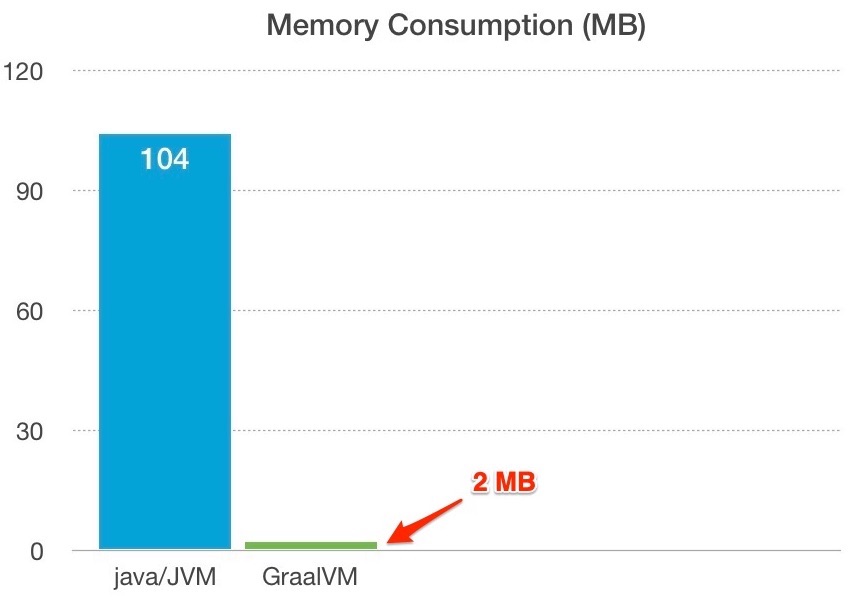
from: https://alvinalexander.com/scala/graalvm-native-executables-...
Graal is very clever, but that memory example is nonsense. I just tried the Find example they give and whether the graal version beats the java version is completely dependent on Xmx.
Obviously I don't have their dataset, so it's not exactly the same test.
edit: In fact the numbers in the blog are so far off mine they may accidently have been testing /usr/bin/find.
Obviously I don't have their dataset, so it's not exactly the same test.
edit: In fact the numbers in the blog are so far off mine they may accidently have been testing /usr/bin/find.
It didn’t take too long, there was AOT compilers available two decades ago as well.
There was just not much interest in it, because performance gets worth, and startup time is seldom interesting. (Pretty much only command line tools would require faster startup, and recent serverless)
And memory usage is a tradeoff. Though most of the time java could run with almost half of the currently used memory, it is unnecessary work to GC if memory is available.
There was just not much interest in it, because performance gets worth, and startup time is seldom interesting. (Pretty much only command line tools would require faster startup, and recent serverless)
And memory usage is a tradeoff. Though most of the time java could run with almost half of the currently used memory, it is unnecessary work to GC if memory is available.
> I think the problem is because of the virtual machine, instead of being compiled to an executable.
I learned Java on gcj (gcc support for Java), and it generated executables. I've no idea why they killed it. Maybe someone more in the know can explain.
I learned Java on gcj (gcc support for Java), and it generated executables. I've no idea why they killed it. Maybe someone more in the know can explain.
> not opinionated enough to compete with Lisp/Haskell
Interesting - you seem to be saying that Lisp is very opinionated. If that was your intent, may I ask why? Your experience doesn't jibe with my experience as a Common Lisp user, which is that Lisp isn't opinionated enough, and gives you too much flexibility (in some cases).
Interesting - you seem to be saying that Lisp is very opinionated. If that was your intent, may I ask why? Your experience doesn't jibe with my experience as a Common Lisp user, which is that Lisp isn't opinionated enough, and gives you too much flexibility (in some cases).
I have the exact same criticism about Python.
Well, that's the point of opinion isn't it ?
You perfectly nailed how I feel about java.
If I can choose, I won't use Java either. Some jobs in the past requires me to use it, since it's popular. However, nowadays I can just use Python since most of my job is about data engineer.
If you are talking about Erlang and D etc then your uses are unusual and not typically commercial and so I don't put much value in your response. No offense intended though.
Java is very high level - it runs on a VM and manages memory for you.
I think the opinion you're trying to convey is "not untyped enough".
I think the opinion you're trying to convey is "not untyped enough".
Ever heard a technology called GraalVM ?
> Python is older than Java, well supported
WELL SUPPORTED???? Have you ever coded a real thing in python?
I'm getting "Warning, no longer supported" console messages in all my basic well established tools and libraries written in python because a guy that lives in a world of academics and theory and not in a world of business and delivery dates decided that python3 was not going to have backwards compatibility with python2 because they made a massive irreparable disaster when they designed python2.
That is not a professional tool for multi-million dollar companies, that is a toy for spoiled nerds. Exactly the same that Visual Basic 5-6 were when I was starting. Extremely easy to use and extremely fast, at the price of been garbage for anything larger than a toy app.
And because all the kids learned that at uni and went to create the next thing in it like PyTorch and TensorFlow, now you have to do all the real code in C / C++ to handle what python can't in terms of speed an reliability, doubling you code base, your Dev teams, and the needed skill set.
I have been programing in java in large multinationals for 10 years and I used python every single day for the past 3 years for what its useful: small hacky scripts to increase productivity. The real sh*t that manages you cellphone towers, you home-banking, you online shopping, your logistic chain and your android cellphone apps, all things that I have worked on, gets done in Java.
WELL SUPPORTED???? Have you ever coded a real thing in python?
I'm getting "Warning, no longer supported" console messages in all my basic well established tools and libraries written in python because a guy that lives in a world of academics and theory and not in a world of business and delivery dates decided that python3 was not going to have backwards compatibility with python2 because they made a massive irreparable disaster when they designed python2.
That is not a professional tool for multi-million dollar companies, that is a toy for spoiled nerds. Exactly the same that Visual Basic 5-6 were when I was starting. Extremely easy to use and extremely fast, at the price of been garbage for anything larger than a toy app.
And because all the kids learned that at uni and went to create the next thing in it like PyTorch and TensorFlow, now you have to do all the real code in C / C++ to handle what python can't in terms of speed an reliability, doubling you code base, your Dev teams, and the needed skill set.
I have been programing in java in large multinationals for 10 years and I used python every single day for the past 3 years for what its useful: small hacky scripts to increase productivity. The real sh*t that manages you cellphone towers, you home-banking, you online shopping, your logistic chain and your android cellphone apps, all things that I have worked on, gets done in Java.
Dropbox, Instagram, Google, Youtube, reddit and Nasa all have been heavily Python powered for a decade.
I myself have coded a streaming platform getting half a million user every day in Python. Baring the CDN to store the content, it runs on 2 servers, one for the DB.
So real things get done in Python pretty well.
I myself have coded a streaming platform getting half a million user every day in Python. Baring the CDN to store the content, it runs on 2 servers, one for the DB.
So real things get done in Python pretty well.
In case of the Dropbox please read this:
_But as the company grew, new engineers who joined couldn’t understand the code. Clever code is usually short and cryptic, written by and for the individual who came up with it, but is hard for anyone else to understand—and nearly impossible to maintain. Guido called this “cowboy coding culture”. He recognized its value in our early stages of trying to implement things quickly, but knew it wouldn’t be sustainable over time, so he decided to speak up in his own quiet way._
And now they'll have to rewrite everything in programming languages where maintenance is not a burden.
[0] https://blog.dropbox.com/topics/company/thank-you--guido
_But as the company grew, new engineers who joined couldn’t understand the code. Clever code is usually short and cryptic, written by and for the individual who came up with it, but is hard for anyone else to understand—and nearly impossible to maintain. Guido called this “cowboy coding culture”. He recognized its value in our early stages of trying to implement things quickly, but knew it wouldn’t be sustainable over time, so he decided to speak up in his own quiet way._
And now they'll have to rewrite everything in programming languages where maintenance is not a burden.
[0] https://blog.dropbox.com/topics/company/thank-you--guido
Your last point is not supported by your link - this is an article praising Guido, the creator of Python, and remarking how good Python is.
Sorry, my bad. They already started rewriting core components in Rust.
Here you go:
https://dropbox.tech/infrastructure/rewriting-the-heart-of-o...
Here you go:
https://dropbox.tech/infrastructure/rewriting-the-heart-of-o...
> If I want a distributed system or something with a lot of I/O, Erlang and Go will always be better than Java.
Based on what?
Based on what?
This post from "an ignorant computer science undergrad" is pretty silly, so allow me to get a little silly in response.
I think if Java's new features are an attempt to woo new developers, Java comes off pretty tragically, like the old guy in the club, trying stay relevant by showing off how it just got up to date with ideas that hit the mainstream ten years ago. Whoa, check out these record classes! Fresh stuff over here! I don't think there's any significant audience for this (a few "ignorant computer science undergrads" aside,) and I doubt that's what Oracle is shooting for.
I think what Java is really doing is reassuring people who committed to it long ago that it will take care of them. Java is not the old guy in the club; it is the middle-aged guy dressing up and taking his wife out for a night (or half an hour, depending on her arthritis) of dancing at a jazz bar. It's doing its honorable best to show the people who committed their lives to it that it understands they still need a little bit of excitement now and then, and they don't have to sacrifice their dignity to some cad at the bar at the country club to get it.
They don't really want to leave Java. Java understands things about them that nobody else ever will. All Java needs to do to keep them is love them enough to keep doing its best.
I think if Java's new features are an attempt to woo new developers, Java comes off pretty tragically, like the old guy in the club, trying stay relevant by showing off how it just got up to date with ideas that hit the mainstream ten years ago. Whoa, check out these record classes! Fresh stuff over here! I don't think there's any significant audience for this (a few "ignorant computer science undergrads" aside,) and I doubt that's what Oracle is shooting for.
I think what Java is really doing is reassuring people who committed to it long ago that it will take care of them. Java is not the old guy in the club; it is the middle-aged guy dressing up and taking his wife out for a night (or half an hour, depending on her arthritis) of dancing at a jazz bar. It's doing its honorable best to show the people who committed their lives to it that it understands they still need a little bit of excitement now and then, and they don't have to sacrifice their dignity to some cad at the bar at the country club to get it.
They don't really want to leave Java. Java understands things about them that nobody else ever will. All Java needs to do to keep them is love them enough to keep doing its best.
As a developer who used Java for 12 years, I don't really like the direction Java takes. It's not happening like you're trying to describe. Java have some weak points which could be addressed easily. For example properties are relatively easy to implement, but instead developers decided to implement records which are very different. Modules are weird thing that nobody asked for and they broke old code (what a blasphemy in Java world). And still I'm not aware of any useful modules use-cases. They throw out Java EE instead of improving it.
I'm sure that Java developers have a vision which they're moving to. They're trying to convert old language into a new one with immutable classes, pattern-matching, green threads, modular JVM, all that stuff. May be I'll like that new language, but so far I'm a little bit unsatisfied. And, as it seems, young people are not that impressed either.
I'm sure that Java developers have a vision which they're moving to. They're trying to convert old language into a new one with immutable classes, pattern-matching, green threads, modular JVM, all that stuff. May be I'll like that new language, but so far I'm a little bit unsatisfied. And, as it seems, young people are not that impressed either.
> For example properties are relatively easy to implement, but instead developers decided to implement records which are very different
But why would they bake in a misfeature? Yeah it is popular, but was never a good idea to begin with. Records and new language features try to slowly shift the focus to a more immutable, FP-oriented style of OOP, which is imo a good decision. Of course it doesn’t make imperative code legacy, the two worlds can coexist perfectly.
> Modules are weird thing that nobody asked for
This is the feature that allows the JDK team to do their work. You either expose the internals and freeze it, effectively killing the platform, or encapsulate it. It is/was a great decision, and it didn’t broke too many things.
But why would they bake in a misfeature? Yeah it is popular, but was never a good idea to begin with. Records and new language features try to slowly shift the focus to a more immutable, FP-oriented style of OOP, which is imo a good decision. Of course it doesn’t make imperative code legacy, the two worlds can coexist perfectly.
> Modules are weird thing that nobody asked for
This is the feature that allows the JDK team to do their work. You either expose the internals and freeze it, effectively killing the platform, or encapsulate it. It is/was a great decision, and it didn’t broke too many things.
I think Kotlin is pretty much what a modernized Java should be. Between it and Clojure I don't spend very much time with Java anymore.
Kotlin could he better, but doesn't go all the way. Without HKTs and implicit injection, Java is going to eat its lunch. Java already has records, type inference, parametric null safety with Optional, Loom provides coroutines, vavr and streaming apis have given us theabilitytodo FP... what's left as a unique feature?
Kotlin will survive because it was picked for Android to avoid copyright issues. But the difference between the two languages is vanishing small.
Kotlin will survive because it was picked for Android to avoid copyright issues. But the difference between the two languages is vanishing small.
When Java gets the Kotlin's brilliant "last argument of lambda type can be a block", let me know. It allows to massively extend the perceived syntax of the language where needed, and create nice, typechecked DSLs. A number of small ergonomic improvements is also impossible to port to Java.
And I'm definitely happy that Java does not feature implicit injection, which looks so cool but is so painful to work with in Scala.
When I need HKTs, I can pick a perfectly good Haskell :) I'm afraid Java or even Kotlin will never achieve this level of FP-ness; for that, a language should be designed differently. Rust, OTOH, likely will.
And I'm definitely happy that Java does not feature implicit injection, which looks so cool but is so painful to work with in Scala.
When I need HKTs, I can pick a perfectly good Haskell :) I'm afraid Java or even Kotlin will never achieve this level of FP-ness; for that, a language should be designed differently. Rust, OTOH, likely will.
Agreed re Scala's implicits. They've just repackaged them for Scala 3 as given/using but it's the same confusing nonsense that drove me away from the language.
Dream on. Java, even including upcoming features, has nowhere near what's included in Kotlin out of the box. Nullability? Extension methods? First class functions? I could go on. Kotlin is much more than a better Java.
Could you clarify the point on Android and copyright issues? At least at the time in 2017 when Google blessed Kotlin as an officially supported language, it seemed like the reasoning was Kotlin was far more ergonomic than Java. How does copyright come into this?
Oracle suited Google for copying the APIs (not the implementation) of the Java standard APIs. It all started in 2010 [0]
Kotlin was Google's backup if the suit went Oracle's way.
[0] https://en.wikipedia.org/wiki/Google_LLC_v._Oracle_America,_....
Kotlin was Google's backup if the suit went Oracle's way.
[0] https://en.wikipedia.org/wiki/Google_LLC_v._Oracle_America,_....
I'm no expert in the Android ecosystem, but I think it was primarily a good choice for giving devs features they wanted to have while the underlying runtime and standard library got stuck at Java 6. The reason why they are still on Java 6 might have to do with the law suit, though.
I guess given the recent court ruling we should see if Google sticks with Kotlin as a hedge, sticks with Kotlin because the community has embraced it, or pulls away from Kotlin as a no longer needed source of extra work.
It's Google. They'll probably come up with a completely new programming language which they'll force on the community in some ham fisted way, then suddenly drop it in a few years when they can't figure out a way to massively monetize it.
I thought that was Dart. Which is honestly a shame because it’s a genuinely great language. But it does very much fit the bill otherwise
Not really. Dart is single-threaded which was a mistake Google made in trying to keep it JS-compatible. If Dart had been multi-threaded from the start it might have stood a chance.
Dart always stuck me as a solution looking for a problem, particularly in lite of more recent progress in JS itself. Can I ask why you think its a genuinely great language worth looking at?
Providing records was never about providing properties, but yes I agree properties would be a great addition.
> They throw out Java EE instead of improving it
Giving EE to the Eclipse foundation and transitioning it to Jakarta EE is about improving it. It allows the Eclipse foundation to move faster without having to go through the JDK standardization process.
> They throw out Java EE instead of improving it
Giving EE to the Eclipse foundation and transitioning it to Jakarta EE is about improving it. It allows the Eclipse foundation to move faster without having to go through the JDK standardization process.
The first thing they did is performed source-incompatible change of package names. That's hardly improving in my book, more like sabotaging. I understand that's because of trademarks, but that's another issue: why didn't Oracle provide all the necessary legal protections at least for package names.
A cynic might suggest that Oracle deliberately sabotaged Java EE because competitors like IBM and RedHat had beaten it in the marketplace and were making all the money off it.
Java development scales, it has pretty good performance, and great tooling.
I agree that it's underhyped. You can pick a lot of other languages, but no other language is as broad as Java.
Python reads like a dream but has useless perf and threading.
Javascript (Node et al) has the I/O concurrency but no clear solution to threading, and is bad at number crunching.
C++ has good perf but is overly complicated, compiles take forever, no good module management, etc.
Rust is great but super-hard to learn.
Golang lacks tooling and perhaps some libs, albeit being a really good contender.
Naturally there are other languages to bring up, but I personally think that Java strikes a good balance. The language itself doesn't really have any clear weak points anymore. With lambdas and streams, even FP is succinct in it.
The only thing really speaking against Java right now is the culture of overly complicated frameworks with too much meta-programming and magic. And the fact that the market of lightweight alternatives is too fragmented.
I agree that it's underhyped. You can pick a lot of other languages, but no other language is as broad as Java.
Python reads like a dream but has useless perf and threading.
Javascript (Node et al) has the I/O concurrency but no clear solution to threading, and is bad at number crunching.
C++ has good perf but is overly complicated, compiles take forever, no good module management, etc.
Rust is great but super-hard to learn.
Golang lacks tooling and perhaps some libs, albeit being a really good contender.
Naturally there are other languages to bring up, but I personally think that Java strikes a good balance. The language itself doesn't really have any clear weak points anymore. With lambdas and streams, even FP is succinct in it.
The only thing really speaking against Java right now is the culture of overly complicated frameworks with too much meta-programming and magic. And the fact that the market of lightweight alternatives is too fragmented.
> Java development scales, it has pretty good performance, and great tooling.
I agree with this, but I think these qualities are shared by a lot of languages that run on the JVM, and Java the language is no longer a worthy flagship language for the JVM.
> With lambdas and streams, even FP is succinct in it.
I have the opposite reaction to lambdas and streams. I think Oracle could have gone two ways with the evolution of Java:
- Be conservative about what features were adopted into Java, but be willing to change the syntax and feel of the language to do it in the best possible way. Only add features that both made sense for Java and had proven themselves after years of experience with the languages that pioneered them, but give Java the most elegant and polished version of them, so that Java would be a kind of "best in class" language that trailed the leading edge but always reflected it in an excellent way -- at any moment, the best version of Java that could be built with the industry's combined experience.
- Or, keep Java feeling as familiar as possible, while adding any features that are embarrassing to lack. It's okay if new features feel bolted on or don't feel as elegant as they do in newer languages; it's more important that longtime Java programmers don't feel like the fundamentals of the language are changing underneath them.
Streams are what convinced me that Oracle were committed to the latter route. They came out with an implementation that looked and felt clunky compared to what people were used to in other languages, but it felt very Java-y, and existing Java developers were pretty immediately comfortable with it.
I agree with this, but I think these qualities are shared by a lot of languages that run on the JVM, and Java the language is no longer a worthy flagship language for the JVM.
> With lambdas and streams, even FP is succinct in it.
I have the opposite reaction to lambdas and streams. I think Oracle could have gone two ways with the evolution of Java:
- Be conservative about what features were adopted into Java, but be willing to change the syntax and feel of the language to do it in the best possible way. Only add features that both made sense for Java and had proven themselves after years of experience with the languages that pioneered them, but give Java the most elegant and polished version of them, so that Java would be a kind of "best in class" language that trailed the leading edge but always reflected it in an excellent way -- at any moment, the best version of Java that could be built with the industry's combined experience.
- Or, keep Java feeling as familiar as possible, while adding any features that are embarrassing to lack. It's okay if new features feel bolted on or don't feel as elegant as they do in newer languages; it's more important that longtime Java programmers don't feel like the fundamentals of the language are changing underneath them.
Streams are what convinced me that Oracle were committed to the latter route. They came out with an implementation that looked and felt clunky compared to what people were used to in other languages, but it felt very Java-y, and existing Java developers were pretty immediately comfortable with it.
What about streams is suboptimal? Isn't it just linking together defined lambdas and one-off lambads?
> great tooling
Something I underappreciated until I delved deeper into other languages is how much observability the JVM gives you into how an application is running. Something like VisualVM makes it incredibly easy to see what threads are running, in what state, etc.
There's a class of things where the overhead of a VM (like the JVM, not VMWare) doesn't make sense (kernels, drivers), and startup time can be an issue, but for code where pretty good performance is enough, running in a VM is an asset to me.
Something I underappreciated until I delved deeper into other languages is how much observability the JVM gives you into how an application is running. Something like VisualVM makes it incredibly easy to see what threads are running, in what state, etc.
There's a class of things where the overhead of a VM (like the JVM, not VMWare) doesn't make sense (kernels, drivers), and startup time can be an issue, but for code where pretty good performance is enough, running in a VM is an asset to me.
This is not Java-specific, though. Tools such as VisualVM are available to all JVM languages.
> I doubt that's what Oracle is shooting for
My guess is that they're not trying to win over people from other languages with these features, but rather to not give Java people a reason to move to other languages. Why move (legacy and lock-in aside), when Java has the features you're considering moving elsewhere to get?
My guess is that they're not trying to win over people from other languages with these features, but rather to not give Java people a reason to move to other languages. Why move (legacy and lock-in aside), when Java has the features you're considering moving elsewhere to get?
More importantly, there are likely billions of lines of java code in production at this point, and just having that as an option matters for those code bases.
It might not be what you choose for a new company, but it may not be fashionable here but it is very common and quality of life improvements are welcome.
It might not be what you choose for a new company, but it may not be fashionable here but it is very common and quality of life improvements are welcome.
I’ve already moved to Kotlin. I love the language other than the fact that JVM objects are just too heavy. Nothing against Java but language has aged like milk, the readability and writability is just too bad. Recent strides with records and project loom etc are evident efforts to make it evident again.
I’ve kinda started to like Kotlin from syntax perspective & Go’s nature of compiled and low overhead prospective. I wish somebody can combine those together (don’t tell me GraalVM).
I’ve kinda started to like Kotlin from syntax perspective & Go’s nature of compiled and low overhead prospective. I wish somebody can combine those together (don’t tell me GraalVM).
This is funny and I would love to hear your personifications of other languages. I imagine Python and Perl offer a lot of material.
How is this the top comment?
I read the linked post from beginning to end. I wouldn't normally post jokes, but for an HN audience, there isn't much to process in it except to criticize the author's inexperience, which seemed mean, and the issues it raises have been argued thoroughly many times on HN, so there didn't seem like much of a chance of a meaty technical discussion. The demographics of who the further evolution of Java will and won't appeal to seems like the most interesting question the post raises.
Agree re: silly OP post. I read it thinking: Eventually this guy will move to sales and marketing majoring in language wars. So I'll further the silly follow-on as follows:
Guys, c'mon, get your head in the game. Before we tech out how under hyped JAVA is we still never sorted out just how awesome VI is and how VI is way better than EMACS, Code Lion, and whatever other crazy complex IDEs are out there. Once we figure that out, only then can we afford to resolve the lesser pressing problems.
Guys, c'mon, get your head in the game. Before we tech out how under hyped JAVA is we still never sorted out just how awesome VI is and how VI is way better than EMACS, Code Lion, and whatever other crazy complex IDEs are out there. Once we figure that out, only then can we afford to resolve the lesser pressing problems.
The amount of vitriol Java receives in the game development space is rather strong. However, whenever people dismiss Java as being a bad language, I can't help but think of Minecraft.
Yes, it's one of the few mainstream titles where Java has been successfully applied, but I believe Minecraft's success was specifically because it was written in Java.
With no JVM, there would have been no Minecraft mods at the level of flexibility that Forge provides, and the game would probably have stagnated in comparison with the sheer amount of community content from the past ten years that's available. Being able to use libraries like ASM that allow you to transform the compiled bytecode in radical ways were possible only because Minecraft targeted a virtual machine. The incredible thing was that this was in spite of the obfuscation Mojang applied to the compiled source. If it was possible to create a flexible mod system at all thanks to the JVM, people were just too motivated for any deterrence to stop them.
For the people who say that Minecraft should have been written in C++ or something from the start, because Java is a mediocre programming language, there's Bedrock Edition. Nobody I know cares about it enough to play it. For all its bloat and performance issues, the benefits of the JVM were simply too convincing.
Yes, it's one of the few mainstream titles where Java has been successfully applied, but I believe Minecraft's success was specifically because it was written in Java.
With no JVM, there would have been no Minecraft mods at the level of flexibility that Forge provides, and the game would probably have stagnated in comparison with the sheer amount of community content from the past ten years that's available. Being able to use libraries like ASM that allow you to transform the compiled bytecode in radical ways were possible only because Minecraft targeted a virtual machine. The incredible thing was that this was in spite of the obfuscation Mojang applied to the compiled source. If it was possible to create a flexible mod system at all thanks to the JVM, people were just too motivated for any deterrence to stop them.
For the people who say that Minecraft should have been written in C++ or something from the start, because Java is a mediocre programming language, there's Bedrock Edition. Nobody I know cares about it enough to play it. For all its bloat and performance issues, the benefits of the JVM were simply too convincing.
> For the people who say that Minecraft should have been written in C++ […] there's Bedrock Edition. Nobody I know cares about it enough to play it.
Been playing for just under ten years, everyone I know plays Bedrock these days. I built and manage a very popular tool / Minecraft community and while I don’t have actual numbers, my general sense is the majority of players run either console or mobile Minecraft - all of which are Bedrock at this point.
If you don’t care about modding or particularly complex redstone, I don’t know why you wouldn’t run Bedrock. It’s far more stable, reliable and performant. My laptops fans rarely come on in Bedrock but never shut off in Java.
In my eyes Java is the public prototype / feature target and Bedrock the actual product.
Been playing for just under ten years, everyone I know plays Bedrock these days. I built and manage a very popular tool / Minecraft community and while I don’t have actual numbers, my general sense is the majority of players run either console or mobile Minecraft - all of which are Bedrock at this point.
If you don’t care about modding or particularly complex redstone, I don’t know why you wouldn’t run Bedrock. It’s far more stable, reliable and performant. My laptops fans rarely come on in Bedrock but never shut off in Java.
In my eyes Java is the public prototype / feature target and Bedrock the actual product.
It's probably worth noting that Minecraft has an incredibly lackadaisical approach to Java and Java upgrades in general. They're still on Java 8 and thinking maybe about upgrading to Java 11 at some point, although the performance benefits of going to the latest versions are really quite enormous in almost any benchmark.
There's an additional problem: when Notch first wrote it, he had some experience of doing games on the JVM and wrote the code in a performance sensitive style. But it wasn't a fully OOP style that people associate with clean, well designed codebases, so when Notch moved on, they immediately went and introduced tons of tiny classes for things like points or vectors where the prior code simply passed the components as parameters. That trashed performance. Again, newer JVMs are better at gobbling this stuff up, but it didn't help. Valhalla will eventually remove this tradeoff.
At any rate, Minecraft is a very good example of why more people should target the JVM for video games: modding is real, it can create communities that propel your game further than ever. It's not a great example of how to get the best possible game performance from the JVM. At all.
There's an additional problem: when Notch first wrote it, he had some experience of doing games on the JVM and wrote the code in a performance sensitive style. But it wasn't a fully OOP style that people associate with clean, well designed codebases, so when Notch moved on, they immediately went and introduced tons of tiny classes for things like points or vectors where the prior code simply passed the components as parameters. That trashed performance. Again, newer JVMs are better at gobbling this stuff up, but it didn't help. Valhalla will eventually remove this tradeoff.
At any rate, Minecraft is a very good example of why more people should target the JVM for video games: modding is real, it can create communities that propel your game further than ever. It's not a great example of how to get the best possible game performance from the JVM. At all.
> It’s far more stable, reliable and performant
I'd bet this has more to do with the fact that the Java version started out as a one-man project (that wasn't even expected to take off), whereas Bedrock started as a multimillion-dollar project by Microsoft who a) knew the project scope ahead of time, and b) could hire a (presumably) world-class team to design and implement it
Personally I've never had real performance issues with either
I'd bet this has more to do with the fact that the Java version started out as a one-man project (that wasn't even expected to take off), whereas Bedrock started as a multimillion-dollar project by Microsoft who a) knew the project scope ahead of time, and b) could hire a (presumably) world-class team to design and implement it
Personally I've never had real performance issues with either
That's curious. I don't play Minecraft myself but my kids do. They have Bedrock Edition (via Nintendo Switch) and they keep begging me to get them the Java Edition. This is partly because it seems all the prominent YouTubers are on Java Edition.
the java edition is significantly more predictable and less buggy. even regarding redstone it is not that bedrock redstone doesn't work* but that contraptions are significantly less deterministic than on java
* some very used redstone features on java are clearly bugs and rightly so are not on bedrock, but even those have a very specific and exploitable use
* some very used redstone features on java are clearly bugs and rightly so are not on bedrock, but even those have a very specific and exploitable use
>I don’t know why you wouldn’t run Bedrock
Because not everybody runs Windows? I don't consider mobile and console platforms as gaming, but that's just my biases.
Because not everybody runs Windows? I don't consider mobile and console platforms as gaming, but that's just my biases.
> Because not everybody runs Windows? I don't consider mobile and console platforms as gaming, but that's just my biases.
Most PC gamers use Windows, consoles or devices. The non-Windows gaming market is very small.
While I prefer Java edition, my kid much prefers Bedrock, because it has the main killer feature of being able to share a world directly with friends. Anyone that's an XBox Live friend can see when they're playing on-line, and join the world. No need to set up a realm, run my own server online somewhere, or punch a hole through the firewall to the minecraft server at home etc.
Most PC gamers use Windows, consoles or devices. The non-Windows gaming market is very small.
While I prefer Java edition, my kid much prefers Bedrock, because it has the main killer feature of being able to share a world directly with friends. Anyone that's an XBox Live friend can see when they're playing on-line, and join the world. No need to set up a realm, run my own server online somewhere, or punch a hole through the firewall to the minecraft server at home etc.
> I don't consider mobile and console platforms as gaming, but that's just my biases.
Gatekeep much? You know that you just excluded probably 90% of all gamers right there?
Gatekeep much? You know that you just excluded probably 90% of all gamers right there?
I actually personally run the Bedrock Android version on my Mac with a launcher. It’s a little temperamental but still preferable to Java Edition in my eyes. I mostly play on Windows and Xbox however.
- https://mcpelauncher.readthedocs.io/en/latest/ - it’s out of date but they link a fork that works.
- https://mcpelauncher.readthedocs.io/en/latest/ - it’s out of date but they link a fork that works.
wtf.
Mobile I was used to, but consoles as well is next level gatekeeping.
Mobile I was used to, but consoles as well is next level gatekeeping.
> The amount of vitriol Java receives in the game development space is rather strong.
Java is a language with mandatory GC, tiny objects scattered around the heap (poor locality), and no value types or low-level memory access.
This makes it very poor for games (you know, other very basic ones).
But they're rapidly addressing these concerns.
Java is a language with mandatory GC, tiny objects scattered around the heap (poor locality), and no value types or low-level memory access.
This makes it very poor for games (you know, other very basic ones).
But they're rapidly addressing these concerns.
> no value types or low-level memory access.
i dont think you need value types at all, and you can simulate it by using byte buffers with an abstraction on top of it. After all, what's the difference between value types and a byte array?
As for things like low level memory access - you also don't need that in most cases. Graphics libraries will give you enough access. And for any other case, you can always JNI into native code, or call any existing system calls or libraries. Interop between java and native is not that bad (cumbersome for sure, but still possible).
The only reason java gets poor performance is the coder doing java is too used to producing garbage (or is too inexperienced to write high performance java code). you can easily avoid most performance problems in memory by pre-allocating and reusing memory by pooling. These techniques are already commonly employed in C.
i dont think you need value types at all, and you can simulate it by using byte buffers with an abstraction on top of it. After all, what's the difference between value types and a byte array?
As for things like low level memory access - you also don't need that in most cases. Graphics libraries will give you enough access. And for any other case, you can always JNI into native code, or call any existing system calls or libraries. Interop between java and native is not that bad (cumbersome for sure, but still possible).
The only reason java gets poor performance is the coder doing java is too used to producing garbage (or is too inexperienced to write high performance java code). you can easily avoid most performance problems in memory by pre-allocating and reusing memory by pooling. These techniques are already commonly employed in C.
Why even use a high language at all when you can just write the assembly directly? Clearly you can write "Java" that is patently unsafe in an effort to eke out some performance, but this is not what most people would consider reasonable or desirable. When writing Java, you almost always want to go with the flow, and that at the moment means creating objects. The general fix for this is to have good abstractions for places where heap allocations can be elided, not dropping down to lower-level primitives in an ad-hoc way.
> Why even use a high language at all
for the parts that don't need high performance. And for leveraging existing libraries, if any are suitable.
for the parts that don't need high performance. And for leveraging existing libraries, if any are suitable.
> i dont think you need value types at all, and you can simulate it by using byte buffers with an abstraction on top of it. After all, what's the difference between value types and a byte array?
The difference is a bit like coding in Java vs coding in assembler (more below in an example).
> The only reason java gets poor performance is the coder doing java is too used to producing garbage (or is too inexperienced to write high performance java code).
Read about Entity Component Systems, the leading architecture of high-performance game engines these days.
To do this in Java, with the implied memory locality, would basically mean storing your entire game state in bytebuffers, and constantly unpacking and packing them to do any operation on them. And when you unpack them if you unpack them to a random object in heap, you negate the entire purpose of the locality of a bytebuffer. So you somehow need to do the job raw, reading everything inline and putting it back inline, so you can stay on the stack.
I also doubt that the get/put calls you'd need to do to get/set every number would be free. So performance would probably end up quite terrible.
> you can easily avoid most performance problems in memory by pre-allocating and reusing memory by pooling.
If you make an object pool in Java you'll save on memory alloc/dealloc. You won't achieve memory locality, so your code will be much slower than languages where you can do that.
The difference is a bit like coding in Java vs coding in assembler (more below in an example).
> The only reason java gets poor performance is the coder doing java is too used to producing garbage (or is too inexperienced to write high performance java code).
Read about Entity Component Systems, the leading architecture of high-performance game engines these days.
To do this in Java, with the implied memory locality, would basically mean storing your entire game state in bytebuffers, and constantly unpacking and packing them to do any operation on them. And when you unpack them if you unpack them to a random object in heap, you negate the entire purpose of the locality of a bytebuffer. So you somehow need to do the job raw, reading everything inline and putting it back inline, so you can stay on the stack.
I also doubt that the get/put calls you'd need to do to get/set every number would be free. So performance would probably end up quite terrible.
> you can easily avoid most performance problems in memory by pre-allocating and reusing memory by pooling.
If you make an object pool in Java you'll save on memory alloc/dealloc. You won't achieve memory locality, so your code will be much slower than languages where you can do that.
Having thousand NPC objects around is no problem at all. The rendering part is the only thing critical/numerous enough that you may have to optimize to such a low level.
Not sure what you cover by "NPC objects" but they easily can participate in physics and AI as well (or at least basic scripted behavior).
Also significant game state is not only represented by renderable content.
Also significant game state is not only represented by renderable content.
Well, if it’s physics as well, then yeah having a separate NPC objects may not be the best idea (though if the physics engine awaits some primitives, like for each “object” 3 coordinates before simulation, and then sets the corresponding position on each NPC, it may be fast enough). But Valhalla really is coming, and until many many games have more than enough performance packed in the JVM already.
This is true for JS too, but I never hear as much hate for that language.
Also there are classes of games for which the latency introduced by a GC may not be that much relevant (e.g. strategy or simulation games).
Also there are classes of games for which the latency introduced by a GC may not be that much relevant (e.g. strategy or simulation games).
> This is true for JS too, but I never hear as much hate for that language.
Really? https://www.google.com/search?q=JavaScript+is+the+worst+lang...
If it exists, some people hate it. If it's popular, most people hate it. It's a universal law. /s
Anyway, you never hear "JS is not suitable for high-end games" because with JS that's kind of self-evident. While with Java, some people don't know enough to realize that.
> Also there are classes of games for which the latency introduced by a GC may not be that much relevant (e.g. strategy or simulation games).
Strategy/simulation games can get quite big/complex. Keep in mind you're not just modeling the units, but also the terrain the various particle effects and so on. You can definitely pull off something like StarCraft 1. But people want games to match the capabilities of their hardware, not that of a Pentium from the 90s.
And performance remains crucial on mobile. I.e. you may get the game going, but it'll suck your battery empty in record time.
Really? https://www.google.com/search?q=JavaScript+is+the+worst+lang...
If it exists, some people hate it. If it's popular, most people hate it. It's a universal law. /s
Anyway, you never hear "JS is not suitable for high-end games" because with JS that's kind of self-evident. While with Java, some people don't know enough to realize that.
> Also there are classes of games for which the latency introduced by a GC may not be that much relevant (e.g. strategy or simulation games).
Strategy/simulation games can get quite big/complex. Keep in mind you're not just modeling the units, but also the terrain the various particle effects and so on. You can definitely pull off something like StarCraft 1. But people want games to match the capabilities of their hardware, not that of a Pentium from the 90s.
And performance remains crucial on mobile. I.e. you may get the game going, but it'll suck your battery empty in record time.
You probably don't hear as much hate for JS as a games language because it's not even on the table for a consideration when making a moderately intensive game
For the great majority of your code base, it doesn’t matter (look at scripting languages inside game engines), and for the performance critical parts, you have excellent profilers and can easily pinpoint which function creates too much garbage and can write that part in an imperative way with arrays and that’s it. It will run plenty fast.
Especially now with ZGC, not even tiny freezes should happen.
Especially now with ZGC, not even tiny freezes should happen.
>But they're rapidly addressing these concerns.
Expand?
Expand?
Project Panama (Foreign Memory Access):
https://medium.com/@youngty1997/jdk-14-foreign-memory-access...
Project Valhalla (Inline Classes aka Value Types):
https://dzone.com/articles/project-valhalla-fast-and-furious...
The links I picked are a bit random but they'll get you going with the basics.
https://medium.com/@youngty1997/jdk-14-foreign-memory-access...
Project Valhalla (Inline Classes aka Value Types):
https://dzone.com/articles/project-valhalla-fast-and-furious...
The links I picked are a bit random but they'll get you going with the basics.
>> The amount of vitriol Java receives in the game development space is rather strong.
I think this is because of the way it handles memory. It's like the clunkiness of C++ without the power to optimize. Also, compared to python it is fast, but not compared to C or Rust.
That said, for 99% of applications the Java garbage collector is safe and tends to produce reliable code. The article is right in that Java is an extremely useful language with good tools. Games are an edge case.
I think this is because of the way it handles memory. It's like the clunkiness of C++ without the power to optimize. Also, compared to python it is fast, but not compared to C or Rust.
That said, for 99% of applications the Java garbage collector is safe and tends to produce reliable code. The article is right in that Java is an extremely useful language with good tools. Games are an edge case.
> Also, compared to python it is fast, but not compared to C or Rust.
It is comparably fast. Much more close to them than to python.
It is comparably fast. Much more close to them than to python.
I think the Minecraft mod scene happened because java is easier to deobfuscate than C++. JVM bytecode doesn't have as many opcodes as x86_64 and JVM bytecode's opcodes are on average simpler. I suspect that modding a new unobfuscated game written in C++ that contains debugging symbols would be far easier than modding Minecraft was before obfuscation maps were available. But games rarely ship like this, since they would be easy to pirate.
Minecraft is also a prime example for why Java is bad for game development.
The GC is constantly overworked because Java has to allocate immutable vector and matrix classes on the heap.
In other languages (like C# for example) you'd make that a struct and enjoy value type semantics and stack allocation (in most cases).
The GC is constantly overworked because Java has to allocate immutable vector and matrix classes on the heap.
In other languages (like C# for example) you'd make that a struct and enjoy value type semantics and stack allocation (in most cases).
Minecraft is not successful because of its programming language, it's successful despite the questionable choice of its programming language. Games can be fine and successful withouth being top-notch software, they need to be enjoyable, not performant. Cities:Skylines is also successful, and with decent hardware you get like 40 fps. Again, not its hardware efficiency made it popular.
Regarding modding, I think if the game is successful, then there will be at least a small handful of people that write a modding interface for others.
Regarding modding, I think if the game is successful, then there will be at least a small handful of people that write a modding interface for others.
Bedrock is by far the most popular version of Minecraft.
It's the version used on all handhelds and consoles.
It's the version used on all handhelds and consoles.
I do think Java has a bad rep as a "dry, corporate, enterprise" language, but I think there is an ecosystem around Java that is pretty awesome and you can build incredible applications with Java if you want to.
Java has a branding problem. Java (and Oracle) missed the wave of the last 15 years when tech became "cool." If you were new to tech/programming and wanted to pick up a language, which of these three would you pick, based on the website?
- Java: https://www.java.com/en/
- Kotlin: https://kotlinlang.org/
- Scala: https://www.scala-lang.org/
Java just doesn't have the cool factor that other languages have. A little rebranding could go a long way to reinvigorating the language in the eyes of newcomers. And I say that because the author of this blog post is a newcomer. Experiened developers know that, despite the ugly Oracle branding, Java is a good language with a sophisticated ecosystem of tools surrounding it. He seems to be mostly enamored with the developer experience of IntelliJ + Java + Maven. And while it is great, that experience is possible with most programming languages.
Disclaimer: I haven't used Java since my early University classes 10+ years ago.
Java has a branding problem. Java (and Oracle) missed the wave of the last 15 years when tech became "cool." If you were new to tech/programming and wanted to pick up a language, which of these three would you pick, based on the website?
- Java: https://www.java.com/en/
- Kotlin: https://kotlinlang.org/
- Scala: https://www.scala-lang.org/
Java just doesn't have the cool factor that other languages have. A little rebranding could go a long way to reinvigorating the language in the eyes of newcomers. And I say that because the author of this blog post is a newcomer. Experiened developers know that, despite the ugly Oracle branding, Java is a good language with a sophisticated ecosystem of tools surrounding it. He seems to be mostly enamored with the developer experience of IntelliJ + Java + Maven. And while it is great, that experience is possible with most programming languages.
Disclaimer: I haven't used Java since my early University classes 10+ years ago.
I actually laughed out loud at the Java.com homepage. I was so surprised, I expected a sleek, modern homepage but instead I got a portal to 2010.
You weren't kidding. The page has barely been tweaked since 2008 https://web.archive.org/web/20080701171554/http://java.com/e...
To be fair, lots of websites were far better in 2010 than today’s white space filled, massive typography, bright colored potpourri of rounded corners, scroll jacked bullshit. Full screen, infinite scroll, hamburger menus. So many awful contemporary design choices.
Don’t pool it all together with this Java website - which sucks but not because it was from 2010.
I abhor and loathe modern web design.
Don’t pool it all together with this Java website - which sucks but not because it was from 2010.
I abhor and loathe modern web design.
I love old web design too. Sometimes I go look at 2007 WorldOfWarcraft.com on Archive.org to enjoy old design.
I just remember the Java.com homepage from visiting it in computer lab in 2011 so I could play Minecraft.
I just remember the Java.com homepage from visiting it in computer lab in 2011 so I could play Minecraft.
The website is a leftover from when you had to download Java to run programs. Microsoft Silverlight homepage have a similar simplistic feel[1]. I expect it to be updated at some point once there is no need for people to download a JRE.
[1] https://www.microsoft.com/silverlight/
[1] https://www.microsoft.com/silverlight/
> I actually laughed out loud at the Java.com homepage. I was so surprised, I expected a sleek, modern homepage but instead I got a portal to 2010.
The Java download button looks clickable without me having to hover over it. The Kotlin "get-started" link doesn't look clickable, because it's next to a different link that has a different style (both actually are clickable). The Scala one has a download link that also doesn't look clickable.
Rubbing salt into the wound, if you click on the second link for Kotlin ("learn more"), the back button doesn't work.
Summary
Java website: made as obvious as possible, prominent download and search interface on main page; type in your search and press enter.
Kotlin: Links differ in appearance from each other, back button broken for some links, which don't even look like links. Cannot type in a search term until after visually finding and clicking a search icon. Then you type in your search term (two-step process).
Scala: download link looks like neither a link nor a button. Never found a search button. At least "Back" works.
I have to say, the Java landing page works best. That your personal preference is for less obvious and less simple user interfaces doesn't make the simple and easy to use interface a bad choice.
The Java download button looks clickable without me having to hover over it. The Kotlin "get-started" link doesn't look clickable, because it's next to a different link that has a different style (both actually are clickable). The Scala one has a download link that also doesn't look clickable.
Rubbing salt into the wound, if you click on the second link for Kotlin ("learn more"), the back button doesn't work.
Summary
Java website: made as obvious as possible, prominent download and search interface on main page; type in your search and press enter.
Kotlin: Links differ in appearance from each other, back button broken for some links, which don't even look like links. Cannot type in a search term until after visually finding and clicking a search icon. Then you type in your search term (two-step process).
Scala: download link looks like neither a link nor a button. Never found a search button. At least "Back" works.
I have to say, the Java landing page works best. That your personal preference is for less obvious and less simple user interfaces doesn't make the simple and easy to use interface a bad choice.
That's more like 2000-2005. By 2010 we had GMail and clumsy 3d gradients were on their way out.
This is a funny comparison, for sure.
What is really going on here is that there isn't a "the Java website". There is no single organisation or project behind Java which could put such up a website. Similarly, where is the C++ website? The C website?
java.com was originally the website aimed at end-users who need to install Java to use desktop applications written in Java. It looks like it's from 2010 because that's when the last of those went extinct.
What is really going on here is that there isn't a "the Java website". There is no single organisation or project behind Java which could put such up a website. Similarly, where is the C++ website? The C website?
java.com was originally the website aimed at end-users who need to install Java to use desktop applications written in Java. It looks like it's from 2010 because that's when the last of those went extinct.
C++ website: https://isocpp.org/
C website: http://www.open-std.org/jtc1/sc22/wg14/
C website: http://www.open-std.org/jtc1/sc22/wg14/
That's a good point, but the various Java JDK websites, intended for developers, really aren't any better.
- https://www.oracle.com/java/technologies/javase-downloads.ht...
- https://jdk.java.net/
- https://openjdk.java.net/
- https://www.oracle.com/java/technologies/javase-downloads.ht...
- https://jdk.java.net/
- https://openjdk.java.net/
Is javadoc any better these days?
I maintain that that lull between 1.6 (2006) and 1.7 (2011) did a large amount of harm to Java. Changing too fast is bad; stasis is also bad. They've played catch up pretty well with features that proved themselves useful in other languages quite well in recent years, but it really fell behind over that five year stretch.
This is both hilarious and a great point. Java has no "cool factor". HN headlines will add "written in Rust/Go/Julia/Elixir" for coolness points. If you put "written in Java", it would actually make it seem less cool.
When I tried android dev I jumped to Kotlin because it's well presented Lol
I haven't been coding as long as most (about 10 years) but I've had phases of Java, Ruby, Python, JS, TS, ObjC, etc.
If I go onto my GitHub and try to get any of my old projects running I am extremely confident that the non-Android Java ones will still work. All of the other ones will probably have "rotted" over the years and send me down a day-long rabbit hole looking for old dependencies or build systems.
There's something to be said for that amazing stability. I can't think of another language where you can find some .edu page from 2001 with a link to a library (.jar) that does what you need and you can actually use it in a modern application.
If I go onto my GitHub and try to get any of my old projects running I am extremely confident that the non-Android Java ones will still work. All of the other ones will probably have "rotted" over the years and send me down a day-long rabbit hole looking for old dependencies or build systems.
There's something to be said for that amazing stability. I can't think of another language where you can find some .edu page from 2001 with a link to a library (.jar) that does what you need and you can actually use it in a modern application.
This, so much this. The value of code just working and staying working is humongous. Having code that is unchanged from Java 1.3 doing it's thing and delivering value 21 years later without needing to be touched and revisited allows us to focus on improving the code that needs to be improved.
Doesn't mean we don't touch old code (change idioms, generic safe, build process etc). It means we do it when there is value to us for updating it. Not because we are forced to due to an infra change.
At the same time code that ran on a PA-RISC machine now happily runs on a mac arm (even then it was great because the same code ran on PA-RISC, powerpc, x86 and X86-64).
If that code was written in python it would have likely gone through two breaking cycles at least. C sure that would have worked but the cost of having it working such a variety of systems would have been humongous for a small group like us. What real alternatives have this claim? C++ chances that I can compile code from 2000 without issues is minuscule.
Sure I had my EJB "fun", and when I look at some of the micro-services being deployed I see the same problems. Because they are reflections of organizations. (i.e. sometimes have the feeling that changing language in an org is like switching your in-office communication to Italian, because it so fast and romantic.).
Just because there was "bad" code written in the past doesn't mean new code is done that way. Yes it exists, yes it needs to be poked once in a while, but that is a lot cheaper than rewriting in a modern style.
Doesn't mean we don't touch old code (change idioms, generic safe, build process etc). It means we do it when there is value to us for updating it. Not because we are forced to due to an infra change.
At the same time code that ran on a PA-RISC machine now happily runs on a mac arm (even then it was great because the same code ran on PA-RISC, powerpc, x86 and X86-64).
If that code was written in python it would have likely gone through two breaking cycles at least. C sure that would have worked but the cost of having it working such a variety of systems would have been humongous for a small group like us. What real alternatives have this claim? C++ chances that I can compile code from 2000 without issues is minuscule.
Sure I had my EJB "fun", and when I look at some of the micro-services being deployed I see the same problems. Because they are reflections of organizations. (i.e. sometimes have the feeling that changing language in an org is like switching your in-office communication to Italian, because it so fast and romantic.).
Just because there was "bad" code written in the past doesn't mean new code is done that way. Yes it exists, yes it needs to be poked once in a while, but that is a lot cheaper than rewriting in a modern style.
I've been mainly a Java developer for almost 15 years, but was working with Python the last few months.
I LMAO when Python changed (or broke...depending how you look at it) the basic print functionality between version 2 and 3. Meanwhile I can use the latest and greatest JDK to compile old java code.
Don't get me wrong, I think Python is awesome for what I needed to do (data manipulation) and would likely be my language of choice for such tasks in the future.
Also, the best way to get a highly commented article on HN is to write one on why you love, or hate Java.
I LMAO when Python changed (or broke...depending how you look at it) the basic print functionality between version 2 and 3. Meanwhile I can use the latest and greatest JDK to compile old java code.
Don't get me wrong, I think Python is awesome for what I needed to do (data manipulation) and would likely be my language of choice for such tasks in the future.
Also, the best way to get a highly commented article on HN is to write one on why you love, or hate Java.
> C++ chances that I can compile code from 2000 without issues is minuscule.
Really? I have code from the late 90ies and it compiles just fine. Do you perhaps mean dependencies? Because the issue there is the completeness of the framework and libraries around Java rather than the language itself.
Really? I have code from the late 90ies and it compiles just fine. Do you perhaps mean dependencies? Because the issue there is the completeness of the framework and libraries around Java rather than the language itself.
Yes, the C++ dependencies are unlikely to be available.
Specifically dependencies on OS libraries that are just not available on current common systems.
So you need to get them but they are not available anymore and may depend on code that doesn't compile anymore. Due to e.g. 32bit assumptions, changes in what a 'long long' means and small hiccups like that.
Or the fact that C++ code was "almost" C++ code and not actually C++ code. Just a variant that was supported by an "almost" C++ compiler.
Not really the case for smaller utilities but larger projects originating on what is now rare equipment suffered from this.
So maybe not "miniscule" but not rare in my experience either.
So you need to get them but they are not available anymore and may depend on code that doesn't compile anymore. Due to e.g. 32bit assumptions, changes in what a 'long long' means and small hiccups like that.
Or the fact that C++ code was "almost" C++ code and not actually C++ code. Just a variant that was supported by an "almost" C++ compiler.
Not really the case for smaller utilities but larger projects originating on what is now rare equipment suffered from this.
So maybe not "miniscule" but not rare in my experience either.
> Specifically dependencies on OS libraries that are just not available on current common systems.
But again, that's a problem with the OS, not a problem with C++. POSIX compliant code still compiles just fine on POSIX-compliant platforms and 32-bit code compiles just fine with 32-bit compilers as well - nothing changed in that regard. It's a similar story with other APIs such as Win32.
> Due to e.g. 32bit assumptions, changes in what a 'long long' means and small hiccups like that.
If you try to compile 32-bit code as 64-bit code you're porting, not recompiling. You can also just specify -std=c++98 (with g++) or just use an old compiler.
In my experience the problems with Java code are just as annoying, but those problems don't come from within the language itself either.
Things that weren't natively available had to be added via external scripts, application servers, native libraries, etc. And getting a fragile jumbled mess to work that relied on a specific Tomcat server version, command line scripts, external libraries or - god forbid! - certificates, was a major PITA as well.
Even today trying to get something as simple as SSL certificates working with Java can be frustrating. Why? Because for some reason Java insists on keeping its own keystore because it's the JDK that decides which authorities are to be trusted - not the user, not the OS, only the JDK.
Well, one of the installed versions, which gets to be real fun if you're working with containers, but I digress...
But again, that's a problem with the OS, not a problem with C++. POSIX compliant code still compiles just fine on POSIX-compliant platforms and 32-bit code compiles just fine with 32-bit compilers as well - nothing changed in that regard. It's a similar story with other APIs such as Win32.
> Due to e.g. 32bit assumptions, changes in what a 'long long' means and small hiccups like that.
If you try to compile 32-bit code as 64-bit code you're porting, not recompiling. You can also just specify -std=c++98 (with g++) or just use an old compiler.
In my experience the problems with Java code are just as annoying, but those problems don't come from within the language itself either.
Things that weren't natively available had to be added via external scripts, application servers, native libraries, etc. And getting a fragile jumbled mess to work that relied on a specific Tomcat server version, command line scripts, external libraries or - god forbid! - certificates, was a major PITA as well.
Even today trying to get something as simple as SSL certificates working with Java can be frustrating. Why? Because for some reason Java insists on keeping its own keystore because it's the JDK that decides which authorities are to be trusted - not the user, not the OS, only the JDK.
Well, one of the installed versions, which gets to be real fun if you're working with containers, but I digress...
All very fair points. But I think the ecosystem of a language is part of this discussion. And the ecosystem of year 2000 C++ is hard to run on current systems. While the ecosystem of year 2000 java still works.(IMHO better than 2005 java)
I would definitely not say that java is perfect, but the java ecosystem does have some very practical advantages that more than compensate for some of its very real disadvantages.
I would definitely not say that java is perfect, but the java ecosystem does have some very practical advantages that more than compensate for some of its very real disadvantages.
My experience with C# is similar. It was always designed to be a Java clone, and Microsoft is well-known for their backwards compatibility.
I once wrote an application in 2005 that kept running with unmodified source code up until 2017 in production across multiple operating system upgrades, database upgrades, and a transition from 32-bit to 64-bit runtimes.
I once wrote an application in 2005 that kept running with unmodified source code up until 2017 in production across multiple operating system upgrades, database upgrades, and a transition from 32-bit to 64-bit runtimes.
And then they decided to end that line of succession. .NET Framework 4.8 is the last version of the framework. I've started experimenting with converting code to .NET 5, but it's a rather large jump compared to any previous upgrade. Going from 2.0 to 4.0 had a few minor hiccups, but going to .NET 5 is basically a rewrite of the framework and runtime, and I'm not sure how old and new assemblies will co-exist. It feels like a fragmenting of the ecosystem, where a bunch of code will be stuck on .NET 4 forever, and other code will move to the .NET 5 and later.
I'm almost expecting a few years down the road, Microsoft will go back on 4.8 being end-of-the-line for .NET 4 and start releasing new minor versions of it because of all the customer code that can't be ported to .NET 5. Or maybe it will just end up like VB6. Stuff written in it still works, and will continue to work, but it's considered a dead language.
I'm almost expecting a few years down the road, Microsoft will go back on 4.8 being end-of-the-line for .NET 4 and start releasing new minor versions of it because of all the customer code that can't be ported to .NET 5. Or maybe it will just end up like VB6. Stuff written in it still works, and will continue to work, but it's considered a dead language.
"[C#] was always designed to be a Java clone"
"Initially" would be somewhat closer to the truth than "always".
"Initially" would be somewhat closer to the truth than "always".
It's still pretty damn similar and they continually add new features to match the other, keeping up with the joneses.
It's mostly Java that's playing catch-up, so arguably it's Java "cloning" C# rather than the other way round, and it's been that way for years now.
This, absolutely. I don't think any of my javascript, python projects, or even golang (pre-modules) would even build after a clean checkout. My maven projects? Sure they will build, and the tests will run just like the last time. Java is not exciting, it's just fine. I really don't get the level of hate Java gets in certain circles. It's like people are putting their entire identity on the line based on their currently preferred programming language.
> Java is fun to write, productive
What the hell? I don't think we have the same definition for any of these words.
I know Java has changed quite a bit since Java 8 (Java 9 being the last version I used professionally before switching completely to Go), but I just can't write Java again, it's physical. When I want to try a new Java feature and think about writing the scaffolding code, my stomach actually hurts.
Not to mention the pain point that it still is to install and configure a JDK, and make it work properly with Intellij, why is it still so complicated?
Then there's Maven and Gradle that are just... bad, I have no other phrasing. I hear a lot of people saying Maven already solves all the problems we have with today's tools but that's just not true, even the entire Maven stupid lifecycle should be thrown away!
What the hell? I don't think we have the same definition for any of these words.
I know Java has changed quite a bit since Java 8 (Java 9 being the last version I used professionally before switching completely to Go), but I just can't write Java again, it's physical. When I want to try a new Java feature and think about writing the scaffolding code, my stomach actually hurts.
Not to mention the pain point that it still is to install and configure a JDK, and make it work properly with Intellij, why is it still so complicated?
Then there's Maven and Gradle that are just... bad, I have no other phrasing. I hear a lot of people saying Maven already solves all the problems we have with today's tools but that's just not true, even the entire Maven stupid lifecycle should be thrown away!
> Not to mention the pain point that it still is to install and configure a JDK, and make it work properly with Intellij, why is it still so complicated?
I used to work for a company that had about 100 different Java web applications running, each with their own JDK. It was _trivial_ to set up and maintain. Was it wasteful? Sure. I shipped a JDK with each application. Was it hard to automate? No. Basic deployment automation made it trivial. The JDK was just an application artifact alongside the JAR file, and the application starting script set JAVA_HOME pointing to it for that process.
IntelliJ makes it trivial to maintain a project specific JDK. You just add the location of your JDKs to it (IIRC it can even auto-populate the list), and then choose the JDK from a simple menu within the IDE.
I used to work for a company that had about 100 different Java web applications running, each with their own JDK. It was _trivial_ to set up and maintain. Was it wasteful? Sure. I shipped a JDK with each application. Was it hard to automate? No. Basic deployment automation made it trivial. The JDK was just an application artifact alongside the JAR file, and the application starting script set JAVA_HOME pointing to it for that process.
IntelliJ makes it trivial to maintain a project specific JDK. You just add the location of your JDKs to it (IIRC it can even auto-populate the list), and then choose the JDK from a simple menu within the IDE.
You just described how I feel about C++
I used to be a C++ wizard. I did things with that language that were just unspeakable. I used features so obscure that I don't even know if they have an official name.
Then after I dunno... the five hundredth nonsensical linker error, something in me just snapped and I just can't ever go back there.
I used to be a C++ wizard. I did things with that language that were just unspeakable. I used features so obscure that I don't even know if they have an official name.
Then after I dunno... the five hundredth nonsensical linker error, something in me just snapped and I just can't ever go back there.
It seems like grappling with these arcane features feels productive, at first. You enter a flow state and after a while, something works that didn’t work before. It’s only when you step back and ask what actually got accomplished that you realize it’s time wasted.
>Not to mention the pain point that it still is to install and configure a JDK, and make it work properly with Intellij, why is it still so complicated?
IDEA can download and configure one of multiple JDK distributions in a single command:
https://www.jetbrains.com/help/idea/sdk.html#jdk-from-ide
IDEA can download and configure one of multiple JDK distributions in a single command:
https://www.jetbrains.com/help/idea/sdk.html#jdk-from-ide
I agree that Java isn't fun or productive, but I'll qualify that statement with "for me".
I really do believe that the reason we have programmer holy wars is because we approach problem solving in different ways.
The way I approach solving a problem with a computer program is almost incompatible with the Java programming language. And, no- this is not a thinly veiled way to shit on object oriented programming. I can work in an object oriented paradigm just fine. It's just Java specifically that doesn't work for me.
Here are some examples that constantly bother me when writing Java:
* Null. Enough said.
* Writing value types used to be very tedious and bug-prone before Records. I haven't written Java with Records yet, but I'm glad to know that they'll be there if/when I do Java again. Even for an object-oriented architecture, value types can be useful and I use plenty of them.
* Type erased generics are painful. Especially with interfaces.
* The number and arithmetic APIs are incredibly frustrating. No unsigned numbers, silent wrap-around on overflow, silent data truncation on casts, etc. I have zero confidence that my Java code that deals with numbers is robust at all.
I'm sure that many programmers don't even notice these things, because they way they interact with program design is just different than my way. But when I write Java (or mostly any JVM language) one or more of these issues are on the forefront of my mind with almost every single line of code I type. It's almost unbearably frustrating.
I really do believe that the reason we have programmer holy wars is because we approach problem solving in different ways.
The way I approach solving a problem with a computer program is almost incompatible with the Java programming language. And, no- this is not a thinly veiled way to shit on object oriented programming. I can work in an object oriented paradigm just fine. It's just Java specifically that doesn't work for me.
Here are some examples that constantly bother me when writing Java:
* Null. Enough said.
* Writing value types used to be very tedious and bug-prone before Records. I haven't written Java with Records yet, but I'm glad to know that they'll be there if/when I do Java again. Even for an object-oriented architecture, value types can be useful and I use plenty of them.
* Type erased generics are painful. Especially with interfaces.
* The number and arithmetic APIs are incredibly frustrating. No unsigned numbers, silent wrap-around on overflow, silent data truncation on casts, etc. I have zero confidence that my Java code that deals with numbers is robust at all.
I'm sure that many programmers don't even notice these things, because they way they interact with program design is just different than my way. But when I write Java (or mostly any JVM language) one or more of these issues are on the forefront of my mind with almost every single line of code I type. It's almost unbearably frustrating.
I also don't understand where is the "fun to write" aspect exactly that the author insists about.
"This cannot be understated: Java simply feels good to write"
But why?
The only explanation that follows is that "a lot of this is due to the craftsmanship JetBrains puts into IntelliJ IDEA. Everything is autocompleted, jump-to-definition is fast, find-usage works well, and refactoring is easy".
I too think that IDEA is an excellent IDE, but why should Java take the credit for it. If anything, the more it needs an excellent IDE in order to feel pleasant, the worse it says about the language itself.
It really looks to me like the "ignorant computer science undergrad" mainly worked with JavaScript (having only dabbled with C++ and a few other languages as part of his uni courses), and got excited by discovering a proper IDE and a statically typed language that happens to have a low entry threshold.
"This cannot be understated: Java simply feels good to write"
But why?
The only explanation that follows is that "a lot of this is due to the craftsmanship JetBrains puts into IntelliJ IDEA. Everything is autocompleted, jump-to-definition is fast, find-usage works well, and refactoring is easy".
I too think that IDEA is an excellent IDE, but why should Java take the credit for it. If anything, the more it needs an excellent IDE in order to feel pleasant, the worse it says about the language itself.
It really looks to me like the "ignorant computer science undergrad" mainly worked with JavaScript (having only dabbled with C++ and a few other languages as part of his uni courses), and got excited by discovering a proper IDE and a statically typed language that happens to have a low entry threshold.
> I too think that IDEA is an excellent IDE, but why should Java take the credit for it. If anything, the more it needs an excellent IDE in order to feel pleasant, the worse it says about the language itself.
It actually does, the language itself makes those features possible. The reason javascript does not have as good IDE is that language itself stands in a way.
It actually does, the language itself makes those features possible. The reason javascript does not have as good IDE is that language itself stands in a way.
You mean by having a (not very powerful) static type system and constructs that serve as name spaces for auto-completion lookup. Any language with modules and a static type system supports this, if the effort is put into creating the tools.
It's a bit of a "stop hitting yourself" situation. Java features make awesome tooling possible, but awesome tooling is necessary due to some really bad features of Java. So I don't care if a different language has worse tooling when it also does not have the problems that Java has that the tooling solves.
The result of that tooling is better. It is easier to read, navigate, refactor and write then supposedly superior language without tooling.
The large the project, the bigger the gap gets.
The large the project, the bigger the gap gets.
Totally agree, especially about Maven/Gradle. I'd also like to point out that the popular Spring Framework is just... annoying. It's full of magic. You have to know the right incantations to get anything done. Somehow there is too much documentation and not enough at the same time.
I've never seen a Java program in my entire career that was actually fast and not a huge pain to work with. I'm working on a new one right now and the prototype/skeleton literally does just basic CRUD operations and the CI/CD pipeline takes 7 minutes.
Golang was a breath of fresh air for me.
I've never seen a Java program in my entire career that was actually fast and not a huge pain to work with. I'm working on a new one right now and the prototype/skeleton literally does just basic CRUD operations and the CI/CD pipeline takes 7 minutes.
Golang was a breath of fresh air for me.
> Java simply feels good to write. A lot of this is due to the craftsmanship JetBrains puts into IntelliJ IDEA.
You can put it another way and say it doesn't feel good to write Java without JetBrains.
You can put it another way and say it doesn't feel good to write Java without JetBrains.
>Not to mention the pain point that it still is to install and configure a JDK, and make it work properly with Intellij, why is it still so complicated?
You just download the JDK, and set JAVA_HOME to point to it when you want to use it.
For IntelliJ, you set the JDK in the project settings. It has a menu where you can point it to a JDK it knows about already, a JDK on your FS, or you can select a JDK for it to download for you. Couldn't be easier.
Java build systems are mostly terrible - you're right about that. Maven has the best tooling support, and is actually very straightforward, but a bit limited. I have had a number of bad experiences with Gradle. The Blaze-family build systems (Bazel, Buck, Pants, Please, etc) are far more sane, but have low adoption.
You just download the JDK, and set JAVA_HOME to point to it when you want to use it.
For IntelliJ, you set the JDK in the project settings. It has a menu where you can point it to a JDK it knows about already, a JDK on your FS, or you can select a JDK for it to download for you. Couldn't be easier.
Java build systems are mostly terrible - you're right about that. Maven has the best tooling support, and is actually very straightforward, but a bit limited. I have had a number of bad experiences with Gradle. The Blaze-family build systems (Bazel, Buck, Pants, Please, etc) are far more sane, but have low adoption.
Installing a JDK is trivial. What do you mean by "configure" a JDK? You mean tell your IDE it exists? Wow.
On my new air I installed IntelliJ and brew-installed Java. It all works.
Where’s the pain?
Where’s the pain?
Wait for updates or projects requiring a different JDK.
You just install any JDK in any directory - nothing to configure there - and then point IntelliJ to this directory... If this is hard, then... hmmm....
That is a perfect demonstration of the toxic attitude I’ve come to expect from Java fanatics.
I've just written an argument which can be verified. If you call me a "fanatic" because of writing a provable argument I can at least say I have a freedom of speech...
I did not mean to make a judgment on substance, rather I made an observation about tone that seems to reflect a disagreeable personality. Would you agree?
I submitted a >>single<< disagreement, so please don't generalize this into a "disagreeable personality". Please provide opposite arguments - for example some facts that show how complicated it is to setup new JDK in IntelliJ... such arguments will improve quality of discussion here...
People tend to forget that everything seems easy when you know things.
I have been in situations where I had to compile some projects from other people and it has been painful every time. Especially as I might be in an environment where there are no IDEs that wrap things up for you.
Everyone has different experiences and requirements for their projects and not everything is same as it is for you. Don't take it personally and try to passively insult other people's intelligence.
I have been in situations where I had to compile some projects from other people and it has been painful every time. Especially as I might be in an environment where there are no IDEs that wrap things up for you.
Everyone has different experiences and requirements for their projects and not everything is same as it is for you. Don't take it personally and try to passively insult other people's intelligence.
The parent said "Not to mention the pain point that it still is to install and configure a JDK, and make it work properly with Intellij, why is it still so complicated?" It is NOT complicated. Everybody can try this out. But if the parent had these problems on some specific project where thigs were messed up, he should not generalize these problems from a specific project to every Java project... Everybody can install a fresh IntelliJ IDEA and fresh JDK - and see that this is easy and not complicated at all.
Acting like Java tooling isn't more difficult than other languages is dishonest. Starting with a Java project is considerably more complex than with most other languages. "Missing manifest" or issues with classpaths are not intuitive.
Building a standard maven or gradle project is substantially easier than most other languages, in my experience.
I don't have to setup a $GOPATH, downloading dependencies doesn't kick off a million scripts that end up running native compilers, like in the node/ruby/python/php ecosystem. I can build and run a Java project on almost any system, without making substantial changes to my environment and without giving up and using docker for my dev environment.
I don't have to setup a $GOPATH, downloading dependencies doesn't kick off a million scripts that end up running native compilers, like in the node/ruby/python/php ecosystem. I can build and run a Java project on almost any system, without making substantial changes to my environment and without giving up and using docker for my dev environment.
"gradle init --type java-application"
Honestly I haven't had to deal with the issues you talk about in the last five years (which is as long as I've been writing java commercially, before that I was mostly a C developer).
Having had recent experience with Go and Javascript/Node, I can't say either struck me as especially easier or more intuitive to get started with.
Honestly I haven't had to deal with the issues you talk about in the last five years (which is as long as I've been writing java commercially, before that I was mostly a C developer).
Having had recent experience with Go and Javascript/Node, I can't say either struck me as especially easier or more intuitive to get started with.
Most likely because you have dealt with them many times before that you don't notice them anymore or prevent them in the first place while setting up a project. But everytime I need to do something in Java I get bitten by this stuff, and I'm not the only one.
I've never had to, was my point. Not since waaay back in the day when I was first learning about it (more than 20 years ago). I came to java (commercially) 5 years ago, and it's not that I've dealt with it so much I don't see it, I've never had to deal with it.
Maybe things have got much better in the last handful of years, I don't know. My experience of getting started with a java project in that time has been no worse (and not really any better either) than in other languages.
Maybe things have got much better in the last handful of years, I don't know. My experience of getting started with a java project in that time has been no worse (and not really any better either) than in other languages.
Ok I'm super sympathetic to how annoying it is to manage JDKs, but holy hell it's not like Python tooling (for example) is a walk in the park. Are you using system python? Is it pip, with it's constantly breaking upgrades, or poetry, which isn't necessarily production ready? Do you have a virtualenv? Pipenv? How do you package it?
Java tooling can be painful but to me it's VERY squarely middle of the road.
Java tooling can be painful but to me it's VERY squarely middle of the road.
I agree, Python is horrible. And I don't even like the language itself much. I like Julia, for example - although packaging there isn't great either.
My problem is that Java is one of the (probably) 3 biggest languages in use, both investment and dev time wise, and it's overall just not that great.
My problem is that Java is one of the (probably) 3 biggest languages in use, both investment and dev time wise, and it's overall just not that great.
I honestly wish I knew what was better - it's not like I've ever used a build tool I didn't hate in some way. Part of the problem with Java to me is that (IMO) maven is the only build tool that doesn't make force me to spend significant time maintaining the build as well as the code, but maven is... very much a local maximum.
I generally agree with "not that great" - Java the language I actually find fine, and to me it scratches a lot of the pragmatism that Go tries to get, with different warts in each. I try to avoid the Java framework ecosystem so I don't have to deal with beans and annotations and piles of codegen, not because I don't like the language. And Android has done much damage to the community's impression of Java.
I generally agree with "not that great" - Java the language I actually find fine, and to me it scratches a lot of the pragmatism that Go tries to get, with different warts in each. I try to avoid the Java framework ecosystem so I don't have to deal with beans and annotations and piles of codegen, not because I don't like the language. And Android has done much damage to the community's impression of Java.
Then you use something like jenv or an alternative
SDKMan
curl -OL <jdk url>
tar -xzvf <jdk archive>
<set JAVA_HOME env var to point to dir>
<add to PATH $JAVA_HOME/bin>
So complicated.
tar -xzvf <jdk archive>
<set JAVA_HOME env var to point to dir>
<add to PATH $JAVA_HOME/bin>
So complicated.
All your projects are belong to that one version of the JDK. Great success.
No success is greater than 100 different projects needing 100 different JDKs on the same machine. But somehow i don't have a problem building an android app in its own java, while the backing service is done in a completely different jdk. It's not ideal as i would want the latest language features in the android side, but that is an android problem.
My point is that you do not simply update PATH and JAVA_HOME these days. That was Java 1.02 or somesuch roughly a hundred years ago.
Ideas in the foundation of maven are old, but that is the only complaint I have with this tool. Problems it solve are not new either.
As for amounts of scaffolding, IntelliJ product writes it for you. And modern Java forces you to write only a half of it anyway.
As for amounts of scaffolding, IntelliJ product writes it for you. And modern Java forces you to write only a half of it anyway.
You actually went to Go and say that java is painful to write? Wth?
>When I want to try a new Java feature and think about writing the scaffolding code, my stomach actually hurts.
Like, if you're out of work for a couple of months and the only way to feed your kids is to take a Java job, I don't think you'd pass it up. I wouldn't pass it up either even though I don't like Java. The whole language feels like it's designed to meet some minimum lines of code requirement.
If you're working on a team, strongly typed languages like Java and C sharp are a must. Otherwise it can get extremely hard to figure out what exactly other people are doing.
Like, if you're out of work for a couple of months and the only way to feed your kids is to take a Java job, I don't think you'd pass it up. I wouldn't pass it up either even though I don't like Java. The whole language feels like it's designed to meet some minimum lines of code requirement.
If you're working on a team, strongly typed languages like Java and C sharp are a must. Otherwise it can get extremely hard to figure out what exactly other people are doing.
If starving is the only reason to take a Java job then it doesn't exactly speak for it.
Python, for example, is also strongly typed. You most likely mean static typing, which is very useful but not exactly Javas or Cs strong suit either.
Python, for example, is also strongly typed. You most likely mean static typing, which is very useful but not exactly Javas or Cs strong suit either.
Yeah, Static typing. In C# I swear this the only reason I can get anything done( Visual Studio's auto complete is nice).
Most people basically work to eat, I've taken Java jobs just because I needed the work. It can always be worse.
Most people basically work to eat, I've taken Java jobs just because I needed the work. It can always be worse.
> Like, if you're out of work for a couple of months and the only way to feed your kids is to take a Java job, I don't think you'd pass it up.
I would honestly consider the alternatives. I'd probably take it in the end because money is good, but I'd try to flirt with manual work instead, if Java was my only option.
I would honestly consider the alternatives. I'd probably take it in the end because money is good, but I'd try to flirt with manual work instead, if Java was my only option.
>I would honestly consider the alternatives. I'd probably take it in the end because money is good, but I'd try to flirt with manual work instead, if Java was my only option.
Eh. 150k working on Java enterprise systems vs working at Costco for 15$ an hour. Java isn't great, but it's still much easier than C or C++ imo.
In a perfect world we could all work in Python all day, but that's not life
Eh. 150k working on Java enterprise systems vs working at Costco for 15$ an hour. Java isn't great, but it's still much easier than C or C++ imo.
In a perfect world we could all work in Python all day, but that's not life
I used to feel like you, but I have come back to Java.
Other languages have other pains, for example I have physical revulsion against the version management hacks for python or ruby (rbenv and stuff like that - somehow hacking environment variables on the fly to manage multiple installations of the language).
Two years ago I wrote a small web app in Python and I found hosting very complicated, compared to Java. PaaS exist but are very expensive.
Other languages have other pains, for example I have physical revulsion against the version management hacks for python or ruby (rbenv and stuff like that - somehow hacking environment variables on the fly to manage multiple installations of the language).
Two years ago I wrote a small web app in Python and I found hosting very complicated, compared to Java. PaaS exist but are very expensive.
"fun to write" give them IDE-driven-developers a text editor and see how much "fun" it is.
"Don't let them use the appropriate/preferred tool for the job and see how much fun it is" is a fairly nonsensical proposal for pretty much every profession.
I can't think of one other major programming language that relies so heavily on the IDE to do the development work, can you?
LabVIEW ;)
More seriously, IDEs exist and work, so if people are productive with them, what does "but you'd be less productive if you didn't have your IDE!" gain us? C++ is a bit less verbose, but still the wide majority of devs uses an IDE with it because it does useful things. Programmers of Lisp etc use editors that have tools to edit Lisp files better. etc. I get not liking the existing options as a matter of personal taste, but that's different.
More seriously, IDEs exist and work, so if people are productive with them, what does "but you'd be less productive if you didn't have your IDE!" gain us? C++ is a bit less verbose, but still the wide majority of devs uses an IDE with it because it does useful things. Programmers of Lisp etc use editors that have tools to edit Lisp files better. etc. I get not liking the existing options as a matter of personal taste, but that's different.
Let's assume it is. So what?
Any non-trivial program will require an IDE, regardless of language.
Give them text-driven-developers a magnetic needle and a hard drive and see how much "fun" it is!
I think, there are three things in this one. JVM, Java itself and how it is used.
JVM is great. I think it gets a lot of love (in comparison with .NET Core which is IMHO as good as JVM). In this one, you see JVM everywhere except desktop apps.
Then, there's Java itself. As a language, it really isn't as modern and doesn't provide much what isn't already available in C#, Scala, Kotlin, or even PHP or TypeScript. And it doesn't provide some things that other languages have. So on this scale, once you know Java, you can be productive, but I doubt you will be more productive than someone who knows C#, Scala, etc.
And then, there's Java culture. Plenty of Java devs (mainly in J2EE, Spring world) don't develop in classes, they develop in design patterns. AbstractFactoryStrategy, complete abstracting out databases, five layer data models, classes for things that should be enums. It's a matter of taste, you don't have to do it (Android devs don't do this that much even when they use Java). And I think all the coolness of modelling, UML, etc. is over.
I think, you can be productive in Java (if you use it a bit like PHP). I think JVM is fantastic. For me, I am 8 years in Clojure world and I wouldn't go back to design patterns, writing (in Java often generating) dozens of lines of code just to insert something to the database (entity, mapping, repository, business logic layer, etc.) when in Clojure, this would be three lines (defn, schema check, insert).
JVM is great. I think it gets a lot of love (in comparison with .NET Core which is IMHO as good as JVM). In this one, you see JVM everywhere except desktop apps.
Then, there's Java itself. As a language, it really isn't as modern and doesn't provide much what isn't already available in C#, Scala, Kotlin, or even PHP or TypeScript. And it doesn't provide some things that other languages have. So on this scale, once you know Java, you can be productive, but I doubt you will be more productive than someone who knows C#, Scala, etc.
And then, there's Java culture. Plenty of Java devs (mainly in J2EE, Spring world) don't develop in classes, they develop in design patterns. AbstractFactoryStrategy, complete abstracting out databases, five layer data models, classes for things that should be enums. It's a matter of taste, you don't have to do it (Android devs don't do this that much even when they use Java). And I think all the coolness of modelling, UML, etc. is over.
I think, you can be productive in Java (if you use it a bit like PHP). I think JVM is fantastic. For me, I am 8 years in Clojure world and I wouldn't go back to design patterns, writing (in Java often generating) dozens of lines of code just to insert something to the database (entity, mapping, repository, business logic layer, etc.) when in Clojure, this would be three lines (defn, schema check, insert).
I left Java due to the culture.
I actually think the core language is great. And under Suns management Java was largely what golang is today; it was the pragmatic choice and it put the focus back onto writing code and away from complicated language features.
Then IBM stepped in with JEE, and it completely transformed Java into a language for bureaucrats and over-complicators. JEEs ethos was that the programmer is stupid and that the framework saves the programmer from their own stupidity. Not the greatest of ideas if you ask me.
Sane people jumped to newer languages. I tried to stick around and argue against bureaucracy, but in the end I realized the pointlessness of it all.
Now I'm ironically back with c++, but still the community is much purer and focusing much more on actual coding than snake oil.
Still write Java on my spare time and love it for it's relative ease of use, speed, and clarity. Not the most portable, ironically, but my language of choice for prototyping.
Java still has some true high quality libraries in it. I'm yet to find a good replacement for Doug Leas concurrency libraries in other languages. And the containers are great. And despite all the flak it gets, I actually think Swing is really good for whipping up a simple UI.
I actually think the core language is great. And under Suns management Java was largely what golang is today; it was the pragmatic choice and it put the focus back onto writing code and away from complicated language features.
Then IBM stepped in with JEE, and it completely transformed Java into a language for bureaucrats and over-complicators. JEEs ethos was that the programmer is stupid and that the framework saves the programmer from their own stupidity. Not the greatest of ideas if you ask me.
Sane people jumped to newer languages. I tried to stick around and argue against bureaucracy, but in the end I realized the pointlessness of it all.
Now I'm ironically back with c++, but still the community is much purer and focusing much more on actual coding than snake oil.
Still write Java on my spare time and love it for it's relative ease of use, speed, and clarity. Not the most portable, ironically, but my language of choice for prototyping.
Java still has some true high quality libraries in it. I'm yet to find a good replacement for Doug Leas concurrency libraries in other languages. And the containers are great. And despite all the flak it gets, I actually think Swing is really good for whipping up a simple UI.
There are a few reasons to avoid Java today.
- The programs are very verbose for the functionality they provide. There are countless lines of getters, setters, and trivial constructors. While IDE helps to write them, it makes reading existing programs slow and frustrating. Lombok helps, but very few programs use it.
- If you do want to use Java ecosystem, there is Scala. It also has strong type system, nice IDE support and big ecosystem of third-party libraries, but is much more expressive and easier to read and write that Java.
- Finally, if you have to run medium to large java programs, you need to constantly tune the JVM. Unfortunately, you can't "confidently trust the JVM to do what's best" -- you need to get familiar with GC algorithms, manual heap sizing, GC tracing options and so on.
Java still has plenty of uses because it has so much code written in it, but luckily, the new projects are using it less and less. I really look forward to the day when I can stop tuning -Xmx option in start.sh files!
- The programs are very verbose for the functionality they provide. There are countless lines of getters, setters, and trivial constructors. While IDE helps to write them, it makes reading existing programs slow and frustrating. Lombok helps, but very few programs use it.
- If you do want to use Java ecosystem, there is Scala. It also has strong type system, nice IDE support and big ecosystem of third-party libraries, but is much more expressive and easier to read and write that Java.
- Finally, if you have to run medium to large java programs, you need to constantly tune the JVM. Unfortunately, you can't "confidently trust the JVM to do what's best" -- you need to get familiar with GC algorithms, manual heap sizing, GC tracing options and so on.
Java still has plenty of uses because it has so much code written in it, but luckily, the new projects are using it less and less. I really look forward to the day when I can stop tuning -Xmx option in start.sh files!
As a Java developer:
- I have no trouble reading java and have a hard time reading the 'less verbose' languages. There's way too much implied meaning and information only gleamed through tooling or backtracing, like determining the type of a variable that is declared with var
- IDE support for Scala is half as good as Java and I suspect a good reason is the language. The auotcomplete in intelliJ is almost as bad as it is for python and the IDE really struggles to understand the code; CPU usage when scala is open is MUCH higher than Java.
- On all the Java apps I've worked on, I've never tuned the JVM. Tuning the VM sounds like focusing on the wrong part of a bottlenecked system. I've never tuned Python or PHP either but they aren't as performant. Regardless, GC gets better every release.
It sounds like your negative views are more about the applications you've worked on than the language or technology.
- IDE support for Scala is half as good as Java and I suspect a good reason is the language. The auotcomplete in intelliJ is almost as bad as it is for python and the IDE really struggles to understand the code; CPU usage when scala is open is MUCH higher than Java.
- On all the Java apps I've worked on, I've never tuned the JVM. Tuning the VM sounds like focusing on the wrong part of a bottlenecked system. I've never tuned Python or PHP either but they aren't as performant. Regardless, GC gets better every release.
It sounds like your negative views are more about the applications you've worked on than the language or technology.
Yup. As a C++ developer back in the day, I had no trouble reading Java when I first started using it. Indeed it was immediately easier to read than the language I'd spent around a decade with.
> IDE support for Scala is half as good as Java and I suspect a good reason is the language. The auotcomplete in intelliJ is almost as bad as it is for python and the IDE really struggles to understand the code;
This is not my experience. I found the IntelliJ autocompletion to work very well with Scala. There are nice code-suggestions, highlights for implicit parameters, refactoring works as a breeze. What exactly are you missing?
> CPU usage when scala is open is MUCH higher than Java.
That is true. MUCH higher.
This is not my experience. I found the IntelliJ autocompletion to work very well with Scala. There are nice code-suggestions, highlights for implicit parameters, refactoring works as a breeze. What exactly are you missing?
> CPU usage when scala is open is MUCH higher than Java.
That is true. MUCH higher.
The Scala autocomplete list often loads with a huge list of awful suggestions then moments later adds a bunch of useful options. We are using scala exclusively to write tests for our java code; we are using scalatest for this. The autocomplete for a lot of the (to me, as a non-seasoned scala developer) screwy operator overloaded 'syntax' just doesn't work at all. IDEA does show compile errors etc in 'realtime' (I put that in quotes because it takes a lot longer to catch up with bad scala code than it does bad java code).
[deleted]
>- The programs are very verbose for the functionality they provide.
That's true for 2005, not 2021, with var, type inference, closures, streams, and other such features. And since forever getters/setters are auto-generated by the IDE (including Emaca and Vim) and can just be ignored, and Java today has Records which don't need them.
>- If you do want to use Java ecosystem, there is Scala.
Now you have exponential problems. Scala has less support, slower builds, and features Scala-devs are eager to abuse to make the code unreadable.
>- Finally, if you have to run medium to large java programs, you need to constantly tune the JVM.
No, you really don't.
That's true for 2005, not 2021, with var, type inference, closures, streams, and other such features. And since forever getters/setters are auto-generated by the IDE (including Emaca and Vim) and can just be ignored, and Java today has Records which don't need them.
>- If you do want to use Java ecosystem, there is Scala.
Now you have exponential problems. Scala has less support, slower builds, and features Scala-devs are eager to abuse to make the code unreadable.
>- Finally, if you have to run medium to large java programs, you need to constantly tune the JVM.
No, you really don't.
> No, you really don't.
Production algorithmic trading app, 100k LOC, 8 GB heap, 258 threads, right now only using 105% CPU; Java 11, and this is the complete extent of JVM tuning we have done:
-Xmx8g -XX:+ExplicitGCInvokesConcurrent
Back in the Java 1.x days, you often did need to do careful JVM tuning. But for the past few years, you haven't. The ergonomics are enough for a very broad range of workloads.
Production algorithmic trading app, 100k LOC, 8 GB heap, 258 threads, right now only using 105% CPU; Java 11, and this is the complete extent of JVM tuning we have done:
-Xmx8g -XX:+ExplicitGCInvokesConcurrent
Back in the Java 1.x days, you often did need to do careful JVM tuning. But for the past few years, you haven't. The ergonomics are enough for a very broad range of workloads.
Yep.
And to add to what you wrote for those that are not familiar with those types of apps: "Production algorithmic trading apps" is among the worst case regarding to peformances / pauses / and tuning needs.
And to add to what you wrote for those that are not familiar with those types of apps: "Production algorithmic trading apps" is among the worst case regarding to peformances / pauses / and tuning needs.
Yeah G1GC has been a marvel for us as well (high traffic streaming video)
> Now you have exponential problems. Scala has less support, slower builds, and features Scala-devs are eager to abuse to make the code unreadable.
Unfortunately, the Scala compiler is quite a bit slower than javac. In practice this doesn't hurt quite so much anymore; incremental builds make working even with large code bases quite snappy. Full-rebuild; get a coffee.
The build tools for Scala have _massively_ improved in the last 5 years. IntelliJ support is superb and VS Code with metals is shaping up very nicely.
I agree that since Scala is a unopinionated language, you need to be strict in what you allow your devs to do. Code reviews and agreements on levels of abstraction and concepts used is mandatory.
I've worked with multiple teams in the last 8 years and this discipline is important when working with Scala. Doing so will give you the opportunity to write clean, maintainable and readable code in a very powerful language.
Unfortunately, the Scala compiler is quite a bit slower than javac. In practice this doesn't hurt quite so much anymore; incremental builds make working even with large code bases quite snappy. Full-rebuild; get a coffee.
The build tools for Scala have _massively_ improved in the last 5 years. IntelliJ support is superb and VS Code with metals is shaping up very nicely.
I agree that since Scala is a unopinionated language, you need to be strict in what you allow your devs to do. Code reviews and agreements on levels of abstraction and concepts used is mandatory.
I've worked with multiple teams in the last 8 years and this discipline is important when working with Scala. Doing so will give you the opportunity to write clean, maintainable and readable code in a very powerful language.
The compile time is horrible, but improving, agreed. SBT is a serious travesty and I don't blame anybody who skips the entire language to avoid it.
Does scala compiler still does 25 or something like that passes? It won't ever be fast when doing this.
It's still too many passes.
https://scala-ci.typesafe.com/grafana/dashboard/db/scala-ben...
The Scala 3 compiler has much fewer passes though.
https://scala-ci.typesafe.com/grafana/dashboard/db/scala-ben...
The Scala 3 compiler has much fewer passes though.
> Scala [is] easier to read and write that Java
You either haven't used Scala, or you haven't used Java.
You either haven't used Scala, or you haven't used Java.
Plenty of things are simpler and easier to read in Scala really: lambdas, constructors, case classes, named and default arguments, for comprehensions, collections, operators on non-primitive types, ...
Sure, you can find libraries using complex type-level machinery, macros and so on. But wading through complex Java libraries that overuse OO design patterns isn't particularly approachable either.
Sure, you can find libraries using complex type-level machinery, macros and so on. But wading through complex Java libraries that overuse OO design patterns isn't particularly approachable either.
I think of Java as hitting an 'anti-sweet-spot':
- It forces us to go through the ceremony and verbosity of static typing, yet blows away lots of the benefit by pervasive use of `null` and `Object`. Compare this to ML or Haskell, where there's less ceremony (Hindley-Milner type inference) yet more safety (no `null` or down-casting)
- Checked exceptions have a similar ceremony and verbosity problem, yet the pervasiveness of unchecked exceptions prevents us actually having much confidence that calls will succeed. Compare this to effect systems, even rudimentary ones like Haskell's (`Maybe`, `Either`, `IO`, etc.): if a function doesn't return one of these 'effect actions', we can be pretty sure that it will succeed (the only unchecked exceptions I've encountered in Haskell are pretty catastrophic things like OutOfMemory).
- It needs to be compiled ahead-of-time, which requires more tooling, makes automated testing more annoying (we have three different failure-reporting mechanisms: app compile error, test compile error, test failure), tools like REPLs are second-class afterthoughts, etc. Yet the resulting bytecode still requires an interpreter (JVM), which takes a while to spin up, and makes deployment and packaging harder (we don't have a self-contained binary).
- It pushes an OOP style, but requires that we keep subverting it; e.g. pervasive use of using structured-programming constructs like `for` (which other OO languages like Smalltalk avoid in favour of method calls), which requires we break encapsulation/implementation-hiding (e.g. if we loop with an 'Iterator', we need to know whether anything we call will use that same Iterator).
- It seemingly pushes a high-level, highly-abstracted design (methods calling other methods, classes maintaining their invariants, etc.); but then throws threading into the mix, which breaks things into such low-level pieces that even 'i++' needs to be thought of in terms of constituent parts (read, increment, write, return).
I agree that Scala's better (e.g. reducing a lot of the typing ceremony; making it easier to remain high-level/abstracted (e.g. encouraging 'map' and friends rather than effectful loops), etc.); it inherits some of Java's problems (and doesn't even flag checked exceptions!), but it's nice enough to tilt the balance in many cases.
- It forces us to go through the ceremony and verbosity of static typing, yet blows away lots of the benefit by pervasive use of `null` and `Object`. Compare this to ML or Haskell, where there's less ceremony (Hindley-Milner type inference) yet more safety (no `null` or down-casting)
- Checked exceptions have a similar ceremony and verbosity problem, yet the pervasiveness of unchecked exceptions prevents us actually having much confidence that calls will succeed. Compare this to effect systems, even rudimentary ones like Haskell's (`Maybe`, `Either`, `IO`, etc.): if a function doesn't return one of these 'effect actions', we can be pretty sure that it will succeed (the only unchecked exceptions I've encountered in Haskell are pretty catastrophic things like OutOfMemory).
- It needs to be compiled ahead-of-time, which requires more tooling, makes automated testing more annoying (we have three different failure-reporting mechanisms: app compile error, test compile error, test failure), tools like REPLs are second-class afterthoughts, etc. Yet the resulting bytecode still requires an interpreter (JVM), which takes a while to spin up, and makes deployment and packaging harder (we don't have a self-contained binary).
- It pushes an OOP style, but requires that we keep subverting it; e.g. pervasive use of using structured-programming constructs like `for` (which other OO languages like Smalltalk avoid in favour of method calls), which requires we break encapsulation/implementation-hiding (e.g. if we loop with an 'Iterator', we need to know whether anything we call will use that same Iterator).
- It seemingly pushes a high-level, highly-abstracted design (methods calling other methods, classes maintaining their invariants, etc.); but then throws threading into the mix, which breaks things into such low-level pieces that even 'i++' needs to be thought of in terms of constituent parts (read, increment, write, return).
I agree that Scala's better (e.g. reducing a lot of the typing ceremony; making it easier to remain high-level/abstracted (e.g. encouraging 'map' and friends rather than effectful loops), etc.); it inherits some of Java's problems (and doesn't even flag checked exceptions!), but it's nice enough to tilt the balance in many cases.
Not really following or agreeing with most of your arguments here but on the subject of Checked/UnChecked exception I agree. Java would have been better off with simply Checked exceptions and errors and no RuntimeExceptions. The current lovefest for unchecked exceptions in Java is very unfortunate. New features like lambdas don't work well with checked exceptions and there seems to be little urgency in rectifying those shortcomings either. Instead everyone is just switching things to use unchecked exceptions. For people running stuff in web containers I suppose it hardly matters, a single request fails, no big deal but for other types of programs having checked exceptions is invaluable.
> pervasive use of `null` and `Object`
Who is pervasively using Object? You are talking about a language that hasn't existed for a decade.
Who is pervasively using Object? You are talking about a language that hasn't existed for a decade.
As a simple example, `x.equals(y)` accepts an arbitrary Object y. This one example has ramifications all over the place, e.g. I had a bug recently where I was checking if an element was in a collection, using `x.contains(y)`. That .contains method seems to use .equals, since it allows y to be any Object. In my case x was a collection of MyType values whilst y was a MyWrapper<MyType> which I forgot to unwrap. Rather than giving a type error, this check was always returning false.
Since then I've defined a .has method which requires the argument to have the same type as the collection, which completely avoids such problems.
Since then I've defined a .has method which requires the argument to have the same type as the collection, which completely avoids such problems.
Yes and also Map's "get(Object key)" and "remove(Object key)". Those are the bane of refactorings, for me.
Fun fact, this also happens in Scala - try to List.contains an object from a type different than that stored in the list. Compiles, returns false always.
I actually encountered this in Scala (my example originally had [square brackets] rather than <pointy ones>).
My `.has` method uses cats.Eq and is monkey-patched on to the Iterable interface:
My `.has` method uses cats.Eq and is monkey-patched on to the Iterable interface:
    implicit final class IOps[A: cats.Eq](val i: Iterable[A]) {
      def has(x: A): Boolean = i.exists(_.eqv(x))
}Ha, yup. We use the .contains_ method with cats eq on the objects, but this is clever.
Those are ancient warts that can never be changed. Almost any static analysis suite will warn you about using equals and contains with incorrect types.
> Almost any static analysis suite
Yet not the most important static analysis suite, which is included in the compiler, and enforced on all code: the type checker ;)
Yet not the most important static analysis suite, which is included in the compiler, and enforced on all code: the type checker ;)
Alt insert generate equals method, select fields, ready.
Or use a record. It is such a minuscule part of the language, that it simply doesn’t matter compared to every other line of code, lib, ecosystem. You may imagine how much more productive you are that this language has sane equals, but it is not even a reasonable constant factor.
> Alt insert generate equals method, select fields, ready.
This sounds like you're not programming in the Java language, you're programming in some sort of graphical macro language which compiles down to Java (presumably built-in to an IDE of some sort?).
The fact that people resort to such things is evidence that this is a valid criticism of the Java language.
This sounds like you're not programming in the Java language, you're programming in some sort of graphical macro language which compiles down to Java (presumably built-in to an IDE of some sort?).
The fact that people resort to such things is evidence that this is a valid criticism of the Java language.
For data only classes, records are an existing solution.
For non-data classes you have to specify what equals means. Is two database connections to the same db equals? No, even though they may have the exact same fields.
Excellent example, thank you.
And yet golang passes empty interfaces everywhere and generics is still a proposal. /salt
Another reason to avoid:
Oracle owns Java.
This automatically puts Java on my list of tools I'd prefer to avoid for new serious projects. (Legacy projects; if it's working and it isn't an issue yet, maintenance.)
Oracle owns Java.
This automatically puts Java on my list of tools I'd prefer to avoid for new serious projects. (Legacy projects; if it's working and it isn't an issue yet, maintenance.)
Use OpenJDK!
Never touch anything from Oracle.
Then you will be fine.
Oracle is the company that wants you to buy a license for your MariaDB(!) instance running on a small AWS instance! Yep, that happened.
Source: have worked with Java for years, three of those around Oracle products.
Never touch anything from Oracle.
Then you will be fine.
Oracle is the company that wants you to buy a license for your MariaDB(!) instance running on a small AWS instance! Yep, that happened.
Source: have worked with Java for years, three of those around Oracle products.
> Use OpenJDK! Never touch anything from Oracle.
But OpenJDK is Oracle's. They are the primary contributors to the project, and they really made it 100% open-source.
But OpenJDK is Oracle's. They are the primary contributors to the project, and they really made it 100% open-source.
Despite Oracle being the primary contributors, there are other big companies (IBM, Apple, Microsoft, etc.) [1] supporting OpenJDK.
And this are only the big companies, there are so much medium/little companies just using Java as a language without actively sponsoring/supporting the OpenJDK project.
IMHO, there is no possible way that the OpenJDK (and Java) arent going to be enhanced further for many many years.
[1] https://en.wikipedia.org/wiki/OpenJDK#Collaboration_with_IBM...
[1] https://en.wikipedia.org/wiki/OpenJDK#Collaboration_with_IBM...
I know, I just wanted to point out that you cannot use OpenJDK and at the same time not use anything from Oracle.
It is not a big deal as long as it’s still run as independent project. There are plenty of other big players interested in keeping reference implementation vendor-neutral.
You can use any other fork/build like AdoptOpenJDK or any other. It is open-source like Linux Kernel...
You can use AdoptOpenJDK or Azul or whatever, but you will be using code largely from Oracle. I don't think there is any problem with that, but the OP said "never touch anything from Oracle".
[deleted]
Java is not only driven by Oracle, there are even independent JVMs. And then, there is OpenJDK, which is supported by many different big companies (Oracle, IBM, Apple, Microsoft, etc.) [1]
As long as you are just _using_ the JDK, I see no problem regarding that Oracle may sue you. And besides that, I see no problems about Oracle _owning_ Java (idk if you really can say that Oracle _owns_ Java, I mean OpenJDK is open-source and free).
Is the Scala language finally stable? I looked at it and discarded it multiple times over the last decade because every significant language revision required changing source code.
It's more unstable that ever with Scala 3 around the corner (which is basically a new language) and the May 1st Bintray shutdown that'll be massively breaking for the ecosystem. SBT builds were failing the other day from the Bintray brown-out cause all SBT plugins are still in Bintray: https://www.reddit.com/r/scala/comments/mph43t/sbt_build_fai...
I like Scala but that Bintray situation sounds like a nightmare.
Yea, JFrog announced the May 1st shutdown of Bintray on Feb 3rd: https://jfrog.com/blog/into-the-sunset-bintray-jcenter-gocen...
3 month warning that they'd blow up the ecosystem. I have no idea why a company that builds products for devs would take such an aggressively anti-dev approach to shutting down a core service.
3 month warning that they'd blow up the ecosystem. I have no idea why a company that builds products for devs would take such an aggressively anti-dev approach to shutting down a core service.
I've been working with Scala professionally for the last 8 years and I consider it pretty stable. Code I've written for Scala 2.10/2.11 still compiles with 2.13.
I think the biggest change for me was the redesigned collections-library, but that was rather simple migration.
That said; there are a few breaking changes with the migration to 3.0 - especially if you rely on unsupported features of the compiler, namely macros. Macros have been widely used in the past and will not be supported anymore.
I think the biggest change for me was the redesigned collections-library, but that was rather simple migration.
That said; there are a few breaking changes with the migration to 3.0 - especially if you rely on unsupported features of the compiler, namely macros. Macros have been widely used in the past and will not be supported anymore.
The GC comment was true of older versions of the JVM but newer versions are much better. And by newer I mean versions released in the last 5 years or so. So not that new.
There are one or two knobs left but those are fundamental to GC technology and it's not even obvious they're bad to have. GC lets you trade off memory against CPU time in ways manual memory allocation does not. You can throw memory at your program and it'll run faster, or you can constrain it and it'll run slower, but that's not a decision the developer can always reasonably make. It's in some ways inherently an ops/deployment/end user thing.
Other GCd languages either:
1. Have knobs too (Go/.NET both have knobs), just usually not very good ones.
or
2. Are so slow (Ruby, Python) that GC tuning is really the least of your worries and they just don't expose it at all.
or
3. Are JavaScript, in which case everyone pretends that running a VM designed exclusively for laptops and mobile phones on the server isn't a giant waste of resources. V8 doesn't do GC tuning because its only real customer is web browsers where users can't do that, and heaps are small anyway.
Java ended up getting a totally unfair rap about GC because it actually was fast enough that GC performance mattered, and was interested in power users on the server where exposing knobs can make sense. Other competitors don't even try, but this doesn't make them better. After all, nothing stops you just ignoring the knobs and plenty of users do exactly that.
There are one or two knobs left but those are fundamental to GC technology and it's not even obvious they're bad to have. GC lets you trade off memory against CPU time in ways manual memory allocation does not. You can throw memory at your program and it'll run faster, or you can constrain it and it'll run slower, but that's not a decision the developer can always reasonably make. It's in some ways inherently an ops/deployment/end user thing.
Other GCd languages either:
1. Have knobs too (Go/.NET both have knobs), just usually not very good ones.
or
2. Are so slow (Ruby, Python) that GC tuning is really the least of your worries and they just don't expose it at all.
or
3. Are JavaScript, in which case everyone pretends that running a VM designed exclusively for laptops and mobile phones on the server isn't a giant waste of resources. V8 doesn't do GC tuning because its only real customer is web browsers where users can't do that, and heaps are small anyway.
Java ended up getting a totally unfair rap about GC because it actually was fast enough that GC performance mattered, and was interested in power users on the server where exposing knobs can make sense. Other competitors don't even try, but this doesn't make them better. After all, nothing stops you just ignoring the knobs and plenty of users do exactly that.
> If you do want to use Java ecosystem, there is Scala.
Scala has a whole slew of problems of it's own. IMHO, Kotlin is where all the Java refugees on the JVM continent are at.
Scala has a whole slew of problems of it's own. IMHO, Kotlin is where all the Java refugees on the JVM continent are at.
I use Kotlin so that I don't have to use Java. But it's still far from the "This is the Language I want to commit the rest of my career to."
Language development looks a lot like the startup path anymore. Claim you fill a need. Focus on growth growth growth by adopting features from as many communities as possible as fast as possible. If it's trendy, add it! Have a flashy web page. Find some venture capital by getting a big org to underwrite/champion you. Figure out how to really solve problems and fix everything once you've got critical community.
Language development looks a lot like the startup path anymore. Claim you fill a need. Focus on growth growth growth by adopting features from as many communities as possible as fast as possible. If it's trendy, add it! Have a flashy web page. Find some venture capital by getting a big org to underwrite/champion you. Figure out how to really solve problems and fix everything once you've got critical community.
[deleted]
Java language gets its hate from its historical lack of focus on developer happiness. Beyond the language, the crufty experience with Java Bean, Java EE, WebSphere era all contributed to this.
Thankfully, Java ecosystem has learnt from other languages and frameworks and with Java 8 onwards has addressed some of major pain points For e.g. lambda, streams, vars, text blocks, records etc,
On the other hand, Shopify and Dropbox that used Ruby and Python heavily had to invest in type checking to bring back some sanity and this is evidence that beyond a size of code base, static type checking is worth it.
Considering these, I find Java to be a very good option to build stable enterprise applications compared to Ruby or Python.
Thankfully, Java ecosystem has learnt from other languages and frameworks and with Java 8 onwards has addressed some of major pain points For e.g. lambda, streams, vars, text blocks, records etc,
On the other hand, Shopify and Dropbox that used Ruby and Python heavily had to invest in type checking to bring back some sanity and this is evidence that beyond a size of code base, static type checking is worth it.
Considering these, I find Java to be a very good option to build stable enterprise applications compared to Ruby or Python.
> Considering these, I find Java to be a very good option to build stable enterprise applications compared to Ruby or Python.
Which is honestly why I think Typescript with Node on the backend is an excellent choice for many enterprises.
Which is honestly why I think Typescript with Node on the backend is an excellent choice for many enterprises.
Speaking as a near 20 year Java programmer, Java is criminally bloated at every level. The ecosystem has been covering for its shortcomings since y2k. That ecosystem is so thick and full of abstraction that no two devs from different framework backgrounds would recognize the others code as Java. And the abstraction... it is a language for people who are more interested is the abstractions than actually getting things done.
The ecosystem is large and diverse. But you don't have to use everything! You don't have to use anything!
I make a point of starting all new projects with just the JDK, and taking that as far as possible before adding dependencies.
A 40k LOC codebase i work on has these external dependencies (plus some company- and vendor-specific libraries, which we would need in any language):
1. Netty, for serving HTTP
2. Glassfish JSON, for parsing and formatting JSON
3. FastUtil, for efficient collections of primitives
4. Guava, purely to get PairedStatsAccumulator
5. SimpleFlatMapper, to parse and format CSVs
No frameworks, no criminal bloat.
For the first few years of its life, this app used the JDK's own HTTP server, which was fine. Then we wanted to add websockets, so we needed a more sophisticated server.
If there is a problem with Java here, it's that people don't realise you don't need frameworks. A lot of developers will reach for Spring, Java EE, or something else like that right at the start of a project, without questioning the need for it. But this is not a failing of the language, or a problem you have to impose on yourself.
I make a point of starting all new projects with just the JDK, and taking that as far as possible before adding dependencies.
A 40k LOC codebase i work on has these external dependencies (plus some company- and vendor-specific libraries, which we would need in any language):
1. Netty, for serving HTTP
2. Glassfish JSON, for parsing and formatting JSON
3. FastUtil, for efficient collections of primitives
4. Guava, purely to get PairedStatsAccumulator
5. SimpleFlatMapper, to parse and format CSVs
No frameworks, no criminal bloat.
For the first few years of its life, this app used the JDK's own HTTP server, which was fine. Then we wanted to add websockets, so we needed a more sophisticated server.
If there is a problem with Java here, it's that people don't realise you don't need frameworks. A lot of developers will reach for Spring, Java EE, or something else like that right at the start of a project, without questioning the need for it. But this is not a failing of the language, or a problem you have to impose on yourself.
As a java n00b, thanks for listing the libraries. Do you know any other simple libraries which will be useful generally?
For http serving, I've always like SparkJava, just because its interface is very simple.
But it's not the only way.
But it's not the only way.
Oh, there's millions of them. That's the problem!
I meant "refreshingly simple" ones, as in _antithesis of spring boot_
I agree with you.
Actually, Java has great tooling, JVM is very nice, it has great potential for high performance code generation. It has everything for debugging. But at the end of the day, language is driving people to write bloated software.
I just wonder, how come e.g Linux kernel code 100 times more readable than any project in Java? More importantly, how did we come to this point that we accept bloated/unreadable code in the name of higher/better languages?
Actually, Java has great tooling, JVM is very nice, it has great potential for high performance code generation. It has everything for debugging. But at the end of the day, language is driving people to write bloated software.
I just wonder, how come e.g Linux kernel code 100 times more readable than any project in Java? More importantly, how did we come to this point that we accept bloated/unreadable code in the name of higher/better languages?
Linux isn't readable because of C. My god, just go look at the source code of most GNU projects like glibc or gcc if you want to disabuse yourself of that notion.
Linux is highly readable because Linus imposes readability on it through sheer force of will, and because they are willing to sacrifice driver API on the altar of clean code. The result is a very efficient and readable kernel that hardly anyone uses in the environment with the most complex and heterogenous hardware i.e. desktops and mobiles. Android doesn't really use Linux these days. Since some years it has developed its own stable driver ABI that bypasses the kernel for most things.
If all Java codebases were run by a dictator-for-life who could sacrifice trifling details like adoption in order to get the most readable code possible, you'd find you'd like them a lot more too. And a few such codebases are actually like that! Look at the source code of the JDK itself sometime (not the bits by Doug Lea though), or Guava, or really quite a few open source Java projects have readable and nice code.
Linux is highly readable because Linus imposes readability on it through sheer force of will, and because they are willing to sacrifice driver API on the altar of clean code. The result is a very efficient and readable kernel that hardly anyone uses in the environment with the most complex and heterogenous hardware i.e. desktops and mobiles. Android doesn't really use Linux these days. Since some years it has developed its own stable driver ABI that bypasses the kernel for most things.
If all Java codebases were run by a dictator-for-life who could sacrifice trifling details like adoption in order to get the most readable code possible, you'd find you'd like them a lot more too. And a few such codebases are actually like that! Look at the source code of the JDK itself sometime (not the bits by Doug Lea though), or Guava, or really quite a few open source Java projects have readable and nice code.
Java won by its portable deployment model, stack traces, GC, libraries and security sandbox safety. In over two decades, very few other platforms have come close to its promises. C# is perhaps much better, but has stronger proprietary ties and vendor lock-in.
Java became overcomplicated by frameworks and design patterns, so has always felt bloated and slow. But has worked best for business logic. Though is maybe behind COBOL thus far, and tends to hide/obscure logic. No two java designs looks the same, scales well or converge to clear consensus. The language did lower the bar for what cheap programmers could accomplish faster though.
Java became overcomplicated by frameworks and design patterns, so has always felt bloated and slow. But has worked best for business logic. Though is maybe behind COBOL thus far, and tends to hide/obscure logic. No two java designs looks the same, scales well or converge to clear consensus. The language did lower the bar for what cheap programmers could accomplish faster though.
> C# is perhaps much better, but has stronger proprietary ties and vendor lock-in
What vendor lock-in? The whole thing is open source from the compiler to the runtime - https://github.com/dotnet
If anything Java is more locked in as the most popular and 'official' runtime/devkit (Oracle Java/JDK) is completely closed source.
What vendor lock-in? The whole thing is open source from the compiler to the runtime - https://github.com/dotnet
If anything Java is more locked in as the most popular and 'official' runtime/devkit (Oracle Java/JDK) is completely closed source.
I don't think you experienced NodeJS development. There isn't a built in collections library. They all had to import a string leftpad function which then broke half of the world when it was pulled from their repository by the original developer.
Honestly I think it's time for some of these frameworks and abstractions to die, and to stop trying to be everything to everyone.
Ship functionality as libraries, not massive sets of "Thou shalt do it our way in our all-encompassing , over-complex, hard to debug straitjackets."
The language itself is not what it was, it's very capable.
Ship functionality as libraries, not massive sets of "Thou shalt do it our way in our all-encompassing , over-complex, hard to debug straitjackets."
The language itself is not what it was, it's very capable.
I was a Java developer for about 15 years, then switched to Node and Typescript about 4 years ago.
I think this author is going to be up for a rude awakening when it comes to the benefits of nominal typing, as this is the area that I couldn't disagree with more. I've commented about this before, but structural typing in Typescript makes it so much easier to refactor and to get one existing piece of code to confirm to another existing piece of code. Refactor projects in Java could sometimes literally take months when you had a major version upgrade from some important dependency and now you had to replace all your Foo1 objects with Foo2 objects, even though the interfaces themselves were largely the same.
I just find myself sooooo much more productive in the Node/Typescript ecosystem than I ever felt in Java.
I think this author is going to be up for a rude awakening when it comes to the benefits of nominal typing, as this is the area that I couldn't disagree with more. I've commented about this before, but structural typing in Typescript makes it so much easier to refactor and to get one existing piece of code to confirm to another existing piece of code. Refactor projects in Java could sometimes literally take months when you had a major version upgrade from some important dependency and now you had to replace all your Foo1 objects with Foo2 objects, even though the interfaces themselves were largely the same.
I just find myself sooooo much more productive in the Node/Typescript ecosystem than I ever felt in Java.
There is no greater sin than to say something positive about Java on the orange site...
IMO Java and C# and other compiled languages have the opposite problem with languages like python and JavaScript (I love all these languages btw). It’s easy to get up and running quickly with the latter. It’s not until your project has grown in complexity when the formers value becomes apparent. This is similar to mongodb vs say, Postgres.
Also modern Java has picked up a lot of the better ideas from Kotlin and Scala. I still prefer Kotlin but I think a lot of criticism I read is referring to older versions of Java.
IMO Java and C# and other compiled languages have the opposite problem with languages like python and JavaScript (I love all these languages btw). It’s easy to get up and running quickly with the latter. It’s not until your project has grown in complexity when the formers value becomes apparent. This is similar to mongodb vs say, Postgres.
Also modern Java has picked up a lot of the better ideas from Kotlin and Scala. I still prefer Kotlin but I think a lot of criticism I read is referring to older versions of Java.
As someone currently trying to juggle a massive, extremely complex Python project, our code looks very Java-esque just so we can actually understand what's going on. Java/C# absolutely have a place, but the heavy startup mentality here will always lean towards "whatever lets me pump out my crapware and go to market fastest". Startups aren't known for producing well maintainable code (not that you can't make maintainable code with JS/Python, it just gets much harder at higher complexity scales).
Agree. It’s YAGNI until you YNI. ;p
The sheer verbosity of Java is just unbearable when you're used to Python/Go/Swift/etc.
No, Java is just about as hyped as it needs to be. Which is to say, it's more or less fine. Not great, not terrible. Middle of the road at best.
No, Java is just about as hyped as it needs to be. Which is to say, it's more or less fine. Not great, not terrible. Middle of the road at best.
>The sheer verbosity of Java is just unbearable when you're used to Python/Go/Swift/etc.
I'm used to Python (and some Go) for decades, and the verbosity of Java is a non-issue to me.
I'd rather have the speed, type safety, and refactoring tools support, over Python... (not to mention the much better packaging situation).
I'd still prefer Python for smaller programs, basically because of the startup time and quick write/try cycle. But for larger stuff, I'm not so sold, and I've been doing them (in Python) for decades...
I'm used to Python (and some Go) for decades, and the verbosity of Java is a non-issue to me.
I'd rather have the speed, type safety, and refactoring tools support, over Python... (not to mention the much better packaging situation).
I'd still prefer Python for smaller programs, basically because of the startup time and quick write/try cycle. But for larger stuff, I'm not so sold, and I've been doing them (in Python) for decades...
Or you could say nobody who has ever had a working IDE setup could ever go back to Python.
Saying this as someone who Java after Python and other languages.
Saying this as someone who Java after Python and other languages.
I honestly don't know how anyone could think Go is less verbose than Java.
Manual for loops? No generics?
Manual for loops? No generics?
I am sorry, Go? That can’t be right. I even doubt it’s any more verbose than python or swift. You CAN make it verbose that’s for sure.
>You CAN make it verbose that’s for sure.
No true scotsman? Even if you want to argue that Java CAN be made more terse, the vast majority of Java that exists today is incredibly verbose. Even running a Java program is verbose. Java is the only language I've used where it's more common to have a shell script that starts your Java program than just running ./helloworld.
And yes, Go is less verbose than Java. Go might require some boilerplate, but it is certainly much less verbose than Java.
No true scotsman? Even if you want to argue that Java CAN be made more terse, the vast majority of Java that exists today is incredibly verbose. Even running a Java program is verbose. Java is the only language I've used where it's more common to have a shell script that starts your Java program than just running ./helloworld.
And yes, Go is less verbose than Java. Go might require some boilerplate, but it is certainly much less verbose than Java.
Verbosity is not a problem in large code bases. Speed of understanding and debugging of what somebody else wrote is.
So, less magic is better. I will take Java codebase over Scala or Python every time, unless it is a toy script which is 100 lines
So, less magic is better. I will take Java codebase over Scala or Python every time, unless it is a toy script which is 100 lines
Every significant Java codebase I've worked in has had incredible amounts of magic. Between AOP, DI frameworks, APT, reflection, proxies, SPI, Lombok compiler hacks, dynamic classloaders, etc., there is a LOT of magic flying around and it can be quite hard to understand what will happen at runtime.
I’m not a backend java dev but whenever I take a look at java web projects which use spring/jsf/jsp etc frameworks, docs say to handle a request, write a method with that signature, we’ll call it when there is a http request. I always want to know enterence/exit points of a network message but that is impossible with these fancy frameworks. It is pure magic.
I’m talking about the language, not frameworks.
AOP sucks because it is paaaain to debug, proxies are magic. There is Dagger that solve some stuff
AOP sucks because it is paaaain to debug, proxies are magic. There is Dagger that solve some stuff
This. Java communities tried to solve redundant code problem by complex, hard to recognize way.
Still got PTSD from a Hinernate codebase that had all sorts of initialization magic afoot.
Who needs CPP macros when you've got reflection?
Who needs CPP macros when you've got reflection?
Don't forget XML DSLs. Or are we past that?
This is what drove me away from Java; the ungodly amount of magic that's required to make it economic. If it all works, it's fine. But as soon as something fails... Get yourself ready from some frustrating hours.
ALL Java developers should be required to watch this course (it's Free):
https://software-mastery.teachable.com/p/uncommon-sense
FYI: I am NOT an author of this course.
https://software-mastery.teachable.com/p/uncommon-sense
FYI: I am NOT an author of this course.
Java style verbosity hurts readability. That’s the most important issue with Java imho.
Take a look at a http server one in Java and one in C. Readability difference is crazy.
My company is in transition from Java to C, for bunch of stuff just for performance reasons. So, I debug similar projects time to time both in Java and C, http server, in memory cache, iot server etc. After seeing both, I just think although Java has great tooling, it drives developers to write unreadable code.
Take a look at a http server one in Java and one in C. Readability difference is crazy.
My company is in transition from Java to C, for bunch of stuff just for performance reasons. So, I debug similar projects time to time both in Java and C, http server, in memory cache, iot server etc. After seeing both, I just think although Java has great tooling, it drives developers to write unreadable code.
I mentioned C as a language of choice. Cool kids are picking node js and esoteric Closure, not C
> And yes, Go is less verbose than Java
No, this is utter, utter nonsense. I have written plenty of both, and it's not even close.
If you are going to press this extraordinary claim, you need to supply at least some evidence for it.
No, this is utter, utter nonsense. I have written plenty of both, and it's not even close.
If you are going to press this extraordinary claim, you need to supply at least some evidence for it.
We should keep in mind the kind of features, performance, observability the jvm can provide, compare that with the other runtimes and then see if the script to execute is too much :)
Go's error handling is painfully verbose. Go's lack of generics leads to passing empty interfaces everywhere (come on proposal!). Don't act like go doesn't have it's warts. If it wasn't backed by google it wouldn't be nearly as popular as it is.
Perhaps verbosity isn't the right word, but having to put every function in a class (in a correspondingly-named file) feels extremely cumbersome to people who grew up with languages that just have functions and weren't exposed to Java early on.
Nobody who has ever written error handling in Go could possibly downvote this comment. Holy moly, the error checking after EVERY interesting method call. Talk about verbose.
You can write verbose code in any language, but most other languages don't consider it normal to name a class LangDetectLanguageIdentifierUpdateProcessorFactory. (Random example from an open source framework.)
Eh, any sufficiently large or complex codebases will get ridiculously long names at some point. Here are some from a famous C API (Windows):
    CoMarshalInterThreadInterfaceInStream

    D3D12_GPU_BASED_VALIDATION_SHADER_PATCH_MODE_UNGUARDED_VALIDATION

    RtlWriteDecodedUcsDataIntoSmartLBlobUcsWritingContext
GtkColorSelectionChangePaletteWithScreenFunc
Or have a good package system... If you use a language with import with aliases, you don't need all that noise.
Java has such a system but people write long class names anyway, because people don't like to have too many types with identical names distinguished only by namespace. You can do it but it's a bit questionable to what extent you should.
But how else will your app automatically detect and inject its enterprise LangDetectLanguageIdentifierConfligurator at startup?
[deleted]
I just got some flashback reading that long string, and my heartbeat raised. The namespacing system is also a nightmare
Com.prout.shit.lol...
Com.prout.shit.lol...
Namespacing in reverse dns order is something Java got right. It naturally segments things and you can immediately see the relative provenance of classes.
It’s just impossible to use without editor support. Nobody who cares for their sanity can type out those package names manually. I think even Gosling said as much.
It’s just impossible to use without editor support. Nobody who cares for their sanity can type out those package names manually. I think even Gosling said as much.
Just trying to find files relevant to some functionality is incredibly difficult without full-text searching all the files. Namespacing is fine but why must the entire path be reflected in directory structures?
To prevent half assed refactoring in the first place where only namespaces and classes get refactored while folders and filenames remain as they were. It would just further confuse new devs on the project.
or as the saying goes, "you can write java in any language".
Making JavaScript turn into Java bytecode is not a magical experience.
Java (and JVM) sure has its advantages. And I enthusiastically advocated it in the nineties, when no one seemed to see its strengths.
It was simple, performed well (other than GUI and classloading sometimes took a minute) and was very portable. I even wrote some demos in it in the late nineties to show it can actually do 60 Hz realtime graphics.
Over time, the ecosystem got pretty strong. JVM improved and the performance got better. Life was good.
But something bothered me. Those crazy dependencies, how everything was overcomplicated. Perhaps JVM got too good at optimizing and monomorphizing abstractions away? You didn't have to pay performance penalty for complexity anymore!
Worse, all these layers of dependencies and abstractions made it nearly impossible to actually understand the whole system and figure out root causes for the issues other than by using arguably fairly mature and good tooling available.
All this made me puke. So I stopped coding in Java, maybe 2005 or so. Haven't looked back.
Nowadays I'm happy developing things where Java doesn't stand a chance. Kernel drivers, bare metal firmware, tricky low level stuff, vectorized high performance code. Things that just can't get bloated or they might not work at all.
I don't have strong feelings about JVM much anymore, as long as I don't have to touch it.
JVM's high power consumption bothers me though, we're wasting so many nuclear powerplants worth of power for pretty much nothing. Of course the same is true for many other high level languages.
Perhaps we should work on high level languages with low power consumption?
It was simple, performed well (other than GUI and classloading sometimes took a minute) and was very portable. I even wrote some demos in it in the late nineties to show it can actually do 60 Hz realtime graphics.
Over time, the ecosystem got pretty strong. JVM improved and the performance got better. Life was good.
But something bothered me. Those crazy dependencies, how everything was overcomplicated. Perhaps JVM got too good at optimizing and monomorphizing abstractions away? You didn't have to pay performance penalty for complexity anymore!
Worse, all these layers of dependencies and abstractions made it nearly impossible to actually understand the whole system and figure out root causes for the issues other than by using arguably fairly mature and good tooling available.
All this made me puke. So I stopped coding in Java, maybe 2005 or so. Haven't looked back.
Nowadays I'm happy developing things where Java doesn't stand a chance. Kernel drivers, bare metal firmware, tricky low level stuff, vectorized high performance code. Things that just can't get bloated or they might not work at all.
I don't have strong feelings about JVM much anymore, as long as I don't have to touch it.
JVM's high power consumption bothers me though, we're wasting so many nuclear powerplants worth of power for pretty much nothing. Of course the same is true for many other high level languages.
Perhaps we should work on high level languages with low power consumption?
Actually, the JVM uses comparably less power than other high level languages.
And frankly, you simply can’t write all the software in use in low level languages. Yeah, it is theoretically possible but not feasible
And frankly, you simply can’t write all the software in use in low level languages. Yeah, it is theoretically possible but not feasible
I agree on both counts, but my point still stands that having a high level language with low power consumption would be great.
Don't ask me how to create one. But perhaps someone who sees this has some ideas that gets us started on this path. You never know.
Power consumption doesn't get enough attention from software developers.
Don't ask me how to create one. But perhaps someone who sees this has some ideas that gets us started on this path. You never know.
Power consumption doesn't get enough attention from software developers.
Yeah I completely agree. But perhaps we should not start from scratch again, maybe another JVM implementation with a focus on power consumption? Perhaps even a fork of OpenJDK is enough.
Having been around in the 1990s, I can assure you that "underhyped" is the very LAST thing I think of when Java is mentioned.
Look at their age. We've arrived in a world were young developers rediscover old tools and missed the time when Sun Microsystems brute forced Java down the throat of everyone.
Heck, here were native Java CPUs, Java Smartcards and different editions like JavaME for what today is branded IoT devices.
I cannot get the "write once - run everywhere"-slogan out of my head to this day. I don't even want to imagine a world where Java Applets actually "won" the internet and we would have proprietary multimedia applets instead of <audio> and <video> tags or even just CSS...
Heck, here were native Java CPUs, Java Smartcards and different editions like JavaME for what today is branded IoT devices.
I cannot get the "write once - run everywhere"-slogan out of my head to this day. I don't even want to imagine a world where Java Applets actually "won" the internet and we would have proprietary multimedia applets instead of <audio> and <video> tags or even just CSS...
I recall that we rapidly turned the "write once run everywhere (WORE)" slogan into "WORN- write once, run nowhere" thanks to all the platform-specific changing that always occurred.
I agree, my first reaction on seeing the title was "Underhyped? Really? You must be joking."
The reason Java can be a nice language/runtime today is the sheer amount of resources available to be poured on it due to all the hype in the 90s. It was supposed to save us from all the effort porting our software to many operating systems and processor architectures (the computing world was much less homogeneous back then). It was supposed to run everywhere without modification, from the smallest smartcard to the biggest mainframe. It was supposed to not only run within our web browser, but also be the implementation language of our web browser, or even the whole operating system. It was supposed to magically be faster than even C and C++ (those who used Java back then can recall how slow it was; for instance, hanging the whole browser for a whole minute while the JVM started up was not uncommon). Everything was supposed be written in Java; it was not good enough to call a native library for whatever functionality you wanted, it had to be rewritten in pure Java.
Java was a mediocre language. All that hype led to a virtuous cycle, which allowed it to grow into what it is today.
The reason Java can be a nice language/runtime today is the sheer amount of resources available to be poured on it due to all the hype in the 90s. It was supposed to save us from all the effort porting our software to many operating systems and processor architectures (the computing world was much less homogeneous back then). It was supposed to run everywhere without modification, from the smallest smartcard to the biggest mainframe. It was supposed to not only run within our web browser, but also be the implementation language of our web browser, or even the whole operating system. It was supposed to magically be faster than even C and C++ (those who used Java back then can recall how slow it was; for instance, hanging the whole browser for a whole minute while the JVM started up was not uncommon). Everything was supposed be written in Java; it was not good enough to call a native library for whatever functionality you wanted, it had to be rewritten in pure Java.
Java was a mediocre language. All that hype led to a virtuous cycle, which allowed it to grow into what it is today.
> It was supposed to not only run within our web browser, but also be the implementation language of our web browser, or even the whole operating system
Tbf with Android that came to pass, at least until the applet apocalypse
Tbf with Android that came to pass, at least until the applet apocalypse
I have programmed in Python, Ruby, JS, C, Go and Java.
The main reason Java receives so much flak is because it's setup is not beginner friendly.
JS, Python, Ruby make it so much easier to just write a program and run it. Naturally, any novice programmer would quit Java in the setup process itself. It's not easy in Java to just write a program and run it instantly.
But once you are through that painful process, there is no other ecosystem more stable than Java. Things don't move too fast and that's a good thing for production applications.
I do dislike the verbosity sometimes while doing something that would take just a few lines in python or ruby. But IntelliJ more than makes up for it.
But once you are through that painful process, there is no other ecosystem more stable than Java. Things don't move too fast and that's a good thing for production applications.
I do dislike the verbosity sometimes while doing something that would take just a few lines in python or ruby. But IntelliJ more than makes up for it.
I vividly remember writing my first few Java programs. It was the most ridiculous thing to get it to run. JRE can't find the program when both the source and class files are right there in the directory where you are trying to run the program from. You have to set the classpath first else it won't ever find your program. A beginner would be definitely frustrated. I was. I earn my livelihood writing Java code but I have recommended Python to both my brother and son who are just getting into programming.
Java is not hyped because it is a tool. Like a microscope, it just does what it supposed to do.
IMO, if you want to get a descent job in a large company working on backend systems, you want to learn: Java, C/C++ or recently Go. You will be able to build pretty much anything, from a micro service to self driving car.
If you want to stick to startups, you can do well with anything else till it growth, experienced engineers are hired and rewrite it in one of those languages.
IMO, if you want to get a descent job in a large company working on backend systems, you want to learn: Java, C/C++ or recently Go. You will be able to build pretty much anything, from a micro service to self driving car.
If you want to stick to startups, you can do well with anything else till it growth, experienced engineers are hired and rewrite it in one of those languages.
The "learn Go" part always puzzles me. In a city of 15 million (Buenos Aires), I can find about ~3 jobs for Go, but ~800 for Java. Clearly Go isn't going to be paying anyones bills anytime soon. At least not in this part of the world.
I always refused to work with C++/Java, and I managed to get a job with Rust at FAANG. If I can do it, you can do it :P
Why would any reasonable person limit their choices based on a tool? Rust or Blast - whatever
I really don’t care what language I’m using if it it doing the job. I use Java, Java Script, Go, Python, Scala when appropriate.
I really don’t care what language I’m using if it it doing the job. I use Java, Java Script, Go, Python, Scala when appropriate.
You just asked "Why would any reasonable person care what they spent half of their waking hours of their life doing?"
The fact that you don't care does not make everyone other than you not a reasonable person.
Frankly I don't see how any reasonable person could fail to develop some preferences, but I bet you would not like it if I called you unreasonable, or perhaps just unsophisticated.
The fact that you don't care does not make everyone other than you not a reasonable person.
Frankly I don't see how any reasonable person could fail to develop some preferences, but I bet you would not like it if I called you unreasonable, or perhaps just unsophisticated.
Because preferences are based on emotions are not rational.
I’m talking about picking a tool that does the job according to the requirements (speed, memory, debuggability), not based on what some YouTuber said.
We are engineers and paid for results. It help with carrier to embrace it.
I’m talking about picking a tool that does the job according to the requirements (speed, memory, debuggability), not based on what some YouTuber said.
We are engineers and paid for results. It help with carrier to embrace it.
I care about security and Java code is unreadable, extremely verbose, extremely bloated. I don't see a single situation where Java is a more appropriate language than something else.
So, you are stating that Java language is not applicable to any situation.
Here is one: there is a database written in Java and you need to implement more features. There is 10000000 lines of code in the companies source and new code should be the same. I can go on and on.
Personal advice - if you want growth, drop preferences. When FAANG interviews nobody even asking what is your preferred language as nobody cares.
Here is one: there is a database written in Java and you need to implement more features. There is 10000000 lines of code in the companies source and new code should be the same. I can go on and on.
Personal advice - if you want growth, drop preferences. When FAANG interviews nobody even asking what is your preferred language as nobody cares.
Mastering a more powerful tool prepares me for more appealing roles solving harder problems. Time spent on a weak tool is just wasted; it'll never get better and neither will I.
Java has become reasonable though I'd always reach first for Scala or Kotlin (maybe Clojure?) I'd like to work with Rust but it seems hard for an employer to cost-justify the dev work to avoid paying for G1.
Java has become reasonable though I'd always reach first for Scala or Kotlin (maybe Clojure?) I'd like to work with Rust but it seems hard for an employer to cost-justify the dev work to avoid paying for G1.
Because it is most likely not your choice.
Java is under hyped in the same way Toyota Corollas are under hyped.
Nothing is exciting about it since it's so common. I personally dislike Java since I just find it hard , you'll never want for work as a skilled Java developer
Nothing is exciting about it since it's so common. I personally dislike Java since I just find it hard , you'll never want for work as a skilled Java developer
That's a great analogy, but I'm a bit confused about the later part, is it "you'll never be wanted for work as ..." or "you'll never want to work as ..."?
"You'll never want for X" means you'll never need X, you'll always have all of the X you could want.
I'm not good at English but shouldn't that be just "You'll never want X"?, "for" seems redundant to me.
Anyway I looked it up, seems it's a legit usage, my bad.
Anyway I looked it up, seems it's a legit usage, my bad.
That is not wrong, but "want for" is also a common and old idiom.
Akin to "for want of a horse"
Another way to think of it is simply another slightly different meaning for the word "want". Just like in "for want of a horse", or "was found wanting", you can replace the word "want" with the word "lack" in all these examples.
"You'll never lack for work", "the project stalled for lack of engineers", "the code was found lacking"
"Want" may be used as a drop-in for "lack" in each of those.
You could also just say "lack work" instead of "lack for work". But that doesn't really make the "for" redundant. Though I can't explain the reason why not.
Maybe the "for" in "lack for X" or "want for X" is like the "for" in "look for X" or "wish for X"
Akin to "for want of a horse"
Another way to think of it is simply another slightly different meaning for the word "want". Just like in "for want of a horse", or "was found wanting", you can replace the word "want" with the word "lack" in all these examples.
"You'll never lack for work", "the project stalled for lack of engineers", "the code was found lacking"
"Want" may be used as a drop-in for "lack" in each of those.
You could also just say "lack work" instead of "lack for work". But that doesn't really make the "for" redundant. Though I can't explain the reason why not.
Maybe the "for" in "lack for X" or "want for X" is like the "for" in "look for X" or "wish for X"
"Want" is a synonym for "lack." "Want" to mean "desire" is a euphemistic usage that doesn't have a citation until over 500 years after the original usage.
> You could also just say "lack work" instead of "lack for work". But that doesn't really make the "for" redundant. Though I can't explain the reason why not.
I think it's just that "want" in its original usage is a noun. "Wanting" in "found wanting" is really a gerund of "have a want," not a gerunding of "want." "Wanting" as a gerunding of the verb "want" doesn't necessarily imply a lack. "Wanting to go to the park on Wednesday" doesn't mean you lack anything.
> You could also just say "lack work" instead of "lack for work". But that doesn't really make the "for" redundant. Though I can't explain the reason why not.
I think it's just that "want" in its original usage is a noun. "Wanting" in "found wanting" is really a gerund of "have a want," not a gerunding of "want." "Wanting" as a gerunding of the verb "want" doesn't necessarily imply a lack. "Wanting to go to the park on Wednesday" doesn't mean you lack anything.
[deleted]
[deleted]
noun: want; plural noun: wants
    1. a lack or deficiency of something.
    "Victorian houses which are in want of repair"
ok I'm wrong on the grammatical analysis, it's not a noun but rather an idiom meaning to lack or need something.
Good analogy.
I think the author just hasn't seen enough. There's not a single language that's better than every other language at everything. Java's type system is inferior to ML language's type system. Java's developer experience is laughable compared to Common Lisp's interactive development. A lot of languages have great package managers - Rust and Elixir comes to mind. Also sometimes smaller community with higher quality is better than huge community with average or below average quality. It always depends. I hope the author doesn't turn into a Java monoglot just because other languages are different. Well, problems also differ from one another.
The fact that somebody had to point out to him that C# also met his four points under "A holy grail of productivity" should tell you all you need to know about his complete lack of experience in the field.
This is nothing more than the ramblings of an inexperienced kid who thinks they know it all. He'll probably look back on this in a few years and realize how little he actually knew.
This is nothing more than the ramblings of an inexperienced kid who thinks they know it all. He'll probably look back on this in a few years and realize how little he actually knew.
The ultimate problem with Java (and OOP too, even in the Kay's sense) is that its philosophy represents a very paternalistic approach to software development. The idea is here are these things called objects, you can't look into them, and you only have to use them the way they are designed; under no circumstances you can break them down into internal components and remix those freely.
In Java, this overall approach manifests in myriad of different ways:
- Functions and data are tied together. It's difficult to create new functions (methods) that operate on existing data, you have to inherit, and even that avenue can be closed, even indirectly because you find that you cannot actually get to some internals.
- Interfaces are tied to objects. You cannot explain to the compiler that a given class actually supports a certain other interface in the way YOU define it.
- Everything is a reference, no value types. No need to worry about the intricacies of cache management, we will handle that for you.
- No need to worry about CPU optimizations or memory management either - we will do that for you, without an escape hatch.
- You cannot change the existing operators to introduce more convenient syntax, because I said so. Any kind of "macro" - code generators, compile-time checks, conditional compilation, DSLs - forbidden.
- The class and package hierarchy determines the access to its components. No way to override this from the outside, no way to expose things that are hidden. Worse, this is implicit, for example, class method accesses an object attribute, where taking a parameter would be more convenient; this hurts reusability pretty badly.
Some of these shortcoming are only now being addressed, because people actually need to do these things anyway, in certain situations, which leads to proliferation of patterns and magical code generators.
In Java, this overall approach manifests in myriad of different ways:
- Functions and data are tied together. It's difficult to create new functions (methods) that operate on existing data, you have to inherit, and even that avenue can be closed, even indirectly because you find that you cannot actually get to some internals.
- Interfaces are tied to objects. You cannot explain to the compiler that a given class actually supports a certain other interface in the way YOU define it.
- Everything is a reference, no value types. No need to worry about the intricacies of cache management, we will handle that for you.
- No need to worry about CPU optimizations or memory management either - we will do that for you, without an escape hatch.
- You cannot change the existing operators to introduce more convenient syntax, because I said so. Any kind of "macro" - code generators, compile-time checks, conditional compilation, DSLs - forbidden.
- The class and package hierarchy determines the access to its components. No way to override this from the outside, no way to expose things that are hidden. Worse, this is implicit, for example, class method accesses an object attribute, where taking a parameter would be more convenient; this hurts reusability pretty badly.
Some of these shortcoming are only now being addressed, because people actually need to do these things anyway, in certain situations, which leads to proliferation of patterns and magical code generators.
This so hard. I’m fearful when I hear things like Java being under hyped. Do people think this is the pinnacle of what software development is today?
I think it’s made worse by the fact that you can program in another language, in a shitty codebase, and walk away saying “wow that language is very painful”.
When in reality, it could’ve been the codebase and not the language.
I see a lot of “but look at this successful project in language X”. Okay sure it was successful despite the language. Programmers are smart, we can make things work.
Philosophically forcing developers into having to program in an OOP style, as opposed to having it as one of many tools, is a cardinal sin in my eyes. Same for forcing reference types.
I’ll argue garbage collectors are bad too, but tbh that is more of a debatable topic.
I think it’s made worse by the fact that you can program in another language, in a shitty codebase, and walk away saying “wow that language is very painful”.
When in reality, it could’ve been the codebase and not the language.
I see a lot of “but look at this successful project in language X”. Okay sure it was successful despite the language. Programmers are smart, we can make things work.
Philosophically forcing developers into having to program in an OOP style, as opposed to having it as one of many tools, is a cardinal sin in my eyes. Same for forcing reference types.
I’ll argue garbage collectors are bad too, but tbh that is more of a debatable topic.
I think you mistake general Objects, and their sub”class” data objects. Data oriented design is popular now, but it is just a subcategory. As a base, OOP is really great, class invariants and encapsulation is the only effective weapon against complexity (and software engineering is largely about managing complexity).
Data classes that expose their internals are a great way for some program logic, but let’s say a database connection is very much not a simple data class. It does have some static data, but it should not be accessible to the outside, because then it is not safe to close/use/whatever.
Data classes that expose their internals are a great way for some program logic, but let’s say a database connection is very much not a simple data class. It does have some static data, but it should not be accessible to the outside, because then it is not safe to close/use/whatever.
Actually, "data-oriented design" is very old, if you look how some old COBOL apps are written, what JCL was about, etc.
But I think you completely missed my overall point about being patronising, meaning, the idea that the author of the language/library knows better than the user of the language/library. The reason why Java is so guilty of this is that its other competitors at the time (C++, Common Lisp, Python) at least acknowledged other paradigms than OOP, and were not so fundamentalist about it.
(Smalltalk is a notable exception, but it is not as patronising in other ways as Java is. But in general, OOP tends to be patronising because its central tenet is that the definition of the object should alone determine its properties, they shouldn't be changed/imposed from the outside. Which is a good rule of thumb, but sometimes in practice becomes an obstacle.)
But I think you completely missed my overall point about being patronising, meaning, the idea that the author of the language/library knows better than the user of the language/library. The reason why Java is so guilty of this is that its other competitors at the time (C++, Common Lisp, Python) at least acknowledged other paradigms than OOP, and were not so fundamentalist about it.
(Smalltalk is a notable exception, but it is not as patronising in other ways as Java is. But in general, OOP tends to be patronising because its central tenet is that the definition of the object should alone determine its properties, they shouldn't be changed/imposed from the outside. Which is a good rule of thumb, but sometimes in practice becomes an obstacle.)
I think Rust also meets all the criteria the author lists, probably Kotlin too, and arguably even Typescript (the quality package manager is a bit of a stretch, but I suspect the nominal typing the author hankers after can be emulated well enough to do the trick e.g. https://www.typescriptlang.org/play#example/nominal-typing). As to the reasons Java lost its hype: Enterprise baggage and Oracle; the terrible startup times and long GC pauses probably also didn't help (even if there has been a lot of progress in this area in recent times).
I didn't care for Java when I learned with it in school, found it verbose.
Working with it as a dev, my opinion improved. A lot of the new FP inspired APIs make logic much terser, and the OOP stuff can make implementing certain architectural patterns very clean.
The other great thing about Java is that nearly every conceivable question has been answered, as far as day to day development. Not so for newer languages.
My biggest pain point with java is the type system. Like, you basically need to write or consume a library to work with tuples.
Working with it as a dev, my opinion improved. A lot of the new FP inspired APIs make logic much terser, and the OOP stuff can make implementing certain architectural patterns very clean.
The other great thing about Java is that nearly every conceivable question has been answered, as far as day to day development. Not so for newer languages.
My biggest pain point with java is the type system. Like, you basically need to write or consume a library to work with tuples.
Stream API allows you to write fluent codes until you met checked exceptions. I wish they had solved this.
Java generics just aren't powerful enough to express that a higher order function's exceptions depend on its args, so pretty much everyone has given up on specific checked exceptions.
Yes, they are:
    @FunctionalInterface
    public interface ThrowingConsumer<T, E extends Throwable> {
        void accept(T value) throws E;
    }

    public static <T, E extends Throwable> void forEach(Collection<T> elements, ThrowingConsumer<T, E> consumer) throws E {
        for (T element : elements) {
            consumer.accept(element);
        }
    }
    public static <T, E extends Throwable> Optional<E> forEach(Collection<T> elements, ThrowingConsumer<T, E> consumer) {
        for (T element : elements) {
            try {
                consumer.accept(element);
            } catch (E e) {                 // <-- not allowed!
                return Optional.of(e);
            }
        }
        return Optional.empty();
    }
Yeah, that sort of works, though I’m not sure a function that throws two distinct exception could be compatible with a generic method that takes functions throwing three distinct exceptions (that may sound crazy but some java.security crypto stuff does it).
Looking back on it now I think our revulsion to simply using "throws Exception" ought to be re-examined. In practice, while it's nice to know exactly what kinds of exceptions are being thrown it could be the emphasis on this actually holds us back. What's more important is whether an Exception could be thrown at all versus none.
You can bind unused parameters to RuntimeException! I'm not telling you you should enjoy doing this, mind, just that it's possible.
I read this post far more as "JS/TS are overhyped" than "Java is Underhyped". Javascript is a mediocre at best language which has been thrusted into the limelight by the fact that it's the language of webpages. Some people have decided that they want to write the same language everywhere, so they started using it for the backend.
The points listed in the article for why Java is great apply to many of the workhorse languages in the industry today.
The points listed in the article for why Java is great apply to many of the workhorse languages in the industry today.
I think the discussion about TypeScript, and particularly type guards, really misses the point. Structural typing and manual type narrowing is basically what you’d do anywhere you don’t know some data’s type in the first place—for instance when you get some JSON from an external service. It just happens that that’s fairly common in JS/TS.
It’s also a natural consequence of TS explicitly choosing not to expose its type system to the runtime; a choice which confuses many, but makes sense given the potentially unpredictable performance impact that could have. But there are plenty of good tools for declaring validation and getting types “for free”, allowing you to choose explicitly where you want to incur that runtime cost—typically at API/network boundaries.
This is not much different from interface/protocol/contract based typing, which often appears in a goofy way in Java: class Foo implements IFoo. But when you work in an environment where interface typing is commonplace and done well, it really helps guide good modular design.
It’s also a natural consequence of TS explicitly choosing not to expose its type system to the runtime; a choice which confuses many, but makes sense given the potentially unpredictable performance impact that could have. But there are plenty of good tools for declaring validation and getting types “for free”, allowing you to choose explicitly where you want to incur that runtime cost—typically at API/network boundaries.
This is not much different from interface/protocol/contract based typing, which often appears in a goofy way in Java: class Foo implements IFoo. But when you work in an environment where interface typing is commonplace and done well, it really helps guide good modular design.
I really like the fact that you have to declare when a class implements an interface. I consider it a valuable feature in Java. It’s a tremendous boon for documentation because it makes finding compatible classes much easier. Documentation indexers make this a snap, and it makes it easy for IDEs to autocomplete for you.
I have spent more time than I ought to have trying to find conforming types in TypeScript and Go code through trial and error. Fortunately I get feedback pretty quickly in my editor, but it is still a frustrating exercise. I want to build mechanisms, not solve jigsaw puzzles.
I have spent more time than I ought to have trying to find conforming types in TypeScript and Go code through trial and error. Fortunately I get feedback pretty quickly in my editor, but it is still a frustrating exercise. I want to build mechanisms, not solve jigsaw puzzles.
> I really like the fact that you have to declare when a class implements an interface. I consider it a valuable feature in Java. It’s a tremendous boon for documentation because it makes finding compatible classes much easier. Documentation indexers make this a snap, and it makes it easy for IDEs to autocomplete for you.
In some contexts I miss this in TS, in others I find it unnecessarily limiting. Probably an even split. Though I find myself wanting nominal types more for primitives (sure email is a string, but not every string is; or is this number really an unsigned int?).
In some contexts I miss this in TS, in others I find it unnecessarily limiting. Probably an even split. Though I find myself wanting nominal types more for primitives (sure email is a string, but not every string is; or is this number really an unsigned int?).
After learning SQL, Powershell, VB script, and taking a fifteen week CIS course on Android; Java was a natural segway for me.
I work an an Android use case, so reading Java stacktraces, and code commits became a valuable skill.
Then, I learned the value of using Java libraries such as Appium and Selenium for end-to-end integration, performance, and reliability testing.
Then I started using Java libraries like Okhttp, Jackson to build fancier test setups.
While this was happening, I was learning the value of writing code that could be ran in containers - which Java does. Now I can create microservices that I stick in containers on Google Cloud Run or Pivotal Cloud Foundry - and pass arguments to execute tasks.
After getting these foundational skills developed, I started working on adding features to Android apps in the use case.
Since I had learned that much, I figured I should write a personal site using Spring MVC, Spring JPA, VueJS, ChartJS, and CockroachCloud (postgres). I then went and wrote a DAO microservice to write to CockroachCloud on a recurring schedule, and used Java with JDBC to learn how to access postgres without Spring.
Java has become a great skill, that I picked up almost entirely during the pandemic. Especially when paired with Javascript. On Javascript, what I find interesting is that some teams have rewrote services from Javascript to Java. IME, Java works on everything, and with everything.
Once you master one object oriented language, having to learn Objective-C or another variant of Java like Kotlin or Scala becomes that much easier.
IMO, there are 3 things are worth learning. They are SQL, a high level scripting language, and a object oriented language. They all have their uses, and the skills are transferable. For me, Java just happened to be the most valuable skill I could learn.
I work an an Android use case, so reading Java stacktraces, and code commits became a valuable skill.
Then, I learned the value of using Java libraries such as Appium and Selenium for end-to-end integration, performance, and reliability testing.
Then I started using Java libraries like Okhttp, Jackson to build fancier test setups.
While this was happening, I was learning the value of writing code that could be ran in containers - which Java does. Now I can create microservices that I stick in containers on Google Cloud Run or Pivotal Cloud Foundry - and pass arguments to execute tasks.
After getting these foundational skills developed, I started working on adding features to Android apps in the use case.
Since I had learned that much, I figured I should write a personal site using Spring MVC, Spring JPA, VueJS, ChartJS, and CockroachCloud (postgres). I then went and wrote a DAO microservice to write to CockroachCloud on a recurring schedule, and used Java with JDBC to learn how to access postgres without Spring.
Java has become a great skill, that I picked up almost entirely during the pandemic. Especially when paired with Javascript. On Javascript, what I find interesting is that some teams have rewrote services from Javascript to Java. IME, Java works on everything, and with everything.
Once you master one object oriented language, having to learn Objective-C or another variant of Java like Kotlin or Scala becomes that much easier.
IMO, there are 3 things are worth learning. They are SQL, a high level scripting language, and a object oriented language. They all have their uses, and the skills are transferable. For me, Java just happened to be the most valuable skill I could learn.
I remember when Java had the hype - Virtual Machine! WORA! Runs in your browser! Your microwave will have Java! That was around my 3rd year in CS at university.
A few years passed and I got to program in Java in a commercial environment. It was J2EE 1.4.
It was bloated, had a really heavyweight and crappy ORM (JavaBeans? Active Beans?). As a framework it sucked. Also it was boring business applications, the cool kids used Python at that time.
Just my personal snapshot of how Java lost the hype for me - crappy "dozens of layers" framework and an unappealing niche.
A few years passed and I got to program in Java in a commercial environment. It was J2EE 1.4.
It was bloated, had a really heavyweight and crappy ORM (JavaBeans? Active Beans?). As a framework it sucked. Also it was boring business applications, the cool kids used Python at that time.
Just my personal snapshot of how Java lost the hype for me - crappy "dozens of layers" framework and an unappealing niche.
Early Java EE was astoundingly bad. It's vastly improved now (from EJB 3 onwards), but still not wonderful.
In one job, i used an enterprise framework that actually predated Java EE. Several ideas in EE were copied from it. But incredibly, this framework was substantially better than early EE. I believe, because that framework was built by people who actually needed to ship products to customers to pay their bills, which limited the amount of overcomplication and obstruction they could get away with. There was no such limit on Sun's architects.
In one job, i used an enterprise framework that actually predated Java EE. Several ideas in EE were copied from it. But incredibly, this framework was substantially better than early EE. I believe, because that framework was built by people who actually needed to ship products to customers to pay their bills, which limited the amount of overcomplication and obstruction they could get away with. There was no such limit on Sun's architects.
Java the language has also improved since that time. Pre-generics Java was pretty bad. Unlike Go (whose creators obviously had decades of history to learn from) there weren't even any baked-in polymorphic types.
One word: Oracle.
Given their insidious licensing and litigious nature, I wouldn’t touch Java with a ten meter pole.
Given their insidious licensing and litigious nature, I wouldn’t touch Java with a ten meter pole.
Open JDK is pretty good now - Im migrating our prod env away from Oracle JDK soon. The smoke test env running Open JDK has passed all tests. No reason to stay on Oracle anymore. There are other JDK makers and they work great.
OpenJDK is pretty nice, it's the "CentOS" of the Java world. Which, given the recent events around CentOS, should give one pause. If Oracle ever closes the language again, will development follow one of these other JDK makers, or will they all trail the "official" Java like in the past (GCJ/Classpath, Harmony, and so on)?
[deleted]
I didn't see this when I wrote my reply under
theamk's post about
> There are a few reasons to avoid Java today.
Hard agree, and had the same thought BECAUSE Oracle.
theamk's post about
> There are a few reasons to avoid Java today.
Hard agree, and had the same thought BECAUSE Oracle.
Java is rock stable and "complete". Not just the language itself. Build tools, JVM, profiling, dependency management. Everything is at least decent, most language problems were solved years ago. I have used many languages and nothing comes close to Java in the balance of speed, flexibility, ecosystem, and polish. If you're not sure which language will be best for a project, Java is perfect.
I work on a codebase with hundreds of thousands of lines that haven't been touched in 15 years. We're on Java 11 with plans to update to 17 later this year. Our 8->11 upgrade took me 3 days on a million+ line codebase. And when we released there were zero bugs related to the upgrade.
Java has the stability keep projects maintainable over decades. The only mainstream language with comparable backwards compatibility is C.
I work on a codebase with hundreds of thousands of lines that haven't been touched in 15 years. We're on Java 11 with plans to update to 17 later this year. Our 8->11 upgrade took me 3 days on a million+ line codebase. And when we released there were zero bugs related to the upgrade.
Java has the stability keep projects maintainable over decades. The only mainstream language with comparable backwards compatibility is C.
C# ?
The languages are kin, but Java has more going for it.
C# is much smaller community.
Microsoft isn't as good about avoiding breaking changes.
Java has more quality tooling options.
The CLR GC is way worse. Shenandoah and ZGC, and even G1 on new versions blow away CLR GC.
Also heard the JIT compiler isn't as good from an Oracle dev a while back. C# performs better in synthetic benchmarks because it exposes more low level primitives.
C# is far ahead in syntactical niceness and exposing lower level primitives. It also has reified generics and true primitive types. The "language" itself is definitely better than Java, there's no question. It's everything built around Java and the capabilities of the JVM that make it better than C#.
C# is much smaller community.
Microsoft isn't as good about avoiding breaking changes.
Java has more quality tooling options.
The CLR GC is way worse. Shenandoah and ZGC, and even G1 on new versions blow away CLR GC.
Also heard the JIT compiler isn't as good from an Oracle dev a while back. C# performs better in synthetic benchmarks because it exposes more low level primitives.
C# is far ahead in syntactical niceness and exposing lower level primitives. It also has reified generics and true primitive types. The "language" itself is definitely better than Java, there's no question. It's everything built around Java and the capabilities of the JVM that make it better than C#.
I've never heard someone with experience in npm say they love maven. Interesting. Regardless, I actually agree Java is a fine language. I'm still surprisingly productive in it despite 10 years of time away.
However, it's the culture around Java that I hate, and that's the reason I avoid Java. The amount of low quality Java code out there is staggering. The culture around Java is one of extreme levels of abstraction and encapsulation, and it makes reasoning about Java code really painful some times. If you have worked in a Java shop, check out the Enterprise edition of FizzBuzz: https://github.com/EnterpriseQualityCoding/FizzBuzzEnterpris...
However, it's the culture around Java that I hate, and that's the reason I avoid Java. The amount of low quality Java code out there is staggering. The culture around Java is one of extreme levels of abstraction and encapsulation, and it makes reasoning about Java code really painful some times. If you have worked in a Java shop, check out the Enterprise edition of FizzBuzz: https://github.com/EnterpriseQualityCoding/FizzBuzzEnterpris...
There are as many Java developers as people in a smaller country. FizzBuzzEnterprise is just a big subset of them, but there are so so many other interesting niches, like robotics, hell real time usage, everything.
Ah, someone who wasn't around to see the years of real Java hype.
I've had to work with Java professionally for a number of projects over the years, and honestly the only use for it I've actually agreed with as "good" is on Android -- and as we know, Google tweaked it, battles ensued, yadda yadda ...and even they are moving away from it.
The shitshow that owns it is good enough to avoid it, let alone the language itself.
I've had to work with Java professionally for a number of projects over the years, and honestly the only use for it I've actually agreed with as "good" is on Android -- and as we know, Google tweaked it, battles ensued, yadda yadda ...and even they are moving away from it.
The shitshow that owns it is good enough to avoid it, let alone the language itself.
No other language has ever been hyped to the degree that Java was back in the day. The marketing was relentless and every month some new Java-related thing was going to change the world: thin clients, Java Cards, Java browsers, Java office suites...
We will never see its like. There's no money in programming languages anymore, no one would drop the kind of cash on pushing their pet language that Sun did back in the day.
What I'm saying is: Java have had its hype and should settle in for a dignified middle age rather than try to hang with the cool kids.
We will never see its like. There's no money in programming languages anymore, no one would drop the kind of cash on pushing their pet language that Sun did back in the day.
What I'm saying is: Java have had its hype and should settle in for a dignified middle age rather than try to hang with the cool kids.
For me personally, it's really important how productive a language environment is after a few years of development. Therefore:
- debugging environment
- memory and CPU profilers
- compilation and linting time of 100k+ codebases
- IDE support for 100k+ codebases
- static analysis & software architecture metric tooling (complexity, dependency analysis etc.)
- inherent scalability of the language, maturity of patterns & practices of scalability
- debugging environment
- memory and CPU profilers
- compilation and linting time of 100k+ codebases
- IDE support for 100k+ codebases
- static analysis & software architecture metric tooling (complexity, dependency analysis etc.)
- inherent scalability of the language, maturity of patterns & practices of scalability
I think the author is still forming their opinion on those languages. Several of their points sound wrong.
"Dependency heavy workloads and industry trends"
The author complains about JS having small packages about trivial things (and for some reason when people talk about this they always mention lpad, apparently lpad is the only small package in NPM /s).
And about the fact Java has a type system. Many languages have a type system. In fact JS also has a type system through TypeScript.
"Nominal typing"
TypeScript typeguards are compared with the lack of Java typeguards.
- Java has typeguards and they're even being extended: https://openjdk.java.net/jeps/394
- Type guards have nothing to do with nominal vs. structural typing. They're rather used to disambiguate unions. If you have no unions you need no type guards.
- Interfaces in TS are structural, but classes are nominal. Typeguards can be either.
"Removal of responsibility for optimization"
The author believes Java frees them from memory management and multithreading race conditions, and the need to optimize (like think about underlying data structures, algorithms etc.).
Java reduces memory management concern relative to C++, but you still have reference leaks, you still need to free resources like file handles, connections etc. Also Java is no different than JS, C#, Python, etc. in that regard.
Java DOES NOT prevent race conditions.
Java DOES NOT mean you don't have to optimize.
-------------
All in all this reads a bit like a JS developer who just discovered Java and is excited. That's good, but my conclusion is Java isn't underhyped. Or overhyped. It's hyped just about as much as it needs to be.
"Dependency heavy workloads and industry trends"
The author complains about JS having small packages about trivial things (and for some reason when people talk about this they always mention lpad, apparently lpad is the only small package in NPM /s).
And about the fact Java has a type system. Many languages have a type system. In fact JS also has a type system through TypeScript.
"Nominal typing"
TypeScript typeguards are compared with the lack of Java typeguards.
- Java has typeguards and they're even being extended: https://openjdk.java.net/jeps/394
- Type guards have nothing to do with nominal vs. structural typing. They're rather used to disambiguate unions. If you have no unions you need no type guards.
- Interfaces in TS are structural, but classes are nominal. Typeguards can be either.
"Removal of responsibility for optimization"
The author believes Java frees them from memory management and multithreading race conditions, and the need to optimize (like think about underlying data structures, algorithms etc.).
Java reduces memory management concern relative to C++, but you still have reference leaks, you still need to free resources like file handles, connections etc. Also Java is no different than JS, C#, Python, etc. in that regard.
Java DOES NOT prevent race conditions.
Java DOES NOT mean you don't have to optimize.
-------------
All in all this reads a bit like a JS developer who just discovered Java and is excited. That's good, but my conclusion is Java isn't underhyped. Or overhyped. It's hyped just about as much as it needs to be.
> Interfaces in TS are structural, but classes are nominal. Typeguards can be either.
Is this true? I might be missing something, but this snippet to me suggests otherwise[0].
[0]: https://www.typescriptlang.org/play?#code/MYGwhgzhAECyCeBhcV...
Is this true? I might be missing something, but this snippet to me suggests otherwise[0].
[0]: https://www.typescriptlang.org/play?#code/MYGwhgzhAECyCeBhcV...
Sorry, you're right. I was thinking about "instanceof" which is a native JS feature, and it matches classes nominally.
Got you. I was a little disappointed that TS only had structural type checking, but then it's still better than nothing.
To be honest it makes sense for it. It means if something (a library, browser API etc.) has no type, you can write an interface for it and hint for it, without depending on anything else.
You can think about the structural type as a hash check on a type. If the hash matches, chances are it's the type you want. Collisions are possible, but highly unlikely, hence why in practice it works great (and we still have instanceof and tagged types).
You can think about the structural type as a hash check on a type. If the hash matches, chances are it's the type you want. Collisions are possible, but highly unlikely, hence why in practice it works great (and we still have instanceof and tagged types).
Java is fine; just fine. It’s not flashy or fun, comes with 25 years of CRUD, and so many ancient, enterprise codebases you’ll never run out of soul-sucking positions to bring your toolbox. Except they moved to the new hot CRUD framework and you’ll have to learn it all again.
Thanks for the two upvotes so far! Please feel free to leave criticism of the article or my writing; I'm trying to strengthen my composition muscle.
Your jab at TS was lame as Java itself has complete type erasure for generics.
>by crystallizing type definitions and guaranteeing type guards by default.
Not so crystallizing if you know.. if you've ever used a Java List, Set or a Map. i.e., List<icouldbeanythinginhere>. such guarantee. wow.
Honestly, I'd prefer TS with strict mode over Java any day because nullability is explicit, don't have to watch out for the dreaded NullPointerExceptions left and right.
>by crystallizing type definitions and guaranteeing type guards by default.
Not so crystallizing if you know.. if you've ever used a Java List, Set or a Map. i.e., List<icouldbeanythinginhere>. such guarantee. wow.
Honestly, I'd prefer TS with strict mode over Java any day because nullability is explicit, don't have to watch out for the dreaded NullPointerExceptions left and right.
Thank you, good point. I forgot about HashMap's type unsafety even though I wrote the following monstrocity a few days ago to loop over a HashMap<UUID, ExpiringEntityPlayer>
    Iterator ghostI = hashtableNPCs.entrySet().iterator();
    while (ghostI.hasNext()) {
        ExpiringEntityPlayer expiringEntityPlayer = (ExpiringEntityPlayer) ((Map.Entry) ghostI.next()).getValue();
    }
You are supposed to use generics:
    Iterator<Map.Entry<UUID, ExpiringEntityPlayer>> ghostI = hashtableNPCs.entrySet().iterator();
    while (ghostI.hasNext()) {
        ExpiringEntityPlayer expiringEntityPlayer = ghostI.next().getValue();
    }
> but you can still be hit by a ClassCastException at runtime if you're not careful.
While it is true the generics are more or less syntactic sugar, I have never seen a ClassCastException due to this in all my years.
While it is true the generics are more or less syntactic sugar, I have never seen a ClassCastException due to this in all my years.
This is exactly like saying all types in C or C++ are a sham because you can cast a typed pointer to a void pointer.
In modern Java there are more terse APIs available. For example:
hashtableNPCs.values().forEach(ExpiringEntityPlayer::something);One thing to bear in mind as you read the comments is that the great majority of people commenting clearly do not have good up-to-date experience of working with Java. They're arguing against the Java that they used a decade ago, or perhaps even just repeating flames they read a decade ago.
The INCREDIBLY VAST majority of people that are working with Java/JVM for a living most likely have never even heard about HN.
And yes, there are countless shitty projects in maintenance mode maybe even written in pre-1.5 Java. If I were stuck in such projects for years I would also be super-bitter about Java
You def. are doing well with both title and content, controversial stuff always has an audience.
I would just recommend learning another programming language :)
I would just recommend learning another programming language :)
I'm curious which editor/IDE you used while writing typescript? I've recently started writing typescript and I've been finding it more or less a mecca of good editor completions and LSP support, compared to what I was doing previously (Python in an old school editor) (I'm using VS Code for typescript).
Anyone interested in modern Java should listen to their podcast:
https://inside.java/podcast/
(I'm not affiliated - just someone coming back to Java after 20+ years of C++ and Python).
Recent stuff includes:
* Vector API
* Record classes
* JDK Flightrecorder
* Java 16
https://inside.java/podcast/
(I'm not affiliated - just someone coming back to Java after 20+ years of C++ and Python).
Recent stuff includes:
* Vector API
* Record classes
* JDK Flightrecorder
* Java 16
I feel like the arguments would've been better applied to kotlin (especially with IntelliJ). Java has two big problems: Null and boilerplate code (getters, setters etc.) which messes with code coverage (and no, lombok is no appropriate solution to this). Kotlin is pretty null safe and has very little things which we cannot properly test. The language is easy to learn and fun to write. It feels sleek, modern and you need to write less code than compared to java. You still get the whole ecosystem and can even migrate file-by-file. We actually still have a mixed codebase with 30% java and 70% kotlin (rough estimate) and it works wonderfully.
Having 100% code coverage just because is not meaningful in itself, so I don’t see your point.
Having 100% is just as not enough because you can arrive at a line of code from exponentially many states. Mutation testing is a good way to show whether the tests are actually worth anything.
Having 100% is just as not enough because you can arrive at a line of code from exponentially many states. Mutation testing is a good way to show whether the tests are actually worth anything.
You misunderstood me. You would need to add tests for getters and setters to guarantee that there's no typo in there (I've seen quite some bugs due to this) but it feels like a waste of time. That's why I'm happy that that's not necessary with kotlin.
Code coverage is just a control tool.
Code coverage is just a control tool.
If you feel that way about Java, I'd love to know how you feel about C. Fast, runs everywhere, tons of interoperability, fairly compact language, your choice of compiler, etc.
Also, congrats on graduating from CU! Just graduated last semester.
Also, congrats on graduating from CU! Just graduated last semester.
the verbosity complainers have no idea. they're just way off base. writing some jax-rs or what not is so compact, so simple, so easy. I can't begin to understand these complaints given the get started cost of any alternative, all the js frameworks, elm, swift, whatever. java's magic annotation systems are wonderful & concise.
I am creature of habits. I like consistency in my world. I hate chaos. Java is not perfect language. But with Java I feel peaceful. At least I am not surprised by my own code. Underhyped or overhyped - I am with Java :)
Java really hasn't had great social stewardship for some time. Oracle has really just kept the tech going, but there's a number of very real issues:
Newcomers get no real guidance on what to do. What do you install? It can be any of a number of different vendors. How do you deploy? The official documentation hasn't been updated since Java 8: https://docs.oracle.com/javase/tutorial/deployment/index.htm.... It still mentions applets! (Which are going to be removed soon.) IMO, all projects should be using jlink and shipping a slim runtime they've used to test against (https://docs.oracle.com/en/java/javase/11/tools/jlink.html). There's basically zero documentation on how to use this for non-modular applications, and you have to find and apply non-official plugins to get that work done. I continue to see most deployments using the entire JDK which, honestly, has been unnecessary for three years.
Nobody really knows what they mean with "OpenJDK". They might be talking about some distribution based on the source code. Or, they might be talking about a download from jdk.java.net. Or they might be talking about installations from Azul, Microsoft, AWS, or any number of ad-hoc vendors because the name is unlicensed. This is a big deal, because I've had team matest install "OpenJDK" and actually end up with ad-hoc builds that weren't tested, and had random bugs.
Professionally, I've ended up having to deal with fixing landmines because Java devs tend to not learn the intricacies of their frameworks as well.
The technology is still going strong, and is moving faster since the modularization. Loom (https://blogs.oracle.com/javamagazine/going-inside-javas-pro...) will be a big deal... but I wonder, will most devs practically understand how to take advantage of it?
Newcomers get no real guidance on what to do. What do you install? It can be any of a number of different vendors. How do you deploy? The official documentation hasn't been updated since Java 8: https://docs.oracle.com/javase/tutorial/deployment/index.htm.... It still mentions applets! (Which are going to be removed soon.) IMO, all projects should be using jlink and shipping a slim runtime they've used to test against (https://docs.oracle.com/en/java/javase/11/tools/jlink.html). There's basically zero documentation on how to use this for non-modular applications, and you have to find and apply non-official plugins to get that work done. I continue to see most deployments using the entire JDK which, honestly, has been unnecessary for three years.
Nobody really knows what they mean with "OpenJDK". They might be talking about some distribution based on the source code. Or, they might be talking about a download from jdk.java.net. Or they might be talking about installations from Azul, Microsoft, AWS, or any number of ad-hoc vendors because the name is unlicensed. This is a big deal, because I've had team matest install "OpenJDK" and actually end up with ad-hoc builds that weren't tested, and had random bugs.
Professionally, I've ended up having to deal with fixing landmines because Java devs tend to not learn the intricacies of their frameworks as well.
The technology is still going strong, and is moving faster since the modularization. Loom (https://blogs.oracle.com/javamagazine/going-inside-javas-pro...) will be a big deal... but I wonder, will most devs practically understand how to take advantage of it?
I know Hacker News doesn't like java a lot. I just want to speak up: I love Maven, Wildfly, IntellyJ and JAVA. Kudos to the brilliant minds behind JAVAs evolution: Brian Goetz and Mark Reinhold.
Language opinions are fun :)
I'm actually old enough that Java was my main language during CS. No Python...
Before that when I during my teenage years I got to lecture by some senior in IBM that showed how amazing is Java and it's the future. (That was 10! Years before I've attended)
And that's that's the thing... Hype is all about "new" things. And after a while it dusts off.
HN had a lot of posts about good developers. usually it sums up as problem solving and human relationship. Never I saw a good developer of language N.
I'm actually old enough that Java was my main language during CS. No Python...
Before that when I during my teenage years I got to lecture by some senior in IBM that showed how amazing is Java and it's the future. (That was 10! Years before I've attended)
And that's that's the thing... Hype is all about "new" things. And after a while it dusts off.
HN had a lot of posts about good developers. usually it sums up as problem solving and human relationship. Never I saw a good developer of language N.
>I'm actually old enough that Java was my main language during CS. No Python...
Is java considered old or outdated for today in CS? I'm learning Java in my AP computer science class to this day.
Is java considered old or outdated for today in CS? I'm learning Java in my AP computer science class to this day.
I wouldn't say outdated.
Like C++ which is even older, it has iterations adding more modern capabilities like Java 8.
lol, Java was overhyped for quite some time.
It even did deliver at the beginning, but then it stagnated.
Now, it's just bloated. The syntax, the programming model, the package manager, the runtime. If you look at systems like Eclipse and Jenkins, even the software developed with it seems to go that way.
It even did deliver at the beginning, but then it stagnated.
Now, it's just bloated. The syntax, the programming model, the package manager, the runtime. If you look at systems like Eclipse and Jenkins, even the software developed with it seems to go that way.
Wait till the author discovers Kotlin his mind will be blown
Kotlin should have called itself Java++ imho, that would help adoption in enterprise where managers might not know difference with Java
Kotlin should have called itself Java++ imho, that would help adoption in enterprise where managers might not know difference with Java
Reading between the lines, I feel like the author (who admits that they are new to the industry) is placing too much emphasis and value on certain technologies having "hype". This is reasonable - I also was a bit like this when I was starting out in my career.
I feel like the takeaway the author should have arrived at is that hype comes and goes, and doesn't really correlate with whether a piece of technology is valuable or not.
I feel like the takeaway the author should have arrived at is that hype comes and goes, and doesn't really correlate with whether a piece of technology is valuable or not.
Exactly my thought as well.
It's following the hype that steered him wrong in the first place.
Over time, I've found myself more interested in tech that sticks around. There's usually something to learn from it.
It's following the hype that steered him wrong in the first place.
Over time, I've found myself more interested in tech that sticks around. There's usually something to learn from it.
The author doesn't seem to be that experienced yet and the arguments/comparisons don't seem so strong IMO. If they say they were hyped about something like Elixir/Haskell but now they are all in for Java, then OK, there might be a quite interesting story to tell. But coming from TypeScript as a backend language to Java as a backend language?... Come on. This is as much of a no-brainer as it can get. It by no means implies Java is any good compared to many other options out there, but is more a testament of how much of a way the JS ecosystem still has to go.
I totally agree that Java is not bad (also chatted with some friends about IntelliJ etc.), but as many have pointed out, it simply has a lot of weird tradeoffs that are already baked into the language. I always say that maybe in a few years I'd just say screw it and go write Java for a big corp. But for now I'd still like to enjoy writing Elixir with similar-minded folks as much as I can. Nothing compares to it in terms of developer experience yet. Maybe it's a form of meaningless stubbornness/resistance idk.
I totally agree that Java is not bad (also chatted with some friends about IntelliJ etc.), but as many have pointed out, it simply has a lot of weird tradeoffs that are already baked into the language. I always say that maybe in a few years I'd just say screw it and go write Java for a big corp. But for now I'd still like to enjoy writing Elixir with similar-minded folks as much as I can. Nothing compares to it in terms of developer experience yet. Maybe it's a form of meaningless stubbornness/resistance idk.
I think the problem is the cohorts your talking about. There is the dimension of how long you've been programming and how large your software projects are. The folks that gravitate to environments like Java are usually in the high experience large software environment. The other quadrants typically gravitate towards the terse and rapid development platforms.
[deleted]
Java is a good language for many use cases. What are the alternatives when I'm looking for a language that is at least as fast, statically-typed, garbage-collected, multi-platform, has good IDE support and similar amount of libraries? There are not many.
There's Kotlin (better than Java but not by a big margin), Typescript, anything else?
There's Kotlin (better than Java but not by a big margin), Typescript, anything else?
Kotlin is better by a large margin.
Java is undermined by the orthodoxical OO culture around it. As a language, it's a pragmatic one with no fancy features to get excited about. Similar in design philosophy to Python or Go. What ruins it is its conservative dev culture stuck in the OO craze of the late 1990s.
While attneding university, Java made an appearance in 4 different classes, the first two clases students take are Java classes.
One interesting thing to note, is that for these classes, none of the students were allowed to use any of the Java libraries, or external libraries, everything had to be built from scratch. So I didn't actually learn about using external libraries or Maven until later when I started developing for Android.
>"How many languages can you think of that meet the following conditions?"
I think that dlang comes pretty close. The Dlang community isn"t super large, but I've found everyone I've interacted with to be polite and helpful.
Java is poor choice as a language for teaching programming. There are simply too many irrelevant bits that will get in the way of learning.
I think the opposite actually.
Python, JS and C/c++ are full of idiosyncrasies.
Java allows students to quickly get up and running and focus on the 'CS'.
That said, Python might be more practical for anything applied in school.
Python, JS and C/c++ are full of idiosyncrasies.
Java allows students to quickly get up and running and focus on the 'CS'.
That said, Python might be more practical for anything applied in school.
I don't that find Java as a language has fewer idiosyncrasies (perfect term btw). For example, the many modifiers: public, private, "package-private", protected, default, abstract, static, final, volatile, synchronized, etc. How much of that is relevant to a fledgling programmer?
If you extend your consideration to build systems and other tooling, it's easy to see that students have a lot to overcome with Java as an intro language.
I think purpose-built languages like the HtDP languages or Logo are better choices. Students can get started with zero faff, learn the essential concepts, and move on.
Java is a fine choice for higher level courses, with students that are already capable programmers.
If you extend your consideration to build systems and other tooling, it's easy to see that students have a lot to overcome with Java as an intro language.
I think purpose-built languages like the HtDP languages or Logo are better choices. Students can get started with zero faff, learn the essential concepts, and move on.
Java is a fine choice for higher level courses, with students that are already capable programmers.
I don't think concepts such as public/private/abstract are idiosyncratic because scoping and non-instantiable entities are common in programming.
Yes - 'Logo' is a good choice for the most entry-level users, maybe for high schoolers who are taking CS as a 'required' part of the curriculum, but anything beyond that Java is fine.
I think Generics, Java9++ 'Modules', jar files and class files might be the idiosyncrasies to worry about.
That said, it's weird that in 2021 we don't have a universally 'basic' programming language that is essentially the 'vanilla' of programming.
Somewhere inside JS/Python/TS/Java/Dart I think is that 'basic vanilla' imperative language I think.
Yes - 'Logo' is a good choice for the most entry-level users, maybe for high schoolers who are taking CS as a 'required' part of the curriculum, but anything beyond that Java is fine.
I think Generics, Java9++ 'Modules', jar files and class files might be the idiosyncrasies to worry about.
That said, it's weird that in 2021 we don't have a universally 'basic' programming language that is essentially the 'vanilla' of programming.
Somewhere inside JS/Python/TS/Java/Dart I think is that 'basic vanilla' imperative language I think.
Schools use it because it used to be the best way to get a job. Not anymore.
> Used to be the best way to get a job
Java is the most in-demand technology in my home country, Estonia. Java also has around 800 open positions at any given time where I live now (Buenos Aires, Argentina). In fact, pretty much everywhere I've looked, Java is consistently one of the best ways to get a job simply because it has the most jobs available.
HN favourites like Go and Rust? I haven't yet found a city in Europe that would have more than 10 job offerings for either of them.
Java is the most in-demand technology in my home country, Estonia. Java also has around 800 open positions at any given time where I live now (Buenos Aires, Argentina). In fact, pretty much everywhere I've looked, Java is consistently one of the best ways to get a job simply because it has the most jobs available.
HN favourites like Go and Rust? I haven't yet found a city in Europe that would have more than 10 job offerings for either of them.
Go/Rust will get you hired in Silicon Valley working on "cool" teams. I believe a bunch of AWS teams are deep diving into Rust, and not to mention the hundreds of startups working in Go/Rust.
However, the sausage is still made Java. Amazon, Google, and Apple are, as far as a I know, primarily Java shops. It's just no one ever starts a blog with "Here's something cool I did in Java".
However, the sausage is still made Java. Amazon, Google, and Apple are, as far as a I know, primarily Java shops. It's just no one ever starts a blog with "Here's something cool I did in Java".
Ah yes, I keep forgetting that HN folk are American-centric and often either do not know or forget that the vast majority of developers do not actually live there, or work for FAANG.
Outside of USA, a little digging I did via Glassdoor:
Buenos Aires, Argentina: - Rust: ~5 jobs - Go: ~3 jobs - Java: ~800 jobs
Lisbon, Portugal: - Rust: ~6 jobs - Go: ~30 jobs - Java: ~278 jobs
Barcelona, Spain: - Rust: ~1 job - Go: ~50 jobs - Java: ~751 jobs
These are just places I've lived at and while I can see Go slowly becoming a thing, Rust is still half a decade away from anything tangible for the real world I would say. So if anyone asks me what should they become an expert in for the next 10 years, I would not hesitate to say Java.
Outside of USA, a little digging I did via Glassdoor:
Buenos Aires, Argentina: - Rust: ~5 jobs - Go: ~3 jobs - Java: ~800 jobs
Lisbon, Portugal: - Rust: ~6 jobs - Go: ~30 jobs - Java: ~278 jobs
Barcelona, Spain: - Rust: ~1 job - Go: ~50 jobs - Java: ~751 jobs
These are just places I've lived at and while I can see Go slowly becoming a thing, Rust is still half a decade away from anything tangible for the real world I would say. So if anyone asks me what should they become an expert in for the next 10 years, I would not hesitate to say Java.
Yeah, I've been on HN for a decade now (back when Ruby was the new hotness), and I remember looking through the engineering jobs in Ireland and almost entirely Java and C#.
Additionally, pretty much all the distributed data processing tools run on the JVM, which is a big deal if that's what you do for a living.
Additionally, pretty much all the distributed data processing tools run on the JVM, which is a big deal if that's what you do for a living.
Not just American-centric, but "Silicon Valley working on "cool" teams"-centric. Across all jobs in the US, Go and Rust are still a tiny share.
[deleted]
Try London.
I had the exact same experience in my C++ courses: no external libraries at all. But those are a PITA anyways, even with CMake.
And I've heard good things about Dlang but I've never used it myself, I'll have to check it out some more.
And I've heard good things about Dlang but I've never used it myself, I'll have to check it out some more.
I have never been a java developer but I get the impression it is similar to C++ in the way that they were not that great early on in their history but have since been dramatically improved, but the old reputation persists to outsiders.
I completely agree with the author. When writing Java code, you get a sense of standing on a bed rock that never lets you down. You can be assured that you get everything you need. It is like a childhood friend or relative who always stands besides you and supports you. I don't get that sense when using any other languages though I have been using them for same number of years. The other languages sometimes annoy me by misguiding me or by being poor in some aspects, but never such case with Java. I have total respect to this language and I go to it whenever these more hyped languages give me a chance to do so.
The Java language is proprietary to Oracle. Oracle lost their lawsuit with Google with the SCOTUS finding that Google's use of some declarative code was "fair use". Oracle's license requirements and its litigious history is enough for me to not want to use Java in a product setting.
I personally find the Java language cumbersome and the type system constraining. These days my preferred languages are Python, Go, and C. In my experience, Java is not a good choice for exploratory programming where adapting old code to new use takes significant repurposing effort.
I personally find the Java language cumbersome and the type system constraining. These days my preferred languages are Python, Go, and C. In my experience, Java is not a good choice for exploratory programming where adapting old code to new use takes significant repurposing effort.
I write java all the time and have the following things I never want to deal with again:
- Maven
- Gradle
- Weak type systems
- 1 class per file and other dogma that leads to a million tiny pieces of spaghetti (cough GoF)
- java version hell
- garbage collection tuning (yes at scale its necessary and no I don't want to make more grafana dashboards of our application's gc and whatever open-source datastore we are using's gc since they thought it was smart to write in java)
- verbosity to the max
- people convinced none of the points are problems and that they are actually features. Its one thing to deny my pain it is another thing entirely to say its a "good" pain.
- Maven
- Gradle
- Weak type systems
- 1 class per file and other dogma that leads to a million tiny pieces of spaghetti (cough GoF)
- java version hell
- garbage collection tuning (yes at scale its necessary and no I don't want to make more grafana dashboards of our application's gc and whatever open-source datastore we are using's gc since they thought it was smart to write in java)
- verbosity to the max
- people convinced none of the points are problems and that they are actually features. Its one thing to deny my pain it is another thing entirely to say its a "good" pain.
The reason Java is so disliked is because new developers first contact with it is maintenance programming on the horrible J2EE/Spring monstrosity that has evolved since 2005, or from even earlier.
For All those who feel Ibstall of java, using maven/gradle and all the Other ceremony about java is too much give a try to https://jbang.dev.
Setup jbang and install java if needed:
curl -Ls https://sh.jbang.dev | bash -s - app setup jbang
Create a java file that has dependency on picocli and just runs:
jbang init -t cli hello.java
Run it: ./hello.java
Edit it in vscodium with live fetching of dependencies(you can use your own ide too): jbang edit --open --live hello.java
Setup jbang and install java if needed:
curl -Ls https://sh.jbang.dev | bash -s - app setup jbang
Create a java file that has dependency on picocli and just runs:
jbang init -t cli hello.java
Run it: ./hello.java
Edit it in vscodium with live fetching of dependencies(you can use your own ide too): jbang edit --open --live hello.java
Comparing TypeScript to Java is like comparing a swimming pool to a sauna. Yes, "ignorant CS undergrad" is quite apt.
Java is one of the most unpleasurable technologies to work with. It is slow to start up, full of idiosyncrasies, and all in all, a pretty awful language when it comes to brevity. Java is the epitome of "lets use this language so we can hire cheap coders." It is a vestige of what it came from, even if some new features have been added 10 years too late.
Java is one of the most unpleasurable technologies to work with. It is slow to start up, full of idiosyncrasies, and all in all, a pretty awful language when it comes to brevity. Java is the epitome of "lets use this language so we can hire cheap coders." It is a vestige of what it came from, even if some new features have been added 10 years too late.
I was surprised that java was missing from CS curriculums at University of Colorado Boulder. Roughly 20ish years ago we moved the data structures class to java at the university I worked at.
There were a lot of complications(students hadn't learned java previously), and it took some understanding of what the JVM was doing, vs c/c++ where pointers made it very clear what was happening. This was also in very early days of java, just at the beginning of JIT and hotspot.
There were a lot of complications(students hadn't learned java previously), and it took some understanding of what the JVM was doing, vs c/c++ where pointers made it very clear what was happening. This was also in very early days of java, just at the beginning of JIT and hotspot.
For me, Java can be very useful for amateur game programming, especially using IntelliJ. You have libraries like LWJGL, that are very powerful, and much others like ODE4J
As a now old guy developer, I laughed when Microsoft released C#. I figured it was just a half-assed attempt at a Java clone. Then I used it, and realized I was wrong. Microsoft has been continuously improving the language, and .NET has support on a lot of platforms. As long as Microsoft keeps making my life easier, I am going to keep using it.
I haven't worked on a big Java project in a few years, but I would always find myself missing stuff from C#.
I haven't worked on a big Java project in a few years, but I would always find myself missing stuff from C#.
Not sure how things are now, but I would rather use Ruby via JRuby and still benefit from most of the Java ecosystem but using the much more higher level abstractions of the Ruby lang.
Many years ago I discovered that I could use all the Java components just like that: https://speakerdeck.com/brutuscat/jruby-experiences
Many years ago I discovered that I could use all the Java components just like that: https://speakerdeck.com/brutuscat/jruby-experiences
there are couple real reasons why managers/executives should choose Java over the other language:
1. it is battle tested, stable, and its strong and weak sides have been pretty much studies and internalized by developers
2. Java devs are like sand on the beach. They can be found everywhere at a cheap price. Develop something, then slowly outsource/offshore dev to cut costs and continue milking sales contracts.
1. it is battle tested, stable, and its strong and weak sides have been pretty much studies and internalized by developers
2. Java devs are like sand on the beach. They can be found everywhere at a cheap price. Develop something, then slowly outsource/offshore dev to cut costs and continue milking sales contracts.
Java is great, because it is not worse at anything.
Java has gotten better over the years (borrowing good ideas from Scala) and is maintainable. They make a huge effort to keep Java backwards compatible, even across major releases.
I depend on some ancient Java libs and they still work just fine. It's a huge relief when major version bumps don't break everything.
I depend on some ancient Java libs and they still work just fine. It's a huge relief when major version bumps don't break everything.
Java is boring because its mature and just works. Plus many have a problem understanding how to do proper OOP.
I wonder if it’s ‘fun to write’ because the boilerplate lets the author feel like they’re writing lots of code, even though it’s unnecessary in other languages. I’ve never met a developer in industry who prefers Java to Scala, and having used both in production myself, I’d agree too.
I like the simplicity of java, syntax is a bit lame but the majority of language is sane. I used to hate the fact that every file must be a class but if you respect inversion of control then that's a good default. The part that I think really stupid is java beans.
I don’t care much about the language, but the JVM/ecosystem might be underhyped, yes.
There’s no GC’ed VM that competes with it still, compatibility is taken seriously and what build systems + Docker try to solve now with a lot of moving parts was solved years ago with uberjars.
There’s no GC’ed VM that competes with it still, compatibility is taken seriously and what build systems + Docker try to solve now with a lot of moving parts was solved years ago with uberjars.
I was surprised to find out that so many of the "software architecture" books are not about how to architect backend ecosystems comprising multiple communicating services, but instead are about patterns to use to organize large java codebases.
I totally agree. I learned Java throughout my entire first-year at University (CompSci 2009) and it gave me such an excellent grounding in how OOP works.
I don't use it day-to-day in my work anymore, but the principles I learnt were definitely useful!
I don't use it day-to-day in my work anymore, but the principles I learnt were definitely useful!
Pretty much anything general purpose that I might want to use Java for, I can use C# instead, and I like it better.
Cross platform support used to be the trump for Java, but DotNetCore/5 works on Linux and has nearly everything ported over now.
Cross platform support used to be the trump for Java, but DotNetCore/5 works on Linux and has nearly everything ported over now.
What IDEs exist for Linux that are free and on par with Eclipse for Java?
I don't much like Eclipse, but it's a fair point.
Rider is really good, better than Visual Studio in most respects even, but it does cost about $100/year for a personal license. There are some programs JetBrains offers for free licenses though.
VS Code is also an option, albeit much less powerful.
Rider is really good, better than Visual Studio in most respects even, but it does cost about $100/year for a personal license. There are some programs JetBrains offers for free licenses though.
VS Code is also an option, albeit much less powerful.
So, I'll admit to not reading TA, but I find this headline a bit silly. Isn't java one of the most widely adopted languages, maybe THE most used? Top tier at least. People aren't using it for no reason, same with C.
I see a lot of comparison with Python and Rust and other languages, but not with C# which I feel is the true java equivalent. Anyone worked with both? I feel this is the comparison I'd really appreciate.
How Java 16, 17 or whatever can claim to be catching up to anything, let alone Kotlin, whilst it still requires developers to escape regex metacharacters - even after introducing raw strings - is beyond me.
> Java simply feels good to write. A lot of this is due to the craftsmanship JetBrains puts into IntelliJ IDEA
The issue with Java is that you need an IDE for it to be usable. That's not an argument for Java itself.
The issue with Java is that you need an IDE for it to be usable. That's not an argument for Java itself.
It needs an ide as much as any other language. Java programmers are just lucky that they have the best IDEs around.
Go was perfectly usable without an IDE, before gocode broke. And I'd still rather program C without any help than Java.
Well, C doesn’t have great IDEs because of its reliance on text-based macro magic.
And that is your opinion, not shared by many. There is nothing inherent in the language that makes it hard to write from a text editor. It’s definitely not made for scripting, but with like 4 additional lines you have to write as a main method, I wouldn’t call it infeasible.
And that is your opinion, not shared by many. There is nothing inherent in the language that makes it hard to write from a text editor. It’s definitely not made for scripting, but with like 4 additional lines you have to write as a main method, I wouldn’t call it infeasible.
As a bookmark I can point to later, I want this on record:
This kid's going to the moon.
This kid's going to the moon.
Java was heavily hyped back in the 1990s and 2000s. It's still a decent language and has a number of things to recommend it, but today we have things like Go and Rust.
I think it really fell out of favor due to Oracle's litigious handling of it. As soon as Oracle bought it I remember people actually cancelling Java projects and changing languages.
Another problem is how complex and verbose it got. Original late-90s Java was pretty clean but eventually the ecosystem fell in love with enterprise style cruft and overengineered everything. It's less a problem with the language than the community though. Like C++, you do not have to use every pattern and language feature... but many people think you do and write ridiculously complicated verbose code.
I think it really fell out of favor due to Oracle's litigious handling of it. As soon as Oracle bought it I remember people actually cancelling Java projects and changing languages.
Another problem is how complex and verbose it got. Original late-90s Java was pretty clean but eventually the ecosystem fell in love with enterprise style cruft and overengineered everything. It's less a problem with the language than the community though. Like C++, you do not have to use every pattern and language feature... but many people think you do and write ridiculously complicated verbose code.
> today we have things like Go and Rust
Except that if you actually code for money, neither of those have many jobs available. Heck, in many cities I've looked _any_ jobs available. Java is still one of the most employable tools out there simply because it has a lot of jobs. Sometimes the hype-train of HN makes me think that people here are just coding for a hobby or their own start-up and entirely forget how the real world actually works.
Except that if you actually code for money, neither of those have many jobs available. Heck, in many cities I've looked _any_ jobs available. Java is still one of the most employable tools out there simply because it has a lot of jobs. Sometimes the hype-train of HN makes me think that people here are just coding for a hobby or their own start-up and entirely forget how the real world actually works.
HN is indeed full of startup warriors. Go and Rust are popular for new fangled stuff, but you are correct that there are a massive number of Java jobs around.
> I think it really fell out of favor due to Oracle's litigious handling of it.
Thanks for the info. Didn’t know this. I use AdoptOpenJDK and am grateful the free version is so fully featured.
I’d imagine back in the day Oracle Java reigned supreme and their licensing terms were a real concern.
Thanks for the info. Didn’t know this. I use AdoptOpenJDK and am grateful the free version is so fully featured.
I’d imagine back in the day Oracle Java reigned supreme and their licensing terms were a real concern.
Back in the day, Java came from Sun, who were generally pretty cool about it.
Oracle bought Sun in 2010, things looked okay for a year or two, then it started to get scary.
The situation now is not scary: there is a community process to manage the language and library definitions, the JDK is open source, with Oracle contributing, there are other significant contributors (notably RedHat and IBM ... so now just IBM), and there are multiple freely-available high quality binary releases of the same source.
It could potentially get scary again. If Oracle stop contributing to the open source JDK, and instead work on a closed-source version of their own, then it's not clear that there is enough developer power among the remaining contributors to keep things moving at a healthy speed. But then, if that happened, maybe users would abandon Java rather than pay Oracle, so it would be a suicidal move for Oracle. Or, if that happened, other contributors could step up contributions to hoover up customers from Oracle. But it's not entirely reassuring to be depending on game theory like this.
Oracle bought Sun in 2010, things looked okay for a year or two, then it started to get scary.
The situation now is not scary: there is a community process to manage the language and library definitions, the JDK is open source, with Oracle contributing, there are other significant contributors (notably RedHat and IBM ... so now just IBM), and there are multiple freely-available high quality binary releases of the same source.
It could potentially get scary again. If Oracle stop contributing to the open source JDK, and instead work on a closed-source version of their own, then it's not clear that there is enough developer power among the remaining contributors to keep things moving at a healthy speed. But then, if that happened, maybe users would abandon Java rather than pay Oracle, so it would be a suicidal move for Oracle. Or, if that happened, other contributors could step up contributions to hoover up customers from Oracle. But it's not entirely reassuring to be depending on game theory like this.
I have heard about Java quite a bit more ever since Oracle lost against Google at the Supreme Court. I don't think that's a coincidence.
Perhaps Java isn't the most popular tool in the shed but its LTS story is unstoppable. I rank Java with Apple/Microsoft, in terms of respecting developers' investments in their APIs.
I think it's interesting that you're lumping Apple in there. Their iOS stuff has been fairly stable, but they've been fairly aggressive in chopping off support for legacy tech (32-bit apps was a big one, especially in the macOS world).
I have followed Apple architecture since the 128k Mac and the Lisa. They have studiously avoided breaking all apps at the same time. To wit, the 68k to Intel migration for many was recompiling with Xcode, and some code review per Apple guidelines. They actually went to great lengths to give you tools to ensure your migration went as smoothly as possible, where the OS interface was concerned. ARM: Lather, rinse, repeat, or not, if you are satisfied with emulated performance.
[deleted]
"Type guards are my least favorite TypeScript feature. They're essentially duck typing that you have to implement yourself and trust that they're implemented correctly." Amen
I used to dislike Java until I had to refactor code with Javascript...
Java is the mini-van of programming languages.
It's not fast, not specialized, but is completely adequate for almost all use cases.
A mini-van is incredibly boring, but that's also it's best selling point.
It's not fast, not specialized, but is completely adequate for almost all use cases.
A mini-van is incredibly boring, but that's also it's best selling point.
C# is a better Java and nowadays is cross platform and open source.
Java: the worst of both the interpreted and compiled worlds.
wow, 2021 and there are still people that think Java is interpreted?
>Surprising absence from university curriculum
Oh if only that was true. Sadly it's probably one of the most popular languages in undergrad courses around the world.
Oh if only that was true. Sadly it's probably one of the most popular languages in undergrad courses around the world.
can you actually write/compile/run/debug a "modern" java project without using a bloated IDE and waste half your morning tinkering with XML configs? my current setup with Go is amazing, I can use a minimal vim/tmux setup to work on just almost anything and it's great. my experience contributing to big java projects has been enough to make me dislike it and never look at it again
Norwegian is underhyped; performs way better than Swedish. Stop quibbering over programming languages already and just build well-tested, robust software.
I prefer Scala, even more elegant and expressive... not to underestimate overuse of its features leads to confusion hell.
It's not perfect for anything but it's very robust and dependable.
The API's are comprehensive, well thought through, to this day it's bizarre nobody has copied Javadoc. Python docs drive me mad.
For a script - Python. For the web Typescript. For low level C or Rust.
But Java is quite powerful for anything that stretches in between: not the fastest to write, but generally fast, the tooling is robust, the performance is quite good usually.
And I love that it's uncool.
The API's are comprehensive, well thought through, to this day it's bizarre nobody has copied Javadoc. Python docs drive me mad.
For a script - Python. For the web Typescript. For low level C or Rust.
But Java is quite powerful for anything that stretches in between: not the fastest to write, but generally fast, the tooling is robust, the performance is quite good usually.
And I love that it's uncool.
> to this day it's bizarre nobody has copied Javadoc.
JavaDoc-style structured documentation in comments with toolchain to generate user docs from a combination of the comments and the associated class/method/function signatures has been widely applied; Doxygen and JSDoc obviously owe a lot to it, as do Sandcastle (for .NET), Rdoc/YARD for Ruby, Sphinx/autodoc (for Python), etc.
I’d be surprised if there is a major language today for whuch there isn’t at least one JavaDoc-inspired documentation generator.
JavaDoc-style structured documentation in comments with toolchain to generate user docs from a combination of the comments and the associated class/method/function signatures has been widely applied; Doxygen and JSDoc obviously owe a lot to it, as do Sandcastle (for .NET), Rdoc/YARD for Ruby, Sphinx/autodoc (for Python), etc.
I’d be surprised if there is a major language today for whuch there isn’t at least one JavaDoc-inspired documentation generator.
I have never done anything professional in Java but I used Maven and Gradle build systems enough to make me hate everything about Java.
I don't know about the language itself but as an ecosystem Java failed spectacularly. Why is there a strong relationship between an application developed in Java and lack/horrible setup of documentation for this app? I just find it everytime I use something developed in Java.
I don't know about the language itself but as an ecosystem Java failed spectacularly. Why is there a strong relationship between an application developed in Java and lack/horrible setup of documentation for this app? I just find it everytime I use something developed in Java.
It's more accurate to say that "JVM is Underhyped". I think more people will agree with that.
Personally for me:
java -jar application.war
v=irJava is Criminally Omnipresent.
Lost me at "This cannot be understated: Java simply feels good to write."
I have an opinion but it's compiling. Check back in 10 minutes to read it.
Off tangent: Is C# hated for the same reasons people here dislike Java for?
Kind of, never touch anything made by M$. /s
Personally, I wonder if/when Java will become the next COBOL: nobody wants to learn it, feels extremely awkward and obtuse compared to whatever is current then, but there will be loads of old code that needs maintaining.
Certainly feels like it's on that track now...
well I heard that good COBOL coders nowadays are recalled from retirement and covered in gold in order to maintain old codebases.
It's not that bad :)
The author is correct, I _am_ wondering what they are smoking.
Java development is like eating fish with bones and caughing to get them loose ocasionally. My stomach hurts when I think Python jobs may run dry and I'll need to go back to Java.
Sorry, but _nobody_ Maven.
Is this a joke?
[deleted]
Ah another new dev enamored with IntelliJ. You'd think one day they'd realize that it's the IDE they love, not the language. But in my observation, they never do.
Reminds me of a rationalization I heard once about how people pick their brand of cigarettes. They all taste like crap until you're finally addicted, then the one you happen to smoke at the time is now your brand.
Every new language / stack now gets compared to Java with IntelliJ because that's what they learned. Can't tell 'em any different.
Reminds me of a rationalization I heard once about how people pick their brand of cigarettes. They all taste like crap until you're finally addicted, then the one you happen to smoke at the time is now your brand.
Every new language / stack now gets compared to Java with IntelliJ because that's what they learned. Can't tell 'em any different.
A fair point, haha! I tried PyCharm recently (normally use VS Code) and I was really impressed.
I think my emotions are misplaced: I might just like IntelliJ.
I think my emotions are misplaced: I might just like IntelliJ.
IntelliJ is nice, don't get me wrong. You can't really get a nice (for 2020) experience out of Java without it, because it's an absolute slog of a language. Just... so... much... ... ... ... everything. IntelliJ cuts through all that. You can get a nice for 2005 experience with Eclipse. Without an IDE, Java really falls down.
Java is a phenomenal piece of kit, the amount of engineering that went into the JVM is insane. But people took the lessons from Java and put them into newer languages, that don't have the problems Java does that require an IDE.
My love is in the language that IDEs don't and can't really add much to, Ruby. Emacs give me all I need.
Java is a phenomenal piece of kit, the amount of engineering that went into the JVM is insane. But people took the lessons from Java and put them into newer languages, that don't have the problems Java does that require an IDE.
My love is in the language that IDEs don't and can't really add much to, Ruby. Emacs give me all I need.
Even Emacs handles Java pretty well these days, with lsp-mode and jdt.ls (powered by...Eclipse). I've been using it for the past year and it works great.
> Without an IDE, Java really falls down.
VSC has a pretty good Java experience.
VSC has a pretty good Java experience.
But doesn't it use the eclipse compiler?
Certainly the emacs mode does: https://projects.eclipse.org/projects/eclipse.jdt.ls
Certainly the emacs mode does: https://projects.eclipse.org/projects/eclipse.jdt.ls
Yeah right; after almost 2 years the standard formatter still occasionally deletes code. [1]
[1]: https://github.com/redhat-developer/vscode-java/issues/1132
[1]: https://github.com/redhat-developer/vscode-java/issues/1132
[deleted]
Exactly, tooling is underhyped, programming languages do not exist in a vacuum. Intellij is at the top of the power continuum as far as I'm aware. It is a perfectly valid to pick Java just for this single reason imo.
The static types enable IDEA to do its magic. It's nowhere near as good for Python, JS, PHP, etc. C# support is great though.
And so is Kotlin!
This reads like it was written by someone with Stockholm syndrome.
Oh man, if you like Java power to you, but I refuse to work with that language.
I'd admit it is very successful, since C++ already existed, it's a commercial miracle. But if you're still promoting Java in 2021, I'd say you're very shortsighted.
I align with most of these purists. But I don't think the verbosity matters. Its not a bottleneck when you're using Java because you shouldn't be in a position to care about such things. Hell, it's probably beneficial in the extensive SDLC you're probably working in.
Sure, java has its place and enables fine productivity in enterprise dependent workloads & scale; but that scale's complexity is often nominal, because what's unique about a traditional java-based system? Why would you use Java to be unique... the jvm is perfectly magical? nah.
Don't generalize engineering, lol, "feels good"... I think you mean "personally comfortable" which is what the oracles and jet-brains want you to feel. There is no art in java.
I'd struggle to invest so deeply or engrain myself in an enterprise setup vs whatever personal/business circumstances Id be in that situation. If you really want to be hip in that type of world go .NET
Sure, java has its place and enables fine productivity in enterprise dependent workloads & scale; but that scale's complexity is often nominal, because what's unique about a traditional java-based system? Why would you use Java to be unique... the jvm is perfectly magical? nah.
Don't generalize engineering, lol, "feels good"... I think you mean "personally comfortable" which is what the oracles and jet-brains want you to feel. There is no art in java.
I'd struggle to invest so deeply or engrain myself in an enterprise setup vs whatever personal/business circumstances Id be in that situation. If you really want to be hip in that type of world go .NET
Being excited about Java is like being excited about dirt—not any particular dirt, just dirt in general. Yes, practically everything that grows grows in dirt, and anybody can walk on dirt, and in a pinch you can throw it at people or dig a hole and crawl in. Dirt.
Java was designed by people who had absolutely no intention or desire to ever use it. They cribbed parts from other languages they didn't really understand, and changed details in ways that make no sense on their own, or with other things they changed for actual reasons.
Their estimation of its expected users was very low, so they made everything dull and squishy so nobody could do much harm whether by mistake or deliberately.
It got billions of dollars more hype than it deserved on merit. Its privileged place in the corporate world, like its good tooling support, are direct products of that hype. The hype it got on first release, beyond the (very large amount of) money backing it, comes from a peculiar twist of history: right then, millions of programmers were sharecropping on Microsoft's plantation, and saw Java as their 40 acres and a mule. It was a balky mule, but it promised freedom from switching to a whole new app framework literally every 2nd year.
Since then, a very large number of libraries have been made to package most common operations. It's barely adequate for making libraries, but people have put a great deal of effort in because of the big user base.
"I enjoyed programming in Java, and being relieved of the responsibility for producing a quality product.":
<http://blog.plover.com/prog/Java.html>
Java was designed by people who had absolutely no intention or desire to ever use it. They cribbed parts from other languages they didn't really understand, and changed details in ways that make no sense on their own, or with other things they changed for actual reasons.
Their estimation of its expected users was very low, so they made everything dull and squishy so nobody could do much harm whether by mistake or deliberately.
It got billions of dollars more hype than it deserved on merit. Its privileged place in the corporate world, like its good tooling support, are direct products of that hype. The hype it got on first release, beyond the (very large amount of) money backing it, comes from a peculiar twist of history: right then, millions of programmers were sharecropping on Microsoft's plantation, and saw Java as their 40 acres and a mule. It was a balky mule, but it promised freedom from switching to a whole new app framework literally every 2nd year.
Since then, a very large number of libraries have been made to package most common operations. It's barely adequate for making libraries, but people have put a great deal of effort in because of the big user base.
"I enjoyed programming in Java, and being relieved of the responsibility for producing a quality product.":
<http://blog.plover.com/prog/Java.html>
I think that Java is more like “concrete” than dirt. Fairly gray, unexciting and utilitarian, but nevertheless much of the world is reliably built on it.
- not high level enough to compete with Python/Ruby/JS/PHP, etc
- not low level enough to compete with Rust/D/Nim/Zig
- not specialized enough to compete with Erlang/R/Go/Julia
- not opinionated enough to compete with Lisp/Haskell
So why use Java ? It's good, it's fast, it's productive, it's well supported, battle tested and documented for decades with a huge pool of devs. And many companies already use it and the tooling is excellent.
But those are not sufficient reasons for me.
Python is older than Java, well supported, battle tested, documented with a huge pool of devs. But it's way better for high level stuff, data mangling, scripting, gluing, and for most web dev stuff.
If I want a distributed system or something with a lot of I/O, Erlang and Go will always be better than Java. Sure, they are less widespread, with all the stuff it implies, but for such a nice need, I will pay the price hapily: my goal is optimization for the use case. Same for stuff that needs to go fast or have a small footprint, I'm not going Java if I can go Rust.
If I want to have fun, Java is out of the loop. Better sharpen my inner weirdness by fighting with some exotic lisp. Why try productive ? I wanna enjoy myself, not run a business.
So Java is not a bad choice. It's an excellent tech. I just don't have a use case for it.